Hello. I have a problem. I made a mistake and I put a lot of money on Trust Wallet and now I can't get it out, I was told a lot of things I haven't heard of, I just want to know how I can get it all out of Trust Wallet.#gfvip#trustwallet#BinanceSquare#binance#bnb
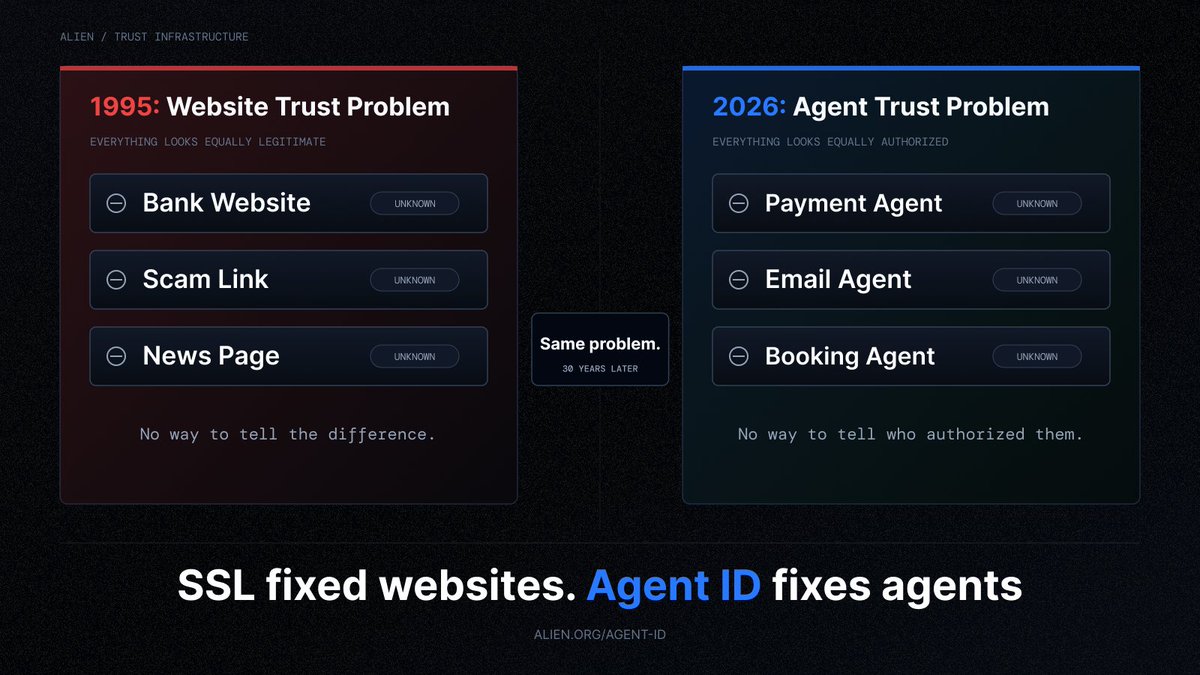
In 1995, every website looked equally legitimate to your browser.
There was no signal for trust. A bank and a scam looked identical in the address bar.
Do you know that the same dangerous situation is happening right now?
Then SSL certificates arrived. Browsers started sorting the web into two categories: sites that could prove who they were, and sites that couldn't.
The web got safer because the infrastructure underneath changed the question it was answering. Not "does this look legitimate?" but "can this prove it is?"
The same sorting is happening again. The axis is moving from websites to agents.
Millions of AI agents are hitting APIs, payment systems, and enterprise services right now.
Every downstream system receiving those requests has the same 1995 problem: the request looks legitimate, but that proves nothing. Who authorized this agent? Which human is behind it? Is this a real orchestration or an injection attack?
The instinct is to build better detection.
Behavioral filters, anomaly scoring, rate limiting by pattern. Every platform is doing it. The problem is that detection is a filter, and filters are an arms race with no ceiling. Content-based spam filters lost to spoofers. Behavior-based agent detection will lose the same way.
SSL won by making fake sites cryptographically impossible to disguise as real ones.
Agent ID is that layer for agents.
A cryptographic link between every agent request and the verified human who authorized it - established before the request lands, readable by any downstream system, without exposing personal data.
The companies building on verified agent identity now won't spend the next decade firefighting what's coming.
alien.org/agent-id
🚨Meet the man who has 7,002 Bitcoin (~$550M), but doesn’t have acces to it…
Back in 2011, a Canadian programmer named Stefan Thomas was paid 7,002 BTC to make a simple “What is Bitcoin?” video.
At the time that was worth around $5,000. He thought it was a nice bonus.....see
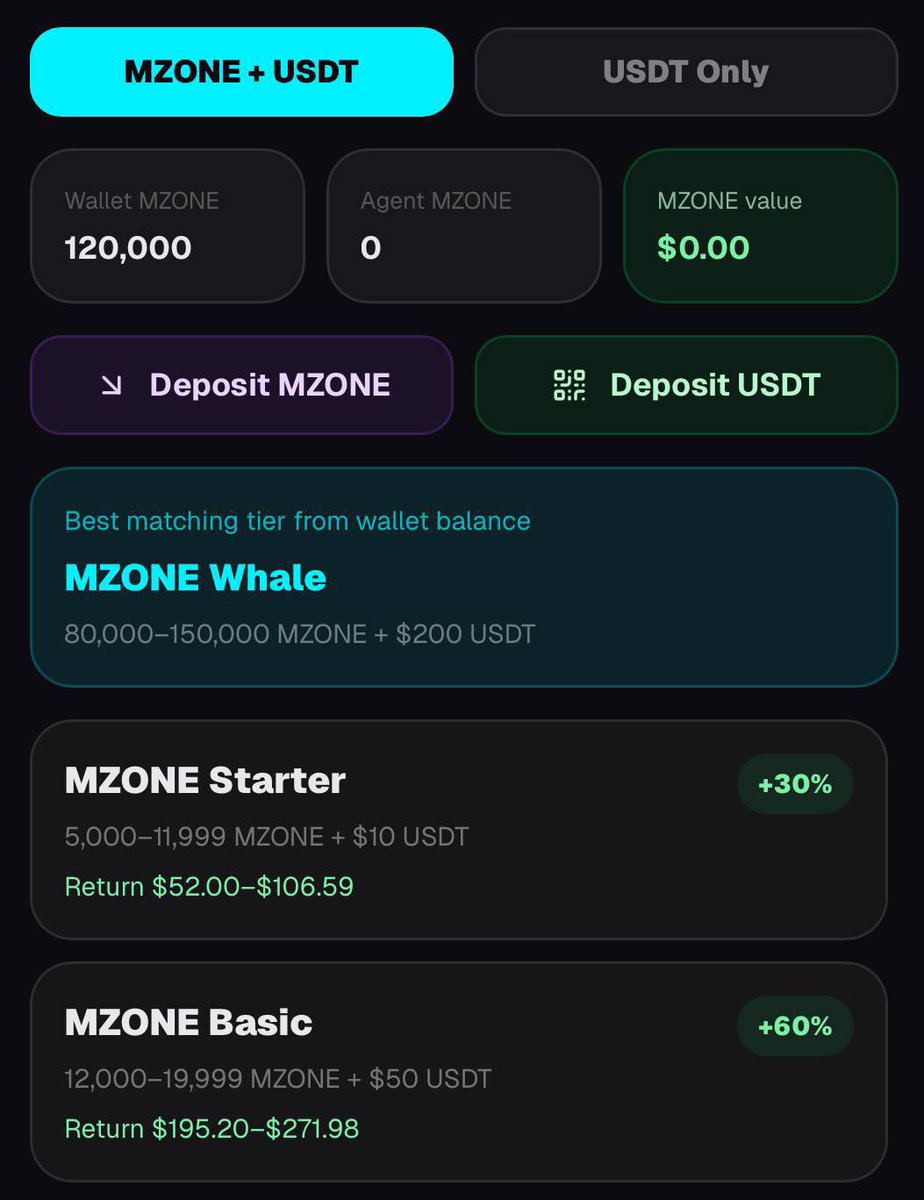
MZONE + USDT AI AGENT PLANS ARE LIVE
You can now activate AI trading cycles using $MZONE + USDT directly inside the Mozone Wallet.
📖 How it works:
1️⃣ Choose your AI Agent tier
2️⃣ Add your $MZONE + required USDT balance
3️⃣ Activate the trading cycle
⚡️Once activated, your invested $MZONE is automatically converted into USDT trading value for the AI Agent cycle.
The AI system then uses the active balance during the 21-day trading period.
━━━━━━━━━━━━━━
⚠️ AI returns are variable and depend on market conditions.
🛡Convert Mozone: t.me/MozoneAiBot
Devin's numbers just came out. And they're wild.
$1 million in ARR in September 2024. $445 million run rate today. Usage doubling every eight weeks.
Cursor held the all-time SaaS record at $1M to $100M in 12 months. Devin crossed that line in roughly 10. Cursor reached $100M through 360,000 individual developers at $276 ACV. Devin reached it through the US Army, Goldman Sachs, Mercedes-Benz, Citi, Dell, Cisco, and Palantir. The United States military pays production rates for an autonomous coding agent.
Cognition is now raising at $25 billion. That's 56x run rate. Cursor cleared $9.9B at a similar multiple last May, and the multiple held because the curve hadn't bent. The unusual part isn't the price. The unusual part is that the doubling is still happening at $445M.
The buried number is the burn. Cognition has spent under $20 million cumulatively since founding two years ago. Most Series B companies spend that in a single year. Devin's $445 million was built on Series A money.
Then the Windsurf paragraph. Google paid $2.4 billion in licensing fees in July to pull Windsurf's founders out the door. The remaining company sold to Cognition inside 72 hours for a fraction of that. Combined enterprise ARR rose more than 30% in seven weeks post-close. Less than 5% customer overlap pre-acquisition. Google paid two and a half billion dollars to hand Cognition the IDE distribution layer.
In March 2024, independent testers said Devin completed 3 of 20 tasks. The internet called it a fake demo.
Two years later, that product codes for the US Army.