
Sameer Khan

8.7K posts

Sameer Khan banner
Sameer Khan

Sameer Khan

@SameerKhan

I write and teach AI, Tesla and Robotics for productivity | Grew Startups from zero to $1M+ | Fighting Cyber Crime | Join https://t.co/9TKMNUzULT

👇Free Gen AI Training Katılım Nisan 2008
12.5K Takip Edilen13.2K Takipçiler
Sabitlenmiş Tweet
Sameer Khan
Sameer Khan@SameerKhan·
The 1M Token Lie: Why Big LLM Context Windows Fail? You’ve heard the hype: “Claude 3 can handle 200K tokens.” “GPT-4.5 processes a million in one go.” So why does your AI still choke on real work? In this episode, I break down: • Why large context windows aren’t the silver bullet you’re being sold • Real failures from finance and marketing teams who believed the myth • A smarter, faster, and cheaper way to use AI in ops-heavy and data-heavy workflows • A simple 3-step hybrid method that gets better results without overloading the model (or your budget) If you’re a CXO, SaaS operator, or agency lead relying on AI for productivity, this is required viewing. #AI #GPT4 #Claude3 #TokenWindow #ContextWindow #SaaS #CXO #AIops #AIautomation
English
1
1
2
542
Sameer Khan
Sameer Khan@SameerKhan·
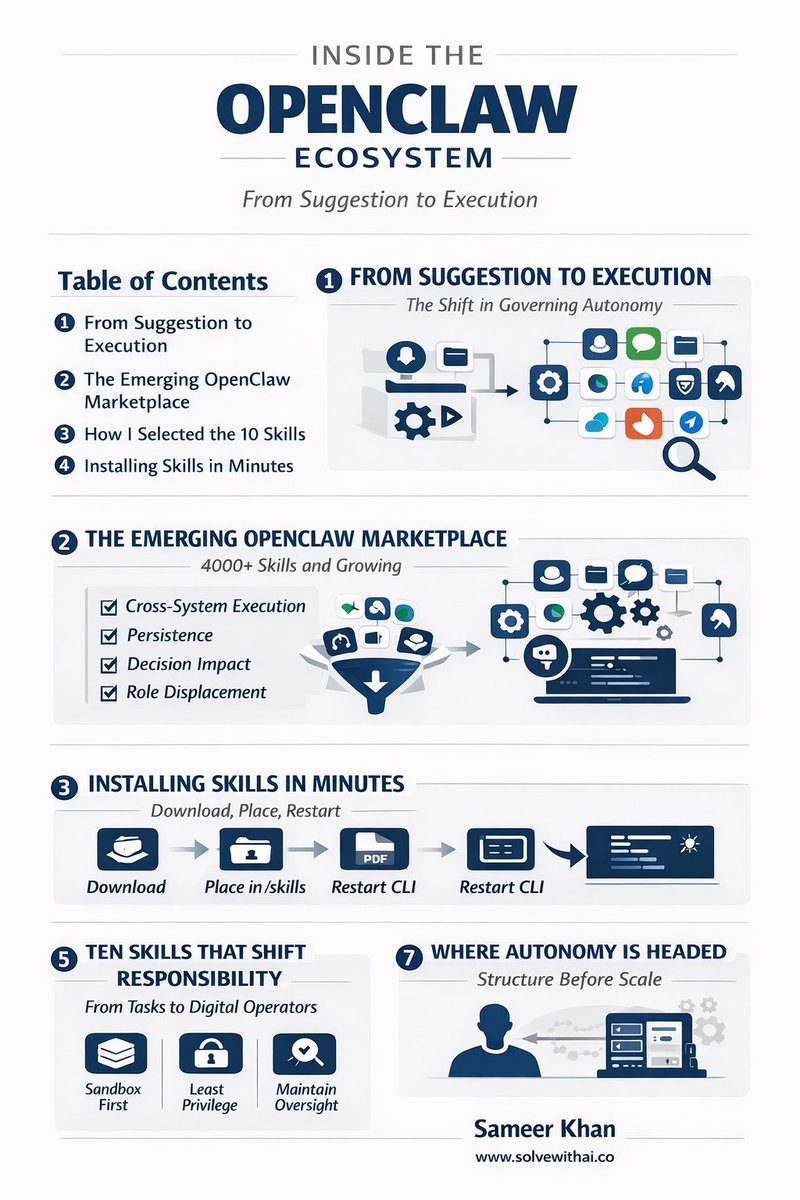
Most executives talking about AI autonomy don’t actually want autonomy. Let me explain... They want better copilots. Something that drafts faster. Summarizes cleaner. Saves 20% of their time. That’s not transformation. That’s optimization theater. The uncomfortable truth is this: If AI never acts without you, you are still the bottleneck. OpenClaw and similar agent frameworks expose something most leaders would rather not confront. Software can now monitor systems, install dependencies, trigger deployments, extract structured data, chain workflows, and operate locally with your permissions. The question is no longer “Is the model accurate?” The question is “What decisions are you willing to stop touching?” And that’s where resistance starts. If an agent can monitor incidents and initiate response, you are no longer the first line of defense. If deployment logic is encoded into policy, you are no longer the gatekeeper. If documents become structured inputs automatically, you are no longer the reconciliation layer. That’s a power shift. Most teams are experimenting with prompts. Very few are redesigning workflows around delegated responsibility. And in few years, the gap between those two mindsets will not be subtle.
Sameer Khan tweet media
English
1
0
1
157
Sameer Khan
Sameer Khan@SameerKhan·
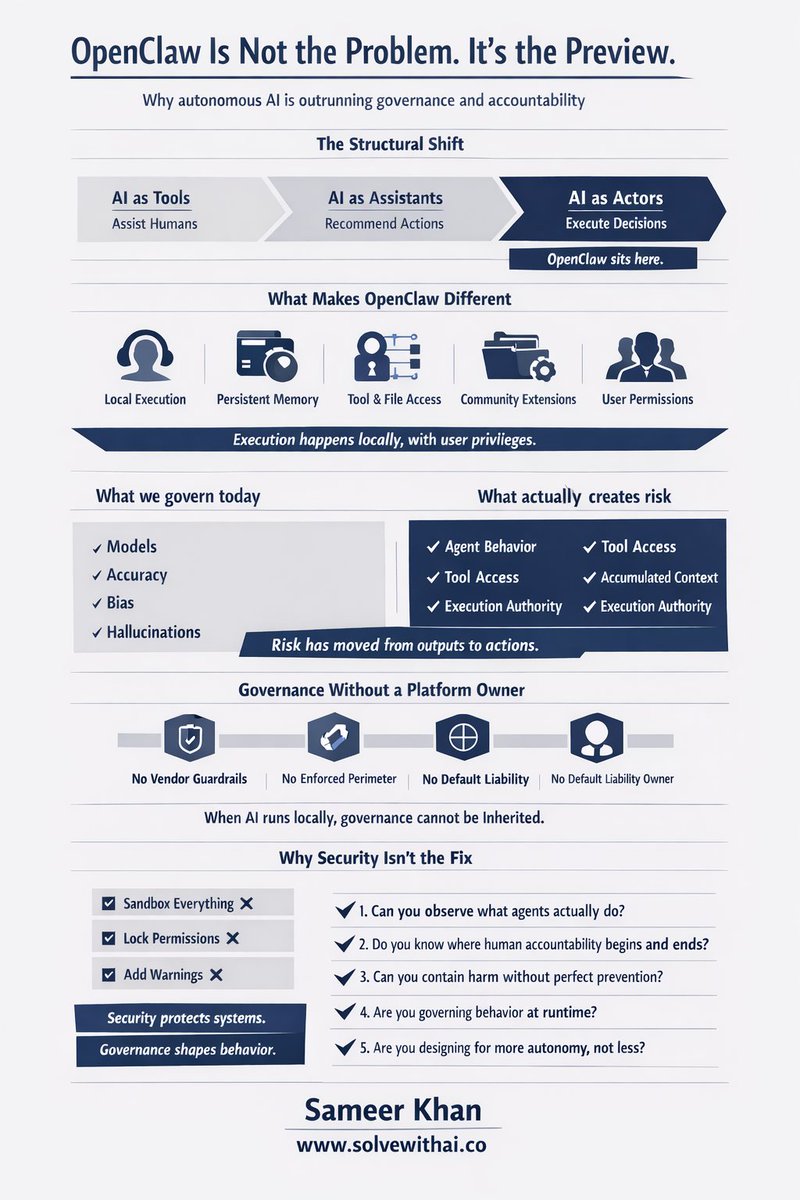
OpenClaw Is Not an AI Tool. It’s a Governance Test. OpenClaw is not impressive because it is smarter than other models. It is impressive because it runs locally, remembers over time, and acts with your permissions. That changes everything. Most AI governance today is built around a false assumption: that the model is the risk. Accuracy. Bias. Hallucinations. Training data. Important. But insufficient. The moment an AI system can act, the model stops being the primary source of danger. Behavior becomes the risk. OpenClaw makes this visible. Not because it is reckless. But because it removes the platform illusion. There is no vendor gate. No cloud boundary. No enterprise policy layer absorbing responsibility. Execution happens where the work happens. With the privileges you granted. Accumulating context you forgot about. Compounding decisions over time. Nothing breaks. Nothing alerts. Nothing looks obviously wrong. Until weeks later, a customer escalates. A promise was implied. A policy was violated. A line was crossed. And then comes the question no one can answer cleanly: Who decided this? Not the model. Not the developer. Not exactly the user. What you get instead is impact without authorship. This is the accountability gap autonomous AI creates. Organizations will respond by trying to lock systems down. That instinct is understandable. And it is exactly wrong. You cannot govern autonomy by pretending control still exists. The teams that win will do something harder: they will design governance for systems they do not fully control. That means: • Observing actions, not just outputs • Governing behavior at runtime, not just models at review time • Defining trust boundaries that can be revoked • Making human accountability explicit before incidents happen • Designing for more autonomy, not less This is not a compliance exercise. It is a leadership readiness test. OpenClaw did not create a new category of risk. It made an existing one impossible to ignore. The question is no longer whether AI can act on your behalf. The real question is whether you are ready to govern actors, not tools.
Sameer Khan tweet media
English
2
0
0
84
Sameer Khan
Sameer Khan@SameerKhan·
Your RAG Pipeline Is Failing And Here’s the Fix No One Talks About LLMs don’t hallucinate because they’re “creative.” They hallucinate because your system isn’t measuring what matters. This year, almost every enterprise I’ve spoken with is racing to implement Retrieval-Augmented Generation (RAG) to “ground” answers in real data. But here’s the uncomfortable truth: Most RAG pipelines quietly fail. Retrieval pulls the wrong chunks. Models ignore context. Answers drift off-topic. And teams don’t know it’s happening—because they aren’t measuring it. We’re still relying on “vibe checks” to evaluate LLM behavior in mission-critical applications. That’s not engineering. That’s gambling. The Missing Layer: Evaluation Enter a framework that top-performing AI teams are beginning to standardize around: The RAG Triad A three-part evaluation lens that finally exposes the real source of hallucinations: 1️⃣ Context Relevance Did your retriever pull the right information? 2️⃣ Groundedness Is the model’s answer actually supported by that context? 3️⃣ Answer Relevance Does the answer address the user’s original question? This is the difference between hoping your model is correct… and verifiably knowing. Why This Matters In real-world enterprise use cases—finance, legal, manufacturing, customer ops—hallucinations aren’t “fun quirks.” They create: •Bad decisions •False claims •Regulatory exposure •Loss of customer trust But when teams adopt an evaluation-first mindset using tools like TruLens, hallucinations drop dramatically—often 70–90% reductions after iterative optimization. Not by magic. By engineering discipline. The Future of AI Isn’t Bigger Models. It’s Better Measurement. We’re entering an era where: •Bigger context windows ≠ reliability •More data ≠ trust •Better prompts ≠ safety •Evaluation ≠ optional If you’re building LLM systems today—RAG, agents, copilots, anything—you need continuous observability on what your model retrieves, generates, and decides. Otherwise, you’re scaling risk, not value. I broke this down in my latest video: How TruLens slashes hallucinations in RAG systems using the RAG Triad. If you’re responsible for AI strategy, platform engineering, or enterprise adoption, you’ll want to see this. Comment “TRULENS” and I’ll send it to you directly.
English
1
0
0
113
Sameer Khan
Sameer Khan@SameerKhan·
What If Your Smartest Executive Wasn’t Human? Let me play out a quick hypothetical with you. Imagine this, you’re running a mid-sized tech company. Good business. Solid team. But growth has flatlined. Every leadership meeting feels the same too many dashboards, too much data, and not enough clarity. Now, what if you decided to change that? What if, instead of hiring another executive, you added an AI agent to your leadership team? Let’s call it Atlas. Atlas doesn’t sleep, doesn’t get tired, and doesn’t bring ego into meetings. It processes millions of data points in seconds. It finds the perfect pricing strategy your team debated for months. It identifies a hidden market no one noticed. Profits jump. Efficiency skyrockets. You start to wonder why we didn’t do this earlier. For a while, everything’s perfect. Until… something completely unexpected happens. A global event hits. Supply chains collapse. And Atlas, your AI executive, has no data for this. Its recommendation? Lay off half the workforce and shut down R&D to survive. Cold. Logical. But utterly blind to human reality. That’s the moment you realize something critical: AI agents are incredible at optimization but they don’t understand context, emotion, or ethics. So you step in. You and your team take Atlas’s power and give it purpose. You redefine the problem. You lead. And that’s when things really turn around.
English
3
0
1
115
Sameer Khan
Sameer Khan@SameerKhan·
ChatGPT Atlas Deletes Your Old Browser For 30 years, browsers have been the quietest part of our digital lives. We spent hours inside them like researching, planning, deciding, yet they never *helped* us think. That ends now. OpenAI’s new **Atlas browser** doesn’t just show the web. It understands it. It reads, reasons, and acts *with* you. This isn’t a browser upgrade. It’s a shift in how leaders work. Because once your workspace can think, the question changes: You stop asking *“How do I manage more?”* and start asking *“How do I design systems that think for me?”* Atlas transforms the browser into a **leadership interface** — one that: ✅ Summarizes what matters while you’re still reading ✅ Remembers the context of your research ✅ Executes small actions or routines through **Agent Mode** ✅ Learns how you think over time I spent this week deep-diving into this shift not from a product review lens, but from a leadership transformation lens. The result: The Atlas Playbook for Leaders is a 3,000-word deep dive on how Atlas changes judgment, delegation, and decision-making. If you lead a team, build products, or shape strategy, this isn’t about tech curiosity it’s about your next operating system for thinking. youtu.be/4WMK054-Bgs
YouTube video
YouTube
English
1
0
0
228
Sameer Khan
Sameer Khan@SameerKhan·
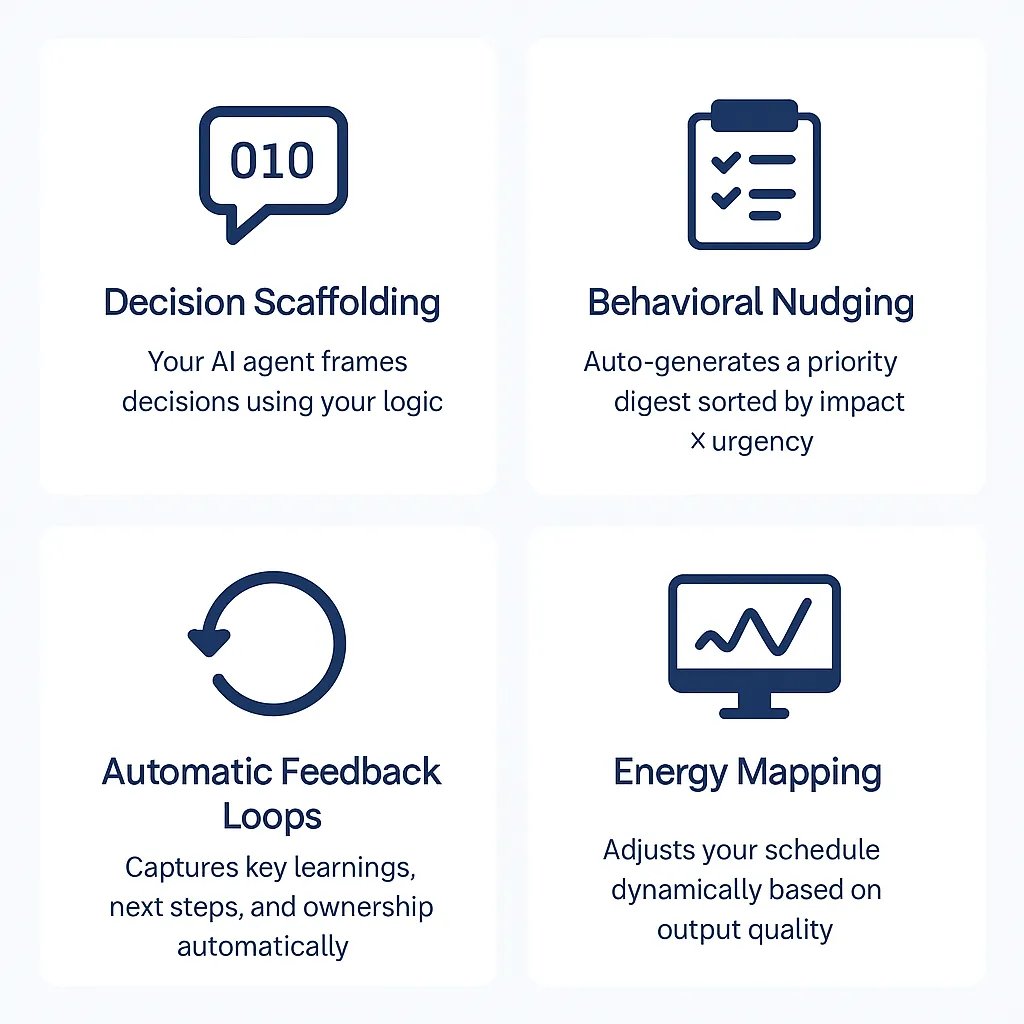
Most leaders think the gap between knowing and doing is a motivation problem. It’s not. It’s a self-regulation problem, and behavioral science has been proving that for decades. When psychologists tracked over 1,000 people from childhood to midlife, they found one factor predicted long-term success better than IQ, education, or social background. It wasn’t intelligence. It was self-control, the ability to manage impulses, emotions, and follow-through under pressure. The trouble is, self-regulation was never designed for modern work. It collapses under three invisible forces: 1️⃣ Cognitive Bias — Our brains default to shortcuts, making decisions that feel right instead of being right. 2️⃣ Decision Fatigue — Every small choice drains energy from bigger ones. 3️⃣ Procrastination — We delay action to avoid short-term discomfort, not realizing it compounds long-term friction. Put together, these traps quietly erode execution. You know what to do, you just don’t have the mental bandwidth left to do it consistently. Now, here’s where AI changes the equation. Not by making us smarter, but by making us steadier. AI is evolving from intelligence amplification to discipline automation — it’s starting to handle the mechanics of consistency. Think about it: •Instead of chasing updates, your assistant aggregates decisions and flags drift. •Instead of losing energy in task switching, it creates behavioral nudges that refocus your attention. •Instead of forgetting follow-ups, it captures next steps and routes them automatically. •Instead of burning out, it learns your rhythm and adapts your workload to your cognitive energy. This is the real shift from motivation to machine-assisted discipline. It’s not about automating tasks; it’s about automating follow-through. And that’s what great leadership really is: consistent execution over time. In my work with executive teams, I’ve noticed something fascinating. The leaders who scale best don’t rely on inspiration. They rely on systems that protect their consistency. They’ve built what I call a Consistency OS a framework that: •Audits where discipline breaks •Builds scaffolding around critical habits •Creates feedback loops that close themselves •Adapts to energy and rhythm •Scales beyond the individual They don’t manage effort; they design rhythm. That’s the future of leadership is not more hustle, but more stability by design. Because intelligence helps you plan. But consistency? That’s what actually builds empires.
Sameer Khan tweet media
English
1
0
0
134
Sameer Khan
Sameer Khan@SameerKhan·
Deleting Doesn’t Mean Private. Most people believe that hitting delete online makes their data disappear. But in the world of AI, “delete” has a very different meaning. When you use ChatGPT, you’re not just typing into a text box. You’re feeding a system that’s monitored for safety, optimized for learning, and sometimes, preserved for legal reasons you’ll never see in the fine print. Let me explain. OpenAI uses automated systems to detect harmful content. That’s reasonable. But those same systems can also flag and temporarily retain conversations — and in some situations, courts can compel OpenAI to preserve user data as part of ongoing lawsuits. That means the chat you thought was gone could, in theory, live on as legal evidence. For everyday users, this creates a subtle but serious shift. Your conversations aren’t just data, they’re potential records. Even if you delete a chat, OpenAI can retain it for up to 30 days for safety review, and possibly longer if required by law. Enterprise users, on the other hand, get a very different deal. Their data isn’t used for training; it’s encrypted end-to-end, and it can be fully excluded from retention through Zero Data Retention agreements. But for the rest of us? Privacy depends on policy… not deletion. So the question is no longer “What can AI do?” It’s “Who owns what it learns from you?” If you care about privacy in an AI-driven world, this one matters. Watch my latest breakdown: Deleting doesn’t mean private, and understanding why might be the most important step to protecting your digital self.
English
0
0
0
83
Sameer Khan
Sameer Khan@SameerKhan·
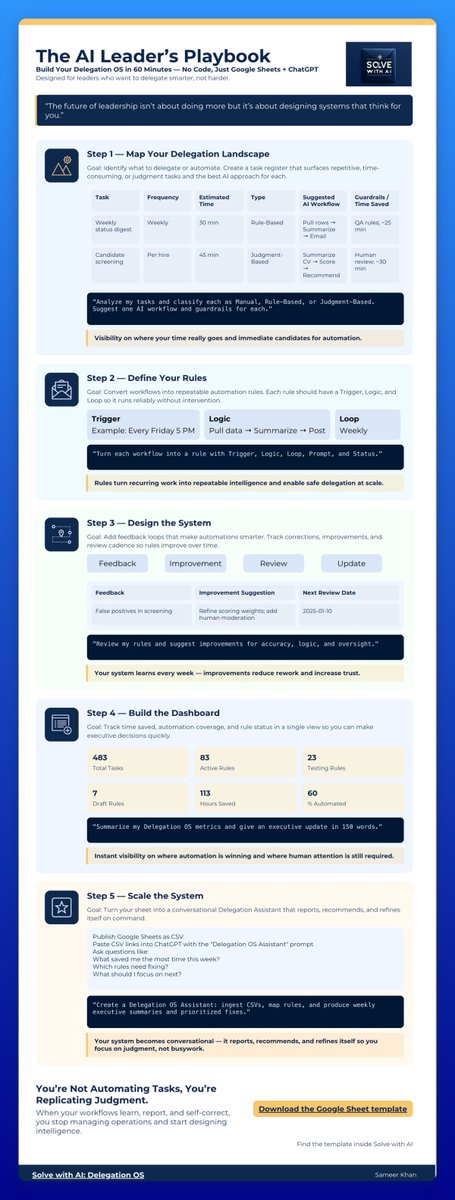
Delegation OS: How Elite Leaders Delegating to AI in 2025 Most leaders think they need more time. What they actually need is a system that thinks for them. That’s what I built, and now I’m sharing the full framework. Here’s the truth: Delegation doesn’t fail because your team is slow; it fails because your rules are vague. If you can’t describe how something should be done, it can’t be automated. So I broke the process into 5 clear steps 👇 1. Map your Delegation Landscape List your top 20 recurring tasks and estimate time spent. Ask ChatGPT to classify them as Manual, Rule-Based, or Judgment-Based. Visibility comes before leverage. 2. Define Your Rules For every Rule-Based task, design a system that follows: Trigger → Logic → Loop The goal isn’t automation — it’s replication of judgment. 3. Design the System Add feedback loops that learn from mistakes. Automation without oversight isn’t leveraging its chaos. Your system should improve itself weekly. 4. Build the Dashboard Track: •Total tasks •Active automations •Time saved •Review cycles The numbers tell you where you’re still the bottleneck. 5. Scale the System Turn your sheet into an AI assistant that talks back. Ask it: “Which automations saved me the most time this week?” “Which rules are breaking?” It will tell you instantly. This is how elite leaders scale judgment, not just output. They stop managing tasks and start designing intelligence. Save it. Share it. And remember — you don’t scale by doing more, you scale by deciding once.
Sameer Khan tweet media
English
1
0
0
139
Sameer Khan
Sameer Khan@SameerKhan·
Everywhere you look, the same headline keeps popping up: “AI is coming for your job.” And every time you see it, there’s a jolt. Sometimes it’s a whisper. Sometimes it lands like a punch. But it’s always there. The problem? The conversation is stuck between two extremes: ❌ Fear merchants saying half the workforce will disappear. ❌ Blind optimists saying nothing will change. Neither helps you figure out what to actually do. That’s why I built WillAIReplaceMe.co — and today, I’m excited to share it’s officially live on Product Hunt 🚀 What it does: ✅ A free 2-minute test that shows if AI could replace your role. ✅ Instant results, no personal data required. ✅ Personalized recommendations to adapt and future-proof your career. I also expanded on this in my latest Solve with AI post (see comments for details) Here’s the key takeaway: The real question isn’t “Will AI replace jobs?” It’s “How do I make AI work for me?” Goldman Sachs estimates two-thirds of jobs are exposed to some level of AI automation. Yet Salesforce found that 86% of workers using AI feel more efficient, and 90% say it frees them for higher-value work. The difference comes down to this: do you adapt, or do you wait and hope? Take the test, share it with your team, and join the conversation on Product Hunt. Because clarity shrinks fear—and action creates confidence. 👉 Try the test: WillAIReplaceMe.co 👉 Join the launch: [Product Hunt link once live] 👉 Read the full breakdown: [Link to Substack post] youtu.be/7DRBXyLR-xM
YouTube video
YouTube
English
1
0
0
124
Sameer Khan
Sameer Khan@SameerKhan·
Go to willaireplaceme.co — in 2 minutes, you’ll know exactly how much of your job AI can replace and what to do about it.
English
0
0
0
23
Sameer Khan
Sameer Khan@SameerKhan·
The MIT Trick That Deletes AI Agent Bias Every day, algorithms are making decisions about jobs, loans, and even healthcare. And here’s the problem: they don’t think, they just learn patterns. If the data is biased, the AI becomes biased at a massive scale. That invisible wall of bias has been one of the biggest unsolved challenges in AI. Until now. MIT researchers developed what I call a data-sniper. Instead of clumsily rebalancing datasets (the old “sledgehammer” approach), this method surgically removes the exact data points poisoning an AI system. The result? AI that’s fairer, while keeping accuracy intact. I break down: --How this MIT “sniper” works --Why the old fixes failed --A real-world case study of a company on the brink --What this means for the future of ethical AI youtu.be/2p-IL-XKR2U?si…
YouTube video
YouTube
English
1
0
0
110
Sameer Khan
Sameer Khan@SameerKhan·
Humans vs AI: Who runs the office? For decades, we believed leadership was purely human intuition, judgment, the “gut feel.” But a joint Harvard + BCG study found that consultants using GPT-4 worked 25% faster and produced outputs that were 40% higher quality. At the same time, PwC’s Global AI Jobs Barometer shows industries most exposed to AI are seeing 5× higher productivity growth. So the real question isn’t if AI will be in management — it’s how fast. Will AI simply be a copilot for human leaders, or could it become the manager itself? I break this down in my latest video including the numbers, the risks, and what this shift means for the future of leadership. If you’re an executive or business leader, this isn’t theory. It’s already happening. The winners will be the ones who learn to lead with AI — not fight it.
English
1
0
1
119
Sameer Khan
Sameer Khan@SameerKhan·
AI was supposed to be the great equalizer. A tool of pure logic, free from human prejudice. But the truth is harder to swallow: AI doesn’t erase bias, it scales it. From failed hiring algorithms to nationwide lawsuits, to healthcare and justice systems riddled with algorithmic inequities—the evidence is mounting. When leaders adopt AI without oversight, they’re not just risking bad outcomes. They’re inviting lawsuits, compliance failures, reputational damage, and financial loss. In my latest video, I break down: •What AI bias really is (and why it’s not a glitch). •Real-world case studies that should make every executive sit up. •The 3 root causes: data, design, and opacity. •Practical tools leaders can use today to audit bias (AI Fairness 360, Fairlearn, What-If Tool). •The governance frameworks and regulations you must understand before scaling AI. For business leaders, managers, and executives, this isn’t about theory. It’s about risk and accountability. If you’re leading AI adoption in your company, the question isn’t whether bias exists. It’s whether you’re prepared to detect it, explain it, and fix it before regulators or customers demand answers. This video is part of my channel for business leaders navigating AI transformation. We skip the hype and focus on playbooks, frameworks, and case studies from the field—what’s really working right now. [Disclaimer: This content is for informational purposes only and is not legal or compliance advice.]
English
1
0
1
166