samir kaji

7.4K posts

samir kaji

samir kaji

@Samirkaji

CEO of Allocate (https://t.co/tCOIHOo5Xl) Host of the Venture Unlocked podcast, https://t.co/J3J8C4Ims6. My opinions are mine, and not related to Allocate.

Menlo Park, CA Katılım Nisan 2009
899 Takip Edilen35.6K Takipçiler
Sabitlenmiş Tweet
samir kaji
samir kaji@Samirkaji·
I talk to thousands of LPs every year. Here's what I'm seeing right now when it comes to how they're approaching VC. 1) Late-stage co-investments have never been hotter. The top 5-7 names have effectively *unlimited* demand. And that supply/demand imbalance has created three real issues: First, the question of *true* access. Many of the SPVs floating around for these companies are not sanctioned by these companies. Buyer beware. These companies are tight on their cap tables, and access can be gated beyond just capacity. The fee creep is getting egregious. Someone shared with me recently that for a top AI lab, a group was charging 15% upfront, 20% carry, and 30% over a 2X. At those economics, you can take what would be a generational company but a bad investment. Fees are the silent killer of returns in late-stage co-invest, and this risk is now being focused on the logo, but ignoring the fee effects. Additionally, for those who aren't getting access to the top companies must go a tier (or two) below. Very dangerous in a high-intensity / valuation market for AI. As I've mentioned, there will be a lot of expensive mistakes made as we figure out what winners will look like in the future. 2) Capital is flowing to large, established brands. This is the clearest trend right now. LPs are concentrating on the top multi-stage and Series A firms. The logic is straightforward: these are easier to underwrite, and given how extreme the power law has become, investors want exposure to the trophy assets soon after investing. If you're a top 10-20 brand, you're oversubscribed, sometimes in multiples. If you're not, the fundraising environment is a different world. 3) Emerging and emerged managers are in the toughest spot, with a notable exception. Spinouts from top firms and operators with strong brands are moving fast and generally very oversubscribed. For everyone else, the bar has never been higher. I think this is actually where the opportunity is for LPs If they have the time/expertise to do so. The issue isn't that LPs don't know this. Most do. The problem is twofold: the time and difficulty of sourcing and diligencing emerging managers is real, and the hangover from 2019-2021 is still very present. A lot of people tried VC during that era who probably shouldn't have, and the failure rate on those Fund 1s has made the entire segment harder to navigate. Matching supply and demand here has become nearly impossible. Supply (Managers) far exceeds demand due to the issues noted.
English
14
23
192
37.2K
samir kaji
samir kaji@Samirkaji·
Hard Anti-AI views are too myopic. Humanity has repeatedly gone through massive technological shifts (I.e. agriculture, assembly lines, internet, etc.). Specific jobs disappear, and real ST pain, but new roles emerge (I.e. agr is ~2% of job vs now vs 50% in 1800's).
Lorena Gonzalez Fletcher@LorenaSGonzalez

So…@GarryTan wants to talk shit about me WHILE he has me blocked. I’m all for blocking folks you don’t want to interact with…shit talking me and blocking me…. Hmmm, that takes extra little man energy.

English
1
0
4
1.6K
Peter Walker
Peter Walker@PeterJ_Walker·
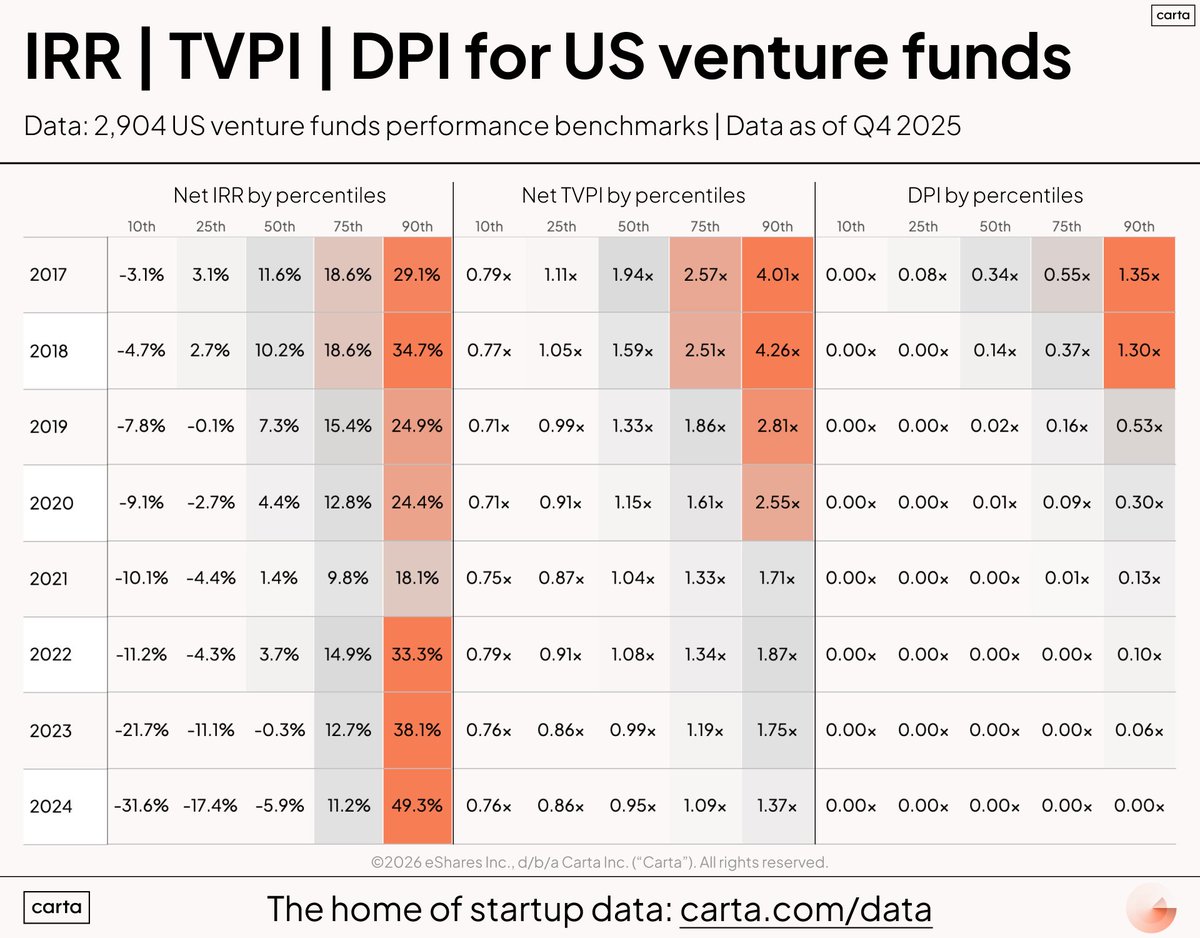
VC benchmarks. IRR, TVPI, DPI. How does your fund (or your portfolio of funds) stack up?
Peter Walker tweet media
English
13
15
157
36.9K
samir kaji
samir kaji@Samirkaji·
I talk to thousands of LPs every year. Here's what I'm seeing right now when it comes to how they're approaching VC. 1) Late-stage co-investments have never been hotter. The top 5-7 names have effectively *unlimited* demand. And that supply/demand imbalance has created three real issues: First, the question of *true* access. Many of the SPVs floating around for these companies are not sanctioned by these companies. Buyer beware. These companies are tight on their cap tables, and access can be gated beyond just capacity. The fee creep is getting egregious. Someone shared with me recently that for a top AI lab, a group was charging 15% upfront, 20% carry, and 30% over a 2X. At those economics, you can take what would be a generational company but a bad investment. Fees are the silent killer of returns in late-stage co-invest, and this risk is now being focused on the logo, but ignoring the fee effects. Additionally, for those who aren't getting access to the top companies must go a tier (or two) below. Very dangerous in a high-intensity / valuation market for AI. As I've mentioned, there will be a lot of expensive mistakes made as we figure out what winners will look like in the future. 2) Capital is flowing to large, established brands. This is the clearest trend right now. LPs are concentrating on the top multi-stage and Series A firms. The logic is straightforward: these are easier to underwrite, and given how extreme the power law has become, investors want exposure to the trophy assets soon after investing. If you're a top 10-20 brand, you're oversubscribed, sometimes in multiples. If you're not, the fundraising environment is a different world. 3) Emerging and emerged managers are in the toughest spot, with a notable exception. Spinouts from top firms and operators with strong brands are moving fast and generally very oversubscribed. For everyone else, the bar has never been higher. I think this is actually where the opportunity is for LPs If they have the time/expertise to do so. The issue isn't that LPs don't know this. Most do. The problem is twofold: the time and difficulty of sourcing and diligencing emerging managers is real, and the hangover from 2019-2021 is still very present. A lot of people tried VC during that era who probably shouldn't have, and the failure rate on those Fund 1s has made the entire segment harder to navigate. Matching supply and demand here has become nearly impossible. Supply (Managers) far exceeds demand due to the issues noted.
English
14
23
192
37.2K
samir kaji
samir kaji@Samirkaji·
@adeoressi Yep. And that side of the market is opaque and fragmented so fundraising is brutal and inefficient
English
1
0
4
743
Adeo Ressi
Adeo Ressi@adeoressi·
@Samirkaji The reality is that most emerging managers don't raise from large limited partners. They raise from emerging LPs and new LPs almost exclusively until they get to Fund II, III, or IV, depending on performance.
English
4
0
9
1.2K
Aram Attar
Aram Attar@TheVCFactory·
Reminders: - looking at IRR < 5 years doesn’t make much sense. I once made 70% realized IRR on an investment. The company was sold 6 months after we invested. 1.3x MOIC. Meh - this is probably mostly TVPI with inflated valuations. It’s not over till it’s over - there’s no correlation between Y5 returns (even DPI) and final fund performance Love what Thrive is doing (I introduced my last report on intuition with the Kushner/OpenAI case study), and this one will probably be the outlier on everything I wrote above. But worth reminding folks that VC perf doesn’t exist in a vacuum imho.
English
1
0
10
895
samir kaji
samir kaji@Samirkaji·
We’ll probably look back at the Anthropic-DoD standoff as the moment AI (and broadly tech) stopped being a technology industry and became a national power industry, with being apolitical no longer an option. Once that happens, nothing is neutral. Not customers, not investors, or employees. All behavior seems to be sorted to a left vs right lens with little room for centrists.
English
3
1
12
2.6K
samir kaji
samir kaji@Samirkaji·
Consistent with what i see too
Sophie Bakalar@sophiebakalar

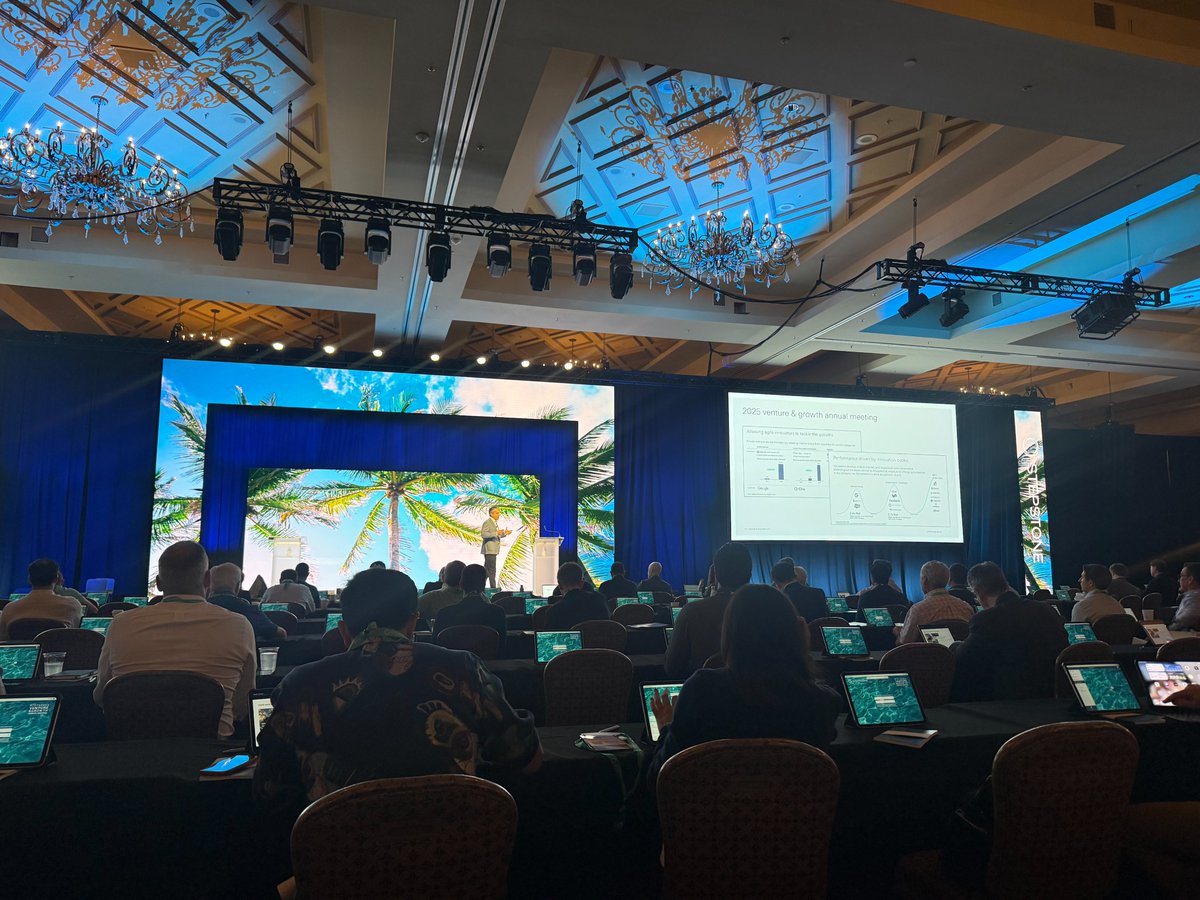
The @stepstonegroup AGM is always a highlight of the year. Some of my favorite conversations: 1. Venture is becoming more important at the exact moment it’s becoming less forgiving. More value is being created in private markets, but fewer companies (and managers) capture it. 2. As a result, many LPs are underweight venture at exactly the wrong time. Weak DPI scared everyone, but you have to be in venture if the next decade's winners stay private longer. 3. The AI boom didn’t make venture easier. It made selection matter more; venture is becoming a concentration game. 4. Venture’s biggest problem right now isn’t NAV. It’s liquidity. There's plenty of paper value, but not enough cash back --> secondaries are becoming core infrastructure. 5. We’re moving from “venture as startup finance” to “venture as economic infrastructure.” AI, energy, defense, compute, manufacturing = the systems layer of the next decade.

English
2
0
8
6.6K
samir kaji retweetledi
Sophie Bakalar
Sophie Bakalar@sophiebakalar·
The @stepstonegroup AGM is always a highlight of the year. Some of my favorite conversations: 1. Venture is becoming more important at the exact moment it’s becoming less forgiving. More value is being created in private markets, but fewer companies (and managers) capture it. 2. As a result, many LPs are underweight venture at exactly the wrong time. Weak DPI scared everyone, but you have to be in venture if the next decade's winners stay private longer. 3. The AI boom didn’t make venture easier. It made selection matter more; venture is becoming a concentration game. 4. Venture’s biggest problem right now isn’t NAV. It’s liquidity. There's plenty of paper value, but not enough cash back --> secondaries are becoming core infrastructure. 5. We’re moving from “venture as startup finance” to “venture as economic infrastructure.” AI, energy, defense, compute, manufacturing = the systems layer of the next decade.
Sophie Bakalar tweet mediaSophie Bakalar tweet media
English
1
10
102
18.1K
samir kaji
samir kaji@Samirkaji·
@honam @gerstenzang Many PE firms also use sub lines aggressively (up to 2-3 year repayment terms) which can significantly alter irr as well in short time frames
English
1
0
2
206
Ho Nam
Ho Nam@honam·
It’s apples and oranges. IRR could be comparable but MOIC will be different. I’ve been surprised by how low cash on cash multiples are on most PE funds that have impressive IRRs. Holding period makes a difference. When IRR is the North Star, the urgency will be to flip ASAP. As Buffett says, time is the enemy of the mediocre business. There has never been a trillion dollar market cap company created by PE.
English
5
1
36
4.3K
Sam Gerstenzang
Sam Gerstenzang@gerstenzang·
This is a really fascinating slide from a16z. The bottom quartile of PE funds are better than the bottom quartile of venture funds - you'd expect this. But the top decile of venture capital and private equity funds perform nearly just as well!
Sam Gerstenzang tweet media
English
18
47
520
57.6K
samir kaji
samir kaji@Samirkaji·
This is correct. Most of these efforts hide behind greater good principles, but overlook the practicalities of the consequences of adopting these bills, including the second- and third-order issues that would likely make the bill a net negative in the long run.
Palmer Luckey@PalmerLuckey

What you are saying is not true in any meaningful way. You can say whatever you want as an untethered hypothetical, but here in reality, what you are actually advocating for is NOT a 1-2% wealth tax for established billionaires - it is a 5% tax calculated all in one year, payable (with interest!) over the subsequent five. That puts massive risk on founders with zero risk for you or Califorjia - as I just pointed out, one market correction (or worst case but sadly common, the company goes under) and I am homeless on the street with literally billions of dollars in debt that cannot be discharged even in bankruptcy. Nor does this initiative you are pushing have ANY sort of provision for founders like me with illiquid shares in unprofitable companies - if I have to come up with billions of dollars, how can I possibly keep putting all our profit back into new R&D that keeps our warfighters safer? You are effectively forcing companies to immediately pivot into profit obsessesion over mission or long-term sustainability! Again, you say that isn't what you support, but that claim is not consistent with what you are actually doing. This is all extraordinarily frustrating politician-speak that nobody in the industry is dumb enough to fall for. It is the same as saying you support reasonable speed limits with higher speeds for rural areas even as you explicitly push for a national 55mph speed limit, all the while claiming with a smile that you "support" a wide range of speeds. No, you don't, and no, you don't.

English
13
2
13
1.5K
samir kaji
samir kaji@Samirkaji·
Vc twitter has become so toxic now
English
9
1
25
1.1K
Brad Evans
Brad Evans@NoisyHuevos·
Quentin Johnston not receiving a single target in a game in which the Chargers scored 30+ is beyond bewildering.
English
45
39
1.3K
56.2K
samir kaji retweetledi
certified thanos
certified thanos@CertifiedThanos·
If Israel was to debut a top secret night-undetectable remote assassination device, they’d obviously first kill the pro-Israel influencer in front of 10k people and reveal the clues only to the woman who staked her entire professional reputation on Brigitte Macrone being a man
Candace Owens@RealCandaceO

Right about now I think that whoever made the decision to assassinate Charlie Kirk is recognizing that it was a terrible mistake. They thought they were going to “grassy knoll” it. Instead they awakened the entire world.

English
0
2
7
1.8K
samir kaji
samir kaji@Samirkaji·
Are we in a Ai investing bubble? Yes Are the top Ai companies going to be bigger than we imagine? Yes Thats the reality, and why we see the valuations we do.
English
4
1
12
1.7K
samir kaji
samir kaji@Samirkaji·
Any “top vc” list is useless as the methodology is almost always flawed due to data limitations
English
2
3
10
1.5K