Saurabh Singh Rajput

306 posts

Saurabh Singh Rajput banner
Saurabh Singh Rajput

Saurabh Singh Rajput

@SauftwareBug

I like my Tea and AI, Green🌱, PhD Student @DalhousieU, NIT Nagpur CS'20, ex @Fidelity

Halifax, Nova Scotia 🇮🇳🇨🇦 Katılım Aralık 2022
803 Takip Edilen93 Takipçiler
Sabitlenmiş Tweet
Saurabh Singh Rajput
Saurabh Singh Rajput@SauftwareBug·
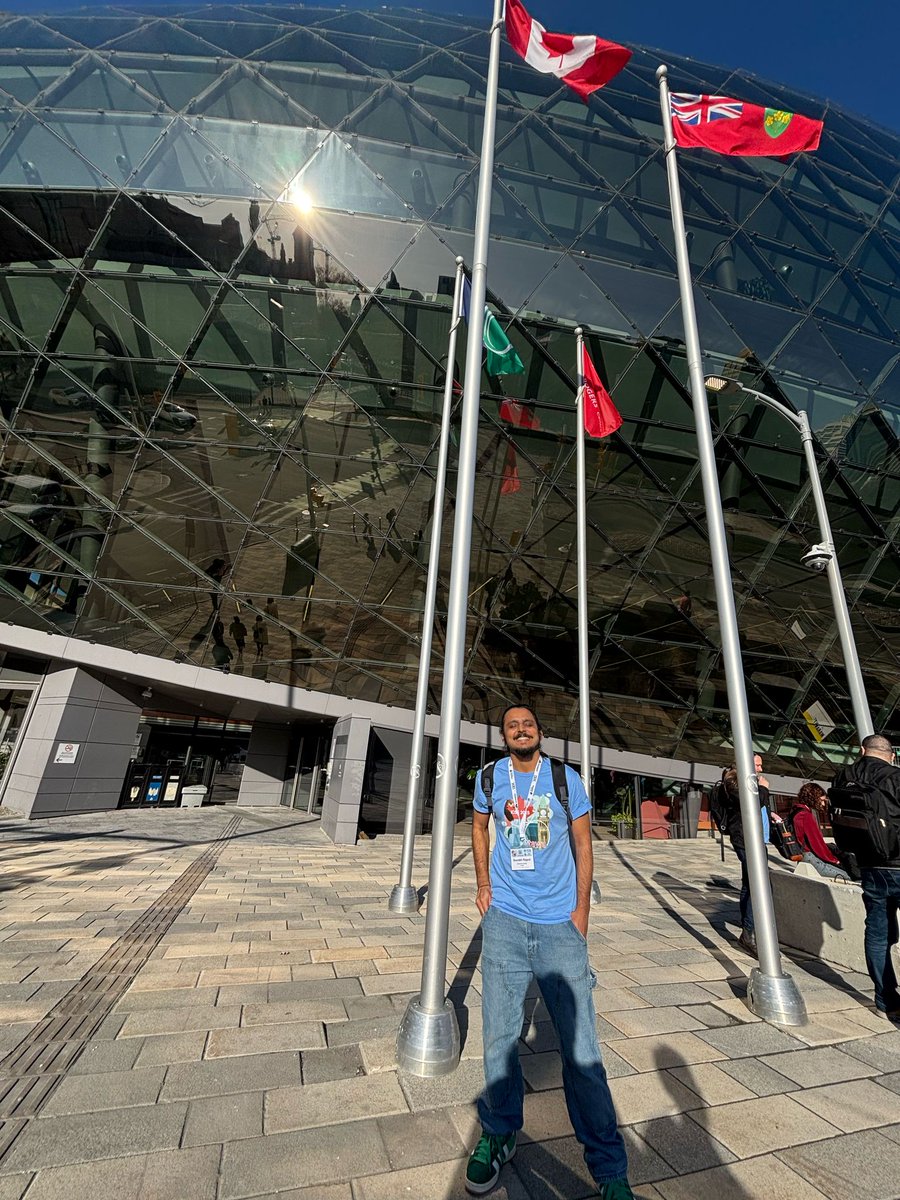
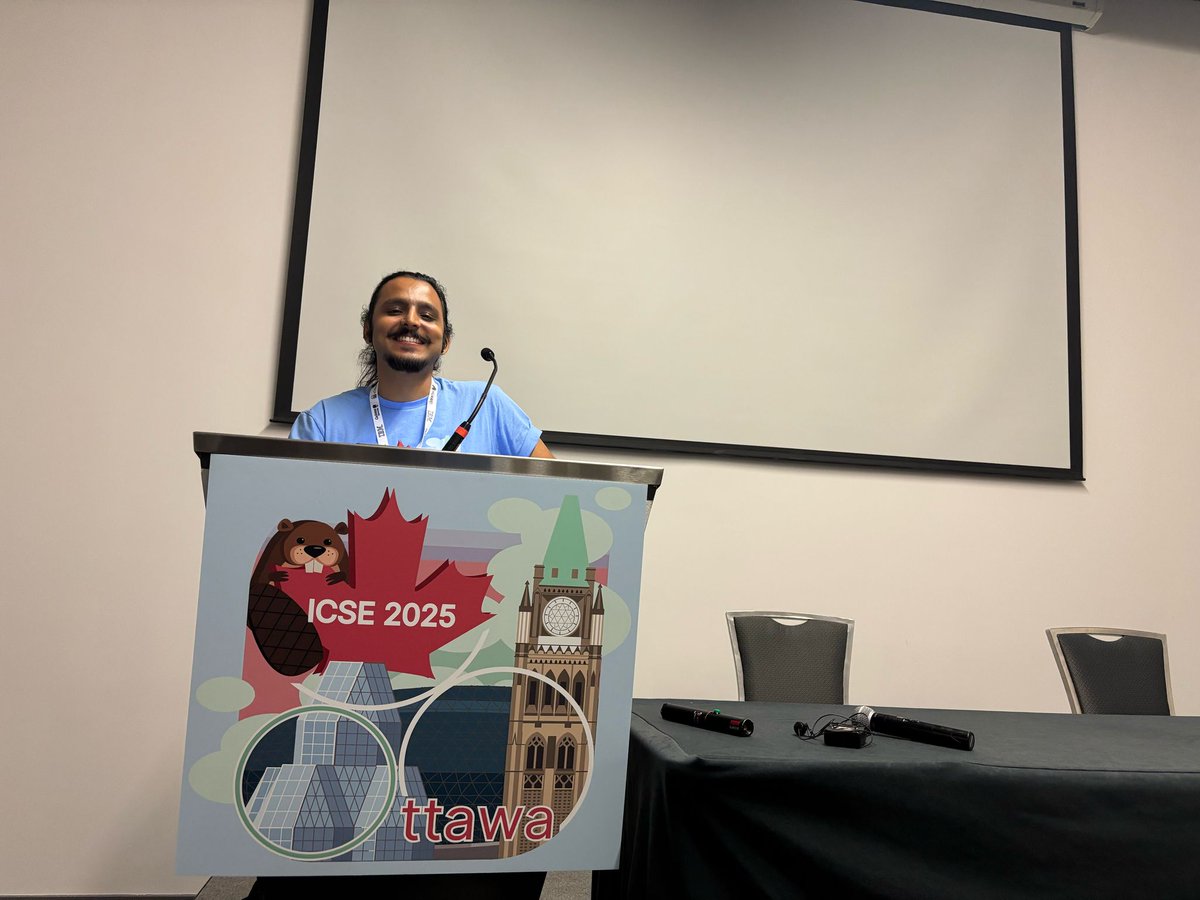
Got to present our work on "Fine-grained energy profiles of DL frameworks" at ICSE'25, met fellow researchers, attended some great talks, got to be student volunteer, saw the parliament amid elections, got some sun after a long time. Overall a good week🌞 @SMART_Dal @ICSEconf
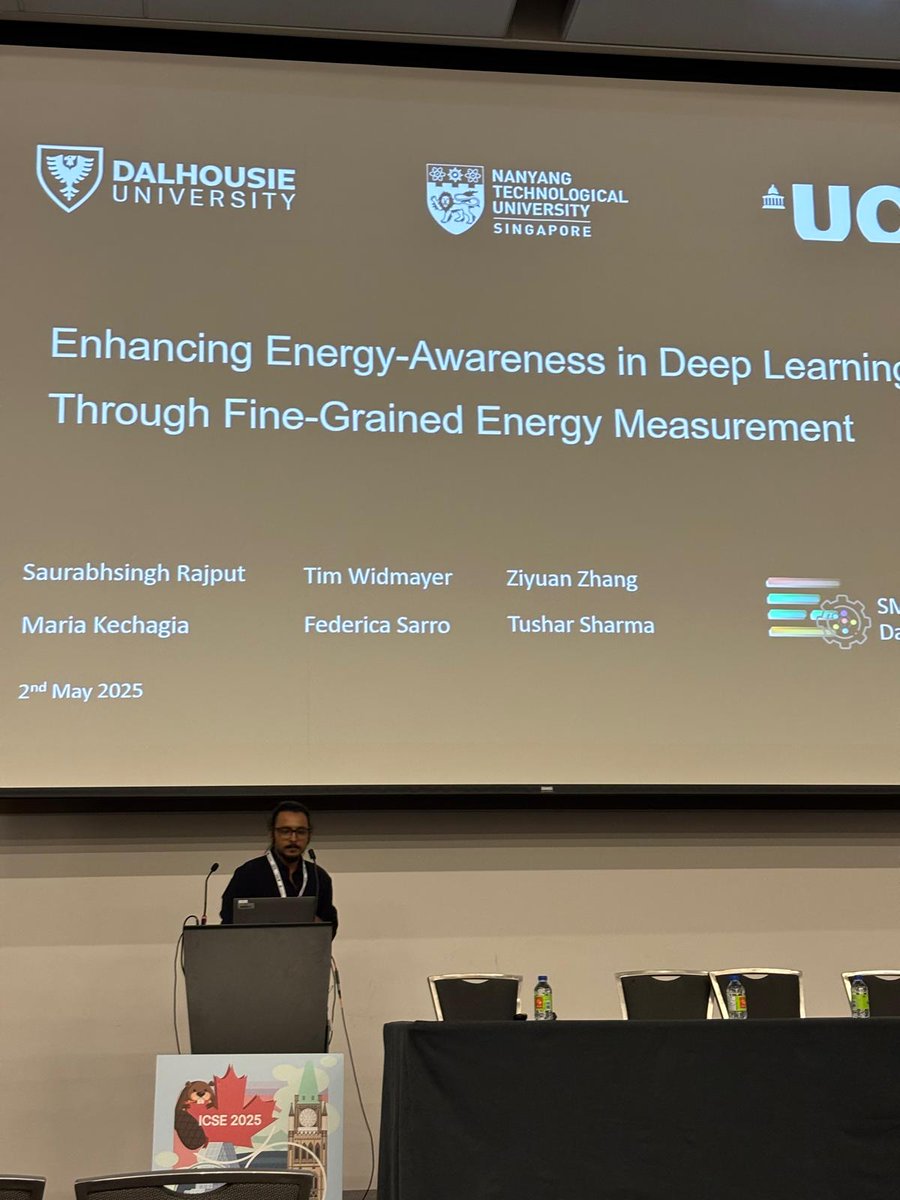
Saurabh Singh Rajput tweet mediaSaurabh Singh Rajput tweet mediaSaurabh Singh Rajput tweet mediaSaurabh Singh Rajput tweet media
English
0
1
10
1.6K
Saurabh Singh Rajput retweetledi
Kuno National Park
Kuno National Park@KunoNationalPrk·
Female Cheetah Jwala has given birth to 5 cubs, taking the total number of Cheetahs in India to 53, with 50 now in Kuno. A proud milestone for Project Cheetah & testament to the dedication of everyone working to restore this iconic species to India’s wild landscapes.
Kuno National Park tweet media
English
42
488
5.5K
193.2K
Saurabh Singh Rajput retweetledi
Pratyush Kumar
Pratyush Kumar@pratykumar·
📢 Open-sourcing the Sarvam 30B and 105B models! Trained from scratch with all data, model research and inference optimisation done in-house, these models punch above their weight in most global benchmarks plus excel in Indian languages. Get the weights at Hugging Face and AIKosh. Thanks to the good folks at SGLang for day 0 support, vLLM support coming soon. Links, benchmark scores, examples, and more in our blog - sarvam.ai/blogs/sarvam-3…
English
208
1.3K
6.9K
725K
Saurabh Singh Rajput retweetledi
Himanta Biswa Sarma
Himanta Biswa Sarma@himantabiswa·
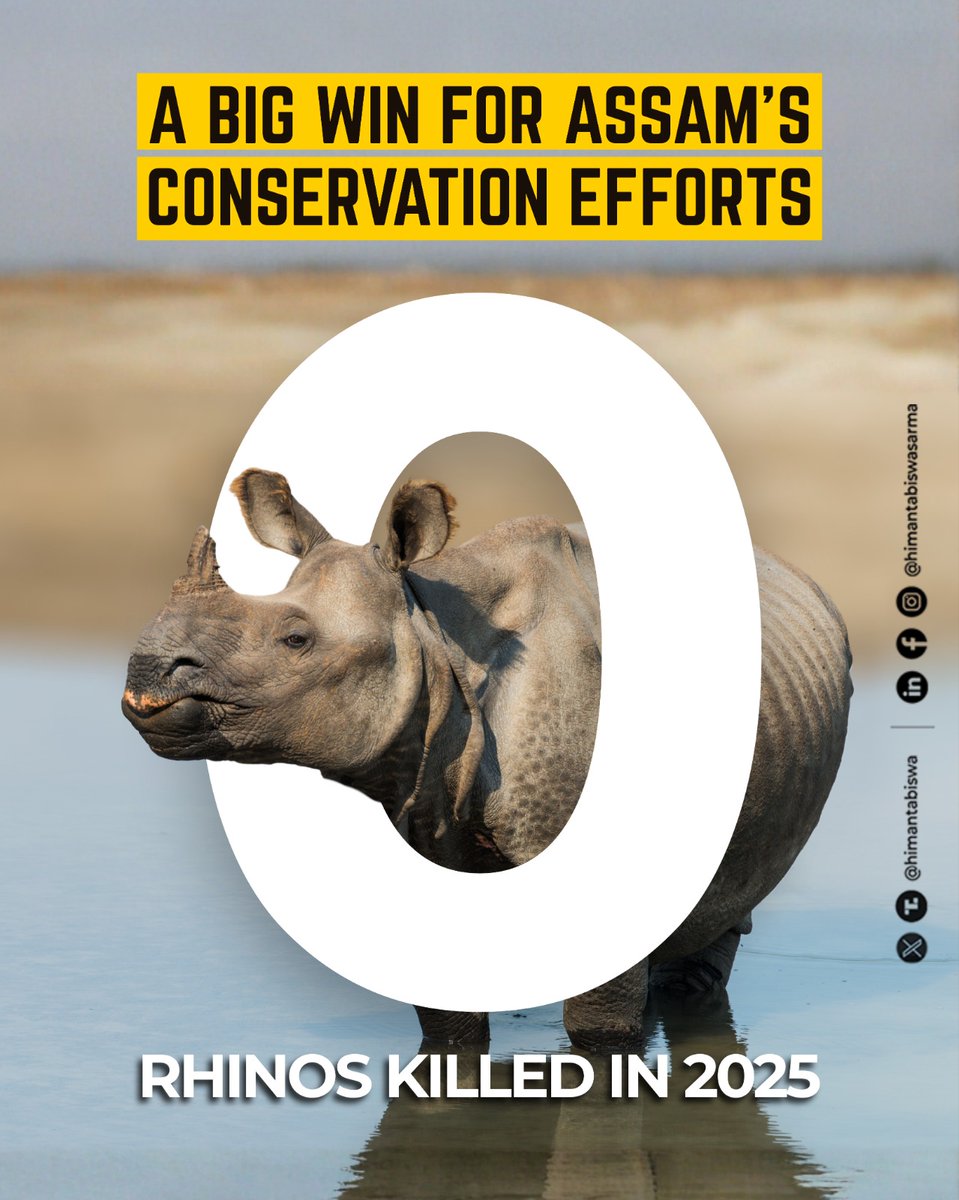
ZERO RHINOS POACHED IN 2025 You heard it right, ZERO rhinos have been poached in Assam in 2025, continuing our excellent conservation efforts and maintaining our streak of protecting Assam's pride.
Himanta Biswa Sarma tweet media
English
330
3K
18.1K
765.9K
Saurabh Singh Rajput retweetledi
SMART Lab@Dal
SMART Lab@Dal@SMART_Dal·
Double bonanza for SMART lab at SANER 2026 (Research track). (cont...)
SMART Lab@Dal tweet mediaSMART Lab@Dal tweet media
English

1
3
3
252
Saurabh Singh Rajput
Saurabh Singh Rajput@SauftwareBug·
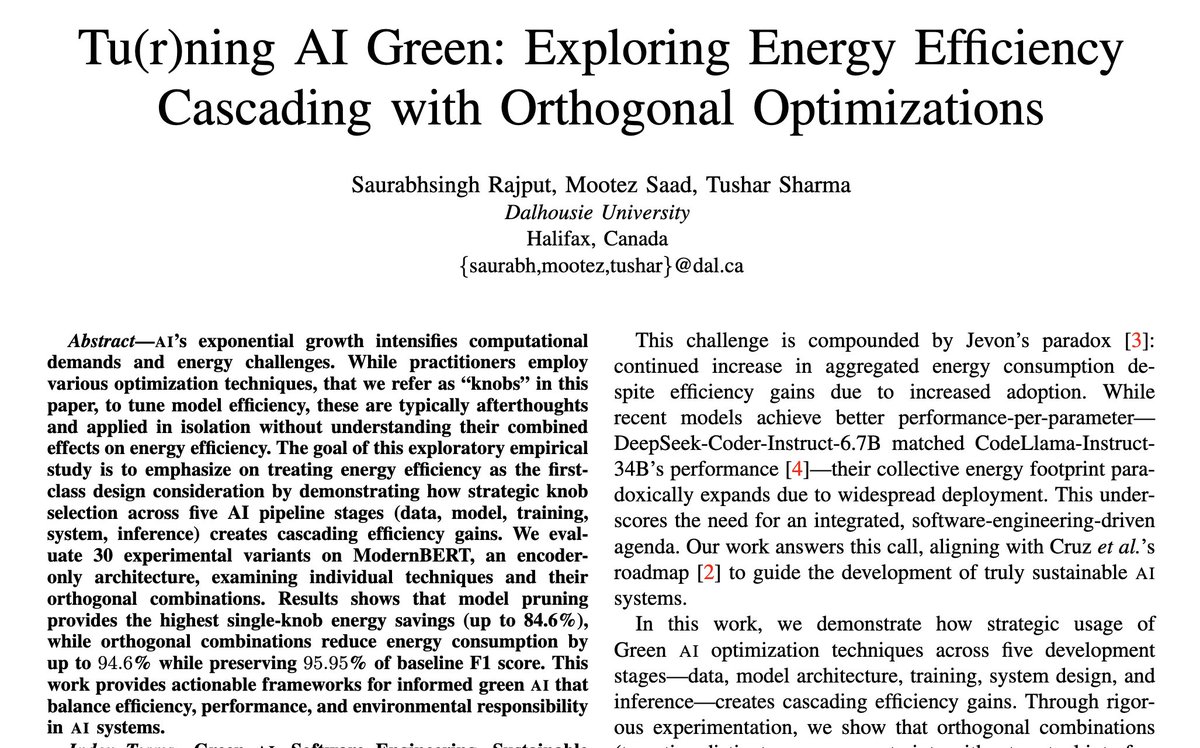
AI pipelines have multiple knobs for tu(r)ning computational resources, but energy often gets sidelined. Our work in IEEE Software shows: tu(r)ning these knobs strategically with energy as a design constraint achieves significant time & energy gains with minimal performance loss.
Tushar Sharma@dr_tusharma

Our study (accepted in @ieeesoftware spl issue on Green Clean Sw #Sustainability) - emphasizes on treating energy efficiency as the first-class design consideration - demonstrates that smartly combining optimizations achieves 94% energy reduction while preserving 95% F1 score.

English
0
2
1
157
Saurabh Singh Rajput retweetledi
Tushar Sharma
Tushar Sharma@dr_tusharma·
Our study (accepted in @ieeesoftware spl issue on Green Clean Sw #Sustainability) - emphasizes on treating energy efficiency as the first-class design consideration - demonstrates that smartly combining optimizations achieves 94% energy reduction while preserving 95% F1 score.
Tushar Sharma tweet mediaTushar Sharma tweet media
English
1
3
5
468
Saurabh Singh Rajput retweetledi
diplo
diplo@diplo·
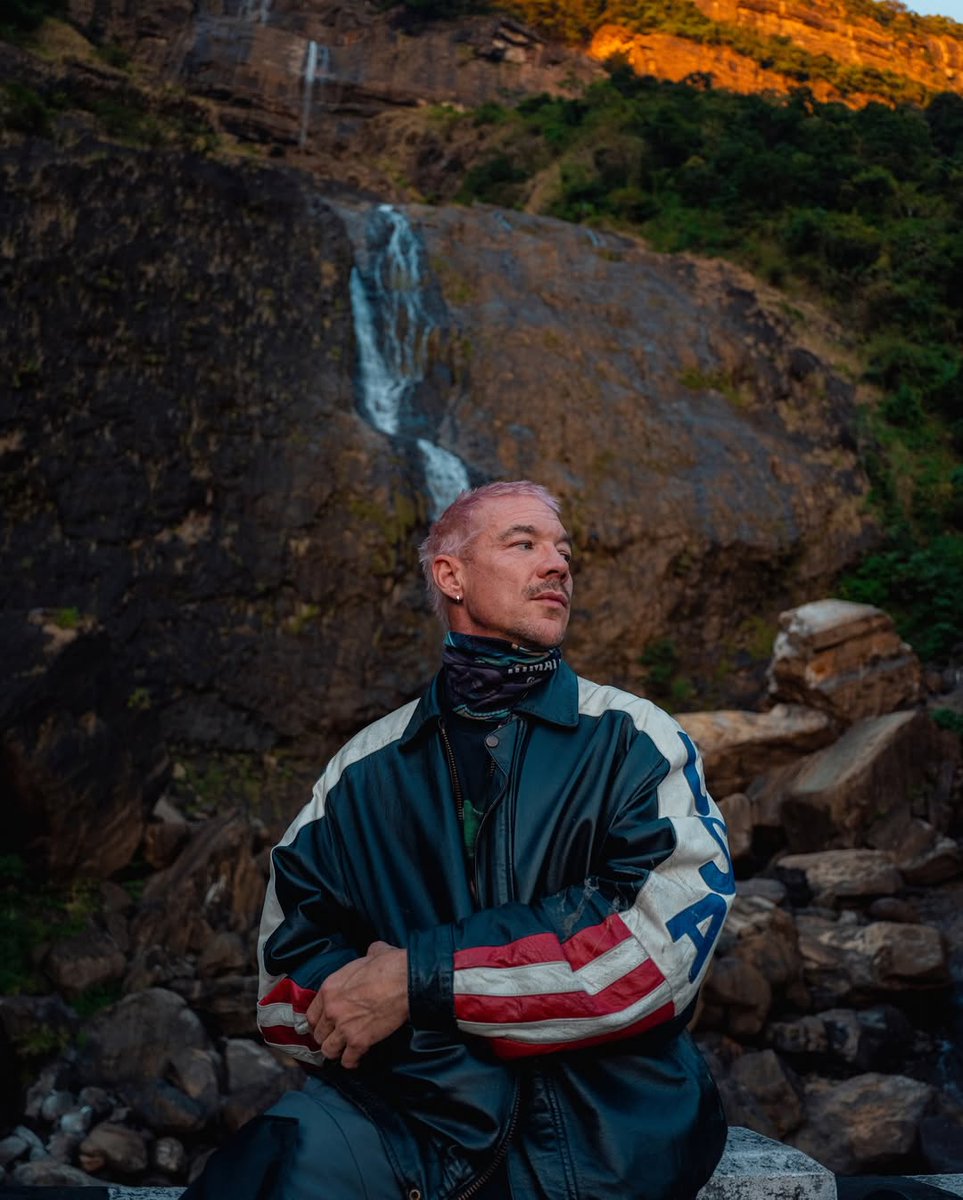
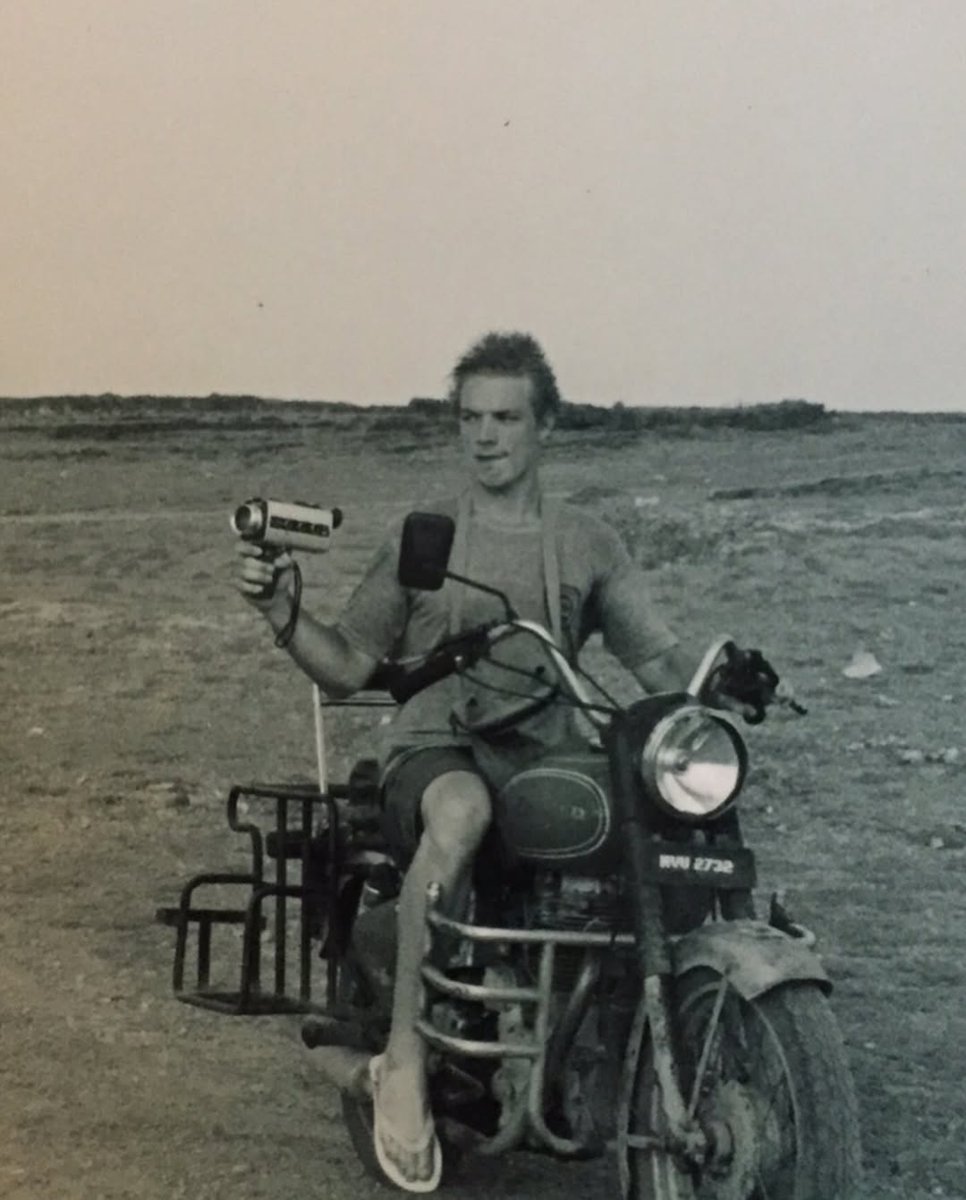
I was 20 when I first came to India with nothing but a restless mind and an old Enfield I bought from a friend in Delhi who taught me to ride in one dusty afternoon. He took my money, flew back to Florida, and left me with one rule: don’t hit a cow, and only ride between 2–6 a.m. if you want to survive the heat and smog. Somehow, that became a philosophy for everything that followed. I crossed the country like a kid inside a dream — Calcutta to Delhi to Rishikesh — sleeping on the bike when I had to, chasing chai stalls to stay awake, tossing the bike on trains when I could afford it. I swam in the Ganges, did yoga with elders who moved like water, bought vinyl in back-alley shops, fell in love the way only your twenties let you, and wrote long confusing emails to my mom from glowing village internet cafés. In Gujarat I stopped long enough to help with earthquake relief, eat thalis in strangers’ homes, and learn “Kem Cho” and “Majama.” India didn’t just teach me independence — it cracked me open creatively. It showed me how improvisation is its own kind of discipline, how getting lost is a form of education. I never imagined I’d be invited back years later to collaborate with artists I once watched on café computers — working with actors like SRK, making videos like “Lean On” that crossed billions of views, nearly dying during spiritual side quests in Leh and Varanasi, falling for Bollywood sweethearts, and still believing every strange turn meant something. Twenty-five years later I returned to these roads, riding nine hours a day across the Himalayas on a much newer Enfield. And then — perfectly — I ended up performing at a massive Enfield festival in Goa and celebrating afterward in a motorcycle garage, as if time folded back on itself. Two decades have changed India and me both. But every time I come back, I feel the same truth: growth happens when you surrender to the unknown, when the road teaches you more than any classroom could. India was my beginning. And somehow, it still is.
diplo tweet media
diplo tweet media
English
222
1.4K
13.2K
517.7K
Saurabh Singh Rajput retweetledi
GO GREEN
GO GREEN@ECOWARRIORSS·
The Masai Mara in Kenya - heartbreaking The great migratory route for animals may soon be gone forever as developers build hotels on the banks of the river that animals cross Kenyan activist tries to block new Ritz-Carlton safari lodge opening reuters.com/business/envir…
English
38
680
1.1K
23.6K
Saurabh Singh Rajput retweetledi
Brandy Jensen
Brandy Jensen@BrandyLJensen·
I hate that AI has made me approach cute animal videos with an air of suspicion. I resent having to harden my heart to the possibility of an unlikely friendship between a very large dog and a very small one
English
100
4.8K
43.3K
537.7K
Saurabh Singh Rajput retweetledi
Kimi.ai
Kimi.ai@Kimi_Moonshot·
🚀 Hello, Kimi K2 Thinking! The Open-Source Thinking Agent Model is here. 🔹 SOTA on HLE (44.9%) and BrowseComp (60.2%) 🔹 Executes up to 200 – 300 sequential tool calls without human interference 🔹 Excels in reasoning, agentic search, and coding 🔹 256K context window Built as a thinking agent, K2 Thinking marks our latest efforts in test-time scaling — scaling both thinking tokens and tool-calling turns. K2 Thinking is now live on kimi.com in chat mode, with full agentic mode coming soon. It is also accessible via API. 🔌 API is live: platform.moonshot.ai 🔗 Tech blog: moonshotai.github.io/Kimi-K2/thinki… 🔗 Weights & code: huggingface.co/moonshotai
Kimi.ai tweet media
English
580
1.5K
9.7K
4.8M
Saurabh Singh Rajput retweetledi
Constance Li
Constance Li@ConLiCats·
This is what algorithmic bias looks like: Earlier this week, Kit Kat, a beloved cat in the San Francisco Mission, was hit and killed by a @Waymo, which witnesses said “did not even try to stop.”
Constance Li tweet mediaConstance Li tweet mediaConstance Li tweet mediaConstance Li tweet media
English
43
57
332
136.6K
Saurabh Singh Rajput retweetledi
Jerason Banes / Architect of Convirgance
It’s a bit easier to just explain how we got here. In the old days, memory and CPU ran at the same speed. The laws of physics make it incredibly hard to ramp up the MHz of the CPU while keeping physically separated memory chips in sync. The distance is just too far for the electricity to travel in time available. The solution was to manufacture a small amount of memory on the chip that is in sync with the chip. Then access the rest of the memory as an external device. Sort of like a linear hard drive. That on-chip memory became the L1 cache and the external chips became DRAM main memory as we know it today. The second problem was the sheer size of RAM was making it hard to keep the CPU fed. The amount of RAM in the L1 cache was too small. And making it bigger wasn’t a very good option from a price and scaling perspective. So a faster bit of RAM that was physically closer to the CPU was invented. Slower than L1, but faster than main memory. This sped up operations that were too large to fit in the L1. Thus L2 was born and eventually moved onto the CPU die rather than being a separate chip on the motherboard. The final piece of the puzzle isn’t about individual CPU performance at all. As CPUs became multi-core, the cores would fight over which one was accessing main memory. A bit of a “dining philosopher’s” problem. Even worse, if data was moved between cores, the first core had to send it all the way back to main memory before the second core could read it. The solution was to create a large chunk of fast memory that was shared between the cores. This acted as a staging point to share memory, and also acted as a place to buffer copies from main memory. The staging point could request a bit more than needed from main memory under the theory that reads would stream from main memory. That way data was available before the core even needed it. This space became the L3 cache. The only singular cache in today’s CPUs. Each core has their own L1 and L2 caches, meaning there are as many copies of L1 and L2 as there are cores. And that’s how we got to today’s 3-level cache.
Vivek Galatage@vivekgalatage

The question: "Why do CPUs have multiple cache levels?" often gets many CS students and professionals thinking and researching. This article from Fabian Giesen narrates a "cache story" in a relatable way, only to delve into the details - a must-read! fgiesen.wordpress.com/2016/08/07/why…

English
45
402
3.9K
271.6K
Saurabh Singh Rajput retweetledi
The Washington Post
The Washington Post@washingtonpost·
Jane Goodall has died at 91. Her startling observations about chimpanzee behaviors revolutionized not only scientific understanding of the capabilities and inner lives of primates, but also long-held notions about what it means to be human. wapo.st/42jMe1f
The Washington Post tweet media
English
211
2.7K
10.4K
717K
Saurabh Singh Rajput retweetledi
SMART Lab@Dal
SMART Lab@Dal@SMART_Dal·
SMART lab's PI, Tushar Sharma, has been honored with the Dean's Research Excellence Award for his contributions to Software Engineering and Green AI! #AcademicExcellence
SMART Lab@Dal tweet media
English
0
4
12
1K
Saurabh Singh Rajput retweetledi
SMART Lab@Dal
SMART Lab@Dal@SMART_Dal·
Our study, fresh out of the oven, explores how various energy optimization techniques that we refer to as 'knobs' influence each other and help us attain an optimized AI pipeline with energy efficiency as the first-class consideration. #greenai arxiv.org/abs/2506.18289
SMART Lab@Dal tweet media
English
0
2
4
387
Saurabh Singh Rajput retweetledi
Tushar Sharma
Tushar Sharma@dr_tusharma·
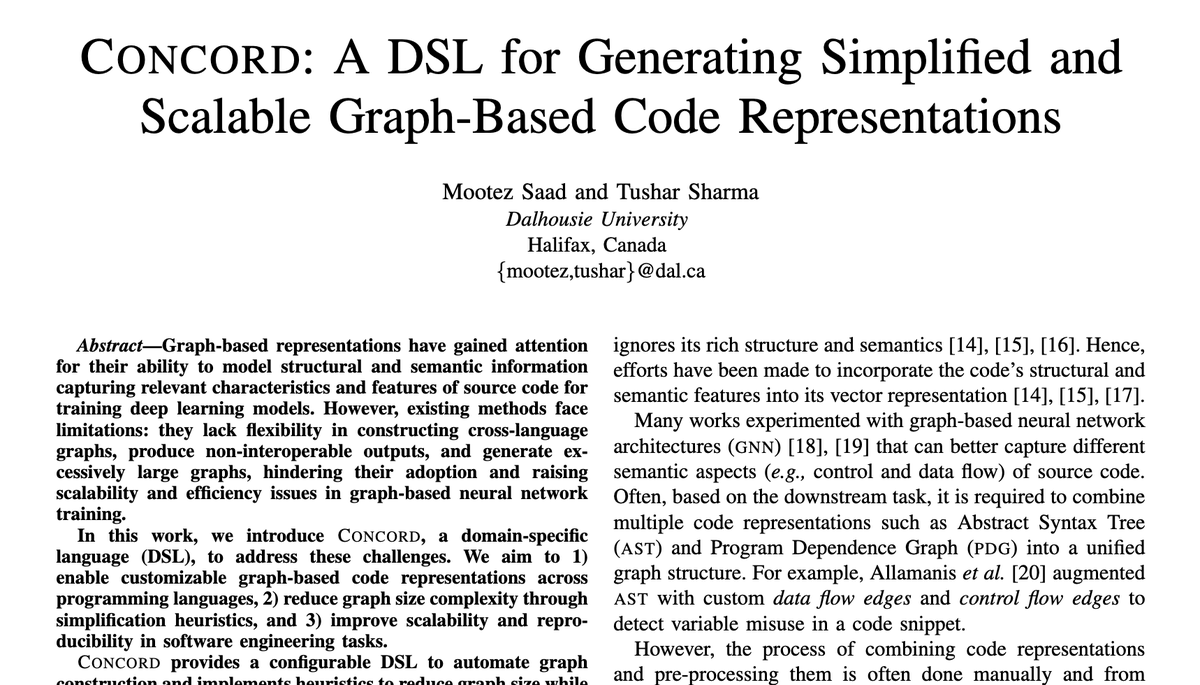
Today, Mootez @s_mootez will present our paper "An adaptive language-agnostic pruning method for greener language models for code" in the 'Fairness and Green' session at 16:00. If you are attending @FSEconf, consider attending it.
Tushar Sharma tweet media
English
1
4
15
1.6K
Saurabh Singh Rajput retweetledi
SMART Lab@Dal
SMART Lab@Dal@SMART_Dal·
To what extent does refactoring actually remove smells? Which refactoring remove which smells? How often do smells disappear w/o any known refactoring? Do all smells live equally long? Our paper exploring these questions has recently accepted at ESEM 2025. Preprint coming soon!
SMART Lab@Dal tweet media
English
0
5
8
876
Saurabh Singh Rajput retweetledi
Simon Willison
Simon Willison@simonw·
The biggest scandal in AI energy right now deserves to be xAI's data center running 35 methane gas turbines that don't need air permits because "temporary" and don't have catalytic reduction pollution controls installed because... they just didn't bother? simonwillison.net/2025/Jun/12/xa…
English
32
142
1.1K
94.7K