Sasha Winkler, PhD

959 posts

Sasha Winkler, PhD banner
Sasha Winkler, PhD

Sasha Winkler, PhD

@ScienceSquil

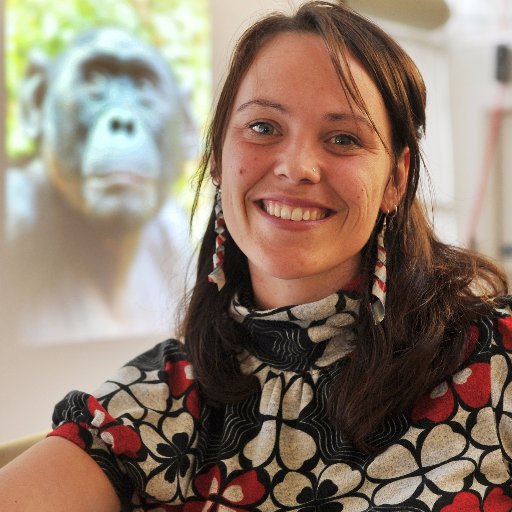
Postdoctoral researcher @DukeU | PhD @UCLA | Primate behavior, communication, social bonds & emotion | Profile pic by @kazfantone for NPR

Portland, OR Katılım Ekim 2014
858 Takip Edilen554 Takipçiler
Sabitlenmiş Tweet
Sasha Winkler, PhD
Sasha Winkler, PhD@ScienceSquil·
My new paper, "Bonobos tend to behave optimistically after hearing laughter” is out! We found that bonobos were more likely to expect rewards after hearing same-species laughter, suggesting that the sound puts them in a good mood. nature.com/articles/s4159…
Sasha Winkler, PhD tweet media
English
1
3
23
716
Sasha Winkler, PhD retweetledi
Zanna Clay
Zanna Clay@zannaclay·
The loss of a legend- Kanzi, the language-competent bonobo, has died age 44. Kanzi was exceptional in so many ways and offered us profound insights into the linguistic & cognitive capacities of great apes. He has taught us so much and will be hugely missed. @ApeInitiative
Zanna Clay tweet media
English
9
86
535
14K
Sasha Winkler, PhD
Sasha Winkler, PhD@ScienceSquil·
The JHU Social & Cognitive Origins lab has a new opening for a full-time position - a great opportunity to work with an all-star team of animal cognition researchers!
Christopher Krupenye@ChrisKrupenye

🚨RT! The Social & Cognitive Origins group at @JohnsHopkins (social-cognitive-origins.com), directed by Dr. Christopher Krupenye, is recruiting a full-time research assistant or lab manager to begin Summer 2025. The position has a one-year minimum, w/ the possibility of extension. 1/

English
1
0
2
377
Sasha Winkler, PhD retweetledi
Neuroscience News
Neuroscience News@NeuroscienceNew·
Toddlers Learn Best After Experiencing Impossible Events Children as young as two understand differences between improbable and impossible events, a new study reveals. Researchers found that toddlers learned significantly better after witnessing an impossible event rather than an improbable one, highlighting the unique impact of unexpected experiences. The study involved two- and three-year-olds interacting with a toy machine rigged to occasionally deliver an impossible result. Children who received an impossible outcome—like a pink toy from a machine filled only with purple ones—showed better learning retention than those who experienced merely improbable outcomes. Researchers believe the impossible events prompted the children to seek explanations, sparking a strong drive for learning. These findings may influence new strategies in early education by creating “mystery” moments that enhance learning.
Neuroscience News tweet media
English
6
30
113
11.2K
Sasha Winkler, PhD retweetledi
Brenda de Groot
Brenda de Groot@brendadegroot·
Not to sound cheesy, but DISI was life-changing for me—and a lot of fun. Can’t think of a better way to spend three weeks of your summer, so.. consider this call if this calls to you!
Diverse Intelligences Summer Institute #DISI@DivIntelligence

📣📣📣 Applications for DISI 2025 are now open!! Interested in intelligence, mind, and cognition in all its forms? Early-career scholars from any discipline—and storytellers in any medium—are encouraged to apply! More info: disi.org

English
0
5
12
1.7K
Sasha Winkler, PhD retweetledi
Christopher Krupenye
Christopher Krupenye@ChrisKrupenye·
Are humans the only species that communicates when a collaborator is missing information? @TownrowLuke and I show that our closest relatives, bonobos, can track when a partner is knowledgeable or ignorant, and tailor communication accordingly @PNASNews pnas.org/doi/10.1073/pn…
Christopher Krupenye tweet media
English
2
56
177
16.5K
Sasha Winkler, PhD retweetledi
Selçuk Korkmaz
Selçuk Korkmaz@selcukorkmaz·
The Datasaurus Dozen is a collection of thirteen datasets that, despite having nearly identical summary statistics—such as mean, variance, and correlation—exhibit vastly different distributions when visualized. This underscores the critical importance of graphing data to uncover underlying patterns that summary statistics alone may obscure. #Statistics #DataScience #Research #Science
Selçuk Korkmaz tweet media
English
15
304
1.6K
129.1K
Sasha Winkler, PhD
Sasha Winkler, PhD@ScienceSquil·
Exciting new animal cognition lab just dropped 😎- congrats Amalia!!
English
0
0
3
275
Sasha Winkler, PhD retweetledi
Fay Clark
Fay Clark@DrFayClark·
I have a really exciting PhD opportunity on a highly novel topic: flow state in animals! This is open to students worldwide, drawing on the University of Bristol's strengths in animal cognition, animal welfare and human game design lnkd.in/eJZ4U3jt
Fay Clark tweet media
English
2
37
71
7.4K
Sasha Winkler, PhD retweetledi
ComparativeCognitionSociety
ComparativeCognitionSociety@ComparativeCog·
🚨Do Rodents Smell with Sound?🚨 Ultrasonic vocalisations may cluster oderants & when this is coordinated with sniffing, it may enhance olfactory sensing. So cool! 🐀👃👂sciencedirect.com/science/articl…
ComparativeCognitionSociety tweet media
English
0
4
14
710
Sasha Winkler, PhD
Sasha Winkler, PhD@ScienceSquil·
My @TED_ED video on the science of laughter just passed 1 MILLION views! 😱 If you haven't seen it yet and want to know more about why humans laugh, check it out here: t.ted.com/l7GtVov (& shout out to @rybak_hanna for the awesome animation!)
English
1
4
15
804
Sasha Winkler, PhD retweetledi
Alex Mielke
Alex Mielke@MielkeAlexander·
PhD Studentship available I am looking for a student to study the 'Quality and function of affiliative actions in non-human primates' - if you are interested in primate sociality, communication, and relationships, get in touch! findaphd.com/phds/project/q…
English
0
50
64
5.9K