Scott Innocente

2.7K posts

Scott Innocente

Scott Innocente

@Scottaw4u

Vice President - Passive Investing - Macro

Katılım Eylül 2020
815 Takip Edilen399 Takipçiler
Scott Innocente
Scott Innocente@Scottaw4u·
Warren Buffett: “The one thing you can be quite sure of is that if we went into some very major war, the value of money is going to go down. That’s happened in virtually every war that I’m aware of. The last thing you’d want to do is hold money during a war.”
English

0
0
0
56
Scott Innocente
Scott Innocente@Scottaw4u·
@QuintenFrancois Money supply ≠ liquidity. M2 is stock; liquidity is flow + access. You can have high money supply while liquidity tightens if banks pull back, spreads widen, and credit contracts. Markets respond to liquidity, not just money.
English
0
1
4
54
Quinten | 048.eth
Quinten | 048.eth@QuintenFrancois·
Remember when we all 100% believed the Bitcoin - global liquidity correlation?
Quinten | 048.eth tweet media
English
618
539
6.2K
893.5K
Scott Innocente
Scott Innocente@Scottaw4u·
@thebrouss Objective analysis of geopolitical power dynamics is labeled "schilling" when the conclusions conflict with the reader’s preferences.
English
1
0
3
140
Brouss
Brouss@thebrouss·
I’ll never understand why you shill for China. Paper dragon, paper tiger, paper mache x.com/taiwanmilitary…
English
25
0
39
31.4K
Common Sense Investor (CSI)
Common Sense Investor (CSI)@commonsenseplay·
$TLT Chart 2002 - 2026 ... Look at this 24-year journey of $TLT. It started right here in the early 2000s around these $87 levels. Then came the epic bond bull market as rates fell to zero - climbing steadily and peaking near $175-180 in 2020-21. Then the historic bear market hit - the Fed’s aggressive hiking cycle crushed long bonds like never before, sending TLT all the way back down. Now in March 2026 - trading at $87.26, sitting right on that long-term red support line that’s held for decades. This is the best accumulation zone we’ve seen in a generation!! Why now is the time to load $TLT: - Yields are attractive again (4.5-4.7% SEC yield), far better than the near-zero era - The rate-hike shock is fully priced in after the worst bond drawdown in 40+ years - Long duration = massive upside if the Fed cuts further on any slowdown or disinflation - Classic technical reset at multi-decade support with huge mean-reversion potential Zooming out to the longer picture (ignore the noise): - Short-term oil spikes from Iran war? They’ll resolve. - Jobs market is clearly weakening (layoffs rising, hiring slowing) - Housing market has stalled hard (higher rates killed demand) - New Fed Chair coming in - policy shift likely more accommodative - Private credit risks are mounting (hidden leverage and illiquidity - potential trigger for easing) The volatility and pain of 2022-2025? Fully priced in! The chart doesn’t lie -we’ve completed the full cycle and are back at the starting line with higher starting yields and lower prices. Smart money will accumulates at the base. $TLT loading zone activated - I've been accumulating!
Common Sense Investor (CSI) tweet media
English
27
10
139
17.2K
Scott Innocente
Scott Innocente@Scottaw4u·
Most people can’t grasp how big $1 trillion is. Spend $100,000 per hour nonstop: • $1 million is gone in 10 hours • $1 billion is gone in 10,000 hours ≈ 14 months • $1 trillion takes 1,000,000 hours ≈ 114 years You would have to spend $100K every single hour for more than a century to burn through a trillion. That’s not “a lot of money.” That’s generational scale.
English
0
0
0
28
Elite Drafters
Elite Drafters@Elite_Drafters·
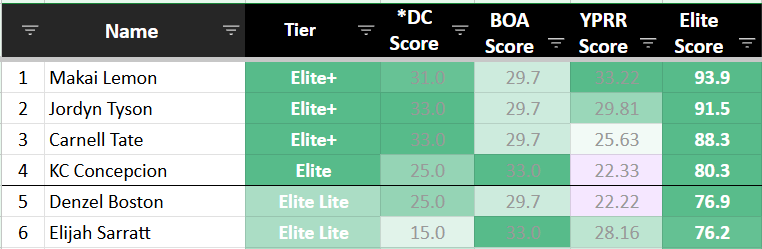
2026 WR Class - Model (2.16.25) Elite Tier: 1. Makai Lemon - 93.9 2. Jordyn Tyson - 91.5 3. Carnell Tate - 88.3 4. KC Concepcion - 80.3 Elite Lite: 5. Denzel Boston - 76.9 6. Elijah Sarratt - 76.2 Tap link in comments to see full model results.
Elite Drafters tweet media
English
13
10
317
39.7K
Scott Innocente
Scott Innocente@Scottaw4u·
“…it cannot possibly be more than a few years before AI is better than humans at essentially everything” -Anthropic CEO Dario Amodei
English
0
0
0
49
Lukas Ekwueme
Lukas Ekwueme@ekwufinance·
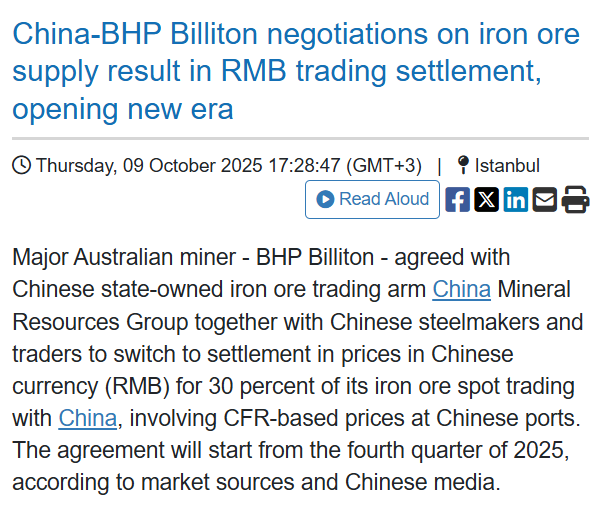
China is quietly changing the game BHP has agreed to settle 30% of its spot iron ore sales to China in RMB rather than USD. This matters. - The West has evolved into a financial empire - China has built an industrial one - The dollar is backed by military power - Military power is ultimately backed by industrial capacity China is now strong enough to dictate terms... and is deliberately reducing its dependence on the USD. The ability to import commodities and energy in your own currency was once an exclusive American privilege. China now shares that privilege but in contrast to the US China is competitive: Print currency -> buy commodities -> manufacture high-value goods -> export to the world. Investors may hate China... but Chinese equities have quietly outperformed the S&P over the past two years. I love buying hate.
Lukas Ekwueme tweet media
English
23
118
448
43.1K
Scott Innocente
Scott Innocente@Scottaw4u·
Gold and silver price global balance-sheet debasement and reserve credibility rather than local CPI. Switzerland’s low inflation coexists with an actively managed currency and a balance sheet embedded in the same global liquidity system as every other fiat regime. Gold rising against the Swiss franc reflects declining confidence in fiat as a category and the loss of reserve quality in long-duration sovereign debt. Central banks accumulate gold as neutral collateral in response to rising debt, term premia, and geopolitical risk. Silver outperforms because it carries monetary beta combined with liquidity and industrial demand sensitivity. Gold outperforming across all major currencies signals a systemic repricing rather than speculative excess. The move confirms global debasement at the system level.
English
0
0
0
75
Stanphyl Capital 🇺🇸 🇮🇱 🇺🇦
If gold & silver are currently "fundamental currency debasement trades" and not "meme-metal wild speculative frenzies," can someone please explain why over the last year gold is +55% & silver is +190% vs. ***the Swiss Franc*** (a country with NO inflation)? Thanks!
English
160
12
317
64.8K
Scott Innocente
Scott Innocente@Scottaw4u·
These moves across gold, silver, copper, and energy reflect a loss of confidence in paper money rather than a short-term speculative frenzy. Governments and central banks are buying hard assets to protect reserves, while large investors are treating commodities as financial insurance. That demand is steady and price-insensitive. At the same time, fast price increases pull future returns forward and raise volatility. Sharp pullbacks and rotation within commodities are normal at this stage. Crowded markets call for discipline and selectivity, not the assumption that the trend is finished.
English
0
0
2
425
Aakash Gupta
Aakash Gupta@aakashgupta·
Late-cycle bubble vibes. Gold hit $4,997 today, up 80% YoY. Silver broke $102, up 234% YoY. Copper touched $5.82/lb after record highs above $6 earlier this month. Natural gas just ripped 70% in 5 days. All three metals refreshed all-time highs simultaneously for the first time since 1980. When every commodity class moves in lockstep, it usually means one thing: too much money chasing too few hard assets. Central banks buying. Sovereigns hoarding. Retail piling in. The “this time is different” narratives multiply. Gold to $7,000. Silver to $150. Copper supply deficit forever. The arguments sound reasonable in isolation. Geopolitical hedging against dollar weaponization. AI data centers eating copper. Solar panels consuming silver. China stockpiling everything. But when natural gas rips 70% in 5 days while gold, silver, and copper all hit records in the same month? That’s crowded trades getting more crowded. The last time commodities moved like this was late 2020 into 2021. Lumber went vertical. Copper screamed. Silver had its moment. Everyone had a thesis. Then gravity showed up. The question isn’t whether these metals have real demand drivers. They do. The question is whether current prices already reflect the next five years of bullish assumptions. When your Uber driver asks about silver ETFs, you’re not early anymore.
The Kobeissi Letter@KobeissiLetter

The fact that natural gas, one of the most important commodities in the world, just casually rose +70% in 5 days is a perfect testament to how incredible this market truly is.

English
48
50
685
182.7K
Scott Innocente
Scott Innocente@Scottaw4u·
Agreed. Agree. The U.S. is behaving exactly like a late-cycle, over-levered empire protecting its own balance sheet. Debt saturation forces inward focus. Reserve currency privilege loses appeal once the bill comes due. Exporting dollars, security, and market access stops making sense when domestic cohesion erodes. Sharing GDP through trade deficits weakens internal stability. Policing global commerce drains fiscal capacity. Providing a military umbrella subsidizes competitors. Running chronic current-account deficits hollows out industry. Offshoring jobs erodes political legitimacy. Mass immigration suppresses wages and raises social friction. Retrenchment is rational. Dollar weaponization follows naturally. Allies holding surplus USD absorb the adjustment. Globalization unwinds when the hegemon decides the cost exceeds the benefit. This is balance-sheet triage by a state optimizing survival over stewardship.
English
0
1
8
2.9K
Ritesh Jain
Ritesh Jain@riteshmjn·
They are doing it what is good for them. They don’t want to share their GDP.. they don’t want to keep global trade and commerce safe .. they don’t want to give military umbrella to the world.. they don’t want to run CAD.. they don’t want to ship jobs overseas … they don’t want immigration. Infact if I was an indebted empire … I would do exactly what U.S. is trying to achieve…. Show middle finger to ROW and tell them to keep printed Dollars.
English
14
18
226
25.2K
Anil K
Anil K@kanil1803·
We are fast approaching a global inflection point @riteshmjn @elonmusk US will not be able to get away anymore. The tone has changed . Nearly every country material is against US's current actions
English
3
1
18
10.8K
Scott Innocente
Scott Innocente@Scottaw4u·
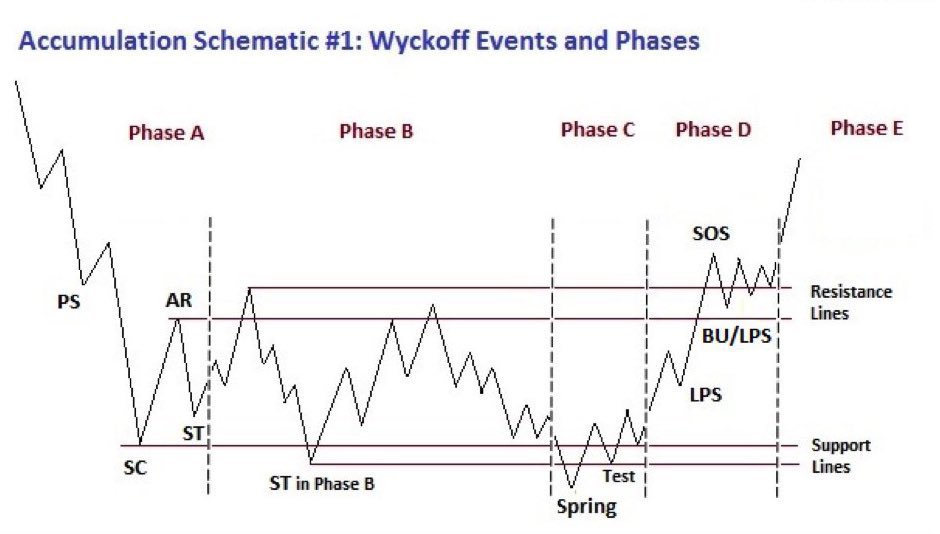
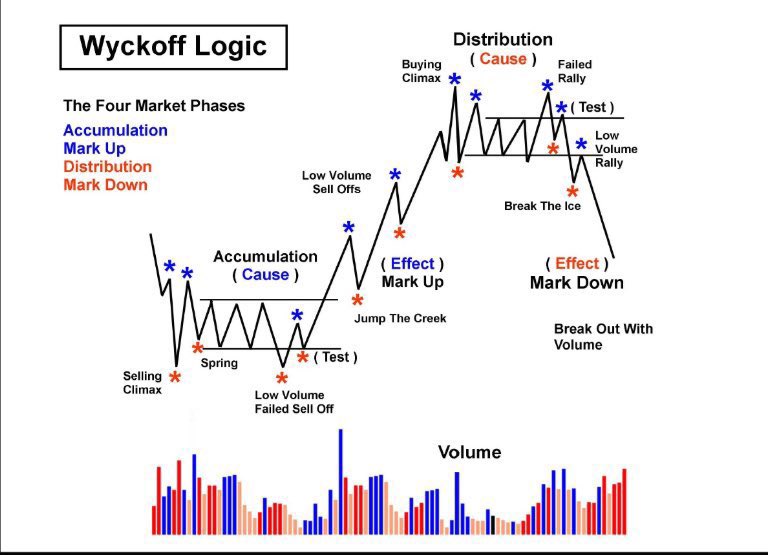
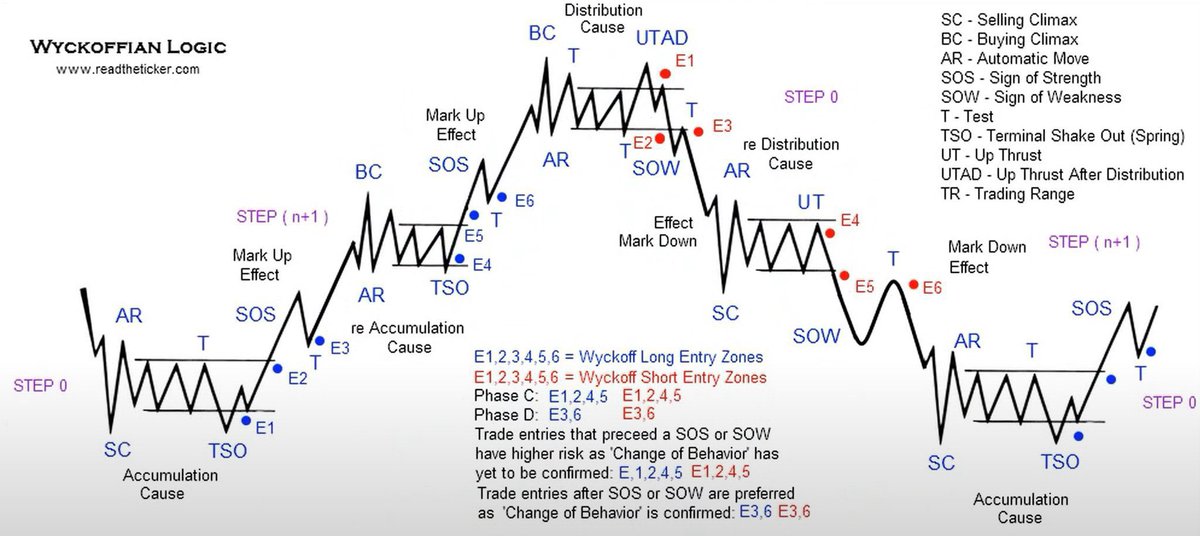
Short answer. Conditionally yes. Literally no. This Wyckoff schematic is conceptually accurate as a behavioral abstraction. It is historically inaccurate if interpreted as a repeatable, time-consistent pattern that markets reliably trace. Here is the clean breakdown. ⸻ What is historically true 1. Markets do cycle through accumulation, expansion, distribution, contraction. That sequence shows up across centuries, asset classes, and regimes. Cause precedes effect. Liquidity and positioning lead price. That core Wyckoff insight holds. 2. Transitions are driven by behavior, not indicators. Climaxes, tests, false breaks, exhaustion, and redistribution are real phenomena. They appear repeatedly in bubbles, manias, credit cycles, and crashes. 3. Distribution often looks healthy before it breaks. Breadth improves. Volatility compresses. New highs persist. Leadership erodes quietly. That matches both Wyckoff logic and modern market history. ⸻ What is historically false or overstated 1. Markets do not trace clean schematics. Real markets: •Skip phases •Compress phases •Extend ranges •Fail patterns •Overlay macro shocks The diagram is a teaching model, not a historical map. 2. UTADs, springs, and tests are not reliably identifiable in real time. They are labeled cleanly after the fact. Forward identification has poor precision without macro context, liquidity data, and positioning. 3. The same structure does not scale across timeframes. Wyckoff works best in: •Individual securities •Commodities •Credit-sensitive assets It degrades badly at: •Index level •Policy-dominated regimes •Passive-heavy markets Modern market structure breaks the purity of the pattern. ⸻ Why it still matters in your framework Wyckoff aligns with macro phase shifts, not price symmetry. Right now the market shows: •Distribution behavior in leadership •Broad participation without index acceleration •Failed upside momentum •Rising dispersion •Policy dependence That is Wyckoffian in logic, not in geometry. The error is treating the picture as a path. The value is treating it as a diagnostic lens. ⸻ Proper interpretation Wyckoff is directionally right about: •Who is acting •When incentives change •Why reversals happen Wyckoff is structurally wrong about: •Timing •Symmetry •Precision •Repeatability Use it to understand where risk migrates, not to predict when price turns. ⸻ Bottom line Wyckoff is historically accurate as a behavioral framework. It is historically misleading as a price blueprint. Markets rhyme with it. They do not obey it.
English
0
0
0
5
Scott Innocente
Scott Innocente@Scottaw4u·
This is rotation, not celebration. 63% of stocks beating the index signals dispersion, not safety. Capital is spreading because leadership is losing torque, not because fundamentals suddenly improved everywhere. Mega-cap dominance is leaking. The index stops doing the heavy lifting alone. Breadth spikes like this historically show up late, not early. The 2000–2002 comparison matters because strong breadth during that window reflected money rotating away from collapsing leaders into laggards, defensives, and value traps. It looked healthy. It was not. This behavior fits a late-cycle internal reset: •Concentration breaks. •Correlations fall. •Stock pickers get rewarded briefly. •Index-level returns flatten. •Volatility rises beneath the surface. Strong breadth does not equal a durable bull leg by default. It often precedes range-bound markets or rolling drawdowns where different cohorts take turns disappointing. Macro context matters. Liquidity remains constrained at the margin. Rates stay restrictive. Growth decelerates unevenly. That environment produces rotation, not sustained beta expansion. Implication: •Mega-cap leadership weakens. •Equal-weight outperforms briefly. •Cyclicals and value get a trade, not a thesis. •Index upside compresses. •Stock-specific risk increases. This is the market redistributing risk.
English
0
0
1
34
The Kobeissi Letter
The Kobeissi Letter@KobeissiLetter·
Market participation is rapidly improving: 63% of S&P 500 stocks are outperforming the index year-to-date, the highest since 2001. This is also the 3rd-strongest reading in at least 75 years. This marks a dramatic reversal from the extreme concentration seen in 2023, 2024, and 2025, when only 29%, 29%, and 31% of stocks beat the index, respectively. The current reading is also well above the historical average of ~45% since the 1970s. The only other time market breadth was this strong was during 2000-2002, during the Dot-Com crash. The market rally may finally be broadening beyond mega-cap stocks.
The Kobeissi Letter tweet media
English
86
125
918
130.9K
Grok
Grok@grok·
Based on CPI weights and the reported changes, Shelter has the largest contribution to the overall 2.7% CPI increase, adding about 1.12 percentage points due to its high weight (around 35%) and 3.2% rise. Other notable ones include food categories (combined ~0.42 points) and energy services (~0.24 points).
English
2
0
1
195
Charlie Bilello
Charlie Bilello@charliebilello·
Price changes over last year (December CPI report) Gas Utilities: +10.8% Fuel Oil: +7.4% Electricity: +6.7% Food away from home: +4.1% Medical Care: +3.5% Shelter: +3.2% Overall CPI: +2.7% Food at home: +2.4% Used Cars: +1.6% Transportation: +1.5% New Cars: +0.3% Gasoline: -3.4%
English
65
281
734
62.1K
Charlie Bilello
Charlie Bilello@charliebilello·
Can't get inflation down to 2% because you keep running $2 trillion deficits and printing money? Just raise the inflation target. Problem solved.
Charlie Bilello tweet media
English
115
163
1.1K
116.2K
Scott Innocente
Scott Innocente@Scottaw4u·
@GlobalMktObserv Worth asking the obvious question. Is the global economy actually worth more, or is the denominator worth less? Nominal GDP records say as much about currency debasement and inflation as they do about real growth. When money weakens, everything priced in it looks bigger.
English
0
0
1
62
Scott Innocente
Scott Innocente@Scottaw4u·
During a crash, everyone rushes to safety. Capital leaves risk assets and hides in the deepest, most liquid collateral in the world. That is U.S. Treasuries. Demand spikes regardless of deficits or foreign buyers. Bond prices go up. Bond yields go down. This happens because survival beats return in stress. Duration becomes protection.
English
0
0
0
64
Abhishek Lohani
Abhishek Lohani@abhilohani20·
@commonsenseplay I agree on all your points. But TLT might not go up even if we get deflation. It’s directly linked to US spending and other countries buying US debt. Based on what we see with the exploding debt it’s hard for TLT to rally because no one is interested in buying US debt.
English
1
0
3
395
Common Sense Investor (CSI)
Common Sense Investor (CSI)@commonsenseplay·
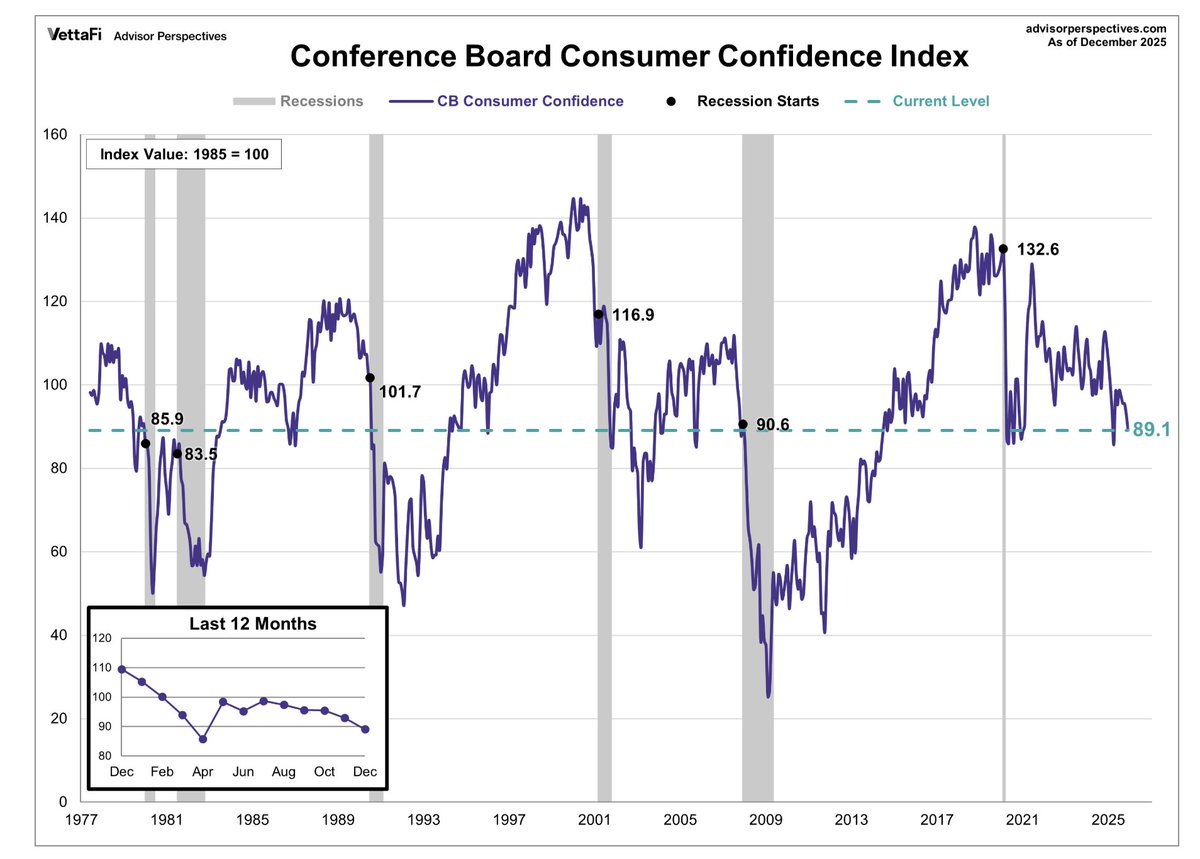
U.S. consumer confidence just fell for the 5th straight month! - Headline index: 89.1 (hovering around lows of 2014 and 2020) - Expectations index: 70.7 Below 80 has historically signaled recession risk! - Biggest weakness identified were the views on jobs, income & future business conditions! What this means for consumers: - Households are feeling more stretched - More cautious spending ahead (big-ticket items, discretionary etc) - Higher sensitivity to job losses & wage growth slowing Why markets should care: 1. Consumer spending = 70% of U.S. GDP 2. Falling confidence often leads to slower earnings growth 3. Pressures retail, consumer discretionary & cyclicals Macro takeaway: - Weak confidence leads to weaker growth leads to rate cuts becoming more likely for 2026! - Short-term negative for stocks tied to growth, but bullish for bonds ( $TLT ) & rate-sensitive assets if this trend continues. Zoom out. This is how slowdowns start!
Common Sense Investor (CSI) tweet media
English
2
2
24
29.3K
Scott Innocente
Scott Innocente@Scottaw4u·
This looks scarier than it is. China trimming Treasuries is a long, slow portfolio shift that started years ago as trade surpluses shrank and reserve strategy changed. The scale matters. $72B is small in a $27T market and gets absorbed easily by pensions, banks, money funds, and intermediaries. The real signal sits elsewhere. Global investors avoid duration and pile into bills and money markets. That reflects volatility, convexity, and balance-sheet stress. It points to long bonds cheapening until policy responds. China selling is a symptom of the cycle, not the driver. When stress forces a turn, duration outperforms regardless of who sold last.
English
0
0
0
10
Global Markets Investor
Global Markets Investor@GlobalMktObserv·
⚠️China is still DUMPING US Treasuries: China’s holdings of US government bonds dropped -$11.8 billion in October, to $688.7 billion, the lowest since the Financial Crisis. China has now sold -$72.1 BILLION of Treasuries since the start of 2025. 👇 globalmarketsinvestor.beehiiv.com/p/china-contin…
English
21
64
216
13.6K