Shavi Pathania

75 posts

Shavi Pathania banner
Shavi Pathania

Shavi Pathania

@ShaviPathania

Scuba diver in the oceans of maths, science, and technology. An Entrepreneur building best harness for digital marketing @vaizle.

Katılım Mayıs 2017
12 Takip Edilen18 Takipçiler
Sabitlenmiş Tweet
Shavi Pathania
Shavi Pathania@ShaviPathania·
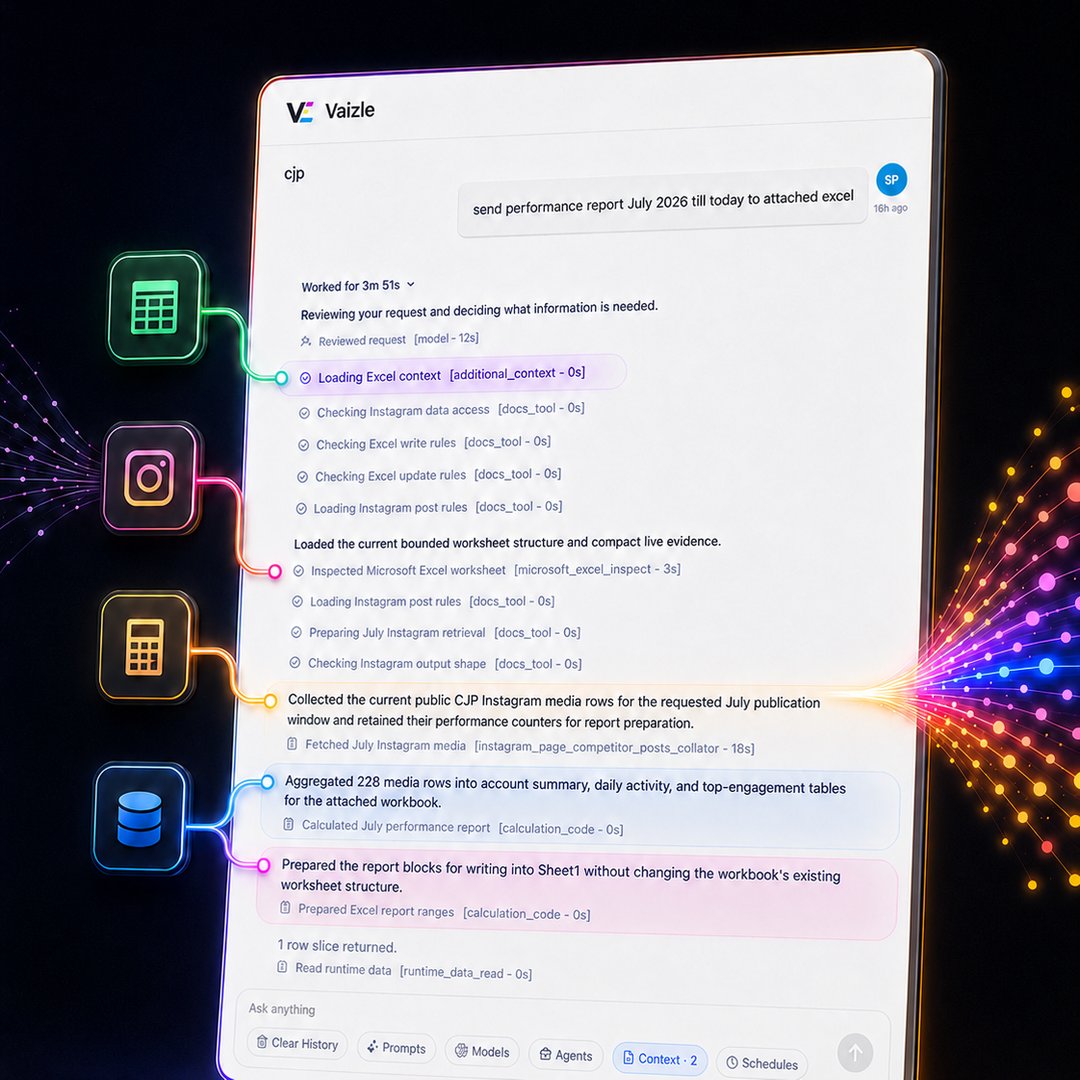
Vaizle AI is not powered by one clever prompt. It runs on an agent engine I built from the ground up. That engine is called VIA. On the surface, Vaizle AI feels simple. Ask it to analyze marketing data, prepare a performance report or update an attached Excel workbook—and it gets to work. The first image is the product experience. The second shows the engineering underneath it during development. It is an execution graph of agents, tools, data, decisions and runtime state working together to complete one task reliably. Game studios face a similar engineering decision. They can use an existing game engine or build their own when they need deeper control and differentiation. The player experiences the game. The studio builds the engine handling physics, state, execution, tooling and debugging. VIA plays that role for intelligent agents. It is a code-first engine that enables agents to choose tools, retrieve and collate large datasets, branch based on what they discover, run work in parallel and preserve state. It can request human approval before sensitive actions, schedule future work, store generated artifacts and stream progress back to the product. The visual execution history shown in the second image is available during development. It allows our engineers to inspect tool calls and state transitions, diagnose failures and replay executions. In production, VIA runs without the visual debugger or verbose execution capture in the request path. Only the minimal telemetry required for reliability and security is retained—keeping execution lean and fast. So why build an engine with this much capability? Because serious digital marketing work cannot be reduced to one prompt. The system must find the correct data, understand business context, choose meaningful comparisons, perform calculations, verify the result and deliver it in the required format. The model provides intelligence. VIA gives that intelligence a controlled environment in which it can see, reason, act and verify. I initially built VIA for the digital marketing harness behind Vaizle AI, but the engine itself is domain-agnostic. It can power intelligent agents for research, operations, finance, customer support and other complex workflows. Digital marketing is its first major proving ground—not its ceiling. We did not want to build another chatbot around a model API. We wanted the engineering foundation required to turn model intelligence into dependable work. Most users will never need to see VIA. They will experience it through deeper analysis, reliable execution and work that actually gets completed. The complexity belongs inside the engine. The simplicity belongs in the product. This is Vaizle engineering at its best.
Shavi Pathania tweet mediaShavi Pathania tweet media
English
0
0
2
327
Thomas
Thomas@VelariCapital·
@ShaviPathania if duct tape can’t solve it, neither can a polished UI.
English
1
0
1
13
Thomas
Thomas@VelariCapital·
Your first client doesn't care that your backend is literally just a Google Sheet and duct tape - they care that you fixed their problem. Sell first. Buy the fancy tape later.
English
13
0
21
548
Ali
Ali@HeyAliux·
Describe your startup using only emojis. I'll try to guess what you built. 😂
English
7
0
8
269
Shavi Pathania
Shavi Pathania@ShaviPathania·
@pmddomingos US don't have enough power... it will be some chinese company who will build something like Skynet
English
0
0
0
7
Pedro Domingos
Pedro Domingos@pmddomingos·
Anthropic’s #1 research goal is to build Skynet to prove to everyone how dangerous AI is.
English
29
8
160
5.7K
Shavi Pathania
Shavi Pathania@ShaviPathania·
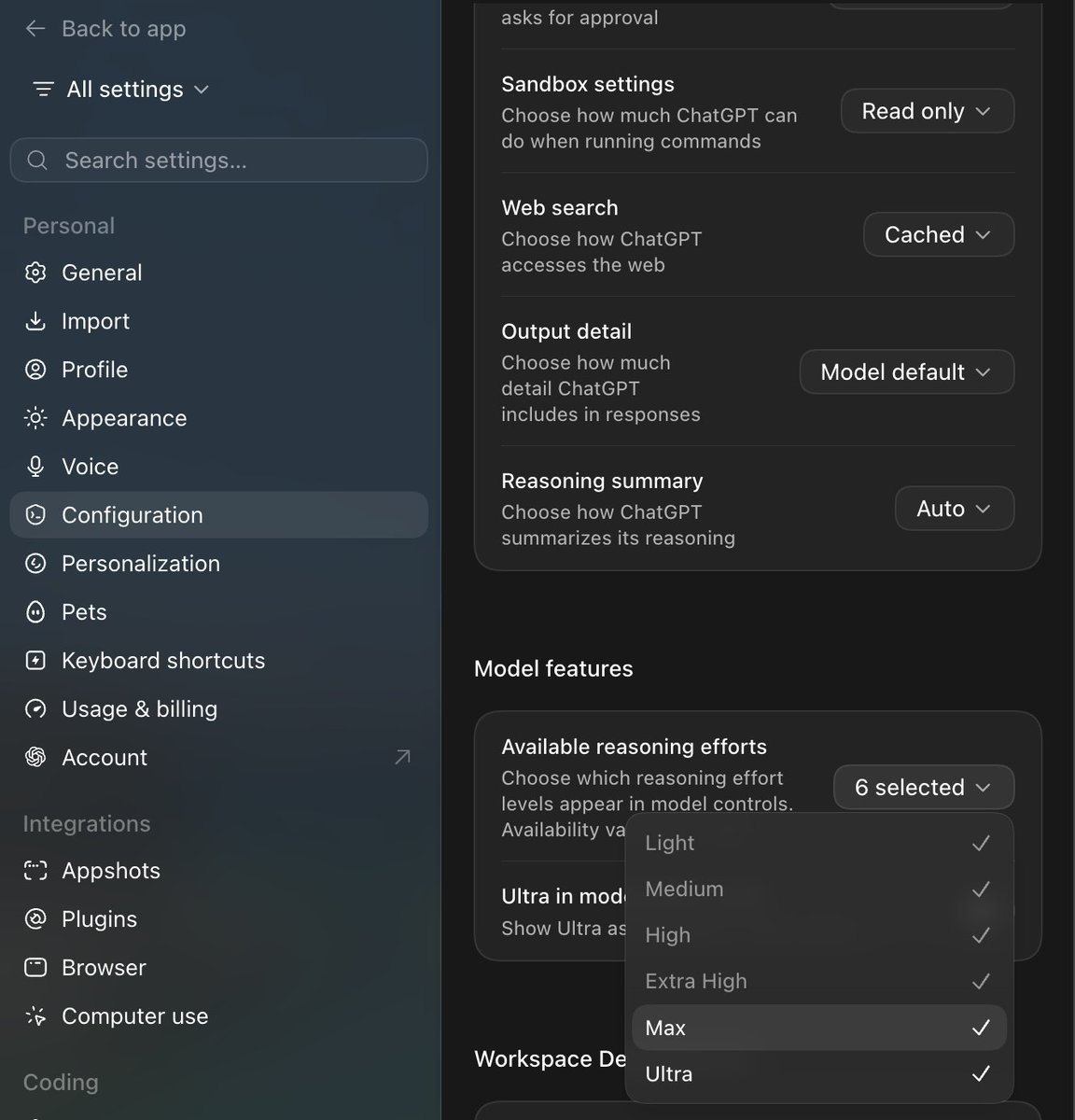
i was looking for Max setting in Codex desktop app... turns out it is hiding under Settings → Configuration → Available reasoning efforts 😅 if you want to use gpt-5.6-luna-max with Max reasoning... enable it from there... why are useful settings always hidden 😂
Shavi Pathania tweet media
English
0
0
0
19
Shavi Pathania
Shavi Pathania@ShaviPathania·
What would you build if you had unlimited cloud/llm credits for 3 years on: GCP AWS Azure Oracle Cloud Cloudflare DigitalOcean Vercel Railway Hetzner OpenAI Claude Any other platform? Would you train a model? Build an army of agents? Launch a SaaS without worrying about infrastructure costs? Process a ridiculous amount of data? Or build something nobody has tried because compute was always the constraint? Tell me exactly what you would build.
English
0
0
1
31
Dumisani Mananga
Dumisani Mananga@DMSCoding11·
If you could only work with one programming language for the rest of your life, which one would you pick?
English
10
0
8
409
W
W@wwontstop·
The older you get, the less impressive expensive things become.
English
48
23
137
2.1K
dax
dax@thdxr·
claude code has been a bit quiet i wonder if they're rewriting
English
146
9
2.1K
214K
Tyler
Tyler@rezoundous·
May I humbly request early access to Astra my good sir
English
5
0
26
2.5K
Elon Musk
Elon Musk@elonmusk·
@dwarkesh_sp AI is already superhuman at many things. We are in the singularity.
English
952
765
7.4K
678.2K
Dwarkesh Patel
Dwarkesh Patel@dwarkesh_sp·
I agree that if you think "capabilities growth will be slower, spikier, and more data-limited than people currently assume", then you should be bearish on LLM companies. But the crux is just you think timelines are long, not necessarily something structural about the business. Progress currently is so fast that many people are willing to pay many times more for models that are 3 months ahead (because 3 months of AI progress counts for a lot). Obviously, capabilities have to plateau at some point, for example when we hit the physical limits of intelligence. But we are so far from even human level intelligence, much less superhuman intelligence, that I don't expect the plateau anytime soon. (There's this misconception where people say that we have already achieved AGI. This makes no sense. The definition of AGI is an AI that can do anything any human can do. Even if you circumscribed this to anything a human can do on a computer, notice that there are billions of people employed in knowledge work jobs who have not yet been automated.) --- I disagree with the implication of the seperate diffusion argument: "even if we froze current capability levels at today's levels, it would take well over two decades to fully integrate in LLMs into our lives." Sure, but that's because we don't have human level intelligence. It will be far easier to integrate AGI labor into companies than human labor. And companies hire human workers all the time! And if they don't, humans start new businesses. That's one of the main ways in which AGI is different from other technologies - AGI diffuses itself, the way, say, a highly skilled immigrant diffuses himself. @steve47285 put it well: "how do highly-skilled, experienced, and entrepreneurial immigrant humans manage to integrate into the economy immediately? Once you’ve answered that question, note that AGI will be able to do those things too." I wrote more about this diffusion question a previous essay that I'm going to copy paste below: "If these models were actually like humans on a server, they’d diffuse incredibly quickly. In fact, they’d be so much easier to integrate and onboard than a normal human employee (they could read your entire Slack and Drive in minutes and immediately distill all the skills your other AI employees have). Plus, hiring is very much like a lemons market, where it’s hard to tell who the good people are, and hiring someone bad is quite costly. This is a dynamic you wouldn’t have to worry about when you just wanna spin up another instance of a vetted AGI model. For these reasons, I expect it’s going to be much much easier to diffuse AI labor into firms than it is to hire a person. And companies hire lots of people all the time."
Andrew Ho@andrewho03

I'm actually fairly bearish on frontier lab valuations. I've never seen the reasons articulated to my satisfaction, so before I go to sleep, I wanted to quickly jot down my thinking here. The basic issue is that the labs are highly unprofitable. This may seem like a simple point, but private market valuations can be relatively irrational; however, like with $SPCX, post-IPO pricing will likely be much more punishing, especially as the standard 6-month lockup period expires and selling pressure intensifies. Many people claim that the labs have high margins. Yet even with high margins, a valuation of $1T would be justified only if the labs were doing nothing aside from serving inference (thus reducing costs only to those relevant to inference) and posting annual revenue numbers in the $100-200 billion range assuming ~80% gross margin and a 20x earnings multiple. This assumption is obviously not true, because the frontier labs have to continually spend money training the next generation of models. This is because of market competition from runner-up firms. For example, if OpenAI had paused model development last year, there would no longer be any point in paying GPT-5 API prices when you can just use Qwen or Kimi instead for much cheaper. Thus, the labs are forced to invest ever-increasing amounts of money in model training, in a way such that at any given point of time, the amount you're forced to invest in the next model is dramatically higher than the amount of money you're actually making, because even if your revenue goes up with higher model capabilities, so do your future training costs. This is a profoundly punishing dynamic which severely penalizes frontrunners. (There is also a related subpoint where frontier labs claim they can distill their leading models to win out at lower intelligence levels as well. This makes no sense because the revenue numbers involved are far too low when taking into consideration the rather low margin of such inference.) Frontier lab valuations appear largely to be based on the assumption that as you scale up, the capabilities which emerge will be sufficiently general and profound that we'll see explosive growth (epoch.ai/publications/e…) from things akin to AI agents starting and autonomously managing entire companies of subagents. But it's not clear to me that this is the case; indeed, as I mentioned in my previous post (x.com/andrewho03/sta…), I believe that capabilities growth will be slower, spikier, and more data-limited than people currently assume. It may be the case that eventually we will see explosive growth of this nature with full automation of the economy, but at the very least my viewpoint implies much longer (multi-decade) timelines until we reach this point. It is not clear to me that the frontier labs will be able to operate unprofitably for so long, although I suppose maybe this foreshadows some sort of inevitable nationalization. I also want to make a broader point about technological diffusion. The reason why technological diffusion is slow isn't just because, e.g., old people take a long time to learn how to use technology (although this is of course a contributing factor to some degree). In my view, it's because when a new, revolutionary technology comes along, the ways to incorporate that technology into subsequent developments are not always obvious, and in fact they cannot necessarily be arrived at through the application of pure reason. If they could be, then perhaps frontier models, at a certain point, would have a perfect understanding of how the LLM application layer should be developed, and they would then autonomously code, deploy, and sell such a layer. But it seems more plausible to me that this diffusion is limited moreso by the hard problem of economic calculation--that is to say, the Hayekian notion through which the price system gradually promotes efficient allocation of resources and which cannot be simulated through central planning--and that even if we froze current capability levels at today's levels, it would take well over two decades to fully integrate in LLMs into our lives. Such a view is consequently rather bearish for the continued profitability of labs as it reduces their prospects for finding, say, something else comparable in profitability to coding agents, which seems to have been a somewhat lucky discovery by Anthropic to begin with. That is to say, even if you spam FDEs you aren't necessarily going to be able to just figure out the "correct" product shapes fast enough. Overall, I don't think that people have clearly reasoned through their mental models for why lab equity should be worth as much as it currently is, and that if you actually bother to write down such a model, you may not arrive at the conclusion that you want to arrive at. This isn't to say that I don't expect AI to experience a huge (industry-wide) boom in the coming decades, but just that I'm not entirely sure I would buy OpenAI or Anthropic stock at latest valuations if I were given the opportunity to do so. Of course, as an ex-lab employee, arguably this is talking against my own book; I should really be giving people more reasons to be bullish. But in the end, my influence is so small that it doesn't make a difference, so why not have some fun?

English
94
88
1.2K
393.5K
Shavi Pathania
Shavi Pathania@ShaviPathania·
@thsottiaux when 'm wake its /fast and when 'm going to sleep I switch to normal and assign a large job i thought everybody do this does weekends even exists for software engineers 🤔
English
0
0
2
177
Tibo
Tibo@thsottiaux·
Fun fact, users use /fast less during the weekend. The weekend is for relaxation, even for the model.
English
818
107
6.1K
436.7K
ak not ok
ak not ok@KabraAakanksha·
Someone needs to build an app called LinkedOut where employees share the real reasons they quit their toxic jobs.
English
10
1
45
2.4K
Shavi Pathania
Shavi Pathania@ShaviPathania·
@Tim_Denning @grok doing above by large amount of population will result in what percentage of good vs bad people
English
1
0
0
485
Tim Denning
Tim Denning@Tim_Denning·
It took me 40 years to understand that the cheat code to life is to avoid what everyone thinks of you and just do whatever the f*ck you want.
English
125
718
9.8K
350.4K
Wahab Khan
Wahab Khan@chaosengineerr·
If AI saves you couple of hours a day, where are you putting those hours in?
English
30
1
24
922
World of Statistics
World of Statistics@stats_feed·
The average 4-year-old laughs 300 times a day. The average 40-year-old laughs just 4 times a day.
English
199
456
6.8K
238.5K
Irakli 🚀
Irakli 🚀@TheSpacerr·
Please someone explain this: Why does Saturday feel like 5 minutes but Monday feels like 5 days?
English
34
0
28
1.3K
DAN KOE
DAN KOE@thedankoe·
Nobody wants to say it, but everyone exchanged their obsession with collecting Notion templates for collecting Claude skills instead (with nothing to show for it, as always).
English
194
115
2.3K
129.9K