Shea Wihlborg

398 posts

Shea Wihlborg banner
Shea Wihlborg

Shea Wihlborg

@Shea_ARK

Multiomics analyst @ARKInvest focused on identifying disruptive innovations that could reshape the future of medicine | Disclosure: https://t.co/sPOP1gVoCR

Katılım Ağustos 2021
151 Takip Edilen5.5K Takipçiler
Shea Wihlborg
Shea Wihlborg@Shea_ARK·
AI and biology are reinforcing each other in a flywheel that we think is just getting started. Here's my top takeaways from @ARKInvest's multiomics research in Big Ideas 2026!
ARK Invest@ARKInvest

Research Analyst @Shea_ARK shares her top 3 takeaways from the Multiomics section of ARK's Big Ideas 2026 report.

English
3
4
44
21.2K
Shea Wihlborg
Shea Wihlborg@Shea_ARK·
Another round trip! Vinay Prasad is leaving the FDA for the second time in roughly a year. His tenure brought high-profile rejections that surprised rare disease developers, raising questions about whether the FDA's messaging on flexibility matched its actions. My take: the reforms that started taking shape over the last year aren't leaving with him. One pivotal trial as the new default. A "plausible mechanism" pathway to streamline approvals for therapies targeting diseases with known biological causes. A national priority review program. These address real structural bottlenecks in drug development, but they're not enough. Case in point: Makary said today that China initiates four times the Phase 1 trials as the US and China is looking to speed that up even further. To keep competitive the FDA is pushing IRB reforms to close that gap. So will this year bring continuous trials, faster Phase 1 entry, more agile oversight? The reform direction is set. The question is the pace now.
ARK Invest@ARKInvest

x.com/i/article/2033…

English
0
1
4
2.6K
Shea Wihlborg
Shea Wihlborg@Shea_ARK·
ARK's Big Ideas 2026 video is LIVE 🎬Jam-packed with ARK's research on the technologies reshaping the global economy. And I’m in it! I may be coming down with a cold when this was taped but don’t mind that 😊 I walk through the Multiomics section (starting ~1:04:00) — 5 subsections on why the convergence of AI and science is catalyzing profound shifts in healthcare: 1/ Defining Multiomics → There are multiple biological layers — genomics, transcriptomics, proteomics, and more — that all work together to shape health, disease, and lifespan 2/ Exploding Data, Collapsing Costs → Remember when the first human genome took nearly $3bn to sequence? Well whole genome sequencing could fall to ~$10 by 2030. The falling cost of sequencing is driving an explosion in data volumes; we expect this volume to scale 10x by 2030. Molecular diagnostic tests are already generating more data tokens annually than what was used to train frontier LLMs 3/ AI Transforming Drug Discovery → Today, nearly 9 out of every 10 clinical drug candidates fail. AI-driven development could increase probabilities of success and reduce total drug costs ~4x and cut time-to-market by ~40%. 4/ Cures Transforming Sickcare into Healthcare → Gene-editing treatments are opening the door to one-time cures instead of lifelong symptom management. We’re just at the beginning of seeing this move from rare diseases to common conditions. Gene-editing for cardiovascular disease alone could represent a ~$2.8T US TAM — 12x Lipitor's cumulative lifetime sales 5/ The Science of Longevity → Next frontier is likely targeting the biology of aging itself. Eliminating disease-related deaths and age-related decline could roughly double US healthy life potential — a ~$1.2 quadrillion opportunity Full video below 👇
ARK Invest@ARKInvest

ARK’s Big Ideas filters out short-term noise to reveal the signals we believe matter most for long-term growth. Explore the themes in Big Ideas 2026 by watching a detailed, section-by-section analysis from the ARK research team. ark-invest.com/videos/analyst…

English
0
0
6
832
Shea Wihlborg
Shea Wihlborg@Shea_ARK·
The FDA just made one of the most significant shifts in its evidentiary standards in decades—and it feels like a lot of people have slept on the news! The FDA will now default to ONE pivotal trial for drug approval, not two. The science of evaluating whether a drug works has advanced enormously. Today, development programs build evidence across multiple dimensions—mechanism of action, biomarker effects, intermediate endpoints—that collectively tell a more complete story. That body of confirmatory evidence, from mechanistic data to real-world evidence, can replace a second pivotal trial. We have historically seen more regulatory flexibility in rare diseases and oncology where need is acute. But the biggest impact we expect to see with the shift from two to one pivotal trial is likely to be in common conditions like cardiovascular and respiratory where the two pivotal trial dogma has been more entrenched. Potentially up to $350M in savings per program and years off timelines. And this might just be the start—could continuous trial designs that collapse the rigid phase structure be the next paradigm shift in clinical development?
ARK Invest@ARKInvest

x.com/i/article/2026…

English
13
26
203
385.6K
Shea Wihlborg
Shea Wihlborg@Shea_ARK·
🚦 Green light, red light — where is genetic medicine headed? Big picture: Gene editing is moving closer to first in-vivo approvals, while early-stage innovation suggests the future toolkit could enable gene-scale edits, broadly expanding the set of genetic diseases that may become addressable. 🧬 Some of the latest developments: 🟢 Late-stage progress: FDA lifted the clinical hold on Intellia’s Phase 3 trial of in-vivo CRISPR nex-zfor ATTR-PN following protocol amendments and enhanced liver monitoring. Serious liver signals remain rare across patients dosed with nex-z (<1%); similar updates could potentially support a future lift of the hold in ATTR-CM. 🔴 Viral vector–based gene replacement hits a snag: FDA placed holds on two AAV gene replacement programs, RGX-111 (Hurler) and RGX-121 (Hunter), after a brain neoplasm was detected in a patient ~4 years after RGX-111 dosing. Preliminary analysis identified vector integration near a proto-oncogene; causality remains under investigation. 🔵 Expanding the toolkit: • Life Biosciences: FDA cleared a first-in-human trial of a gene therapy designed to partially “reset” cells by restoring epigenetic information, with initial focus on optic nerve damage. • Lilly + Seamless: advancing programmable recombinases to enable gene-sized DNA insertions, exchanges, or excisions, potentially extending gene editing beyond first-generation short edits.
ARK Invest@ARKInvest

x.com/i/article/2018…

English
5
9
28
22.6K
Shea Wihlborg
Shea Wihlborg@Shea_ARK·
Only ~2% of the human genome codes for proteins. The other 98%? Biological “dark matter.” DeepMind’s new AlphaGenome AI could help decode how non coding DNA influences gene regulation and disease, much like AlphaFold transformed protein structure prediction from amino acid sequences. A big step toward programmable biology.
ARK Invest@ARKInvest

x.com/i/article/2018…

English
3
9
43
20.5K
Shea Wihlborg
Shea Wihlborg@Shea_ARK·
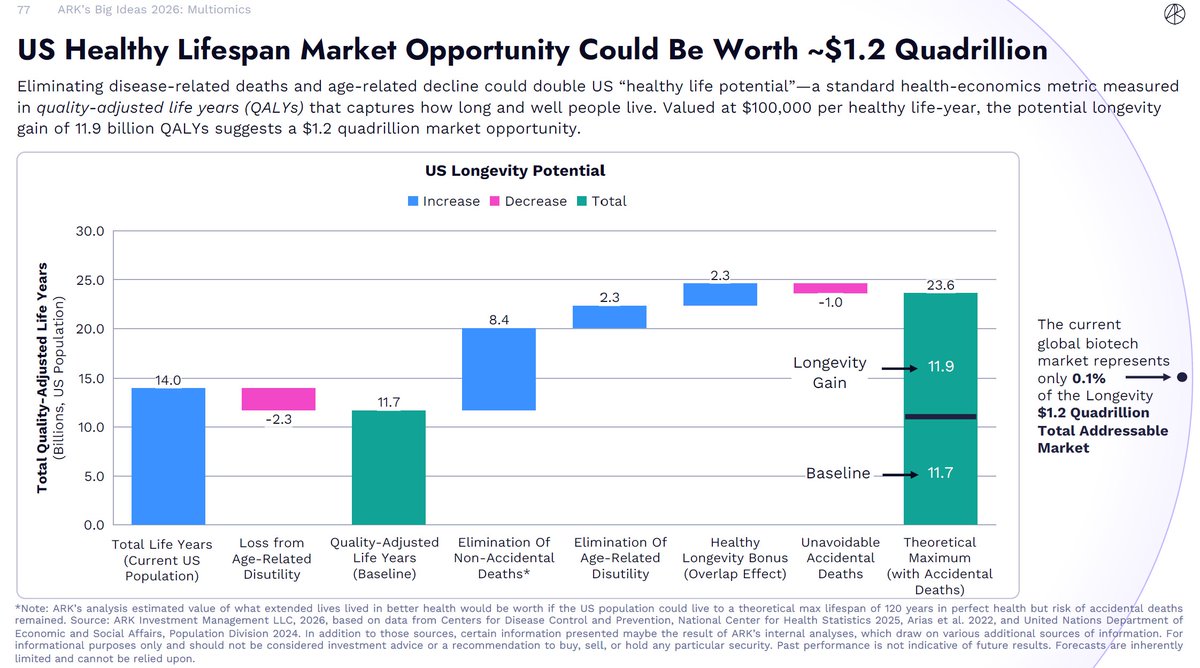
How large is the potential economic value of extending healthy human life? Delaying age-related disease and functional decline could significantly expand healthy lifespans. Measured in quality-adjusted life years (QALYs), the potential gains suggest an opportunity far larger than today’s global biotech market. This Big Ideas 2026 slide shows how our analysis estimates the value of what extended lives in better health would be worth if the US population could live to a theoretical max lifespan of 120 years in perfect health while the risk of accidental deaths remains. Valued at $100,000 per healthy-life year, the implied longevity gain of 11.9 billion QALYs corresponds to a $1.2 quadrillion market opportunity. ark-invest.com/big-ideas-2026
English
1
0
5
699
Shea Wihlborg
Shea Wihlborg@Shea_ARK·
You know your chronological age—but how old are you biologically, and how well can we measure it and assess mortality risk? Progress in medicine has meaningfully extended lifespans by reducing early deaths from infectious and chronic diseases. As a result, mortality is now increasingly concentrated at older ages. As understanding of the biology of aging advances, our ability to measure biological age and assess risk of mortality and functional decline has improved as well. This Big Ideas 2026 slide illustrates how approaches to measuring aging have evolved—from basic clinical markers to functional tests, molecular clocks, and digital aging measures—sharpening precision in how biological aging and mortality risk are quantified. ark-invest.com/big-ideas-2026
Shea Wihlborg tweet media
ARK Invest@ARKInvest

Don’t chase what was. Own what’s next. Big Ideas 2026. Download now: ark-invest.com/big-ideas-2026

English
4
5
36
90.6K
Shea Wihlborg
Shea Wihlborg@Shea_ARK·
What happens when curative therapies scale from rare disease to common disease? While gene-editing cures are initially being developed in rare diseases, the underlying technologies have the potential to scale into far more common conditions. As gene-editing approaches advance, they are expanding into diseases like cardiovascular disease. Even partial risk reduction, when applied across large patient populations, could support multi-trillion-dollar markets at value-based prices. This Big Ideas 2026 slide illustrates how a one-time gene-editing therapy for atherosclerotic cardiovascular disease (ASCVD) could represent a ~$2.8 trillion total addressable market in the U.S., capturing even one-twelfth would match the blockbuster success of the statin Lipitor, one of the best-selling drugs of all time. ark-invest.com/big-ideas-2026
Shea Wihlborg tweet media
English
0
0
6
343
Shea Wihlborg
Shea Wihlborg@Shea_ARK·
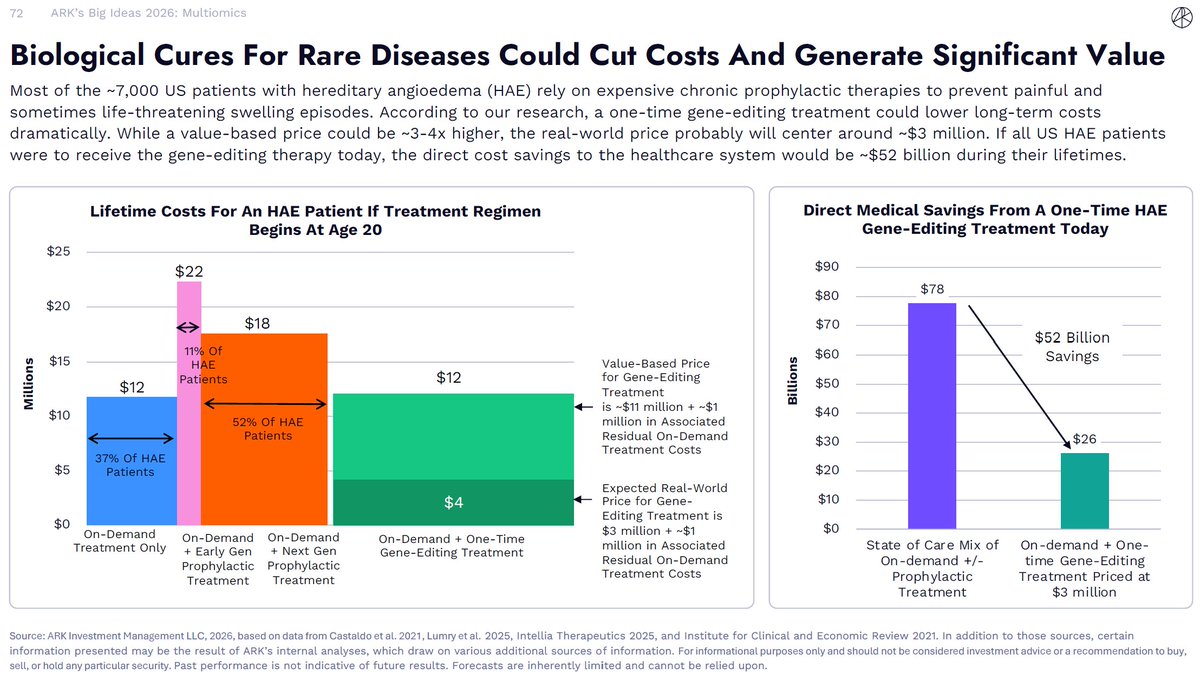
If you could choose—would you prefer a one-time treatment or lifelong chronic therapy? Innovations in gene-editing medicine could enable one-time treatments for certain rare diseases. While these therapies are likely to carry higher upfront prices than chronic treatments, they could also improve patient outcomes and lower long-term healthcare costs. This Big Ideas 2026 slide examines hereditary angioedema (HAE), where emerging clinical data indicate that a one-time gene-editing therapy could more effectively prevent painful—and sometimes life-threatening—attacks than chronic treatment. Based on modeled pricing assumptions, our analysis suggests this approach could also reduce lifetime medical spending despite a higher initial cost. ark-invest.com/big-ideas-2026
Shea Wihlborg tweet media
ARK Invest@ARKInvest

Don’t chase what was. Own what’s next. Big Ideas 2026. Download now: ark-invest.com/big-ideas-2026

English
1
5
28
20.4K
Shea Wihlborg
Shea Wihlborg@Shea_ARK·
Gene editing is at an inflection point. In-vivo CRISPR could move single-dose, functional cures beyond rare diseases to common killers like cardiovascular disease—the world’s leading cause of death. Hear me discuss the science and implications on this week’s episode of The Brainstorm 👇
ARK Invest@ARKInvest

Gene editing is moving from rare diseases to major illnesses like heart disease. This could reshape the entire healthcare industry. What does this shift means for the future of medicine and long-term investment opportunities? Watch this week's episode of The Brainstorm. ark-invest.com/podcast/the-br…

English
11
38
206
51.2K
Shea Wihlborg
Shea Wihlborg@Shea_ARK·
Gene-editing is moving from rare diseases to some of the world’s biggest killers. With in-vivo, LNP-delivered CRISPR, a one-time gene edit could potentially lower lifelong cardiovascular risk and transform treatment for millions who don’t adequately respond to current therapies. Our analysis here ⬇️
ARK Invest@ARKInvest

x.com/i/article/2000…

English
1
9
51
24.4K
Shea Wihlborg
Shea Wihlborg@Shea_ARK·
Baby KJ need not be a one-off success story. For families who have felt left behind as their children faced similarly devastating diagnoses, the FDA’s new plausible mechanism pathway offers a reason for real hope. As described in the FDA’s NEJM paper, the pathway would allow regulators to consider streamlined evidence when a therapy addresses a disease with a known biological cause and targets the underlying or proximate biological alteration. If implemented as outlined, it signals that treatments for rare genetic diseases could scale faster than ever — giving more patients a chance at accessing transformative therapeutic options.
ARK Invest@ARKInvest

x.com/i/article/1990…

English
0
5
22
31.4K
Shea Wihlborg
Shea Wihlborg@Shea_ARK·
While there may be bumps along the way, gene-editing innovation marches on—and regulators are evolving to keep pace. The FDA is signaling a major shift: building a faster pathway for personalized gene-editing therapies by grouping related disorders into combined trials. This evolution could accelerate access to one-time, potentially curative treatments and marks a meaningful step toward bringing precision medicine to more patients. I’m especially encouraged by what this could mean for families of children with rare diseases—those who saw Baby KJ’s success and hope for the same for their own children.
ARK Invest@ARKInvest

x.com/i/article/1985…

English
2
6
22
26.5K
Shea Wihlborg
Shea Wihlborg@Shea_ARK·
It’s amazing how far we’ve come in sequencing the human genome. Last week, PacBio cut the cost of long-read sequencing by ~40% - now down to <$300 per genome at scale. Hard to believe the first human genome in 2003 cost ~$2.7BN! These breakthroughs will keep accelerating diagnostics and precision medicine.
ARK Invest@ARKInvest

x.com/i/article/1980…

English
2
12
61
37.4K
Shea Wihlborg
Shea Wihlborg@Shea_ARK·
Wow, exciting work out last week on a new gene editing system called bridge editing, which could expand the range of diseases addressable by genetic medicine. Where CRISPR fixes “typos,” bridge editing may be able to rewrite an entire chapter of DNA—up to nearly 1 million base pairs. That scale matters. For example, diseases like Huntington’s and Friedreich’s ataxia are driven by long, repetitive DNA expansions. Even partially trimming those repeats could lessen severity of disease. Earlier gene-editing tools weren’t designed to correct these large structures. Bridge editing may finally make them tractable at the genetic level—potentially enabling cures by targeting the root cause of disease. The technology is still early, but it could open therapeutic opportunities that previous editing approaches left out of reach.
ARK Invest@ARKInvest

x.com/i/article/1972…

English
6
10
70
153.3K