
Shining Science

6.2K posts

Shining Science banner
Shining Science

Shining Science

@ShiningScience

Sky above, science within — your guide to the universe.

In the Realm of Bright Ideas Katılım Haziran 2022
16.6K Takip Edilen128.3K Takipçiler
Shining Science
Shining Science@ShiningScience·
A healthy sex life may be one of the most enjoyable ways to protect your heart against cardiovascular disease. Maintaining an active and satisfying sex life offers more than just emotional connection; it acts as a potent boost for cardiovascular wellness. Research indicates that men who engage in intercourse at least twice a week, along with women who report high levels of sexual satisfaction, face a lower risk of experiencing a heart attack. This physical activity serves as a unique form of exercise that helps strengthen the heart muscle, naturally lowers blood pressure, and promotes better sleep patterns—all critical factors in maintaining a healthy circulatory system. The benefits extend far beyond the physical exertion, tapping into the power of human connection to combat psychological stressors. According to experts at the Johns Hopkins Ciccarone Center for the Prevention of Heart Disease, the intimacy shared between partners fosters strong social bonds that reduce feelings of loneliness, anxiety, and depression. By mitigating these negative mental health states, which are closely linked to heart disease, regular intimacy provides a holistic shield for the body, proving that a healthy heart depends as much on emotional closeness as it does on physical fitness. source: Johns Hopkins Medicine. The Heart-Healthy Benefits of Intimacy. Johns Hopkins Ciccarone Center for the Prevention of Heart Disease.
Shining Science tweet media
English
0
9
29
5K
Shining Science
Shining Science@ShiningScience·
Feeling sore after a workout doesn’t necessarily mean your muscles are growing. Scientists have found that soreness often comes from inflammation in connective tissues, not from actual muscle damage. Training while still sore doesn’t slow recovery or prevent progress. Some exercises and people simply experience more soreness than others due to muscle length and activation. In reality, soreness is just a sign of unfamiliar movement, not a reliable measure of muscle growth.
Shining Science tweet media
English
4
10
71
3.8K
Shining Science
Shining Science@ShiningScience·
Scientists say orcas appear to be getting smarter…and scarier. Orcas are proving that their social intelligence is a powerful tool for survival in an increasingly human-dominated ocean. Orcas are demonstrating that they are much more than just apex predators; they are strategic thinkers capable of rapid cultural evolution. Recent observations have documented pods coordinating attacks on blue whales, outsmarting commercial fishing lines, and even teaching one another to disable vessels. This surge in complex behaviors isn’t a result of biological evolution, but rather an extraordinary capacity for social learning. By sharing specialized techniques within their pods, orcas are effectively building a collective knowledge base that allows them to master new challenges and pass those skills down through generations in real-time. This cognitive agility is being pushed to the limit as human activities, such as overfishing and climate change, reshape the marine landscape. Scientists suggest that the increasing frequency of these sophisticated behaviors—from scavenging to navigating melting Antarctic ice—is a direct response to environmental stressors. While there is no evidence that these marine mammals are intentionally targeting humans, their ability to innovate and pass on survival strategies highlights a form of intelligence that mirrors human culture. As we continue to alter their habitats, we are witnessing the emergence of a highly adaptable apex intelligence that is redefining the rules of the ocean. source: Whitehead, H., & Rendell, L. The Cultural Lives of Whales and Dolphins. University of Chicago Press.
Shining Science tweet media
English
6
27
97
6K
Shining Science
Shining Science@ShiningScience·
A study published on PubMed shows that chewing firm foods activates jaw muscles and sensory nerves, rapidly sending signals to the brain that increase neural activity. According to the researchers, this mechanical stimulation boosts levels of brain antioxidants within minutes, helping protect neurons from oxidative stress. The study explains that active chewing improves cerebral blood flow and oxygen delivery, which supports the brain’s natural antioxidant defenses. These biological changes occur shortly after chewing begins, demonstrating a direct link between oral activity and brain chemistry.
Shining Science tweet media
English
3
39
157
5.4K
Shining Science
Shining Science@ShiningScience·
What's your take on theory of evolution? 🤔
English
27
1
20
2.6K
Shining Science
Shining Science@ShiningScience·
Scientists created a gel that regenerates tooth enamel. This could end permanent dental erosion. Human tooth enamel is the hardest tissue in the body, yet it famously lacks the ability to heal itself once eroded by acids, grinding, or physical wear. A new breakthrough in dental science aims to change this biological limitation through a protein-based gel that mimics the natural mineral-forming process. When applied to damaged teeth or exposed dentine, the gel acts as a microscopic scaffold, attracting calcium and phosphate ions from the user's saliva to build a new mineralized layer that fuses seamlessly with the existing tooth structure. In laboratory tests on extracted human teeth, the regenerated enamel achieved a hardness and structural integrity nearly identical to healthy natural enamel within just ten days. The treated surfaces successfully resisted simulated brushing and acid exposure, performing as well as or better than native tissue. While researchers note the new layers are currently thinner than original enamel and require further clinical testing for long-term durability, the technology marks a revolutionary shift from simply patching cavities to actively rebuilding the body's natural defenses. source: Dogan, S., Fong, H., Yucesoy, D. T., Gungormus, M., Karimizadehtouriz, M., & Sarikaya, M. Biomimetic Tooth Repair: Amelogenin-Derived Peptides Regrow Enamel and Dentin-Like Mineral. ACS Biomaterials Science & Engineering.
Shining Science tweet media
English
9
76
271
9.2K
Shining Science
Shining Science@ShiningScience·
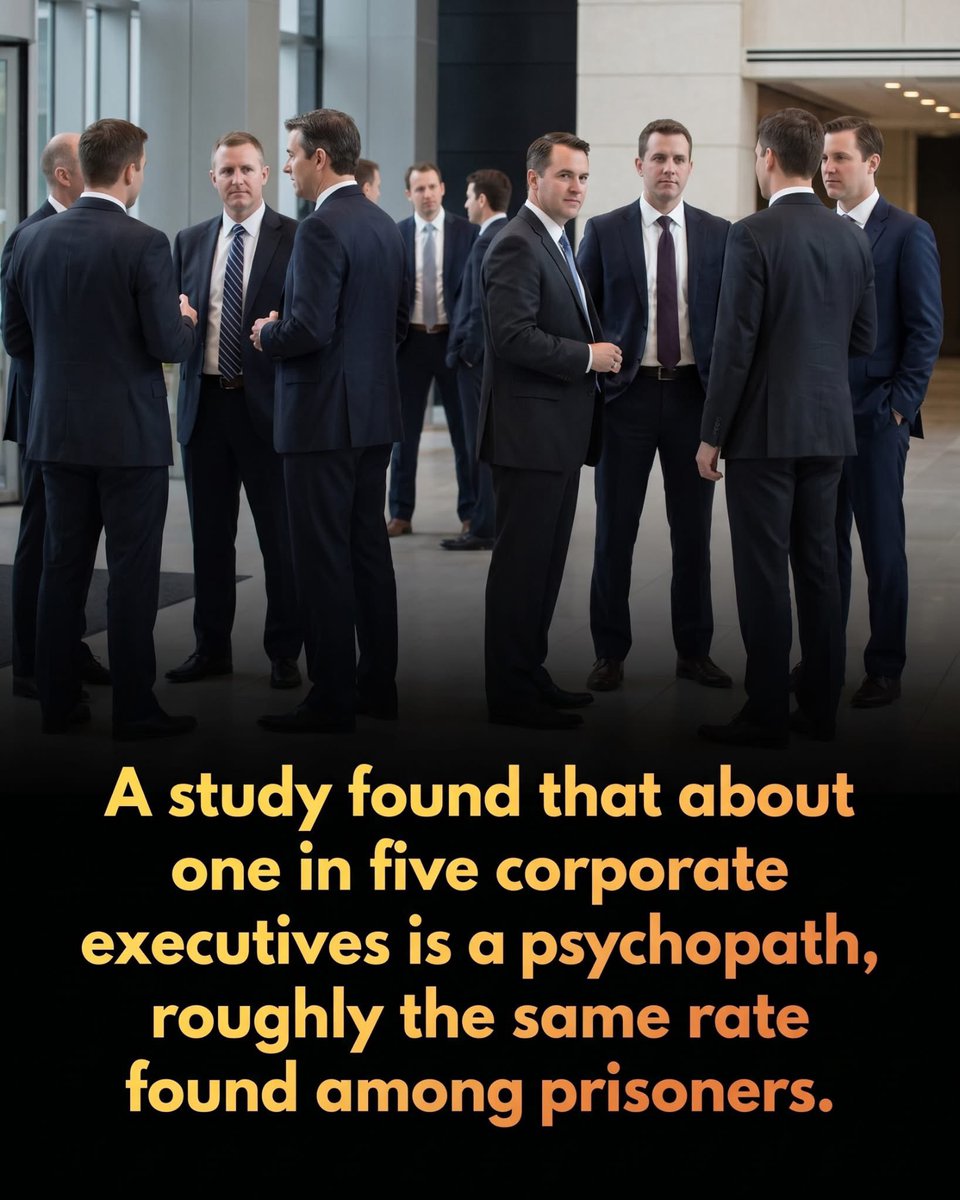
🚨 Research shows one in five CEOs exhibits clinically significant psychopathic traits. It’s a rate nearly identical to that found in prison populations. Recent findings presented at the Australian Psychological Society’s annual congress indicate a startling trend in the corporate world: approximately 21% of senior professionals possess clinically significant psychopathic traits. This figure mirrors the prevalence of psychopathy within prison populations and stands in stark contrast to the estimated 1% to 4% found in the general public. These individuals, often dubbed "successful psychopaths," navigate their way into high-ranking positions by leveraging superficial charm and flamboyant personalities. However, these same traits—including a profound lack of empathy and a penchant for insincerity—can predispose leaders to unethical behaviors and long-term organizational failure. Forensic psychologist Nathan Brooks, who led the study alongside researchers from Bond University and the University of San Diego, suggests that current recruitment strategies are partially to blame. Many firms focus exclusively on technical skills and professional history, inadvertently ignoring toxic personality features that can damage corporate culture. To combat the rise of psychopathy in the C-suite, the study advocates for more rigorous personality screening during the hiring process. By shifting the focus from mere competence to character, businesses can better protect themselves from the "short-term success" that psychopathic leaders often buy at the cost of the company's future integrity. source: Brooks, N., Fritzon, K., & Croom, S. Corporate Psychopathy: Highlighting the Importance of Personality Screening in the Recruitment Process. Australian Psychological Society Annual Congress.
Shining Science tweet media
English
8
21
67
4K
Shining Science
Shining Science@ShiningScience·
Which way should they drive — forward or backwards?
Shining Science tweet media
English
42
1
33
7.6K
Shining Science
Shining Science@ShiningScience·
Study shows staying awake past 1 AM is detrimental to mental well-being. New research from Imperial College London suggests that regardless of your natural sleep preference, hitting the sack after 1 AM significantly elevates the risk of mental health challenges. Analyzing data from over 73,000 participants in the UK Biobank, researchers found that those who consistently stayed up late experienced higher rates of depression, generalized anxiety disorder, and various neurodevelopmental issues. Even when accounting for individual sleep cycles, the 1 AM threshold emerged as a critical marker for maintaining psychological stability and overall brain health. Perhaps the most surprising finding is that night owls—individuals who naturally prefer evening hours—suffered the poorest mental health outcomes when they followed their late-night instincts. While experts previously believed that aligning sleep with one's internal clock was most important, this study suggests that the actual timing of sleep plays a more dominant role. Morning people who retired before 1 AM showed the lowest risk, proving that early rest may be a fundamental pillar of long-term mental resilience. source: Stone, R. L. F., et al. (2024). Lark or owl? Late to bed is associated with poorer mental health regardless of propensity. Psychiatry Research.
Shining Science tweet media
English
7
34
116
5.5K
Shining Science
Shining Science@ShiningScience·
Gut feelings may actually be memories from the future, suggesting that our consciousness can transcend the linear flow of time. Researchers Julia Mossbridge and Dean Radin explore the phenomenon of precognition, where individuals experience intuitive knowledge of future events. Experiments, like the EEG study, reveal how brain activity spikes before subjects are exposed to negative images, offering evidence for precognition. This challenges our traditional understanding of time and consciousness, suggesting a more fluid, non-linear experience of reality. Ultimately, this perspective opens up new possibilities for how we perceive and interact with time itself.
Shining Science tweet media
English
13
46
212
6.1K
Shining Science
Shining Science@ShiningScience·
Clapping to the rhythm helps children develop coordination and timing as they learn to synchronize movement with sound, laying the foundation for more complex motor skills. This simple rhythmic activity also boosts focus and attention, which are critical for early learning and classroom readiness. As kids match beats and anticipate the next sound, they’re engaging language centers in the brain that support speech and communication development. Each successful pattern builds confidence and encourages continued musical exploration and self-expression. According to research from Stanford Children’s Health, rhythmic movement and sound coordination in early childhood are linked to improved cognitive and social development.
Shining Science tweet media
English
3
56
161
5.4K
Shining Science
Shining Science@ShiningScience·
Research from Northumbria University found that exposure to the aroma of rosemary essential oil can measurably enhance memory performance. In controlled experiments, participants who inhaled rosemary scent scored 5–7% higher on memory tests compared to those in unscented environments. Scientists attribute this effect largely to 1,8-cineole, a compound in rosemary that has been shown to influence neurotransmitter activity in the brain. Higher blood levels of 1,8-cineole were directly associated with improved speed and accuracy in cognitive tasks. These findings suggest that even subtle sensory inputs, like scent, can meaningfully shape human cognitive performance.
Shining Science tweet media
English
7
71
266
6.9K
Shining Science
Shining Science@ShiningScience·
🌱 This Plastic Vanishes in 50 Days… Seriously Researchers in China have developed a bamboo-based material that looks and works like regular plastic—but can fully break down in about 50 days under the right conditions. It’s strong, flexible, and made from bamboo, one of the fastest-growing plants on Earth. This isn’t just a lab idea anymore. At the China International Consumer Products Expo in Hainan, this material was reportedly used for food containers, packaging, and signage—showing it’s already being tested at real scale. If this keeps advancing, it could be a game-changer—turning everyday plastic waste into something that simply… disappears.
Shining Science tweet media
English
9
56
225
140.4K
Shining Science
Shining Science@ShiningScience·
🧠 Trauma can shrink your brain—but exercise can help rebuild it. Scientific studies show that trauma and chronic stress reduce the size of your hippocampus—the part of your brain responsible for memory and emotion—mainly by suppressing BDNF (Brain-Derived Neurotrophic Factor) and neurogenesis. But there’s good news: 🏃‍♂️ Regular aerobic exercise (like running or cycling) has been shown to increase hippocampal volume, boost BDNF levels, and promote the growth of new brain cells—even after injury or emotional trauma. • Erickson et al. (2011) found that 1 year of aerobic exercise increased hippocampal size in older adults by ~2%. • Animal studies show that post-trauma exercise reverses brain shrinkage and improves memory—only when BDNF pathways are active. 💡 Movement isn’t just good for your body—it literally helps rewire and regrow your brain.
Shining Science tweet media
English
10
198
776
21.8K
Shining Science
Shining Science@ShiningScience·
Regular physical activity doesn’t just strengthen the body—it reshapes the brain. Neuroscientists at institutions like Harvard Medical School and the NIH report that exercise stimulates neuroplasticity, helping the brain weaken traumatic memory pathways while strengthening positive ones. This process can ease PTSD symptoms and improve mental resilience, showing how movement heals beyond muscles.
Shining Science tweet media
English
4
74
299
9.1K
Shining Science
Shining Science@ShiningScience·
The brain is naturally wired to remember pain, threats, and criticism more strongly than praise. This evolved to help humans survive by spotting danger quickly. The amygdala, a key emotional center, becomes highly active during negative experiences, signaling the hippocampus to store these memories deeply. Positive moments trigger less activity, so compliments often fade faster. This is called the negativity bias—one negative event can outweigh several positive ones. While this bias once protected us, today it can fuel anxiety and overthinking. Thankfully, through neuroplasticity, habits like gratitude journaling and mindfulness can train the brain to hold onto positive memories longer. Sources: Cleveland Clinic (2023); Psychology Today (2023).
Shining Science tweet media
English
8
78
251
7.9K
Shining Science
Shining Science@ShiningScience·
Deliberately restricting visual stimulation during a routine shower forces the brain to drastically reduce its sensory processing load. By eliminating harsh artificial lighting, the mind naturally shifts away from hyper-alertness and into a restorative, parasympathetic state. Neurologists note that chronic exposure to bright screens and fluorescent lights keeps the sympathetic nervous system locked in a continuous stress response. Removing these visual triggers allows the body to prioritize tactile and auditory sensations, effectively grounding the mind through the soothing rhythm and temperature of the water. This accessible sensory deprivation technique acts as a powerful mindfulness tool, helping individuals disconnect from the overwhelming demands of modern digital environments. The warm glow of a candle provides just enough ambient light to maintain safety while clearly signaling to the brain that it is time to power down. Sleep specialists frequently recommend this specific practice as an ideal evening transition ritual for those struggling with severe insomnia or racing thoughts. The sudden drop in core body temperature after exiting a warm, dimly lit shower further stimulates natural melatonin production. While highly effective for deep relaxation, individuals who experience heightened anxiety in the dark should ease into this practice slowly to avoid triggering unease. Customizing this daily sensory environment can ultimately transform a mundane hygiene habit into a profound biological reset button.
Shining Science tweet media
English
4
27
127
4.2K
Shining Science
Shining Science@ShiningScience·
Chinese scientists set a world record, keeping a quantum 'Schrödinger's cat' alive for 23 minutes. Researchers at the University of Science and Technology of China have shattered records by maintaining a quantum "Schrödinger-cat" state for an astounding 1,400 seconds—nearly 23 minutes. By cooling 10,000 ytterbium-173 atoms to near absolute zero and trapping them with lasers, the team successfully suspended the particles in two distinct spin states simultaneously. While these fragile superpositions usually collapse almost instantly due to environmental noise, the scientists utilized a specialized "decoherence-free subspace" and a "magic wavelength" optical lattice to shield the atoms, effectively creating a quantum safe room that preserved the state far longer than previously thought possible. This achievement is not just a feat of endurance; it represents a major leap for quantum metrology and fundamental physics. Because these long-lived states are exceptionally sensitive to external forces, they could serve as the foundation for ultra-precise magnetic field detectors, atomic clocks, and advanced navigation systems. Beyond practical applications, the stability of this system allows researchers to test the boundaries of the Standard Model and explore elusive physical forces. As vacuum technology improves, this record-breaking duration could be pushed even further, bringing us closer to fault-tolerant quantum computing and a deeper understanding of the quantum world. source: Zuo, X., et al. A 1,400-second long-lived Schrödinger-cat state in a thousand-atom system. University of Science and Technology of China.
Shining Science tweet media
English
11
73
250
9K
Shining Science
Shining Science@ShiningScience·
Dermatologists often suggest that showering two to three times per week is enough for most people to maintain healthy skin. Frequent, hot showers can strip away natural oils that protect the skin, leading to dryness and irritation. However, daily showering can still be healthy if it is limited to about five minutes and done with lukewarm water instead of hot water. The ideal frequency should be adjusted based on factors like physical activity, climate, and individual skin type. According to experts at Harvard Medical School, shorter, cooler showers help protect the skin’s natural barrier and maintain moisture.
Shining Science tweet media
English
6
13
87
6K
Shining Science
Shining Science@ShiningScience·
Exercise isn’t just about building muscle or shedding weight—it fundamentally changes your brain. Recent research reveals that regular physical activity stimulates neurogenesis in the hippocampus, a region critical for memory and emotional regulation. This growth of new neurons doesn’t just enhance cognitive function—it can actively weaken the grip of trauma and addiction-related memories. Through a process known as neural remodeling, exercise helps rewire the brain’s pathways, reducing the emotional weight of past experiences and improving resilience. It’s a biological reset that not only sharpens focus and lifts mood but also reshapes the mind’s response to pain and craving, making movement one of the most powerful forms of mental healing available.
Shining Science tweet media
English
9
85
273
7.7K