Soon Hoe Lim

138 posts

Soon Hoe Lim banner
Soon Hoe Lim

Soon Hoe Lim

@Shoelim8

Incoming Scholar @UCBerkeley. Ass. Prof. @KTHuniversity @NorditaSweden. PhD Applied Math @uarizona, BS Math & Physics @UMich. Forever learning, a student at 💙

Stockholm, Sweden Katılım Mayıs 2020
844 Takip Edilen158 Takipçiler
Soon Hoe Lim retweetledi
Stat.ML Papers
Stat.ML Papers@StatMLPapers·
On The Hidden Biases of Flow Matching Samplers ift.tt/wuDZaMi
English
1
2
15
1.5K
Soon Hoe Lim retweetledi
Timothy Gowers @wtgowers
If you are a mathematician, then you may want to make sure you are sitting down before reading further.
English
164
880
9.2K
3.1M
Soon Hoe Lim retweetledi
Machine Learning (ML) Papers
Sharpen Your Flow: Sharpness-Aware Sampling for Flow Matching Aditi Gupta, Soon Hoe Lim, Annan Yu, N. Benjamin Erichson arxiv.org/abs/2605.11547 [𝚌𝚜.𝙻𝙶 𝚌𝚜.𝙰𝙸]
English
0
2
8
473
Soon Hoe Lim
Soon Hoe Lim@Shoelim8·
@JCJesseLai Nice! I believe there is some kind of tradeoff between training-time transport compression and sampling-time integration. Are you aware of any recent work in this direction? Also, this paper arxiv.org/abs/2605.17244 (not mine) just came out...
English
1
0
3
148
Chieh-Hsin (Jesse) Lai
Chieh-Hsin (Jesse) Lai@JCJesseLai·
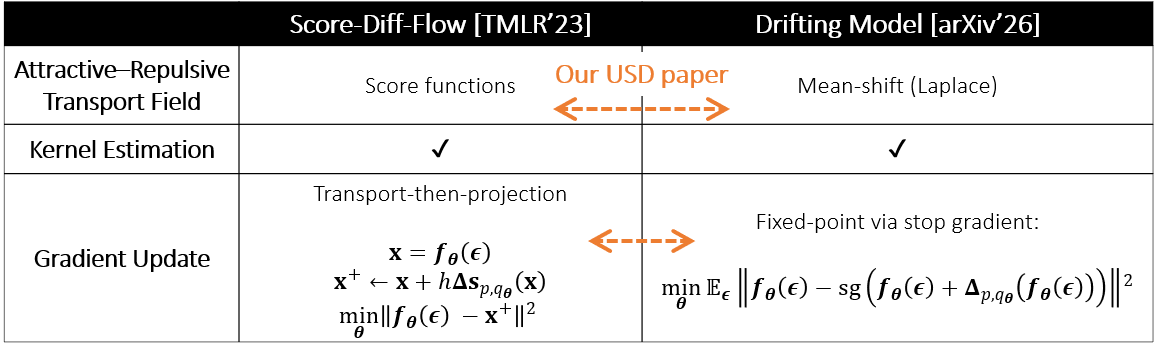
💡 To those interested in drifting models: valuable ideas can sometimes be overlooked in the fast-moving literature. Romann Weber’s Score-Difference Flow (TMLR’23) already contains several important ingredients closely related to drifting models, including kernel-based attractive–repulsive transport and a transport-then-projection training view. We updated Sec. 5.1 of our USD paper, A Unified View of Score-Based and Drifting Models, to make this connection explicit and give proper visibility to this earlier work (see also Score-Diff's Sec. D.2).
Chieh-Hsin (Jesse) Lai tweet media
Chieh-Hsin (Jesse) Lai@JCJesseLai

[1/D] 🤔 What are drifting models really connected to? 📢 Our new paper, A Unified View of Drifting and Score-Based Models, shows that the bridge to score-based models is clear and precise (w/ team and @mittu1204, @StefanoErmon, @MoleiTaoMath)! ✍️ Main takeaway: drifting is more closely connected to score-based (diffusion) modeling than it may first appear! 🔗 arxiv.org/abs/2603.07514 🎯 Here’s why: Drifting’s mean-shift moves a sample toward the kernel-weighted average of nearby samples. Score function points toward regions of higher density. So both describe local directions that push samples toward where data is denser. We show that this link is exact for Gaussian kernels (Section 4.1): 📌drifting’s mean-shift = a rescaled score-matching field between the Gaussian-smoothed data and model distributions — the vector field underlying score matching (Tweedie!). 📌This also clarifies the bridge to Distribution Matching Distillation (DMD): both use score-based transport directions, but only differ in how the score is realized—drifting does so nonparametrically through kernel neighborhoods, whereas DMD relies on a pretrained diffusion teacher. 🤔 So what happens for the default Laplace kernel used in drifting models? Let’s look below 👇

English
2
12
64
6.5K
Soon Hoe Lim
Soon Hoe Lim@Shoelim8·
Ever wondered where a pre-trained flow matching sampler should spend its finite Euler budget? We propose a relatively simple yet effective solution: arxiv.org/abs/2605.11547
English
0
0
2
84
Soon Hoe Lim retweetledi
Amit LeVi
Amit LeVi@AmitLeViAI·
I liked it, so I extended the analysis to NeurIPS, ICLR, and ICML 2025 including acceptance rates for ICLR, accepted papers per capita, and additional analyses. The calculation uses 1/K credit per paper author, where K is the number of authors on the paper.
Amit LeVi tweet media
English
7
5
33
7.5K
Soon Hoe Lim retweetledi
Pushmeet Kohli
Pushmeet Kohli@pushmeet·
The future of Math is mathematicians and AI agents working together. Very pleased to introduce @GoogleDeepMind's AI co-mathematician: a multi-agent system designed to actively collaborate with human experts on open-ended research mathematics. Mathematicians testing the agent across areas as diverse as group theory, Hamiltonian systems, and algebraic combinatorics have reported impressive results. In autonomous mode evaluation on the rigorous FrontierMath Tier 4 problems, AI co-mathematician scored an unprecedented 48% — a new high score among all AI systems evaluated.
Pushmeet Kohli tweet media
English
172
372
2.6K
310.9K
Soon Hoe Lim retweetledi
Statistics (Machine Learning) Papers
Is Flow Matching Just Trajectory Replay for Sequential Data? Soon Hoe Lim, Shizheng Lin, Michael W. Mahoney, N. Benjamin Erichson arxiv.org/abs/2602.08318 [𝚜𝚝𝚊𝚝.𝙼𝙻 𝚌𝚜.𝙻𝙶 𝚗𝚕𝚒𝚗.𝙲𝙳]
Statistics (Machine Learning) Papers tweet media
English
0
2
11
645
Soon Hoe Lim retweetledi
Surya Ganguli
Surya Ganguli@SuryaGanguli·
Tracey Burns and I were recently interviewed by @sarojacoelho at @CBCRadioCanada. We had a fun conversation about AI, brains and education: cbc.ca/listen/live-ra… My take: AI for eduction is a dual-use technology: it has the immense potential to deliver powerful educational experiences at scale across the globe if done correctly, but it also has the capacity to dull the human mind if used incorrectly. The key to powering education with AI is the development of human-AI interfaces that encourage human exploration, provide only targeted hints, automatically generate related challenges, but never just gives the answer. Giving the answer too early is detrimental. Using AI to do directly solve your homework is as pointless as using a robot to lift your weights at the gym. The human struggle is where the growth lies, in both mind and body. To prevent students from using AI to do their homework, the second key, ironically, is that we should evaluate younger students without AI, through closed book in class written exams, especially for fundamental subjects like writing, mathematics and the sciences. Knowing they will be evaluated this way will ensure they can solve problems on their own as they first encounter new concepts. For older students once they have mastered concepts, we can teach them how to use AI to superpower their creativity and productivity with those concepts. We have already been following such a best practice for years: for example when we teach 1st graders arithmetic, we do not immediately hand them a superhuman calculator; we make sure they master it and only years later do they use calculators. In any case, excited about how education can transform for the better with AI, but not all old school approaches should be abandoned. In the age of AI, we should not take away the gift of struggle from the next generation.
English
2
6
23
5.3K
Soon Hoe Lim retweetledi
Edgar Dobriban
Edgar Dobriban@EdgarDobriban·
AI is getting great at math, but how good is it at solving real research problems in areas outside of those covered by Erdős problems? Towards gauging this, I have started putting together a list of unsolved research problems in mathematical statistics and machine learning, sourced from recent papers in a leading statistics journal, the Annals of Statistics (with some bonus COLT open problems: solveall.org. Currently >100 problems. In my view, much of the value of AI for researchers in the mathematical sciences stems from helping with their own research problems. These are problems without known solutions. There are many math benchmarks, but few with the following properties: (1) of a realistic research-level, so that solving them can potentially lead to a publication in a top journal (problems discussed in papers already, not contest math, not Millenium problems, not problems created for a benchmark, not problems that have a known solution); I'd say Erdős problems are the best example of this. (2) cover problems outside of the usual focus (combinatorics, number theory, ... ) of Erdős problems. Especially under-represented are domains of applied math, along with statistics, operations research, etc. I'm interested in statistics and ML, so that's where I started, but this could grow over time. Hope this can grow into something useful to the community! Happy to hear your thoughts...
Edgar Dobriban tweet media
English
32
73
432
55.1K
Soon Hoe Lim retweetledi
Yi Ma
Yi Ma@YiMaTweets·
We invite submissions to the ICML 2026 Workshop “Foundations of Deep Generative Models: Understanding Memorization, Generalization, and Reasoning.” The workshop aims to bring together researchers to advance the theoretical understanding of modern generative models and their behavior. We welcome submissions of recent work in related areas, including both published and unpublished papers. For more details, please visit: fdgm-workshop.github.io/FDGM_ICML2026/.
English
4
14
144
14.7K
Soon Hoe Lim retweetledi
Dwarkesh Patel
Dwarkesh Patel@dwarkesh_sp·
Terence Tao spent a year at the Institute for Advanced Study - no teaching, no random events of committees, just unlimited time to think. But after a few months, he ran out of ideas. Terence thinks that mathematicians and scientists need a certain level of randomness and inefficiency to come up with new ideas.
English
127
600
5.8K
911.8K
Soon Hoe Lim retweetledi
Dan Roy
Dan Roy@roydanroy·
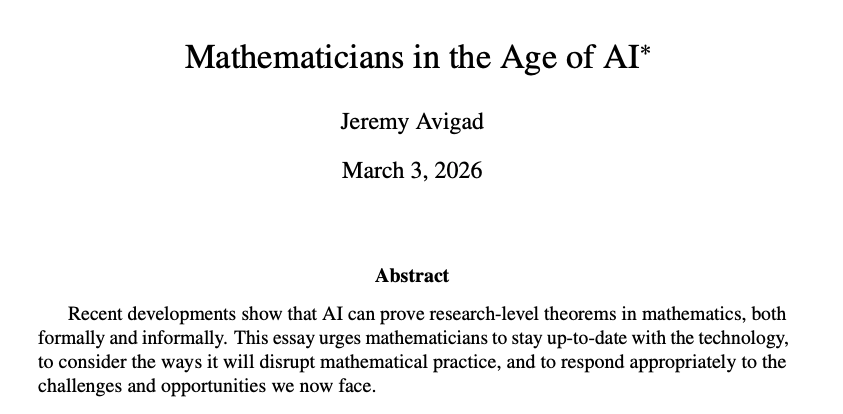
How are mathematicians facing the wave of rapidly advancing AI-for-math capabilities? Jeremy Avigad (CMU prof and co-author on the original 2015 system description paper for Lean) just posted a paper with his thoughts in the wake of the Math, Inc. announcement on sphere packing. andrew.cmu.edu/user/avigad/Pa… There are a lot of interesting passages in here, including a bit of the back story of the Math, Inc. bomb drop and how it was initially received by the humans working on the formalization project. But, as for how mathematics proceeds, here's the key last passage: "We need to remember our strengths: mathematicians are problem solvers and theory builders extraordinaire. Rather than fight the use of AI in mathematics, we should own it. It is not enough to keep up with current events and design benchmarks for AI researchers; we need to play an active role in deploying the technology and molding it to our purposes. We also need to learn how to raise our students with the wisdom to use the new technologies appropriately, and we need to be careful that we still manage to impart core mathematical intuitions and understanding. Figuring out how to use AI effectively to achieve our mathematical goals won’t be easy, but mathematicians have always embraced challenges—indeed, the harder, the better. If we face AI head-on and stay true to our values, mathematics will thrive. We just need to show up and get to work." The next few years should be a golden era for mathematics. For those of us working on the frontier, I hope we do well by our mathematician colleagues.
Dan Roy tweet media
English
23
192
852
108.5K
Soon Hoe Lim retweetledi
Emma Zang 臧熙璐
Emma Zang 臧熙璐@DrEmmaZang·
"Unpopular Academic Advice" #7: With AI and computational tools, the cost of doing research has dropped a lot. What hasn’t dropped is the cost of attention. I used to think: If a question is interesting, I should do it: because if I don’t, probably no one will. That logic made sense when data and methods were scarce. It doesn’t hold anymore. Many projects can now be done by many people. So the binding constraint has shifted. The scarce resource is no longer ideas or tools—it’s taste. For me, research is worth doing only if it meets at least one of these: 1) It meaningfully advances theory or methods, 2) It tackles substantive questions with direct, real policy implications, 3) It reflects a curiosity I care deeply about and enjoy pursuing Everything else may be fine work, but it’s optional. In an era of low research costs, developing good taste about what matters and what doesn’t, is one of the most important academic skills.
English
15
59
477
40.7K