Sibusiso Cele

779 posts

Sibusiso Cele

Sibusiso Cele

@Sibusis99106958

Katılım Haziran 2021
1 Takip Edilen7 Takipçiler
Anele Mdoda
Anele Mdoda@Anele·
🥳🥳🥳🥳🥳🥳🥳🥳🥳🥳🥳🥳🥳🥳🥳🥳🥳🥳🥳🥳🥳🥳🥳🥳🥳🥳🥳🥳 His dad called him doctor cause he wanted him to be a doctor… not too shabby hey Ta Pro Khumalo 😇 🕊️ Celebrating Dr Doctor Khumalo #Aneleandtheclubon947
English
32
198
2.5K
130K
Sibusiso Cele
Sibusiso Cele@Sibusis99106958·
@daddyhope This is above my pay grade #but well said brother well said just hope the leadership of this country takes some notes.
English
0
0
1
119
Hopewell Chin’ono
Hopewell Chin’ono@daddyhope·
You are confusing cause and effect, and in doing so, you are missing the deeper structural reality that is the central point of the argument. Migration in Africa does not happen in a vacuum. People do not wake up and casually decide to leave their homes, families, and countries for no apparent reason. Movement of people across colonial borders is driven by economic collapse, political instability, conflict, and governance failures, yes, but also by powerful historical forces that shaped those very conditions in the first place. Not everyone has the third eye to see those historical forces at play unless they read, comprehend and follow ideas and not populist demagoguery. Apartheid was not just a South African policy that ended in 1994. Its effects still live with South Africans to this very day. It was part of a wider political and more importantly economic system of racial capitalism that structured the region’s economy. What you fixed in 1994 was only the political and not the economic side of it. South Africa was designed as the industrial hub, while neighbouring countries were deliberately underdeveloped and turned into labour reserves for South Africa’s economy. Migrant labour from countries like Zimbabwe, Mozambique, and Lesotho was not an accident at all, it was built into the system. It was designed that way and remains so to this very day. The owners of the means of production then remain the owners of the means of production today. Black people are largely still workers. You have a few token black individuals at the top, but the majority remain little more than exploited labour. So when people move from their countries today, they are often moving along routes that were created decades ago. The inequality between South Africa and its neighbours did not emerge overnight, and it is not simply the result of “African leaders” in isolation of other key factors. It is the continuation of a historical economic design that concentrated wealth in one place and poverty in others. That does not absolve African governments of responsibility. Many have failed their citizens through corruption, mismanagement, and repression. I write about this daily, and I have gone to prison three times in my lifetime for doing so. I have had to leave my country to save my life for doing so. But to reduce a complex, multi-layered issue to “it is African leaders” is intellectually lazy and historically dishonest. It ignores history, economics, and global power dynamics. As for Malema, whether you agree with him or not, his political skill lies in identifying how political and economic narratives are shaped and who benefits from them. He is pointing out that anger is often redirected away from the very systems of inequality and towards vulnerable people, migrants, who did not create those conditions. If you want a serious conversation, then deal with the full picture. Migration is about history, economics, governance, and global inequality. Blaming one factor while ignoring the rest is not analysis at all, it is deceitful propaganda. The economically and intellectually illiterate are often the easiest targets of political propaganda, precisely because they are fed simple, emotionally satisfying explanations for complex structural problems. They are told who to blame for their suffering, migrants, neighbouring countries, or vague notions of “outsiders”, while the real drivers, historical dispossession, entrenched economic inequality, and elite collusion, are deliberately obscured. In Southern Africa, and particularly in South Africa, this manifests in xenophobic narratives that blame Zimbabweans or Mozambicans for unemployment and poverty, when in reality those conditions are rooted in a long standing economic architecture that concentrated wealth and ownership in very few hands. It is easier to turn the poor against the poor than to confront systems that benefit those in power. What is often forgotten in this debate is that the political elites of colonial South Africa and Rhodesia worked in concert to sustain a repressive regional system that enriched a minority while extracting labour and resources from the rest. Your former apartheid Prime Minister John Vorster says it in this video in a very tactful manner. That logic has not disappeared at all, it has merely changed form. Today, segments of the political elite in both South Africa and Zimbabwe continue to operate in ways that protect entrenched economic interests while the majority remain economically marginalised. South Africa was the only true white settler “home”, where wealth, infrastructure, and industry were concentrated, while territories like Southern Rhodesia (Zimbabwe), Northern Rhodesia (Zambia), and Nyasaland (Malawi) functioned largely as economic outposts, feeding capital, labour, and raw materials into that system. The Federation of Rhodesia and Nyasaland was presented as a project of regional integration, but in practice it reinforced patterns of extraction, with mining in Zambia, agriculture in Zimbabwe, and labour flows from Malawi all tied into a broader economic network dominated by South African capital. The same remains to this very day. The tragedy of focusing on Julius as the messenger rather than the message is something I speak about regularly, the need to focus on ideas and not personalities. You do not have to like Julius Malema. You do not have to agree with everything he says. All you need to do is focus on his message and interrogate it critically. I am not enslaved to Julius Malema’s ideas. I pick and choose what I agree with, and I am able to articulate a reasoned argument for both what I support and what I reject. You should do the same. One of the most powerful weapons of colonialism was the deliberate fragmentation of black people into small Bantustans, into isolated villages where communities were conditioned to view the next village with suspicion. In Rhodesia we had “reserves” and “keeps.” People from other Bantustans were treated as outsiders. That mentality was never dismantled, it still exists today. The idea of seeing others with suspicion simply because of an arbitrary line, a colonial border, remains deeply entrenched. Many do not fully appreciate how powerful and enduring that mentality and conditioning is. Yet when you look at the descendants of colonialists, they do not view each other through those same lenses. White Zimbabweans move into South Africa without attracting the same hostility because of the economic architecture that allows them to stay away from the so called lumpen. White people from across the world come and settle with ease in South Africa. In fact, one of the most visible figures advocating for the secession of the Western Cape is a British citizen, yet there is no comparable outrage from black South Africans. The same energy of protests and marches that is directed at fellow Africans is rarely directed there. That is not accidental at all, it is well designed that way. It speaks to the protection afforded by entrenched economic power and privilege, but also to a deeper psychological conditioning in how black people are taught to see each other and to see whiteness. This will not disappear overnight. It may not even disappear in my lifetime. But the task is to keep planting the seeds of awareness and unity. As Bob Marley said, you give your more to get your little. What you do today may seem small, but in time it contributes to something much larger, especially if there is collective effort to confront and resolve these divisions. One of the most important things colonialists understood was that education is the key to discernment, to the ability to interrogate and understand issues such as those I raised in this essay. That is precisely why they restricted access to it. Only a few black people were allowed meaningful education, and the consequences of that exclusion remain with us today, not only in South Africa but across much of the continent. We did not dismantle the systems that underpinned colonialism. We largely inherited them, changed the faces at the top, and continued to operate within the same structures. So I will end by saying this, if anyone truly wants change on the issues being debated, you must fix the foundation. You cannot repair window panes when the foundation itself is cracking. Immigration, whether legal or illegal, will always exist, but it is sustained not by foreigners alone, but by the system itself. When Zimbabweans cross the border without passports, they are often enabled by South Africans within a broken system. When documents are obtained illegally, it is again the system that enables it. When Zimbabwe’s political crisis persists without free and fair elections, regional dynamics, including South Africa’s political and economic interests, often play a role in sustaining that status quo. There is a web of political and economic interests that mirrors, in some respects, the relationships that existed during the colonial and apartheid eras. As long as those interests remain, there is little incentive for those in power to confront injustice decisively. The corruption and governance failures in Zimbabwe are real and significant, but they are part of a broader structural problem. The real issue is the foundation. If black South Africans were living well, with access to quality education, meaningful employment, and economic security, they would not be marching in the streets. The anger you see today is not simply about immigration. It is a reflection of an economic structure that has remained fundamentally unchanged, even after 1994. Repression underpinned by racism in Rhodesia effectively came to an end when South Africa shifted its position and recognised that the system was no longer sustainable. The same principle applies today. Repression underpinned by political corruption in Zimbabwe will begin to end the day South Africa, the regional power whether one accepts it or not, decides that the current situation is no longer acceptable. Zimbabwe’s crisis has, over time, been treated as a largely domestic issue rather than a regional one, yet the political and economic realities of Southern Africa make that distinction artificial. What happens in Zimbabwe does not exist in isolation, it is shaped, sustained, and, at times, enabled by regional dynamics, particularly South Africa’s stance. This may be an uncomfortable truth, but history consistently shows that regional power centres play a decisive role in determining outcomes. Ignoring that reality does not change it, it only delays the moment when it must be confronted. It was convenient then for John Vorster and successive apartheid regimes to continue using illegal migrants as a source of cheap labour in South Africa for menial jobs. It remains the same today. As I have said, the political and economic architecture of the apartheid era largely remains in place. What has changed are the political faces, the white faces that held power then and the black faces that hold office today, often operating within and alongside the same entrenched economic structures. Whether one accepts it or not, that is the reality of our politics in the region and of the economic architecture that continues to shape it. There is a reason why certain political actors avoid critically engaging with the structural drivers of immigration, particularly those that sustain flows of cheap labour. There is also a reason why figures like Helen Zille often emphasise the need to document illegal immigrants in South Africa, that position can be understood within the broader context of preserving an economic order that has long depended on controlling and managing labour rather than fundamentally transforming the conditions that produce it. That economic order is rooted in historical structures of concentrated power that shaped not only South Africa, but the wider region more than a century ago. How black Africans view themselves is often reflected in how they respond to political messages. It is why some are quick to criticise Julius Malema for positions that are, in substance, not fundamentally different from those expressed by Helen Zille. On immigration, there is significant overlap in what has been said across the political spectrum, including by the DA and the EFF. Yet the EFF is frequently viewed through a lens of hostility, in part because it is a black-led party, and that perception shapes the reaction it receives. As a result, some black citizens, influenced by long-standing narratives, direct harsher and more emotive criticism towards it. When similar points are made by figures like Helen Zille, the response is often markedly different. That contrast speaks to deeper historical conditioning and the psychological legacy of colonialism. It has not disappeared, and changing it will take time. The fundamental difference, however, lies in the intent and framing of their messages. Malema’s position on immigration is part of a broader effort to confront and address the structural inequalities created by colonial rule. Zille’s position, by contrast, can be seen as operating within and reinforcing an existing economic framework that has its roots in that same colonial architecture which feeds off cheap migrant labour. However, you can't fix the broken system by chasing away immigrants, legal or illegal, you can only empower black South Africans by allowing them to own the means of production and not fighting in the streets for crumbs. Have a lovely weekend.
Every day is Ashura, Every Land Is Karbala@mzabalazobatho2

@daddyhope It's crazy how apartheid is to blame when the influx of illegal immigrants is caused by African Leaders. What skill does Malema have ?

English
54
47
166
20.5K
Sibusiso Cele
Sibusiso Cele@Sibusis99106958·
@Sentletse I am not condoning this nonsense I am seeing here but i what I see around communities is not sustainable I just want to focus on bo my friends #Everywhere you turn is them#It is a national security risk#They are in every small town,villages and townships across the country .
English
0
0
0
186
Sentletse 🇿🇦🇷🇺🇵🇸🇱🇧
The problem of illegal immigration crisis is not merely a failure of law enforcement, but a damning indictment of widespread institutional corruption and societal hypocrisy. This is how South Africans themselves actively perpetuate illegal immigration: •Border officials at ports of entry routinely accept bribes and turn border posts into lucrative turnstiles for undocumented entrants. •Police officials, who are entrusted with enforcing the law, mirror this venality by pocketing bribes and ignore violations. •Ordinary South Africans lease properties to illegal immigrants and provide safe havens that embed them deeper into communities. •Corrupt Home Affairs officials issue fraudulent documents and effectively grant false legitimacy to those who bypass legal channels. •Home Affairs itself operates without a functional tracking system for visa overstays and allows violations to fester unchecked. •Home Affairs has no robust mechanisms to bar the re-entry for previously deported individuals and renders deportations a hollow exercise. •South African women enter into sham marriages with illegal immigrants in order to facilitate permanent residency through deceit. •A lawless underbelly among South Africans entwines them in criminal enterprises alongside these migrants, from petty hustles to organised syndicates. The marauding mobs of illiterate tribalists rampaging through the streets and harassing foreign nationals, embody the pinnacle of delusion. They must introspect as their own family members are mostly likely also neck-deep in this rot mentioned above. What is needed now is introspection and self-correction, not this nonsensical scapegoating we are seeing. The problem of illegal immigration is a problem created and sustained by Home Affairs, the SAPS and ordinary South Africans themselves.
English
55
148
329
22.1K
Sibusiso Cele
Sibusiso Cele@Sibusis99106958·
@RonaldLamola I am with you Minister but hey Minister it is crazy out here abo my “friends “ are all over I don’t know whether they’re legally or illegally #They have taken over our small towns our villages every where you turn is them they are competing amongst themselves
English
0
0
0
44
Minister: International Relations and Cooperation
We must not lose our sense of humanity when we confront the problems we have as a nation. There is no justification for taking the law into your own hands, our laws must be adhered by citizens and visitors. We do not at all condone illegal immigration we are determined to address this by strengthening the capacity of the law agencies and our legal instruments. And crucially we will continue engaging all the stakeholders including our partners on the continent and beyond about the root causes that lead to some of the immigration challenges we face.
Blanco®@DineoDMufamadi

Yeyyy @RonaldLamola stop calling concerned South Africans who are fed up of being put last while your government puts illegal immigrants first “VIGILANTES”! They are not vigilantes, they are fed up of you as leaders who continue to open doors for the entire Africa. 🤬🤬🤬🤬🤬

English
1.5K
115
386
247.5K
Mboe
Mboe@mboendlov·
Playing with rich kids is messy, now Tobias is stuck alone in jail for the next 3 years.
Chriselda Zozi Lewis (Babes Wendaba)@Chriseldalewis

BREAKING [WATCH] #Mugabe First glimpse of Bellarmine #Mugabe as he is about to leave the Alexandra Regional Court for deportation His lawyers have confirmed to me that the R600 000 fine has been paid. We are awaiting Home Affairs officials to process him. Lawyers also tell me his ticket has been bought and he is going to Zimbabwe. #sabcnews
English
104
604
3.5K
297.7K
Sibusiso Cele
Sibusiso Cele@Sibusis99106958·
@daddyhope This is sad really sad#Every family should have a right to bury their loved ones irrespective of the office they occupied during their lifetime.
English
1
0
0
727
Hopewell Chin’ono
Hopewell Chin’ono@daddyhope·
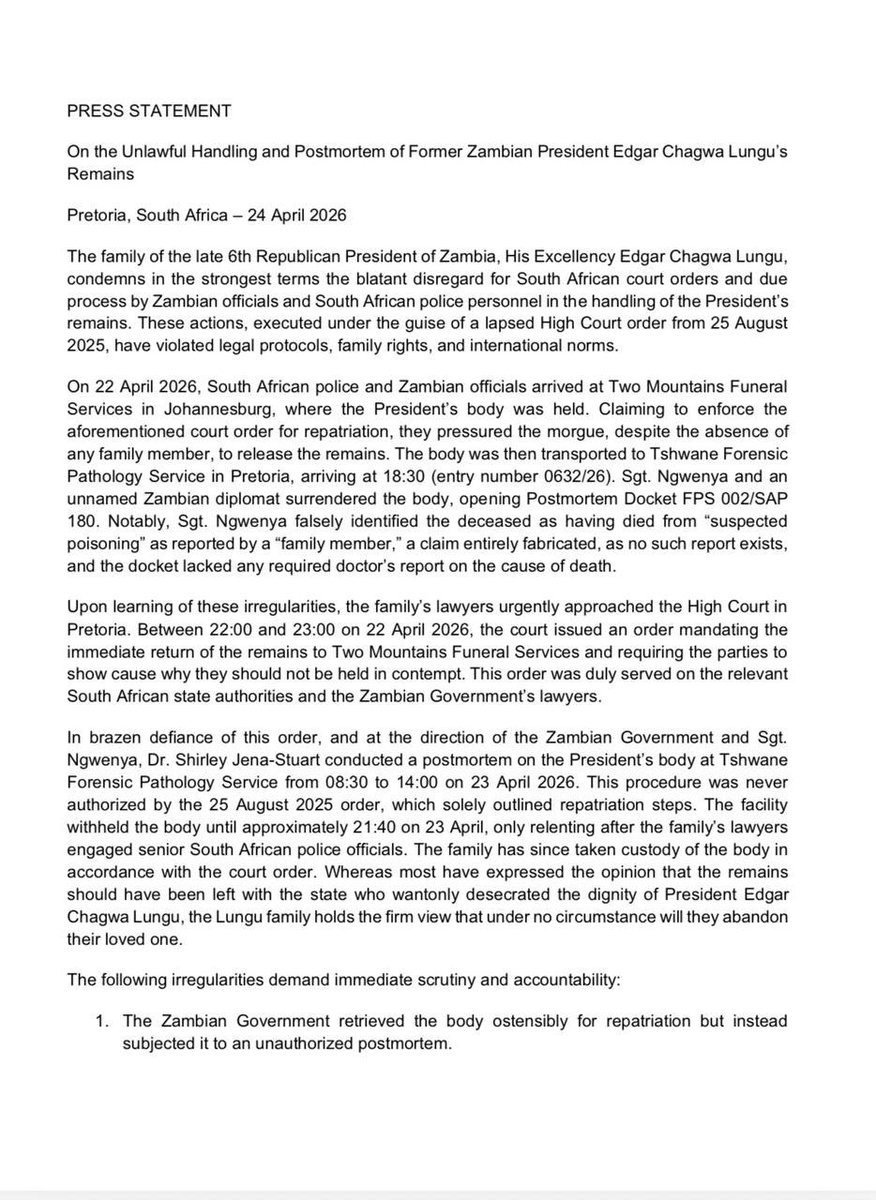
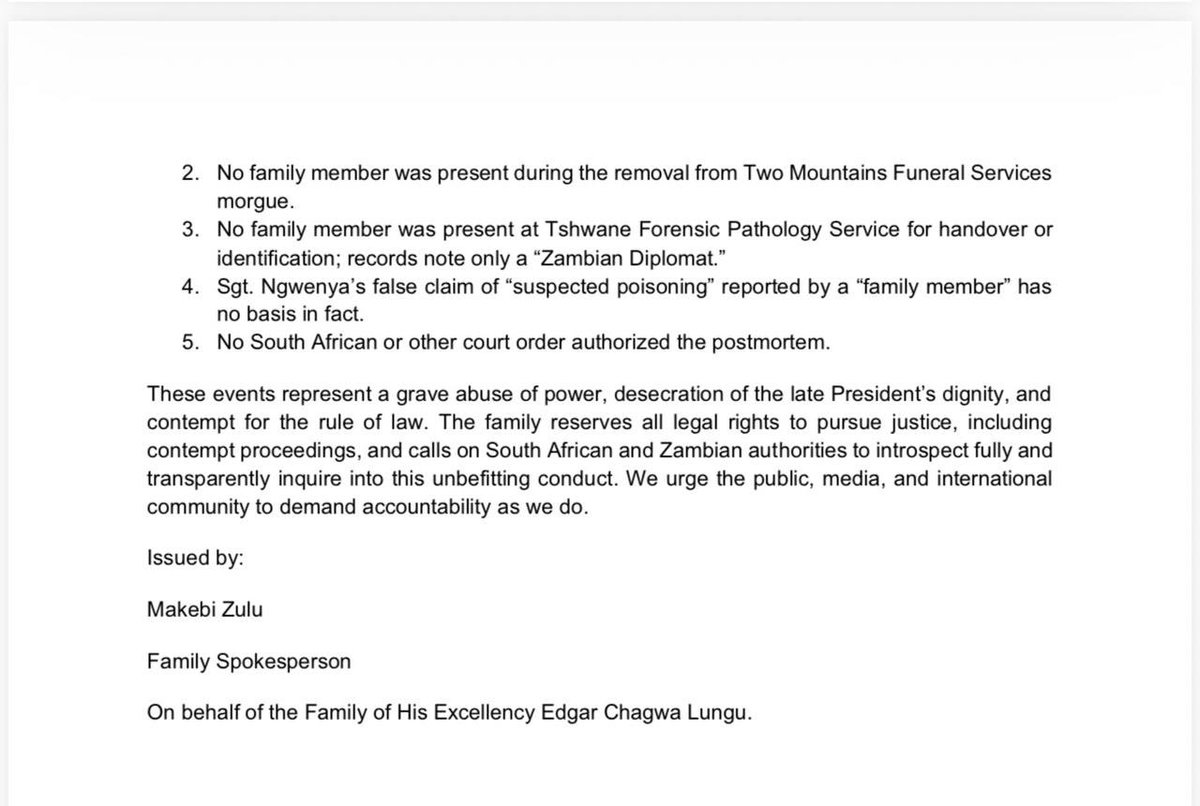
The embarrassing drama surrounding the death and the chaotic contestation for control of former Zambian President Edgar Chagwa Lungu’s remains continues, with yet more disturbing developments emerging from the latest tussle between the Zambian government and the Lungu family. What should have been a solemn, dignified process has instead descended into a deeply troubling spectacle marked by allegations of abuse of power, legal irregularities, and a shocking disregard for both the rule of law and the dignity of the deceased. The Lungu family has issued the statement below through their lawyer. Lungu died in South Africa on 5 June 2025, and nearly ten months later, he has still not been buried. PRESS STATEMENT "On the Unlawful Handling and Postmortem of Former Zambian President Edgar Chagwa Lungu’s Remains Pretoria, South Africa – 24 April 2026 The family of the late 6th Republican President of Zambia, His Excellency Edgar Chagwa Lungu, condemns in the strongest terms the blatant disregard for South African court orders and due process by Zambian officials and South African police personnel in the handling of the President’s remains. These actions, executed under the guise of a lapsed High Court order from 25 August 2025, have violated legal protocols, family rights, and international norms. On 22 April 2026, South African police and Zambian officials arrived at Two Mountains Funeral Services in Johannesburg, where the President’s body was held. Claiming to enforce the aforementioned court order for repatriation, they pressured the morgue, despite the absence of any family member, to release the remains. The body was then transported to Tshwane Forensic Pathology Service in Pretoria, arriving at 18:30 (entry number 0632/26). Sgt. Ngwenya and an unnamed Zambian diplomat surrendered the body, opening Postmortem Docket FPS 002/SAP 180. Notably, Sgt. Ngwenya falsely identified the deceased as having died from “suspected poisoning” as reported by a “family member,” a claim entirely fabricated, as no such report exists, and the docket lacked any required doctor’s report on the cause of death. Upon learning of these irregularities, the family’s lawyers urgently approached the High Court in Pretoria. Between 22:00 and 23:00 on 22 April 2026, the court issued an order mandating the immediate return of the remains to Two Mountains Funeral Services and requiring the parties to show cause why they should not be held in contempt. This order was duly served on the relevant South African state authorities and the Zambian Government’s lawyers. In brazen defiance of this order, and at the direction of the Zambian Government and Sgt. Ngwenya, Dr. Shirley Jena-Stuart conducted a postmortem on the President’s body at Tshwane Forensic Pathology Service from 08:30 to 14:00 on 23 April 2026. This procedure was never authorized by the 25 August 2025 order, which solely outlined repatriation steps. The facility withheld the body until approximately 21:40 on 23 April, only relenting after the family’s lawyers engaged senior South African police officials. The family has since taken custody of the body in accordance with the court order. Whereas most have expressed the opinion that the remains should have been left with the state who wantonly desecrated the dignity of President Edgar Chagwa Lungu, the Lungu family holds the firm view that under no circumstance will they abandon their loved one. The following irregularities demand immediate scrutiny and accountability: 1. The Zambian Government retrieved the body ostensibly for repatriation but instead subjected it to an unauthorized postmortem. 2. No family member was present during the removal from Two Mountains Funeral Services morgue. 3. No family member was present at Tshwane Forensic Pathology Service for handover or identification; records note only a “Zambian Diplomat.” 4. Sgt. Ngwenya’s false claim of “suspected poisoning” reported by a “family member” has no basis in fact. 5. No South African or other court order authorized the postmortem. These events represent a grave abuse of power, desecration of the late President’s dignity, and contempt for the rule of law. The family reserves all legal rights to pursue justice, including contempt proceedings, and calls on South African and Zambian authorities to introspect fully and transparently inquire into this unbefitting conduct. We urge the public, media, and international community to demand accountability as we do. Issued by: Makebi Zulu Family Spokesperson On behalf of the Family of His Excellency Edgar Chagwa Lungu."
Hopewell Chin’ono tweet mediaHopewell Chin’ono tweet media
English
39
21
91
32.9K
ANC SECRETARY GENERAL | Fikile Mbalula
[WATCH] We are not in Alliance with any party in the GNU, they all serve there in their own right. That is why you need to understand that the Government of National Unity (GNU) is not a melting pot of political parties. Parties maintain their own identities. We will also work with the SACP beyond the upcoming election. #ThePeoplesMovement
English
20
8
33
14.9K
Sibusiso Cele
Sibusiso Cele@Sibusis99106958·
@zilevandamme Mina not DA ngamane ngife okungcono#Anyone who is sensitive kulo ku hlupheka okungaka esibhekene nakho has my vote.
Filipino
0
0
0
19
Phumzile Van Damme
Phumzile Van Damme@zilevandamme·
Sooooooo Who are you voting for, guys? Sorry if I have ruined your day with this question, but you've gotta start thinking and deciding. 😝
English
136
13
103
17.1K
Sibusiso Cele
Sibusiso Cele@Sibusis99106958·
@KhuselaS Uyangxaka u Mapaila #ANC has been very patient with this brother #We are handing him back his SACP and u U brother comrade ngath akayifuni#Ufunani kanti?
Filipino
0
0
0
198
Khusela Diko🇿🇦
Khusela Diko🇿🇦@KhuselaS·
I am so surprised by this response. ANC has not asked anyone to resign. The NEC has invoked rule 25.17.14 of the ANC constitution which affirms as an act of misconduct to canvass for any other candidate other than that endorsed by the ANC. Obviously should members not wish to declare who they will be canvassing for, it will be assumed they will be acting in alignment with the ANC constitution. Should they be found to be engaged in activities which go against the letter and spirit of the above constitutional principle then the prescribed consequences on dealing with misconduct will follow.
Kaya News@KayaNews

"No Comrade shall submit to ultimatums" - SACP Secretary-General Solly Mapaila urges members to remain calm and refrain from submitting resignations, following the ANC's ultimatum. The ANC has given dual members ten days to declare which group they will support in the upcoming election. KJ #KayaNews


English
75
31
106
48.2K
Mbuyiseni Ndlozi
Mbuyiseni Ndlozi@MbuyiseniNdlozi·
This country & society benefits NOTHING with Malema in prison. NOTHING! Not on those charges! His voice is crucial right inside Parliament. We can’t give way to liberal right-wing forces to dominate. AfriForum must NOT WIN! Ngxa!
English
2.4K
5.6K
24.9K
909.4K
Sixolise Gcilishe
Sixolise Gcilishe@SixoGcilishe·
Our SG @DlaminiMarshall says the gun was released and the person who supposedly gave President a gun was acquitted. He also says President subjected himself to this process for 8 years, no person who thinks is above the law does that. #HandsOffJuliusMalema
English
68
246
896
41.5K
Sibusiso Cele
Sibusiso Cele@Sibusis99106958·
@MbuyiseniNdlozi Ngabe ngizwa kahle Dokotela ay a politician will always remain a politician😂😂😂😂😂#The CONCOURT must do ini?#is it an instruction or an opinion lol
English
0
0
0
54
Mbuyiseni Ndlozi
Mbuyiseni Ndlozi@MbuyiseniNdlozi·
On Phala-Phala: it is irrational for parliament to establish an independent panel to determine if the president has a case to answer. When this panel says he does have a case, then they subject the same decision to a vote. It cannot be a matter of vote as to whether someone has a case to answer or not! It is simply a matter based on facts and evidence! Which an independent panel of experts has long established! The ConCourt MUST rule in favour of the EFF. Ramaphosa must go in front of an impeachment committee, face interrogation on all the Phala-Phala matters. After his answers, this committee can write a report with recommendations. And only then can an impeachment vote take place. Simple!
English
154
551
2K
85.5K
Sibusiso Cele
Sibusiso Cele@Sibusis99106958·
@MbuyiseniNdlozi It looks like a public servant will never win against the politicians.The politicians run the show.It looks like politics will win maybe it’s like this in the whole world.
English
0
0
0
12
Mbuyiseni Ndlozi
Mbuyiseni Ndlozi@MbuyiseniNdlozi·
APPOINT GEN. NHLANHLA MKHWANAZI AS ACTING NATIONAL POLICE COMMISSIONER NOW! Masemola is not being accused of CORRUPTION! IDAC is dragging him to court over PFMA violation. The objective is to have Ramaphosa remove him. Once removed, the hope is that Khumalo & Mkhwanazi will be exposed. No one protecting their work anymore. This was always the Original mission with Mchunu’s illigal disbandment of the PKTT: To render criminal investigations of organised gangs and their collaborators in the high echelons of SAPS. Ramaphosa has a duty to defend the credibility of the criminal justice system! What should he do: 1. Suspend Masemola 2. Suspend the head of IDAC 3. PUT NHLANHLA MKHWANAZI AS ACTING NATIONAL POLICE COMMISSIONER NOW! The criminals MUST NOT WIN!
English
809
4.3K
14.8K
439.6K