Sillitoe Lab

423 posts

Sillitoe Lab banner
Sillitoe Lab

Sillitoe Lab

@SillitoeLab

We have moved on from X. Find us @cerebellumcenter.bsky.social

Houston, TX Katılım Ağustos 2019
883 Takip Edilen801 Takipçiler
Sillitoe Lab
Sillitoe Lab@SillitoeLab·
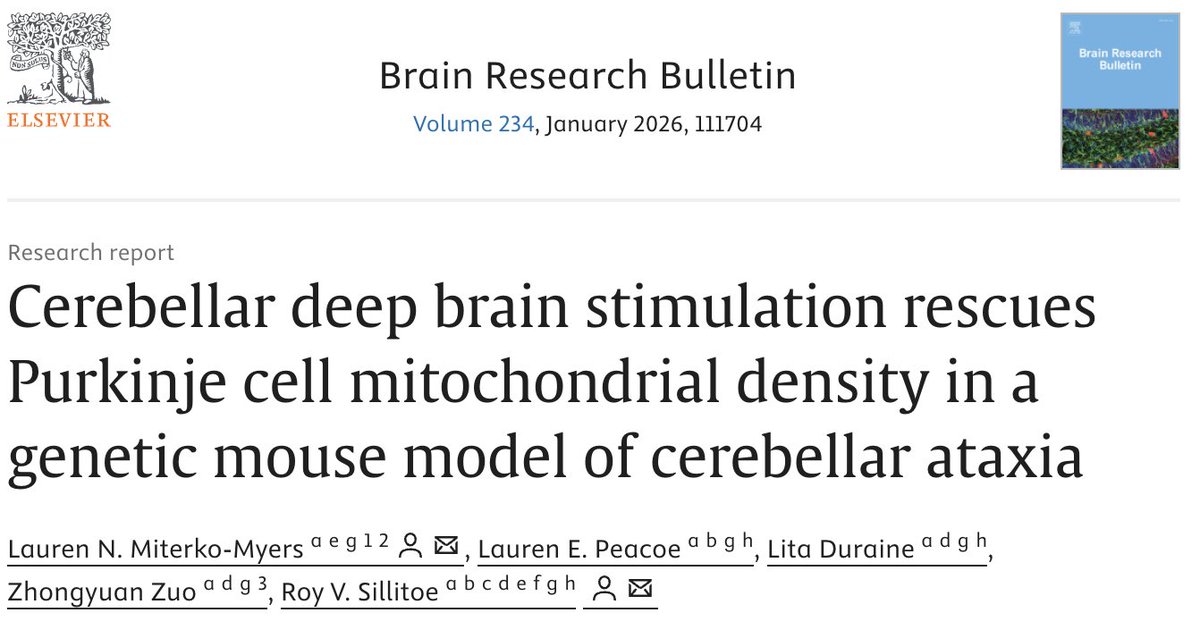
Our group has spent the last 15 years developing a surgical therapeutic approach called Cerebellar Deep Brain Stimulation. Here, we showed that the approach may restore brain circuit function and movement by modulating the sub-cellular structure of organelles.
Sillitoe Lab tweet media
English
0
2
10
534
Sillitoe Lab retweetledi
Michael Pacold
Michael Pacold@MichaelPacold·
Just published: nature.com/articles/s4158… Coenzyme Q10 (CoQ10) is critical for mitochondrial function and for controlling reactive oxygen species damage to biological membranes. Because CoQ10 is poorly bioavailable, new approaches are needed to promote CoQ10 synthesis. In our latest paper @Nature, we use CoQ10 headgroup intermediates to restore CoQ10 synthesis in mouse models of HPDL encephalopathy, a rare pediatric neurodevelopmental disease driven by loss of CoQ10 headgroup synthesis. We also use CoQ10 headgroup intermediates to modify the course of this same disease in a patient. Primary CoQ10 deficiencies are rare mitochondrial disorders caused by loss of function of the enzymes that make CoQ10. The neurological symptoms of these diseases respond poorly to CoQ10, likely due to poor bioavailability of this molecule. The newest primary CoQ10 deficiency is HPDL encephalopathy, which is due to loss-of-function variants in the enzyme 4-hydroxyphenylpyruvate dioxygenase-like (HPDL). A few years ago, we discovered that HPDL carries out the first committed step of the mammalian CoQ10 headgroup synthesis pathway, in a study led by Robert Banh @BanhLab: nature.com/articles/s4158… We found that the enzyme HPDL makes 4-hydroxymandelate (4-HMA), the first committed precursor of 4-hydroxybenzoate (4-HB), which generates the CoQ10 headgroup. Patients with HPDL encephalopathy develop spastic paresis, and in severe cases, seizures, neurodevelopmental delay, and death. Mice lacking Hpdl recapitulate these symptoms and die by 15 days after birth. We find that treatment of Hpdl-/- mice with 4-HMA or 4-HB significantly improves the survival of mice from days to years. We treated a single patient with loss-of-function HPDL variants with 4-HB, with dramatic improvement in his symptoms. Thanks to co-authors including Robert Banh @BanhLab and Sota Kuno @kuno_sota, editors George Caputa @curiousdrgeorge and Victoria Aranda @mvicaracal, and reviewers including @RutterLab and everyone at @NYULangone @nyugrossman who made this work possible! Many thanks to our collaborators, Roy Sillitoe @BCMHouston / @TexasChildrens and Alex Joyner @MSKCancerCenter. Grateful for funding from @DamonRunyon @PershingSqFdn @psscra @MindPrize @AmericanCancer @HarringtonDI_UH @OHRareDisease @NIH.
English
19
32
133
16.1K
Sillitoe Lab retweetledi
Imaging Neuroscience
Imaging Neuroscience@ImagingNeurosci·
New paper in Imaging Neuroscience by Leana King, Kevin S. Weiner, et al: Transcriptomic gradients of the human cerebellum doi.org/10.1162/imag_a…
Imaging Neuroscience tweet media
English
1
22
56
4.3K
Sillitoe Lab retweetledi
Danny Huang, MD
Danny Huang, MD@YuhaoHuangMD·
The cerebellum, often underestimated in its role, is crucial for driving neuroplasticity. Groundbreaking @NatureMedicine study showed that deep brain stimulation targeting the cerebellum dramatically improved motor functions in stroke patients, even three years post-stroke.
Danny Huang, MD tweet media
English
7
207
874
45K
Sillitoe Lab retweetledi
Tina Termini
Tina Termini@CterminiPhD·
Ever joined a new lab and felt that not knowing where/what stuff is was holding your research back? Yeah, same. Kudos to Kage & Taylor from our lab for a beautiful piece in @TrendsBiochem highlighting how lab inventory systems support independence. doi.org/10.1016/j.tibs…
Tina Termini tweet media
English
4
49
248
21.6K
Sillitoe Lab retweetledi
UC San Francisco
UC San Francisco@UCSF·
UCSF’s @KriegsteinLab @LiWang_neuro took a closer look at gene expression in the growing human brain and found sets of genes that could help explain autism and even adult brain cancer – revealing new possibilities for future therapies. tiny.ucsf.edu/8EHYHf
English
1
3
12
1.5K
Sillitoe Lab retweetledi
David
David@dav1dcg·
Understanding GABAergic synapse diversity and its implications for GABAergic pharmacotherapy: doi.org/10.1016/j.tins… Review on the diversity of GABAergic synapse organizer proteins
David tweet media
English
0
49
175
13.3K
Sillitoe Lab retweetledi
BCM Department of Neuroscience
BCM Department of Neuroscience@bcm_neurosci·
Congratulations to Dr. Huda Zoghbi on being invested as a member of the American Academy of Sciences and Letters. The Academy promotes learning and honors outstanding scholarly excellence and intellectual courage in the humanities, social sciences, and natural sciences.
BCM Department of Neuroscience tweet media
English
0
7
44
2.4K
Sillitoe Lab retweetledi
Hanieh Falahati هانيه فلاحتى
Our paper is out in time for #EM_Monday! It is about a specialized neuron-specific ER, the spine apparatus, that is close to synapses and has a peculiar shape. If you think neurons are special, the spine apparatus is their🦄horn! But how does it form?!(1/9)doi.org/10.1016/j.cub.…
GIF
English
9
34
150
14.5K