
Singing Data retweetledi
Singing Data
8.7K posts

Singing Data
@SingingData
Reno Seattle On b*sky @pattyryan On Discord @singingdata
Reno, NV Katılım Temmuz 2014
1.6K Takip Edilen739 Takipçiler



Singing Data retweetledi
This is amazing.
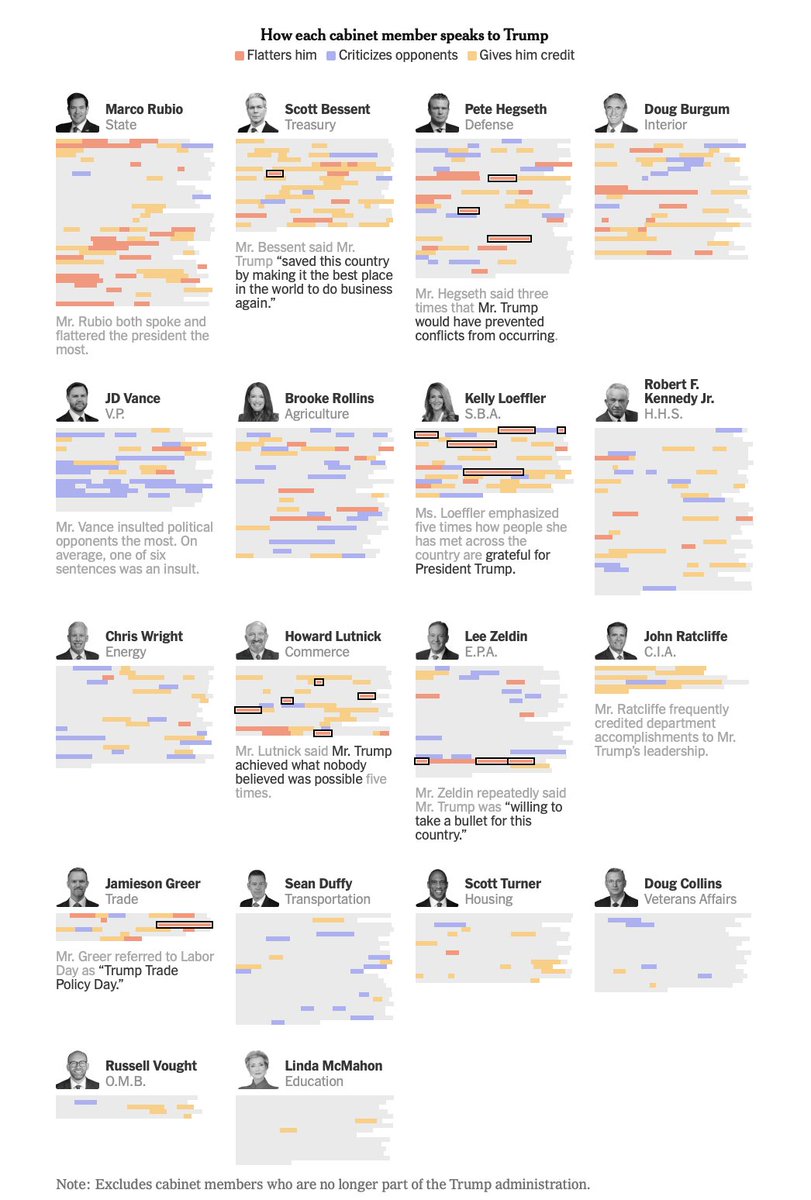
The New York Times put together a graphic of how much time cabinet members spend kissing up to Trump in meetings.
"On average, at least one of every six sentences either flattered Mr. Trump, gave him credit or criticized his political opponents."
North Korea.
English
Singing Data retweetledi

Singing Data retweetledi

AI-Enhanced LiDAR. Left vs right.
A real LiDAR device costs thousands of dollars. What's in your iPhone Pro is a "baby LiDAR". Limited depth resolution, noisy output, not really built for high-precision 3D.
You can't change the hardware. So we built an ML layer on top. Denoising, geometry completion, detail recovery. Processed server-side. Same sensor. Very different result.
English
Singing Data retweetledi

Nvidia's PID (Pixel diffusion Decoder)
It decodes latent representations into high-resolution images, replacing the decode–then–super-resolve cascade while achieving lower latency and higher visual quality
page:
research.nvidia.com/labs/sil/proje…
HF repo:
huggingface.co/nvidia/PiD
English
Singing Data retweetledi
New paper from Microsoft on Self-Evolving Agent Skills
elvis@omarsar0
New research from Microsoft Research I see a lot of AI engineers handwriting agent skill docs and hope they generalize. Probably not optimal. This works show why. It treats the skill doc as a trainable external state of a frozen agent instead. It introduces SkillOpt, where an optimizer model makes validation-gated edits to the skill file. It adds, deletes, or replaces instructions, with a textual learning rate that controls how aggressively each round rewrites the doc. The agent itself never changes. SkillOpt is best or tied on all 52 (model, benchmark, harness) cells. On GPT-5.5 it adds 23.5 points in direct chat, 24.8 with Codex, and 19.1 with Claude Code over no skill. It beats human-written skills, TextGrad, GEPA, and EvoSkill, carries zero extra inference-time cost, and the learned skills transfer across models and harnesses. Paper: arxiv.org/abs/2605.23904 Learn to build effective AI agents in our academy: academy.dair.ai
English
Singing Data retweetledi

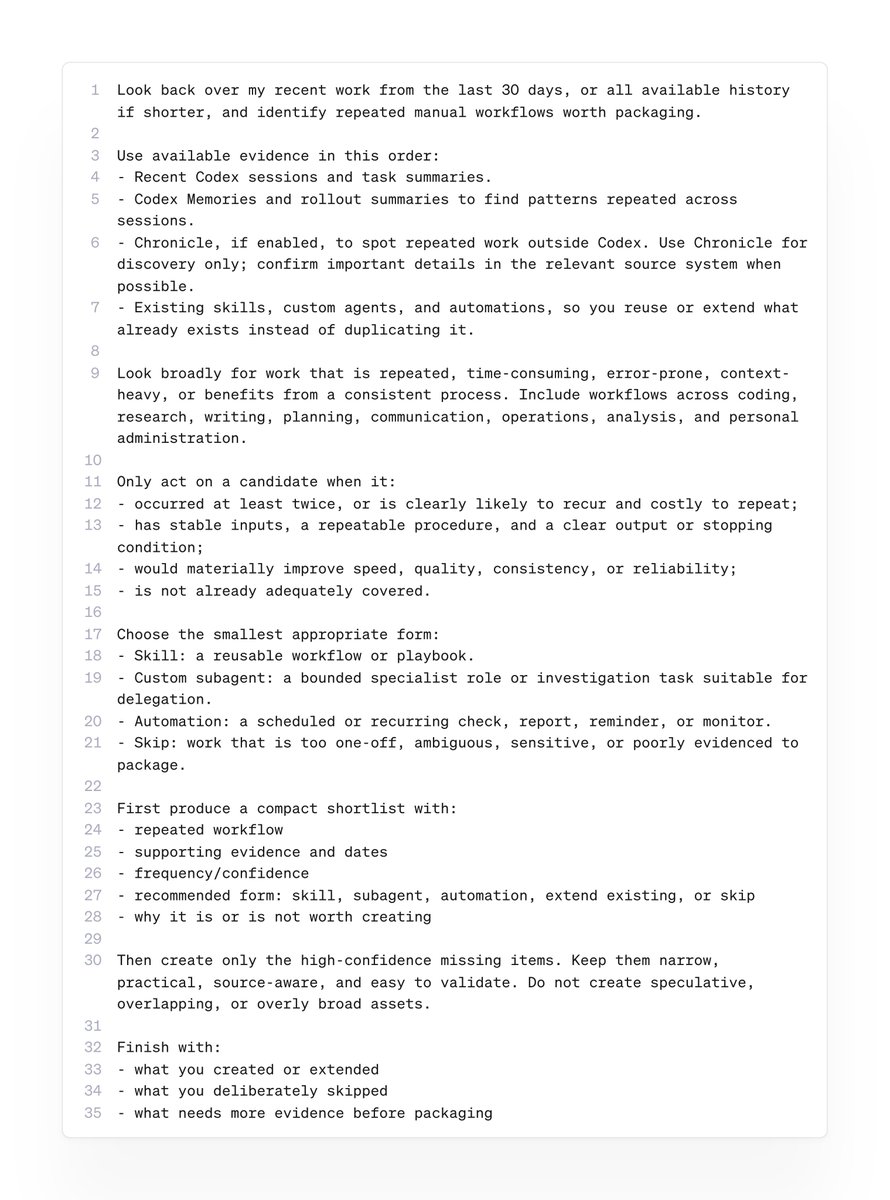
UPDATE: Came up with an even better version of this prompt after the feedback
Ask Codex to look across your sessions, Memories, and Chronicle, identify patterns, reuse what already exists, and only create the smallest useful skill, subagent, or automation.
"Look back over my recent work from the last 30 days, or all available history if shorter, and identify repeated manual workflows worth packaging.
Use available evidence in this order:
- Recent Codex sessions and task summaries.
- Codex Memories and rollout summaries to find patterns repeated across sessions.
- Chronicle, if enabled, to spot repeated work outside Codex. Use Chronicle for discovery only; confirm important details in the relevant source system when possible.
- Existing skills, custom agents, and automations, so you reuse or extend what already exists instead of duplicating it.
Look broadly for work that is repeated, time-consuming, error-prone, context-heavy, or benefits from a consistent process. Include workflows across coding, research, writing, planning, communication, operations, analysis, and personal administration.
Only act on a candidate when it:
- occurred at least twice, or is clearly likely to recur and costly to repeat;
- has stable inputs, a repeatable procedure, and a clear output or stopping condition;
- would materially improve speed, quality, consistency, or reliability;
- is not already adequately covered.
Choose the smallest appropriate form:
- Skill: a reusable workflow or playbook.
- Custom subagent: a bounded specialist role or investigation task suitable for delegation.
- Automation: a scheduled or recurring check, report, reminder, or monitor.
- Skip: work that is too one-off, ambiguous, sensitive, or poorly evidenced to package.
First produce a compact shortlist with:
- repeated workflow
- supporting evidence and dates
- frequency/confidence
- recommended form: skill, subagent, automation, extend existing, or skip
- why it is or is not worth creating
Then create only the high-confidence missing items. Keep them narrow, practical, source-aware, and easy to validate. Do not create speculative, overlapping, or overly broad assets.
Finish with:
- what you created or extended
- what you deliberately skipped
- what needs more evidence before packaging"
Vaibhav (VB) Srivastav@reach_vb
Copy and paste this into your codex: “Look through my recent Codex sessions and identify repeated workflows or repeated asks. For anything I keep doing manually, suggest: 1. a skill if it is a reusable workflow 2. a custom subagent if it is a bounded role or investigation task Focus on practical things like CI failures, PR reviews, changelogs, docs updates, release prep, debugging, and test triage. Create the useful ones only. Keep them simple.”
English
Singing Data retweetledi

Everyone COPY this video, share it far and wide. Paramount Skydance billionaire baby David Ellison can’t handle that Stephen Colbert is getting millions of views . @Youtube we will cancel our subscription as we did when we dumped @paramountplus.
English
Singing Data retweetledi


Singing Data retweetledi

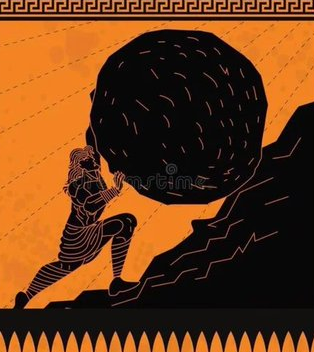
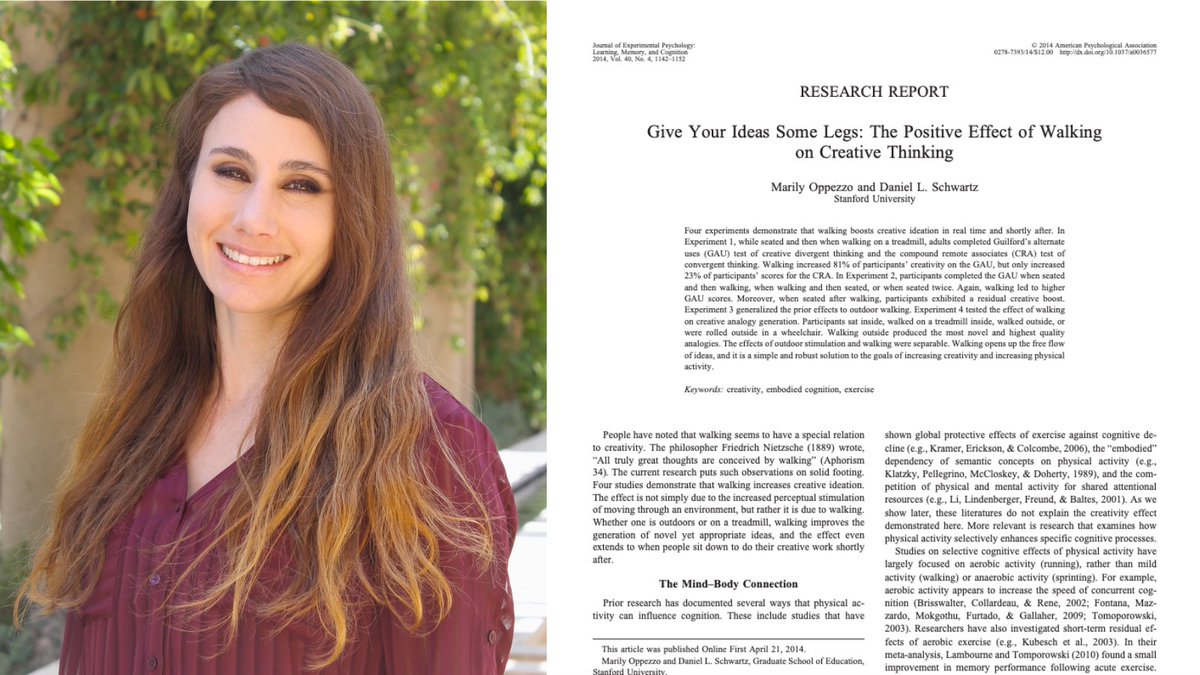
A Stanford psychologist spent 4 years proving that the simple act of walking generates 60% more creative ideas than sitting, and the experiment she designed to kill every alternative explanation is one of the most decisive findings in modern psychology.
Her name is Marily Oppezzo.
She got the idea for the study while walking with her advisor at Stanford to discuss her thesis topic, and the paper she eventually published in the Journal of Experimental Psychology in 2014 is sharp enough that it should have ended the seated meeting on the day it came out.
She ran 4 experiments on 176 people. Same person tested twice. Once sitting, once walking. The creativity tasks were the standard ones psychologists have used for decades to measure how good a brain is at generating novel useful ideas.
The result was almost too clean to publish.
81% of participants in the first experiment produced more creative ideas while walking than while sitting. In the second experiment, 88%. In the third, 100%. Every single person walked into a more creative version of themselves.
On average, people generated 60% more novel useful ideas the moment their legs started moving.
The skeptical question is the obvious one. Maybe it was the fresh air. Maybe it was the scenery passing by. Maybe it was the change of environment doing the work, not the walking itself.
Oppezzo killed every one of those explanations with one experimental decision.
She put people on a treadmill facing a blank wall. No scenery. No fresh air. No environmental change. Just legs moving in place while staring at white drywall. The 60% boost held.
Then she ran the experiment that closed the case completely. She took participants outside in two conditions. Half of them walked through a Stanford courtyard. The other half were pushed through the exact same courtyard in a wheelchair. Same outdoor stimulation. Same scenery passing at the same speed. The only difference was whether the legs were moving.
The walkers produced dramatically more novel high-quality ideas than the wheelchair group. The outdoors did almost nothing on its own. The walking did everything.
This is the part of the study that hit hardest when I read it the first time.
She also tested the opposite kind of thinking. Convergent thinking. The kind where there is one right answer and you have to narrow down to it.
Word puzzles where 3 words share a hidden fourth word that connects them. The seated participants did slightly better on these. Walkers got slightly worse.
Walking is not a general intelligence enhancer. It does one specific thing. It opens up the divergent search inside your brain. The part that generates options. The part that produces unexpected connections. The part that takes a problem and finds five ways into it instead of one.
When you need to converge on the single right answer, sit down. When you need to find the answer in the first place, get up.
The mechanism is now well understood. Walking selectively activates what neuroscientists call the default mode network, the system inside your brain that runs when you are not consciously focused on anything. The DMN is where mind-wandering happens. Where memories cross-reference each other. Where ideas that have been sitting in separate folders inside your head finally bump into each other.
When you sit at a desk and force yourself to concentrate, you suppress the DMN. When you walk at a natural pace, the executive part of your brain gets just busy enough handling the walking that the DMN comes online and starts doing the work that focus was blocking.
The most useful finding in the entire paper is the one almost nobody quotes.
The boost did not turn off the moment people stopped walking. Participants who walked first and then sat back down stayed elevated. Their next round of seated creativity work was still significantly better than people who had been sitting the whole time. The rest lingered for at least several minutes after the legs stopped moving.
You do not need to do creative work while walking. You need to walk before the creative work. The brain holds the state.
The history of this is the part that should haunt anyone who still does meetings in chairs.
Charles Darwin built a gravel loop behind his house in Kent called the Sandwalk and walked it 3 times a day for the rest of his life. The theory of evolution was developed one lap at a time on that path.
Nietzsche walked up to 10 hours a day during the years he wrote his most important books and openly said the work was conceived on his feet.
Beethoven composed for the morning and walked for 5 hours every afternoon with a pencil in his pocket for when something landed.
Kahneman said the best thinking of his Nobel Prize-winning career happened on leisurely walks with Amos Tversky. Steve Jobs refused to take important conversations sitting down. He held them on foot.
Every one of them was using the system Oppezzo would not measure until 2014. They just did not know what to call it.
The question worth sitting with is the one almost nobody asks.
Every meeting you have ever attended sitting around a table was a meeting held at a fraction of the brain power that was actually available to the people in the room. Every brainstorm that got stuck inside a conference room. Every problem you tried to solve at a desk and gave up on. Every idea you could not quite get to.
The intervention is the easiest one in modern science. No supplement. No app. No subscription. No training program. Just a pair of legs and 15 minutes.
The Stanford lab proved it. The philosophers knew it. The neuroscience explains it.
And almost everyone reading this is still trying to think their way out of problems sitting completely still.
English
Singing Data retweetledi

The future of agriculture lies in optimization. A system like this costs very little: a drone with a camera and a computer vision system accurate enough to count and identify plants or diseases.
It's so easy that anyone can make it at home for their own crops.
English
Singing Data retweetledi

Maybe CBS did him a favor bc some of these public access show clips are funnier than anything else I’ve watched recently
English
Singing Data retweetledi

Folks: when you write skills, ask your agent to be token efficient, relax grammer. I see too many skills that write books in the skill description, and all that crap is loaded into every context.
I wrote a skill that finds the worst offenders. github.com/steipete/agent…
English
Singing Data retweetledi

Levie’s Law of AI Psychosis:
The farther away you are from the actual work the more confident you are that humans are no longer needed
I like it
Aaron Levie@levie
CEOs are uniquely prone to AI psychosis because they’re sufficiently distant from the last mile of work that still has to happen to generate most value with AI. So when they play with AI, they see the happy path results, often not considering the next 10 or 20 things that have to happen to get sustainable results from agents. “Look I made this awesome product prototype”. Yes but you didn’t have to review the code before it went into production and fix a bunch of issues. “Look I generated a contract”. Yes but you didn’t verify all the terms before it goes out to the counterparty and didn’t have to wire up all the past contracts to work with. The best thing you can do as a CEO is to use AI a *ton* to figure out the real implications of agents in the enterprise, and come out the other side with an appreciation for both the upside and the real work that goes into them.
English
Singing Data retweetledi


Singing Data retweetledi
The Top AI Papers of the Week (May 18 - 24):
- AIRA
- MetaCogAgent
- Memory as a Model
- Code as Agent Harness
- Weak-Model Critic-Comparator
- OpenAI Disproves the Unit Distance Conjecture
- Production Agent Architecture Methodology
Read on for more:
DAIR.AI@dair_ai
English
Singing Data retweetledi

I really enjoyed this book about the history, politics and future of microchip tech.
Kosta Derpanis (sabbatical in Zurich)@CSProfKGD
Saturday morning reading.
Vaughan, Ontario 🇨🇦 English
Singing Data retweetledi
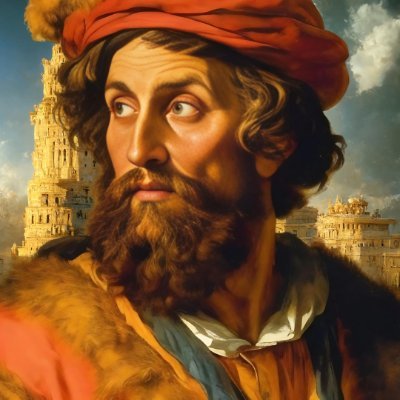
There was a 40 year period in history when samurai, pirates, and cowboys all technically existed at the same time.
Today in History@TodayinHistory
What is your favorite historical fact?
English
Singing Data retweetledi
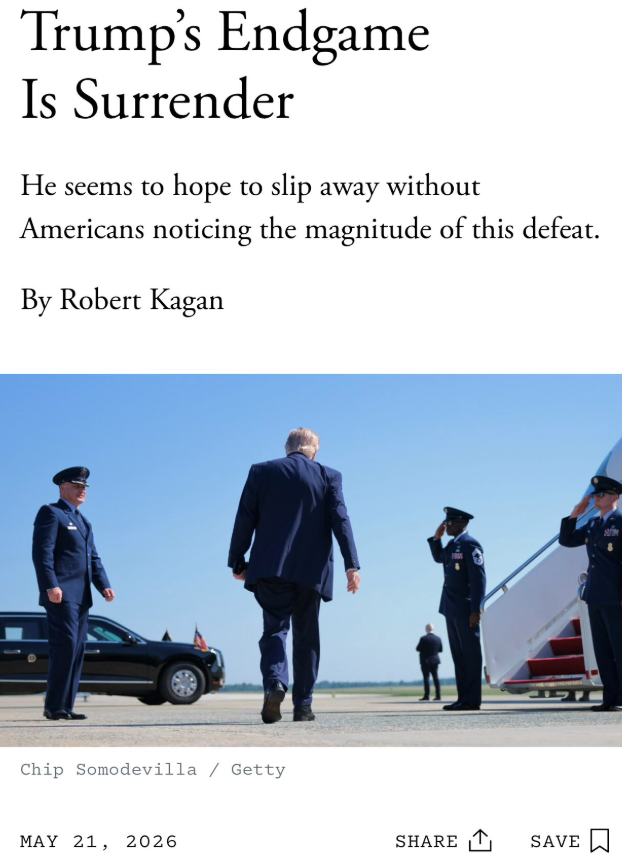
Shaping up to be the biggest and most embarrassing geopolitical defeat in U.S. history. By a large margin.
English
Singing Data retweetledi

Microsoft finally releases the full weights for the Lens T2I 3.8B models (Lens/Turbo/Base).
- uses FLUX.2 VAE + GPT-OSS
- 1440x1440
- 4-step gen with Turbo
Looks pretty interesting
huggingface.co/microsoft/Lens


English