Slowburnt

461 posts

Slowburnt

Slowburnt

@Slowburnt2

Katılım Aralık 2019
13 Takip Edilen2 Takipçiler
Slowburnt
Slowburnt@Slowburnt2·
@PowersDecoded @LexDiamonds__ I said: "No data supports that the more 'feminine' a boy appears, the more stupid and unruly he's treated - its the opposite." By the "the opposite," I meant that the more MASCULINE a boy appears, the more stupid and unruly treated.
English
1
1
1
48
Powers Decoded | Systems • Class • Truth
@Slowburnt2 @LexDiamonds__ Again, goalpost moving. Your claim started as femininity reduces penalties or signals less disruption. You’ve now shifted to masculinity increases scrutiny. That’s not the same argument, and it doesn’t contradict the mechanism I described:
English
3
0
0
18
Lex
Lex@LexDiamonds__·
It’s really a simple truth but y’all not gonna like it. Gay men don’t have children or build families, letting them in your ranks opposes no threat to this system. Those men are already considered emasculated so they’re not seen as out group males.
Zion 🇸🇩@afroanalytic

The “antiblack misandry” thesis collapses the moment you introduce sexuality. Black gay boys outperform straight Black boys despite greater marginalization, which means the mechanism is not hostility to boys—it’s something else entirely. The recent research on sexuality, race & educational outcomes completely shatters this thesis. Black gay high school boys outperform straight black boys while experiencing worse discrimination & mental health challenges in school than straight boys.  Antiblack misandry can’t explain this because the theory would have to incorporate heteronormativity/masculinity norms, not just “misandry.” Gay boys outperform straight boys & often close gender gaps. In some cases, gay boys match or even EXCEED the educational outcomes of straight girls, despite greater marginalization. Misandry can’t explain that, because the framework would imply gay boys would actually perform worse—they perform exceptionally well even amidst structural homophobia & mental health challenges.  Aside from this afro-androcentric and misogynoiristic erasure of black girls as also targeted racial victims of the school to prison pipeline and racist school practices, this is why believers in “antiblack misandry” or black male studies have to believe white boys & men are victims of “misandry” as well.  Every intra-racial gender disparity they point to is mirrored in some way across all or most other races—-with racism exacerbating it for non-whites. white, asian, black boys all perform worse than their same-race girl counterparts in school. In the same groups, the men are more incarcerated than women, & are murdered more than women.  Somehow, misandry only explains these BLACK intra-racial gender disparities in education, imprisonment, etc, but not the other intra-racial gender disparities. This is analytically incoherent in both social science & philosophy.  Across races, the gender gap persists, but within that gap sexuality reorganizes outcomes. Antiblack misandry can’t explain that, unless misandry overall can explain the same disparities among nonblacks.  If (straight) boys across all races are experiencing negative disparities in education, & schools are structurally antiblack, then black boys will be on the antiblack end of negative gendered disparities. Black feminists already taught us how to analyze compounded social locations.  What must also be taken into account is the feminization of literacy in the late 20th century, adolescent masculinities’ cultural (in)compatibility with “good student” conduct, and for black boys what Vershawn Ashanti calls the “sociolinguistics of racial performance” and its irreconcilable conflict between racial authenticity and white standards of conduct.  “Misandry” is being used to misname the consequences of patriarchal masculinity itself. If boys who deviate most from dominant masculinity outperform those who conform to it, then the problem is not hostility to boys——-its the structure of masculinity itself.


English
6
35
159
7.5K
Slowburnt
Slowburnt@Slowburnt2·
@PowersDecoded @LexDiamonds__ Your point has no specificity "Femininity increases 'harassment', 'negativity.' Of course the data supports this, but it also supports the same for masculinity - the question is what MANNER of harassment and negativity is being increase, and what is PRECISELY the impact
English
0
0
0
9
Powers Decoded | Systems • Class • Truth
@Slowburnt2 @LexDiamonds__ racialized threat and gender-norm policing still explain why boys perceived as feminine face more harassment and negative attention. Keep shifting the claim, but the data on observable outcomes still backs my point, not yours. It was nice chatting with you though.
English
1
0
0
14
Slowburnt
Slowburnt@Slowburnt2·
@PowersDecoded @LexDiamonds__ That was NEVER my claim - my claim was about masculinity from the very beginning. "femininity reduces penalties or signals less disruption" was an inference that YOU made and continued to run with.
English
1
0
0
10
Slowburnt
Slowburnt@Slowburnt2·
@PowersDecoded @LexDiamonds__ Again, you aren't specifying the type of negative attention that femininity compounds, or its degree of correlation with academic performance. The literature does not show that femininity, more than masculinity, imposes negative attention associated with presumed disruptiveness
English
0
0
0
12
Slowburnt
Slowburnt@Slowburnt2·
@PowersDecoded @LexDiamonds__ We know that perceived 'problem children' are graded more harshly. We know that black male stereotypes contain certain criteria. A black girl fits those criteria less than a queer boy, and a queer boy fits those criteria less than a masculine boy.
English
1
0
0
20
Slowburnt
Slowburnt@Slowburnt2·
@PowersDecoded @LexDiamonds__ I'm not linking femininity to lower penalties so much as I'm linking masculinity to a particular form of scrutiny. We know that black male stereotypes include being disruptive. We know that black boys are perceived by teachers as more disruptive. (cont.)
English
1
1
0
58
Slowburnt
Slowburnt@Slowburnt2·
@PowersDecoded @LexDiamonds__ That's fine because I'm not limiting my scope to academic performance as it relates to threat response, discipline or harassment. I'm talking about how gender perceptions impact academic performance.
English
1
0
0
21
Powers Decoded | Systems • Class • Truth
@Slowburnt2 @LexDiamonds__ Showing that students perceive Black boys as academically incapable doesn’t contradict (or validate) the effect of racialized threat and gender norm policing on discipline and harassment. They’re related topics, but not the same research question. Are you okay?
English
1
0
0
22
Slowburnt
Slowburnt@Slowburnt2·
@PowersDecoded @LexDiamonds__ This conversation is about how perception of boys/masculinity projects stereotypes which impact academic performance and, ultimately, structural outcomes It was never just about teacher behaviors
English
1
0
0
15
Slowburnt
Slowburnt@Slowburnt2·
@PowersDecoded @LexDiamonds__ You're aggregating experiences to obscure nuance. Femininity often increases *what kind* of harassment? *What kind* of negativity? And does this kind of negativity correlate with low academic performance? If so, to what degree? How does it measure to low academic expectations?
English
1
1
0
46
Powers Decoded | Systems • Class • Truth
@Slowburnt2 @LexDiamonds__ (2/2) racialized threat and gender-norm policing. If you’re claiming femininity lowers academic penalties or signals less disruption, please provide data, because AGAIN, the evidence shows the opposite: femininity often increases harassment and negativity, not decreases it.
English
2
0
1
28
Slowburnt
Slowburnt@Slowburnt2·
@PowersDecoded @LexDiamonds__ ??? This directly relates to behavioral expectations in schools, particularly the expectations of the students themselves - this is highly relevant to the discussion. It shows that gender stereotypes differ by race, and that black boys are perceived as academically incapable
English
2
0
0
33
Slowburnt
Slowburnt@Slowburnt2·
@PowersDecoded @LexDiamonds__ Once again, the harassment that 'feminine' boys receive doesn't necessarily correlate with low academic performance - harsh discipline, on the other hand, is highly correlative. And "the literature" identities far more than two mechanisms at play.
English
1
0
0
33
Slowburnt
Slowburnt@Slowburnt2·
@PowersDecoded @LexDiamonds__ ..."Black youth (with scores averaged across grades) and 10th graders (with scores averaged across race) reported that girls were more competent than boys in science. In contrast, girls and boys were viewed as equally competent in science by White adolescents."
English
1
0
0
42
Slowburnt
Slowburnt@Slowburnt2·
@PowersDecoded @LexDiamonds__ "Black and White adolescents of both genders showed strong endorsement of stereotypes favoring girls in verbal domains. Traditional stereotypes favoring boys in math were endorsed by White adolescents but not Black adolescents and increased across time." (cont.)
English
1
0
0
39
Slowburnt
Slowburnt@Slowburnt2·
@PowersDecoded @LexDiamonds__ I know - what I'm saying is that low expectations and harsher discipline are leveled at black boys the more they seem to align with certain masculine stereotypes. No data supports that the more 'feminine' a boy appears, the more stupid and unruly he's treated - its the opposite.
English
1
0
0
43
Slowburnt
Slowburnt@Slowburnt2·
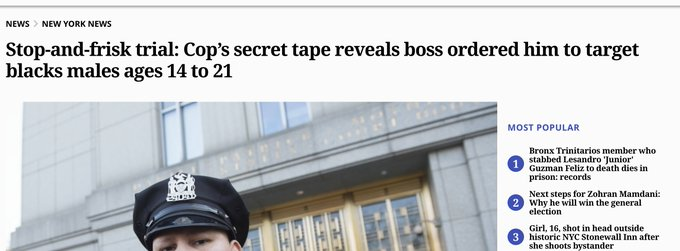
@PowersDecoded @LexDiamonds__ The racialized threat perception is gendered. The more 'male' a black boy/man seems, the higher the threat perception. We also observe this in the treatment of transwomen who don't 'pass' vs those who do. Masculinity is rewarded in some contexts, yet punished in others.
Slowburnt tweet media
English
1
0
1
27
Powers Decoded | Systems • Class • Truth
@Slowburnt2 @LexDiamonds__ You’re mixing two different things. ‘Brutish thug’ stereotypes are about racialized threat perception, not a stigma against masculinity itself. Masculinity is still rewarded and enforced, while boys who deviate from it face the highest bullying and harassment rates.
English
2
0
0
26