
smartprogrammer.eth 🦇🔊

5.7K posts

smartprogrammer.eth 🦇🔊 banner
smartprogrammer.eth 🦇🔊

smartprogrammer.eth 🦇🔊

@Smartprogrammer

Ethereum Core Developer @nethermind Building https://t.co/sfqD9U0xd8 Opinions are my own. believe in somETHing.

kuwait Katılım Aralık 2009
453 Takip Edilen1.1K Takipçiler
smartprogrammer.eth 🦇🔊 retweetledi

DuckDegen 🦞
DuckDegen 🦞@DuckDegen·
I built JobStash to help people find crypto jobs. Now I need the Ethereum community’s help finding mine. My time at Nethermind has ended. I’m looking for an Engineering Manager, Head of Engineering or Technical Program Director role with ownership across people, technology and execution. At Nethermind, I led engineering delivery for Surge, a $1.6M program, and worked across business development, strategic accounts and incident response. Thanks @Smartprogrammer for leading the product and @tkstanczak for trusting me with Surge. Before that, I grew JobStash to 100k+ users, hired and managed a seven-person team, and owned its data and agentic AI systems. Former Principal Engineer. 20+ years in software. I care deeply about Ethereum and want my best work yet in Ethereum, infrastructure, AI or developer tooling. Amsterdam-based; U.S./EU citizen; open to remote. CV: docs.google.com/document/d/1uv… Know the right team? Please DM me or repost.
DuckDegen 🦞 tweet media
English
9
34
94
4.6K
smartprogrammer.eth 🦇🔊 retweetledi
Marek Moraczyński
Marek Moraczyński@M25Marek·
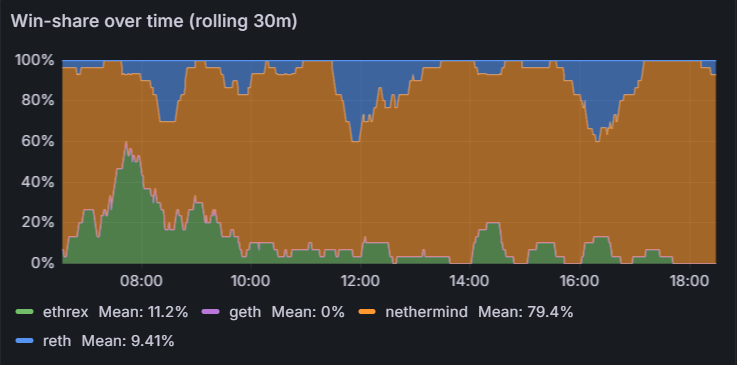
Great dashboard for tracking Ethereum client performance, created by the EthRex team. @Nethermind has been the fastest client to process approximately 80% of Ethereum blocks (last 12 hours results). Full dashboard: grafana.ethrex.xyz/d/client-cmp-v…
Marek Moraczyński tweet media
English
7
11
68
9.4K
smartprogrammer.eth 🦇🔊 retweetledi
Marek Moraczyński
Marek Moraczyński@M25Marek·
Looking back at Nethermind's core development journey over the years makes me incredibly proud of what the team has accomplished. The Resiliency Phase Before the Merge, there was effectively no alternative to Geth. It was by far the most stable and performant execution client, and execution client diversity barely existed. That concentration posted a major risk to Ethereum's resilience and one of its core properties: never going down. Today, Nethermind stands alongside Geth as one of the leading execution clients, with each accounting for roughly 30% of the network. The Ethereum Scaling Phase Once execution client diversity became a reality, the next major challenge was scaling Ethereum. Ethereum had been stuck at around a 30M gas limit for a long time. Nethermind led much of the performance engineering effort, demonstrating that Ethereum could safely operate at significantly higher throughput. Beyond setting an example, many of our optimisations and ideas were adopted by other client teams, helping raise performance across the whole Ethereum. Just as importantly, we helped establish a performance engineering culture within Ethereum core development, bringing a more data-driven approach to gas limits and gas pricing. That work was later adopted and expanded by the EF. Ethereum still has plenty of room to scale, but we're moving in the right direction. What's Next We’re now focused on the next set of challenges: 1. Executing on the Strawmap while leveraging AI as much as possible and exploring how AI agents can make Ethereum development increasingly autonomous. 2. Making Ethereum post-quantum resilient. It's part of the Strawmap, but it's important enough to deserve a separate point. 3. Accelerating institutional adoption of Ethereum. 4. Improving RPC layer - from hardening and design to making it verifiable.
English
4
21
143
16.3K
smartprogrammer.eth 🦇🔊 retweetledi
Ethereum Institutional
Ethereum Institutional@ethereuminsti·
1/ Announcing Ethereum Institutional An independent non-profit dedicated to accelerating the institutional adoption of Ethereum, its L2s, applications and overall ecosystem.
Ethereum Institutional tweet media
English
281
687
3.3K
914.1K
smartprogrammer.eth 🦇🔊 retweetledi
Sebastian Bürgel
Sebastian Bürgel@SCBuergel·
When I joined crypto, people talked about "banking the unbanked". That was a long time ago. In the meantime we built a bunch of cool tech - it was fun! But nobody banked the unbanked. Today, MiniPay is launching @gnosispay. Now you've probably not heard about MiniPay and maybe you find it a weird wallet. But they do onboard many people to crypto who aren't banked otherwise. And they got a custody-maximized card now.
MiniPay@minipay

Your dollars. Your card. Anywhere. 🌍 The MiniPay Card is rolling out— a stablecoin-powered Visa card that spends globally straight from your wallet. Up to 5% cash back, paid in digital gold and stablecoins. The first wave is going out now. Claim your spot → minipay.to/card

English
8
10
121
17K
smartprogrammer.eth 🦇🔊 retweetledi
Nethermind
Nethermind@Nethermind·
UBS and Nethermind have completed two joint proofs of concept showing that a public, permissionless network can support the compliance and operational needs of regulated financial institutions. The PoCs show that banks and asset managers can apply strong compliance controls through the infrastructure they run on top of Ethereum, without changing how the protocol itself works. We built and tested a node that applies customizable compliance rules to outgoing transactions, and a routing component that sends approved bundles directly to selected block builders. Both validated end-to-end on Sepolia, no live transactions. This is what enterprise-grade blockchain infrastructure built on deep protocol expertise looks like in practice. We plan to build on this work with @UBS. Full release: ubs.com/global/en/medi…
English
22
82
454
136.4K
smartprogrammer.eth 🦇🔊 retweetledi
Marek Moraczyński
Marek Moraczyński@M25Marek·
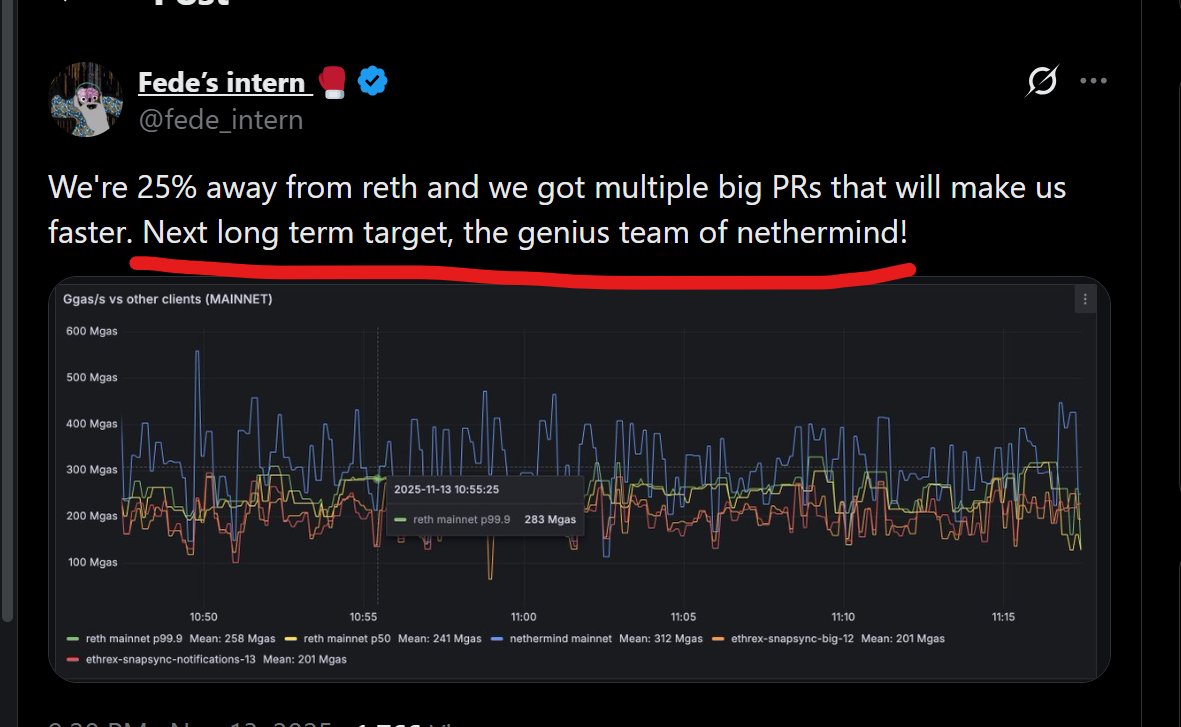
"The moment Reth and Ethrex started delivering, execution client performance jumped" You forgot about the Nethermind team. Nethermind’s contribution to performance doesn’t stop at our own client. Many clients, including Reth and Ethrex, have benefited from our optimizations in their own clients significantly. Additonally, we kicked off the right approach to performance engineering for all Ethereum clients.
Marek Moraczyński tweet media
English
1
12
91
5.3K
smartprogrammer.eth 🦇🔊 retweetledi
Lefteris Karapetsas
Lefteris Karapetsas@LefterisJP·
The Ethereum ecosystem is lucky to have Friederike, Martin, Stefan and the entire Gnosis team on its side. The products they built are really useful and have pushed the space forward. But what stands out most is how they handled themselves under pressure these past years. Owning problems fast, in public and standing behind their users every time. Today was no exception. Not sure what to say in moments like this except: thank you. Keep being awesome.
English
18
33
477
18K
koeppelmann
koeppelmann@koeppelmann·
would love to use it for Gnosis Chain bridges to have bridge time down to <1min (as an intermediate step towards EEZ). All it needs is a little bit more "love" of the feature from CL teams.
English
1
0
8
1.3K
koeppelmann
koeppelmann@koeppelmann·
fastconfirm.it Did you know that under normal networks conditions CEXs and bridges could already safely accept deposits after 13sec? Those are the kind of improvements that matter so much and deserve more attention.
English
4
6
45
3.6K
smartprogrammer.eth 🦇🔊
smartprogrammer.eth 🦇🔊@Smartprogrammer·
Is posting state diffs somehow preferred over posting transactions? Is there any other advantage to posting state diffs than potentially having smaller footprints in blobs thus better utilization of them? Am i the only one who prefers transactions being posted for history preservation and ease of reexecution?
English
1
0
0
47
donnoh.gwei 💗
donnoh.gwei 💗@donnoh_eth·
@nero_eth do you think evm L2s could use BALs to publish state diffs for DA instead of txs out of the box?
English
1
0
1
298
Toni Wahrstätter ⟠
Toni Wahrstätter ⟠@nero_eth·
Ethereum is about to fundamentally change how blocks are executed. With the upcoming Glamsterdam hardfork, it's shipping EIP-7928: Block-level Access Lists, a proposal that brings parallelization to the EVM. Here's a short explainer of what it is, how it works, and why it's a big deal for scaling. Let's start from the top. Alongside EIP-7732 (ePBS), EIP-7928 is the execution-layer (EL) headliner for Glamsterdam. Like ePBS, the main focus has been scaling Ethereum, though both proposals come with a bunch of other, equally important properties on the side e.g. removing trust requirements from the PBS pipeline or improving sync. EIP-7928 adds a Block Access List (BAL) to every Ethereum block. A BAL is a list of accounts and storage slots that the block touches, but that's not all: it also contains post-transaction state diffs (this part is critical!). Post-transaction state diffs tell you what the state looks like after each transaction. Quick example: user A swaps 1 ETH for DAI on DEX B. The BAL tells you that user A's ETH balance decreased by 1 ETH + tx fees and their nonce went up by 1; that DEX B's ETH balance went up by 1 ETH; and that inside the DAI contract, user A's DAI balance increased while DEX B's decreased. In other words, all of that info becomes statically available, something that previously required tracing the transaction. Client software (Geth, Nethermind, Besu, Erigon, Reth, Ethrex, Nimbus) can use this to do a few very powerful things: 1. Parallelize transaction execution. Knowing the post-state of each tx resolves the dependencies between them. No transaction has to wait on the previous one anymore, so execution can be perfectly parallelized. Instead of large parts of block validation sitting idle waiting on sequential execution, clients can finally make much better use of modern hardware. 2. Batch prefetch. One of the most cumbersome jobs for a node has been fetching the state needed for execution from disk. Because state locations (e.g. the exact storage slot in the DAI contract where user A's balance lives) are only discovered along the way, while executing, state-fetching has been a real drag on scaling: it blocks execution, takes time, and eventually slows everything down. With BALs, everything a node needs for execution is known upfront and can be loaded into cache in one go, in parallel. This speeds things up even further. 3. Parallelize post-state root calculation. Another expensive task is walking the updated state tree to compute the post-state root, which is needed so that everyone agrees on what's on disk after executing the block. With the post-tx state already in the BAL, nodes can do this in parallel while executing. A heavy task that used to wait until all transactions had finished can now run alongside prefetching and execution. 4. Snap sync (v2). An often overlooked, less sexy aspect of blockchains is syncing. Nodes need to catch up with the chain, and they need to catch up faster than the chain progresses. Today, most nodes do snap sync: downloading blocks, headers, and state in parallel while chasing the tip, and then "healing" the database once they're close to the head. Healing means asking peers for trie nodes, receiving them, validating them, and updating the local DB. It's iterative, networking-heavy, can take a while, and especially higher throughput pushes that phase to its limits. BALs help here too: with snap v2, nodes can catch up to the tip and skip the healing phase entirely. Syncing at higher throughput becomes more robust and reliable. So, to summarize, a BAL contains two things: -> The state locations the block accesses -> The state changes after each tx (incl. the new values) We're already seeing big performance gains today: on 6-core machines, EL clients validate blocks up to 5x faster, making block gas limits of 300M a very realistic outcome. ePBS will add to that by decoupling the block from the payload, giving validators 2-4x more time for execution. To not overshoot (security stays priority #1), the fork will likely ship with a 200M gas limit, but we shouldn't be stuck there for long before pushing to 300M and beyond. That's a 10x in scaling since we started taking the topic seriously, without touching hardware requirements. None of this would have happened without people going all-in, heads down, shipping: so many hours spent in calls debating the right design, so many iterations refining the specs, and tons of test cases written (and still being worked on). The road from whiteboard to production-ready code has been a journey, and we're not at the finish line yet, but from what I can tell, things look super bullish for Ethereum. Glamsterdam will be a fork that shows what's possible when a distributed, decentralized community works on a shared goal, laser-focused on providing enough block space to onboard the next wave of users.
English
43
151
785
68.9K
smartprogrammer.eth 🦇🔊 retweetledi
Protocol Guild
Protocol Guild@ProtocolGuild·
1/ We're thrilled to welcome @AztecFND as the latest project to take the 1% Pledge 🎉 1% of the AZTEC token supply has been deposited into Protocol Guild's 4-year vesting contract to support 187 Ethereum core contributors across client teams, research, and coordination
Protocol Guild tweet media
English
17
43
179
41.7K
smartprogrammer.eth 🦇🔊 retweetledi
koeppelmann
koeppelmann@koeppelmann·
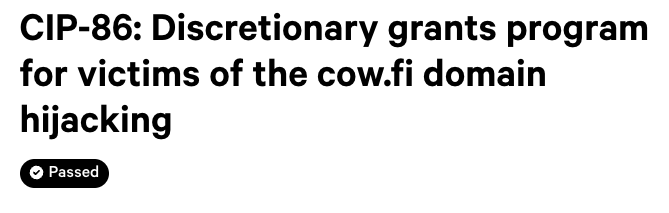
.@CoWSwap protects its users! Even though the hack was caused by something outside CoWSwap’s control - the domain registrar - CoW DAO decided to reimburse affected users. If you were affected, reach out!
koeppelmann tweet media
English
2
15
73
5.7K
smartprogrammer.eth 🦇🔊 retweetledi
Anshu Jalan
Anshu Jalan@AJ_Jalan·
And we just made another breakthrough! This is the first in-production system enabling instant swaps on an L2 using L1 liquidity, directly through the native bridge.
Nethermind@Nethermind

No third-party bridge. No custodial risk. A user on an L2 swaps xDAI to USDC using a Sushiswap liquidity pool on Gnosis L1. The rollup accesses L1 liquidity natively and settles the result back to L2 in a single transaction. 15 seconds.

English
1
3
8
1.3K
smartprogrammer.eth 🦇🔊 retweetledi
Nethermind
Nethermind@Nethermind·
No third-party bridge. No custodial risk. A user on an L2 swaps xDAI to USDC using a Sushiswap liquidity pool on Gnosis L1. The rollup accesses L1 liquidity natively and settles the result back to L2 in a single transaction. 15 seconds.
English
5
8
75
10.5K
Benjamin Marie
Benjamin Marie@bnjmn_marie·
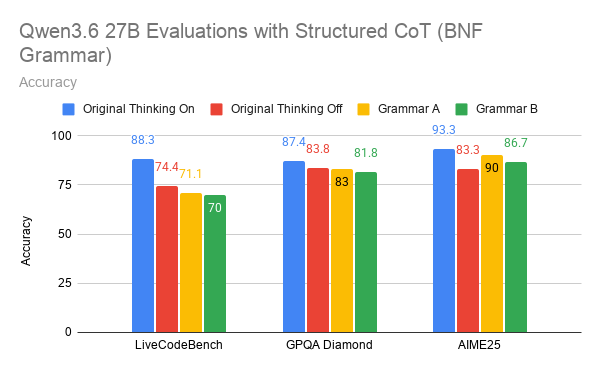
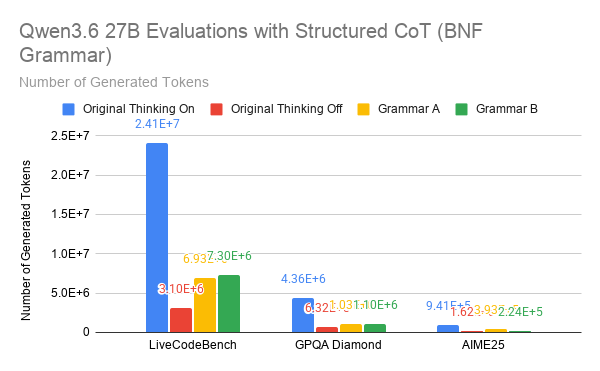
Done. I have evaluated the structured CoT, with BNF grammars, to shorten the reasoning of Qwen3.6 27B. Conclusion: It's better to just disable reasoning😅 It works very well at shortening the reasoning when it's enabled, but it costs accuracy and still generates more tokens than with thinking disabled. I'm writing a full article to explain how I ran this.
Benjamin Marie tweet mediaBenjamin Marie tweet media
English
12
7
103
6.8K