SmoothieGrooves.eth

3K posts

SmoothieGrooves.eth

SmoothieGrooves.eth

@SmoothieG_

Gen⚪️ 0000659 | #NFT | Vibe with the bass groove and be smooth like a smoothie 🕺🏼🍃

Katılım Ağustos 2021
1.4K Takip Edilen460 Takipçiler
Sabitlenmiş Tweet
SmoothieGrooves.eth
SmoothieGrooves.eth@SmoothieG_·
Patience is everything 🍃
English
0
0
0
96
SmoothieGrooves.eth retweetledi
Crypto Fergani
Crypto Fergani@cryptofergani·
CZ, founder of Binance, says that he only holds Bitcoin and BNB. “I believe that in 2026 the four-year cycle will be broken and we’ll see a Bitcoin supercycle.”
English
127
240
2K
206.8K
Yucky Ducks
Yucky Ducks@yuckyducks·
The time has come. The Waddle needs 7,777 Ducks. Only then can we finish the mission using @opensea and take back the Yuckpot. April 2nd In 7 days the Waddle grows and the battle begins. Be ready. Retweet for a chance at Yucklist. Mint link in first reply 👇 #StayYucky
Yucky Ducks tweet media
English
1.2K
1.3K
2.8K
193.2K
SmoothieGrooves.eth retweetledi
jack
jack@jack·
we're making @blocks smaller today. here's my note to the company. #### today we're making one of the hardest decisions in the history of our company: we're reducing our organization by nearly half, from over 10,000 people to just under 6,000. that means over 4,000 of you are being asked to leave or entering into consultation. i'll be straight about what's happening, why, and what it means for everyone. first off, if you're one of the people affected, you'll receive your salary for 20 weeks + 1 week per year of tenure, equity vested through the end of may, 6 months of health care, your corporate devices, and $5,000 to put toward whatever you need to help you in this transition (if you’re outside the U.S. you’ll receive similar support but exact details are going to vary based on local requirements). i want you to know that before anything else. everyone will be notified today, whether you're being asked to leave, entering consultation, or asked to stay. we're not making this decision because we're in trouble. our business is strong. gross profit continues to grow, we continue to serve more and more customers, and profitability is improving. but something has changed. we're already seeing that the intelligence tools we’re creating and using, paired with smaller and flatter teams, are enabling a new way of working which fundamentally changes what it means to build and run a company. and that's accelerating rapidly. i had two options: cut gradually over months or years as this shift plays out, or be honest about where we are and act on it now. i chose the latter. repeated rounds of cuts are destructive to morale, to focus, and to the trust that customers and shareholders place in our ability to lead. i'd rather take a hard, clear action now and build from a position we believe in than manage a slow reduction of people toward the same outcome. a smaller company also gives us the space to grow our business the right way, on our own terms, instead of constantly reacting to market pressures. a decision at this scale carries risk. but so does standing still. we've done a full review to determine the roles and people we require to reliably grow the business from here, and we've pressure-tested those decisions from multiple angles. i accept that we may have gotten some of them wrong, and we've built in flexibility to account for that, and do the right thing for our customers. we're not going to just disappear people from slack and email and pretend they were never here. communication channels will stay open through thursday evening (pacific) so everyone can say goodbye properly, and share whatever you wish. i'll also be hosting a live video session to thank everyone at 3:35pm pacific. i know doing it this way might feel awkward. i'd rather it feel awkward and human than efficient and cold. to those of you leaving…i’m grateful for you, and i’m sorry to put you through this. you built what this company is today. that's a fact that i'll honor forever. this decision is not a reflection of what you contributed. you will be a great contributor to any organization going forward. to those staying…i made this decision, and i'll own it. what i'm asking of you is to build with me. we're going to build this company with intelligence at the core of everything we do. how we work, how we create, how we serve our customers. our customers will feel this shift too, and we're going to help them navigate it: towards a future where they can build their own features directly, composed of our capabilities and served through our interfaces. that's what i'm focused on now. expect a note from me tomorrow. jack
English
8.7K
6.6K
51K
64.3M
SmoothieGrooves.eth
SmoothieGrooves.eth@SmoothieG_·
Ohh… it seems that Trump is not the Messiah of crypto. He destroys it 🤪
English
0
0
0
12
SmoothieGrooves.eth
SmoothieGrooves.eth@SmoothieG_·
CZ…. my guy, I’m not glazin’ with u anymore 🥀 Max pain it is 🩸
English
0
0
0
14
SmoothieGrooves.eth retweetledi
Jacob King
Jacob King@JacobKinge·
JUST IN: Michael Saylor has officially wiped out ALL of his gains on Bitcoin and is now sitting at a net loss. At one point, he was up around $10 billion but now facing a major loss. Flashback to 2000: he was ranked the #1 biggest loser of the entire dot-com bubble, losing more money than anyone else on Earth. History seems to be repeating itself.
English
336
616
5.8K
636.8K
SmoothieGrooves.eth retweetledi
Star_OKX
Star_OKX@star_okx·
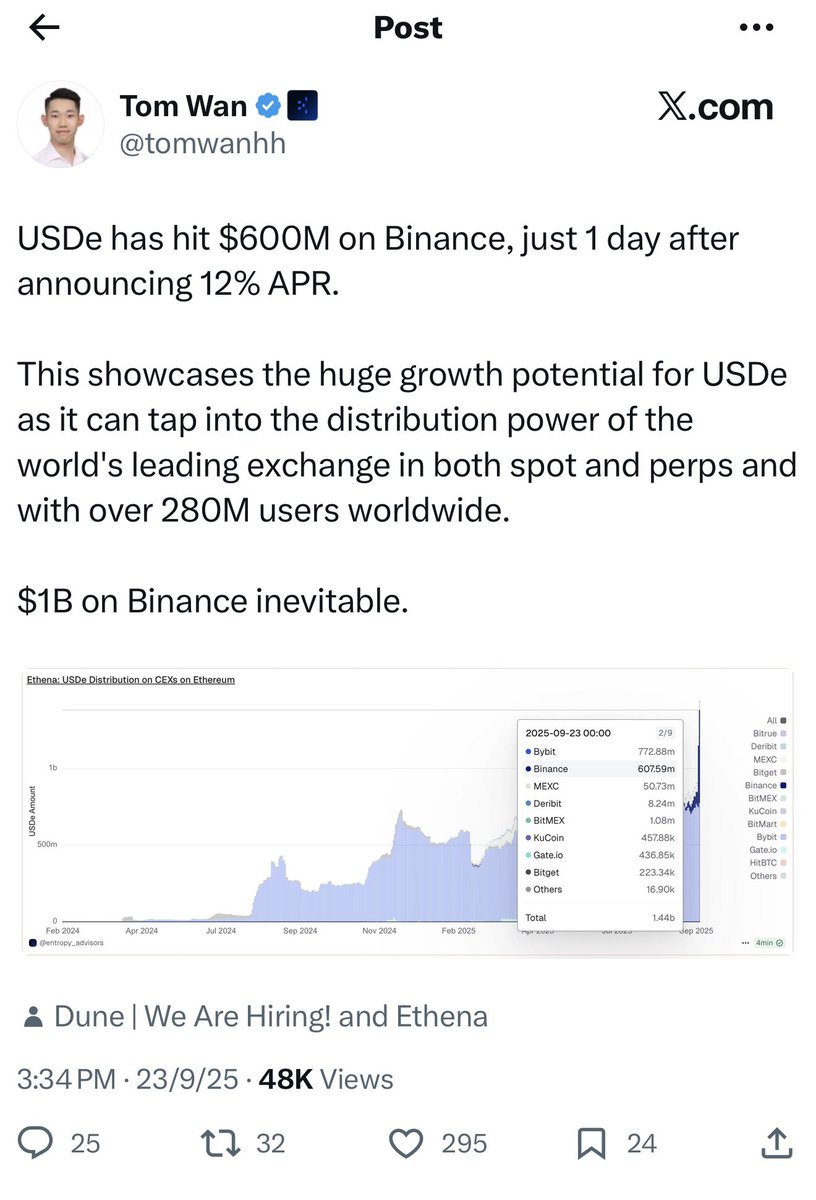
No complexity. No accident. 10/10 was caused by irresponsible marketing campaigns by certain companies. On October 10, tens of billions of dollars were liquidated. As CEO of OKX, we observed clearly that the crypto market’s microstructure fundamentally changed after that day. Many industry participants believe the damage was more severe than the FTX collapse. Since then, there has been extensive discussion about why it happened and how to prevent a recurrence. The root causes are not difficult to identify. ⸻ What actually happened 1.Binance launched a temporary user-acquisition campaign offering 12% APY on USDe, while allowing USDe to be used as collateral with the same treatment as USDT and USDC, and without effective limits. 2.USDe is a tokenized hedge fund product. Ethena raises capital via a so-called “stablecoin,” deploys it into index arbitrage and algorithmic trading strategies, and tokenizes the resulting fund. The token can then be deposited on exchanges to earn yield. 3.USDe is fundamentally different from products such as BlackRock BUIDL and Franklin Templeton BENJI, which are tokenized money market funds with low-risk profiles. USDe, by contrast, embeds hedge-fund-level risk. This difference is structural, not cosmetic. 4.Binance users were encouraged to convert USDT and USDC into USDe to earn attractive yields, without sufficient emphasis on the underlying risks. From a user’s perspective, trading with USDe appeared no different from trading with traditional stablecoins—while the actual risk profile was materially higher. 5.Risk escalated further as users: •converted USDT/USDC into USDe, •used USDe as collateral to borrow USDT, •converted the borrowed USDT back into USDe, •and repeated the cycle. This leverage loop produced artificial APYs of 24%, 36%, and even 70%+, widely perceived as “low risk” simply because they were offered by a major platform. Systemic risk accumulated rapidly across the global crypto market. 6.At that point, even a small market shock was sufficient to trigger a collapse. When volatility hit, USDe depegged quickly. Cascading liquidations followed, and weaknesses in risk management around assets such as WETH and BNSOL further amplified the crash. Some tokens briefly traded near zero. The damage to global users and companies—including OKX customers—was severe, and recovery will take time. ⸻ Why this matters I am discussing the root cause, not assigning blame or launching an attack on Binance. Speaking openly about systemic risks is sometimes uncomfortable, but it is necessary if the industry is to mature responsibly. I expect there may be significant misinformation and coordinated FUD directed at OKX in the near future. Even so, speaking honestly about systemic risk is the right thing to do—and we will continue to do so. As the largest global platform, Binance has outsized influence—and corresponding responsibility—as an industry leader. Long-term trust in crypto cannot be built on short-term yield games, excessive leverage, or marketing practices that obscure risk. The industry needs leaders who prioritize market stability, transparency, and responsible innovation—not a winner-take-all mentality where criticism is treated as hostility. Crypto is still early. What we choose to normalize today will determine whether this industry earns lasting trust—or repeats the same mistakes again.

Star_OKX tweet mediaStar_OKX tweet media
English
1.8K
2.7K
13.6K
5.5M
SmoothieGrooves.eth retweetledi
Star_OKX
Star_OKX@star_okx·
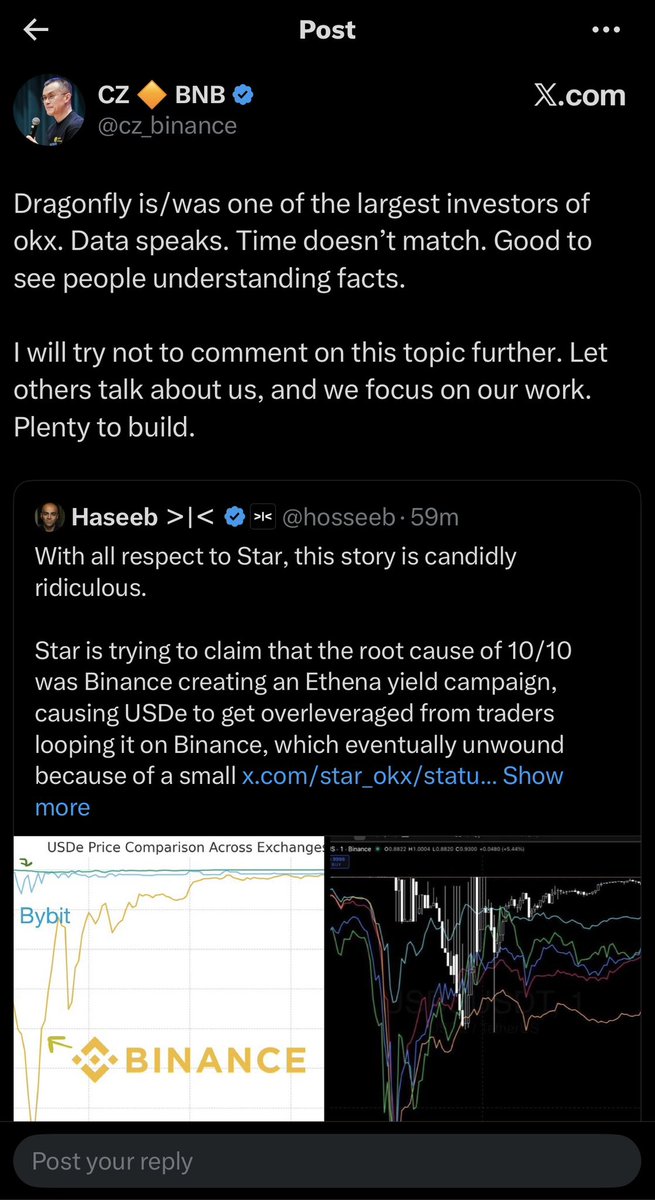
I don’t like debate—because you can never wake someone who is pretending to sleep. That said, clarifying the facts matters. For the record: 1.BTC began declining roughly 30 minutes before the USDe depeg. This exactly supports the earlier point: the initial move was a market shock. Absent the USDe leverage loop, the market would likely have stabilized at that point. The cascading liquidations were not inevitable—they were amplified by structural leverage, as explained previously. 2.Dragonfly has never been an investor in OKX—neither a minor nor a major one. In fact, OKX invested in Dragonfly before @hosseeb joined the firm. Separately, one partner’s previous fund (not Dragonfly) invested in OKX. These are distinct and easily verifiable facts. 3.I will not spend further time on this topic. The facts are clear. I do not intend to engage in extended debate.
Star_OKX tweet media
Star_OKX@star_okx

No complexity. No accident. 10/10 was caused by irresponsible marketing campaigns by certain companies. On October 10, tens of billions of dollars were liquidated. As CEO of OKX, we observed clearly that the crypto market’s microstructure fundamentally changed after that day. Many industry participants believe the damage was more severe than the FTX collapse. Since then, there has been extensive discussion about why it happened and how to prevent a recurrence. The root causes are not difficult to identify. ⸻ What actually happened 1.Binance launched a temporary user-acquisition campaign offering 12% APY on USDe, while allowing USDe to be used as collateral with the same treatment as USDT and USDC, and without effective limits. 2.USDe is a tokenized hedge fund product. Ethena raises capital via a so-called “stablecoin,” deploys it into index arbitrage and algorithmic trading strategies, and tokenizes the resulting fund. The token can then be deposited on exchanges to earn yield. 3.USDe is fundamentally different from products such as BlackRock BUIDL and Franklin Templeton BENJI, which are tokenized money market funds with low-risk profiles. USDe, by contrast, embeds hedge-fund-level risk. This difference is structural, not cosmetic. 4.Binance users were encouraged to convert USDT and USDC into USDe to earn attractive yields, without sufficient emphasis on the underlying risks. From a user’s perspective, trading with USDe appeared no different from trading with traditional stablecoins—while the actual risk profile was materially higher. 5.Risk escalated further as users: •converted USDT/USDC into USDe, •used USDe as collateral to borrow USDT, •converted the borrowed USDT back into USDe, •and repeated the cycle. This leverage loop produced artificial APYs of 24%, 36%, and even 70%+, widely perceived as “low risk” simply because they were offered by a major platform. Systemic risk accumulated rapidly across the global crypto market. 6.At that point, even a small market shock was sufficient to trigger a collapse. When volatility hit, USDe depegged quickly. Cascading liquidations followed, and weaknesses in risk management around assets such as WETH and BNSOL further amplified the crash. Some tokens briefly traded near zero. The damage to global users and companies—including OKX customers—was severe, and recovery will take time. ⸻ Why this matters I am discussing the root cause, not assigning blame or launching an attack on Binance. Speaking openly about systemic risks is sometimes uncomfortable, but it is necessary if the industry is to mature responsibly. I expect there may be significant misinformation and coordinated FUD directed at OKX in the near future. Even so, speaking honestly about systemic risk is the right thing to do—and we will continue to do so. As the largest global platform, Binance has outsized influence—and corresponding responsibility—as an industry leader. Long-term trust in crypto cannot be built on short-term yield games, excessive leverage, or marketing practices that obscure risk. The industry needs leaders who prioritize market stability, transparency, and responsible innovation—not a winner-take-all mentality where criticism is treated as hostility. Crypto is still early. What we choose to normalize today will determine whether this industry earns lasting trust—or repeats the same mistakes again.

English
682
400
3K
974K
SmoothieGrooves.eth retweetledi
Benjamin Cowen
Benjamin Cowen@benjamincowen·
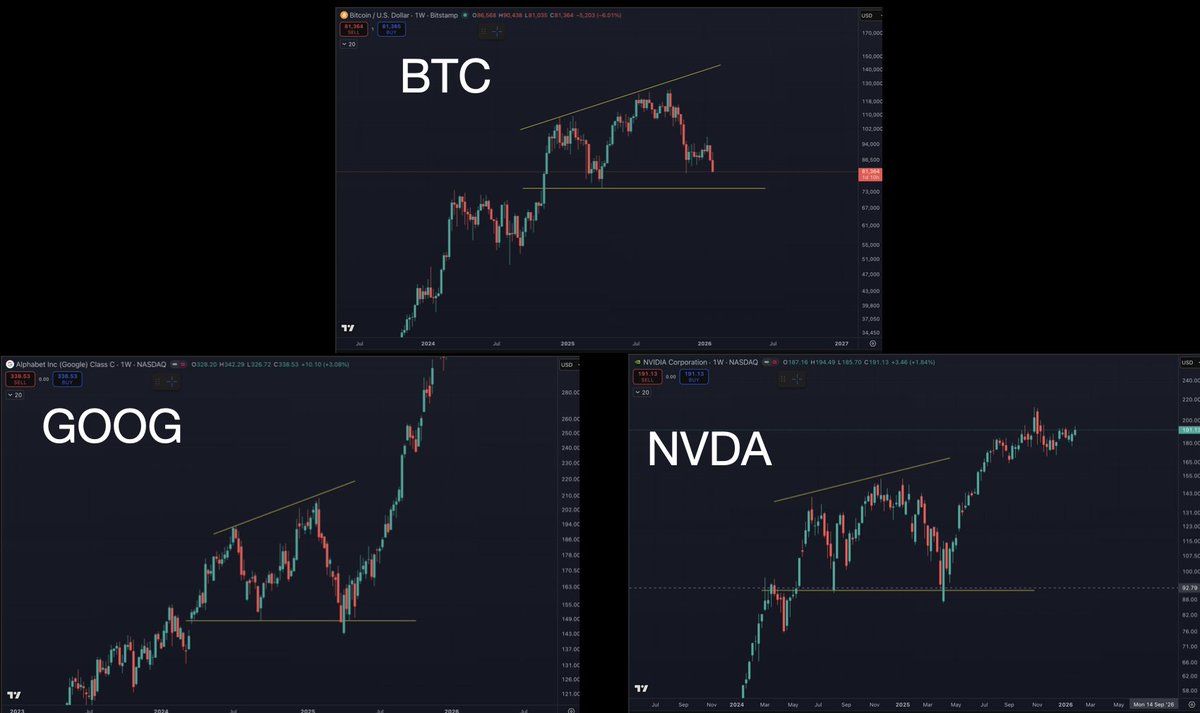
This is the bull case for Bitcoin by the way. If Bitcoin sweeps the low, the pattern would look a lot like prior patterns by GOOG and NVDA. I would assume that the rally would not result in a new all time high, but a macro lower high, before going to the 200W SMA.
Benjamin Cowen tweet media
English
341
497
5.2K
764.6K
SmoothieGrooves.eth retweetledi
Mayank Dudeja || SPYONGEMS
Mayank Dudeja || SPYONGEMS@imcryptofreak·
🚨 OKX CEO Exposed #Binance So guys, now even the OKX CEO has exposed Binance. The October 10 crash was not an accident. It was caused by irresponsible yield marketing by Binance. Binance promoted USDe as if it were a stablecoin, even though it is actually a high-risk, hedge-fund-style product. Users were pushed into leverage loops → fake APYs (30–70%) → massive systemic risk.
Mayank Dudeja || SPYONGEMS tweet media
Star_OKX@star_okx

No complexity. No accident. 10/10 was caused by irresponsible marketing campaigns by certain companies. On October 10, tens of billions of dollars were liquidated. As CEO of OKX, we observed clearly that the crypto market’s microstructure fundamentally changed after that day. Many industry participants believe the damage was more severe than the FTX collapse. Since then, there has been extensive discussion about why it happened and how to prevent a recurrence. The root causes are not difficult to identify. ⸻ What actually happened 1.Binance launched a temporary user-acquisition campaign offering 12% APY on USDe, while allowing USDe to be used as collateral with the same treatment as USDT and USDC, and without effective limits. 2.USDe is a tokenized hedge fund product. Ethena raises capital via a so-called “stablecoin,” deploys it into index arbitrage and algorithmic trading strategies, and tokenizes the resulting fund. The token can then be deposited on exchanges to earn yield. 3.USDe is fundamentally different from products such as BlackRock BUIDL and Franklin Templeton BENJI, which are tokenized money market funds with low-risk profiles. USDe, by contrast, embeds hedge-fund-level risk. This difference is structural, not cosmetic. 4.Binance users were encouraged to convert USDT and USDC into USDe to earn attractive yields, without sufficient emphasis on the underlying risks. From a user’s perspective, trading with USDe appeared no different from trading with traditional stablecoins—while the actual risk profile was materially higher. 5.Risk escalated further as users: •converted USDT/USDC into USDe, •used USDe as collateral to borrow USDT, •converted the borrowed USDT back into USDe, •and repeated the cycle. This leverage loop produced artificial APYs of 24%, 36%, and even 70%+, widely perceived as “low risk” simply because they were offered by a major platform. Systemic risk accumulated rapidly across the global crypto market. 6.At that point, even a small market shock was sufficient to trigger a collapse. When volatility hit, USDe depegged quickly. Cascading liquidations followed, and weaknesses in risk management around assets such as WETH and BNSOL further amplified the crash. Some tokens briefly traded near zero. The damage to global users and companies—including OKX customers—was severe, and recovery will take time. ⸻ Why this matters I am discussing the root cause, not assigning blame or launching an attack on Binance. Speaking openly about systemic risks is sometimes uncomfortable, but it is necessary if the industry is to mature responsibly. I expect there may be significant misinformation and coordinated FUD directed at OKX in the near future. Even so, speaking honestly about systemic risk is the right thing to do—and we will continue to do so. As the largest global platform, Binance has outsized influence—and corresponding responsibility—as an industry leader. Long-term trust in crypto cannot be built on short-term yield games, excessive leverage, or marketing practices that obscure risk. The industry needs leaders who prioritize market stability, transparency, and responsible innovation—not a winner-take-all mentality where criticism is treated as hostility. Crypto is still early. What we choose to normalize today will determine whether this industry earns lasting trust—or repeats the same mistakes again.
English
127
387
2K
282.2K
SmoothieGrooves.eth retweetledi
Leonidas 🧡 $DOG
Leonidas 🧡 $DOG@LeonidasNFT·
͏ ͏ ͏ ͏ ͏ ͏ ͏ ͏ ͏ ͏ ͏ ͏ 𝗘𝗿𝗿𝗼𝗿 Your account is currently locked due to several reports that you are not bull posting $DOG ͏enough ͏ ͏ ͏ ͏ ͏ ͏ ͏ ͏ ͏ ͏ ͏ ͏ ͏ ͏ ͏ ͏͏ ͏ ͏ ͏ ͏ ͏͏ ͏ ͏ ͏ ͏ ͏͏ ͏ ͏ ͏ ͏ ͏͏ ͏ ͏ ͏ ͏ ͏͏ ͏ ͏ ͏ ͏ ͏͏ ͏ ͏ ͏ ͏ ͏͏
78
233
842
12.6K