Sntry.Fun

161 posts

Sntry.Fun banner
Sntry.Fun

Sntry.Fun

@SntryFun

Trust code. Not promises. Compliance-first platform for meme tokens on Monad. 9 AI agents. On-chain reputation. Code-enforced rules. EST. Nov 2025 https://t.co/smpZllgZfv

Michigan, USA Katılım Şubat 2026
122 Takip Edilen61 Takipçiler
Sabitlenmiş Tweet
Sntry.Fun
Sntry.Fun@SntryFun·
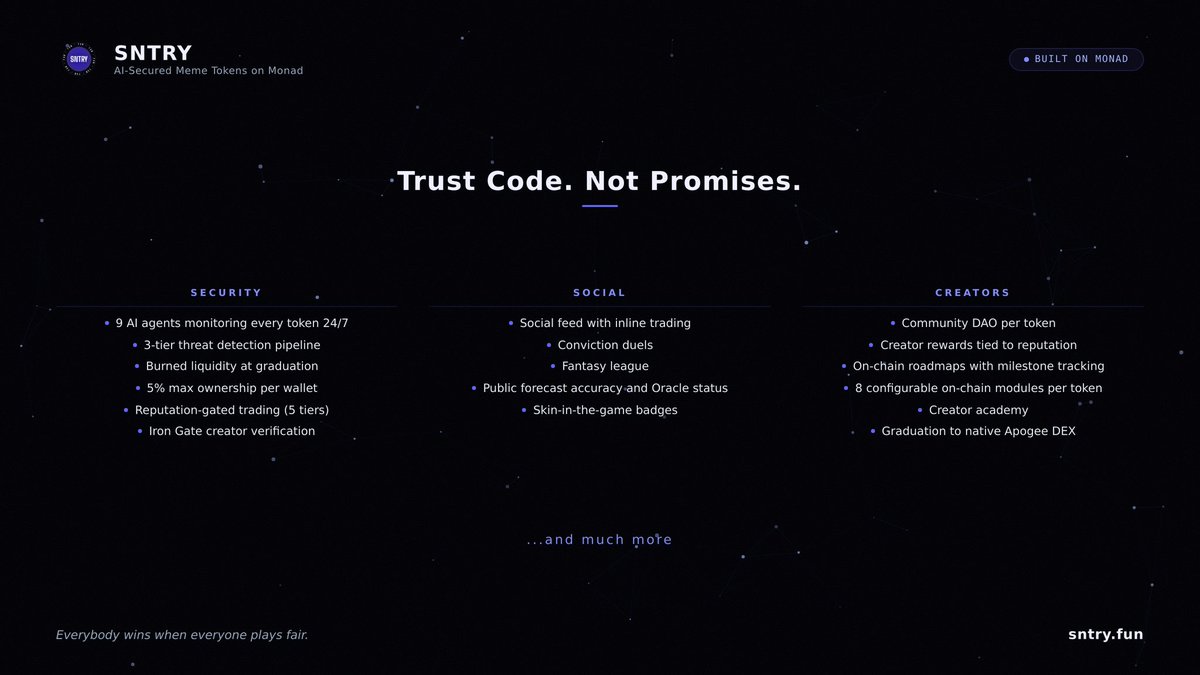
The next wave of meme tokens won't just be about who gets in first. They'll be about what the community builds after. Real governance. Real accountability. Real tools for creators and traders to grow together — not just trade against each other. That's the version of this space we want to see. So that's what we're building. First alpha users coming on next week. More to come soon. Sntry.fun
Sntry.Fun tweet media
English
4
1
11
2.2K
Sntry.Fun
Sntry.Fun@SntryFun·
"What chain are you on?" For most platforms it's a question about identity — whose ecosystem, whose community, whose side of the timeline. For us it couldn't be. Safety is the entire product, so the chain isn't a badge to wear — it's the foundation everything else stands on. If the base layer is slow, expensive, or weak, no amount of protection on top holds. So we treated the chain like part of the security model, not a marketing choice. Sntry.fun — the secure arena for meme tokens — is built on @monad Here's what a security-first platform needs, and what Monad gives it: Security engineered into the base layer, not patched on top. Speed that means safety doesn't have to slow anyone down. Costs low enough to run a security check on every action — not just the risky ones. None of that is packaging. It's why a security-first platform can run here the way it's meant to and we're building here for the long haul. Trust code, not promises. Waitlist is open: sntry.fun
Sntry.Fun tweet media
English
0
0
0
34
Sntry.Fun
Sntry.Fun@SntryFun·
The meme coins that stick around usually have one thing in common: the community became a real thing. Devs shipping tools, members building a brand, a culture that outlasts the first spike. They built all of it by hand — separate from the platforms that only handed them a chart and left the rest to them. Most never grow into that, and they don't have to. Fast, funny, of-the-moment is the heart of the category, and it needs no apology. But all of them have run on the same thin rails: a launch, a price chart, and little else. The fun deserves a floor under it. The builders deserve tools in their hands. So Sntry is built for both speeds. Launching for the moment? The ground is defended by default — the same ground under every token on Sntry, quick coin or long-haul venture. Every account is a verified human, one badge per person, free; every token is screened before it goes live, then protected after — code-enforced rules, a real-time policy engine, and a 9-agent security swarm that keeps watching. The fun stays fun. Building for the long haul? You start on that same floor — then the arena opens up: belong, and build. Launch a venture — a brand, a community, a club — where membership means something because every member is a real person; where the community steers, voting on how its own community fund is spent, every proposal screened for compliance before the vote opens; where on-chain modules add real functionality with one click. Not a chat stretched over a chart — a place where people do things together. The communities that beat the odds proved the instinct was right all along. What was wrong was the architecture underneath them. We think the next evolution of the meme coin is the arena that fixes it — trust engineered, not asserted; the moment protected; the long haul equipped. Trust code, not promises. Waitlist is open: sntry.fun
Sntry.Fun tweet media
English
0
0
1
157
Sntry.Fun
Sntry.Fun@SntryFun·
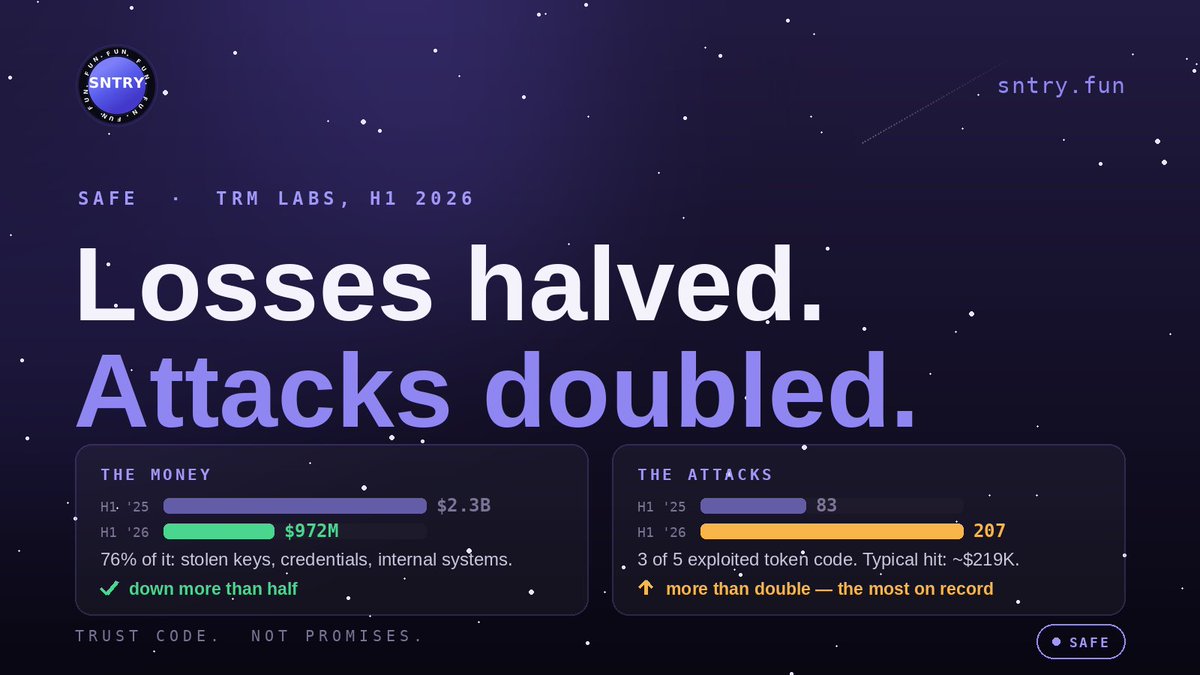
The @trmlabs , a blockchain intelligence firm that tracks hacks across the industry, published its half-year security report this month. The headline sounds like progress: roughly $972 million lost to hacks in the first six months of 2026 — less than half of what was stolen in the same period last year. The number underneath tells a different story. The same report counts 207 separate attacks — the most TRM has ever recorded in a six-month span, and more than double the first half of 2025. Losses fell. Attacks didn't. The gap between those two numbers comes down to two very different kinds of attack. Most of the money — about three-quarters — was taken by attackers who broke into the keys, credentials, and internal systems of major targets. Those are the hacks that make the news. The other kind is what drove the record. Three out of five attacks were smart contract exploits — flaws in the code of token projects and DeFi protocols. Across all 207 incidents, the typical loss was about $219,000. Attacks that size rarely make the news. Not because the money doesn't matter, but because the victims are small projects most people have never heard of. For the young community behind one, $219,000 can be everything. That second kind is the threat most people will actually meet. Not the record-setting heist — the small, frequent attack, run at scale, against exactly the kind of project they'd join. And those keep climbing, because the target list keeps growing: more tokens, more contracts, more places to probe. TRM's own warning is blunt: don't mistake lower losses for a safer environment. At that pace, security that reacts after the damage is already too late. Screening has to run before a token trades, and the watching can't stop once it's live. That's how Sntry is built: rules written into the contracts themselves, a policy engine checking activity in real time, and a nine-agent security swarm that reaches consensus before any token goes live — and keeps watching the whole arena after it does. The everyday attack has industrialized. The answer isn't promising to be careful — it's structure. Trust code, not promises. sntry.fun
Sntry.Fun tweet media
English
0
0
0
78
Sntry.Fun
Sntry.Fun@SntryFun·
Agree — and I'd take it one step further: the product was never the problem. Neither were the users. The predation in the memecoin ecosystem mostly happened at the platform layer. Insider allocations, bundled launches, bots with priority on day one — none of that is native to memecoins. It's behavior the platforms allowed. A memecoin is just a coin. Who gets in first, how much of the supply one buyer can take, how fast insiders can exit: the platform decides all of it, in code. Every launch already has rules. The only question is who they favor. Every cycle ends the same way for the same reason. The exciting product changes — ICOs, yield farming, memes — but the enforcement gap doesn't. Extraction runs on code: snipers, bundlers, sybil wallets. Fairness runs on promises: a docs page, a mod team, an honor system. People didn't quit because the fun stopped. They quit because they were outgunned. Which is why useful, non-predatory products alone won't fix it. Put the most useful product in crypto on rails that don't enforce fairness, and the same crews show up with the same bots. The fix lives where the problem lives: fairness written into the platform's own code and enforced at execution time — the same layer the extraction runs on. Anything softer is a promise, and promises already lost that fight. Excitement is permanent, like you said. Predation isn't. It's a platform choice.
English
0
0
0
40
zayn
zayn@zayn4pf·
don’t think memecoins are really the problem the real problem is the fact that we don’t have normal, useful and non-predatory products that are as exciting as memecoins. people would always want excitement so memes would always be a thing, but memes being the “MAIN” thing is a symptom of the problem i mentioned.
English
2
0
4
230
Ryan Watkins
Ryan Watkins@RyanWatkins_·
Bubbles can be good for new industries and the memecoin bubble from 2023 - 2025 was just that. Memecoins onboarded an enormous amount of new users, stress tested chains like Solana and Base, and funded a ton valuable trading infrastructure in the ecosystem. But now we’re in 2026 and memecoin bubble popped long ago. Insider trading, bundling, and bots ruined what was once a fair game. What’s left is a shrinking pool of fish chasing past highs they will never reach while sharps extract the remaining money. The same thing happened on Ethereum twice, first from 2017 - 2018 with ICOs, then 2020 - 2022 with yield farming. At a certain point the game gets figured out and edge gets competed away. The thesis becomes stale and people stop playing. Memecoins may ultimately have a place in the cryptoeconomy long-term. If someone can find a way to make them fair again, they could survive as an onchain native casino game, or better yet, evolve into something new like creator coins. In any case, speculation will continue on, and speculators will continue searching for an outlet. But the point is that any chain looking for a spark will need to look beyond. Growth is found on the frontier, not in the echoes of the last cycle.
English
49
19
283
45.6K
Sntry.Fun
Sntry.Fun@SntryFun·
We say in our post "a major step toward solving MEV at the protocol level." Not that its solved. What stops what you're asking about is math first, then structure. Under BTX, transactions are encrypted and the decryption key is secret-shared across the validator set no single party holds it. Decrypting anything early takes shares from more than the corruption threshold; below that line, the shares reveal nothing. One proposer can't peek. Neither can a small cartel. Cadence removes the other lever: several proposers per block, none able to shape its proposal in reaction to the others'. And while the network is healthy, a transaction any correct proposer includes can't be censored or deferred. The deal you're describing stops being a bot with a fast node and becomes a conspiracy across a third of the network's weight — the same threshold consensus safety itself rests on. That's also the line the validator side is engineered around: ~200 validators spread across operators and geographies with stake at risk, while every fill stays on the public record — sandwiching at scale shows up in the data even when the coordination doesn't. Nothing is ever impossible but if you're interested in further details i suggest reading @category_xyz releases yourself they are extremely informative.
English
0
0
0
65
Leon From The Block
Leon From The Block@HopiumCalling·
@SntryFun @category_xyz "Solved MEV at the protocol level" is basically the industry's favourite last words. What stops the validators from just cutting a deal and splitting the sandwich amongst themselves?
English
1
0
0
54
Sntry.Fun
Sntry.Fun@SntryFun·
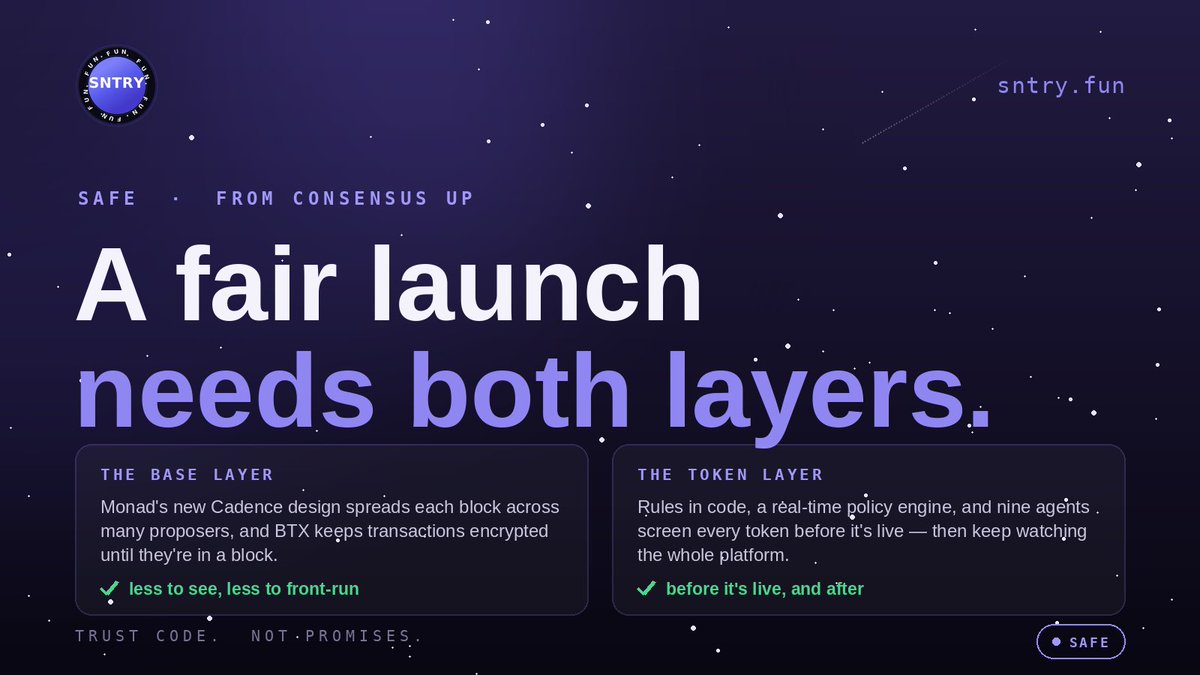
Security starts at the base layer. You can't bolt it on afterward. This week @category_xyz introduced Cadence, a new consensus design in which multiple validators propose each block instead of a single leader. Add BTX, the encrypted-mempool scheme it published in April, and you have what the team calls a major step toward solving MEV at the protocol level. MEV is the quiet tax most traders never see. A bot reads your pending transaction, jumps ahead of it, and sandwiches your fill — you get a worse price, it pockets the difference. Meme coins get the worst of this. A new token's first minutes are some of the most contested blockspace in crypto: sniper bots race ahead of real buyers the moment a launch goes live, and fast-moving prices push people to set high slippage — exactly the margin sandwich bots harvest. The smaller and faster the market, the heavier the tax. Cadence's design works against that twice over. No single proposer controls what goes in a block, and no proposer can see the others' proposals and react. BTX covers the rest — transactions stay encrypted until they're already in a block. Less to see, less to front-run. And it's fast: 100ms blocks to start, with finality averaging 219 milliseconds in simulation across Monad's 200 validators. We chose @monad back in November for what its builders care about and keep working toward: speed, cost, and security treated as base-layer engineering problems. That's what a real-time security layer needs underneath it. Monad's throughput lets us screen every token before it trades — not a sample, all of them. Its fees make launching cost next to nothing. Its 400ms blocks and sub-second finality mean a pre-trade check clears before the trade lands, not after the money is gone. Cadence doesn't change that math. It extends it. A fair launch needs both layers. Monad is working to close off extraction in the ordering of transactions. We work on the tokens themselves: rules written in code, a real-time policy engine, and nine AI agents that reach consensus before any token goes live, then keep monitoring the whole platform after. Stacked defenses, from consensus up. That is the difference between enforcing safety in real time and promising it after the fact. Trust code. Not promises. sntry.fun
Sntry.Fun tweet media
English
1
0
2
337
Sntry.Fun
Sntry.Fun@SntryFun·
Most meme markets have a headcount problem: you can't tell how many people are actually in the room. A launch looks crowded — hundreds of wallets, volume climbing. But wallets aren't people. One operator with a sybil farm can look like a community. A few bots can manufacture a chart that says "everyone's here" before a single human shows up. Sntry's answer is a rule, enforced at the door: every account that trades is a verified human. One badge per person. The badge is free, so verification never becomes a paywall. And this isn't a policy we promise to enforce — it's built into the code. That single rule gives the numbers real meaning. A growing holder count means more people showed up. A community here is built from people, one badge each. Verification doesn't make anyone honest, so the layers behind it stay on: immutable on-chain rules, a real-time policy engine, and a 9-agent security swarm watching what happens after the door. Trust code, not promises. Waitlist sign up live at: sntry.fun
Sntry.Fun tweet media
English
0
0
1
108
Sntry.Fun retweetledi
FastLane Labs
FastLane Labs@0xFastLane·
monad is doing what every L1 promised and never delivered
English
20
9
128
3.7K
Sntry.Fun
Sntry.Fun@SntryFun·
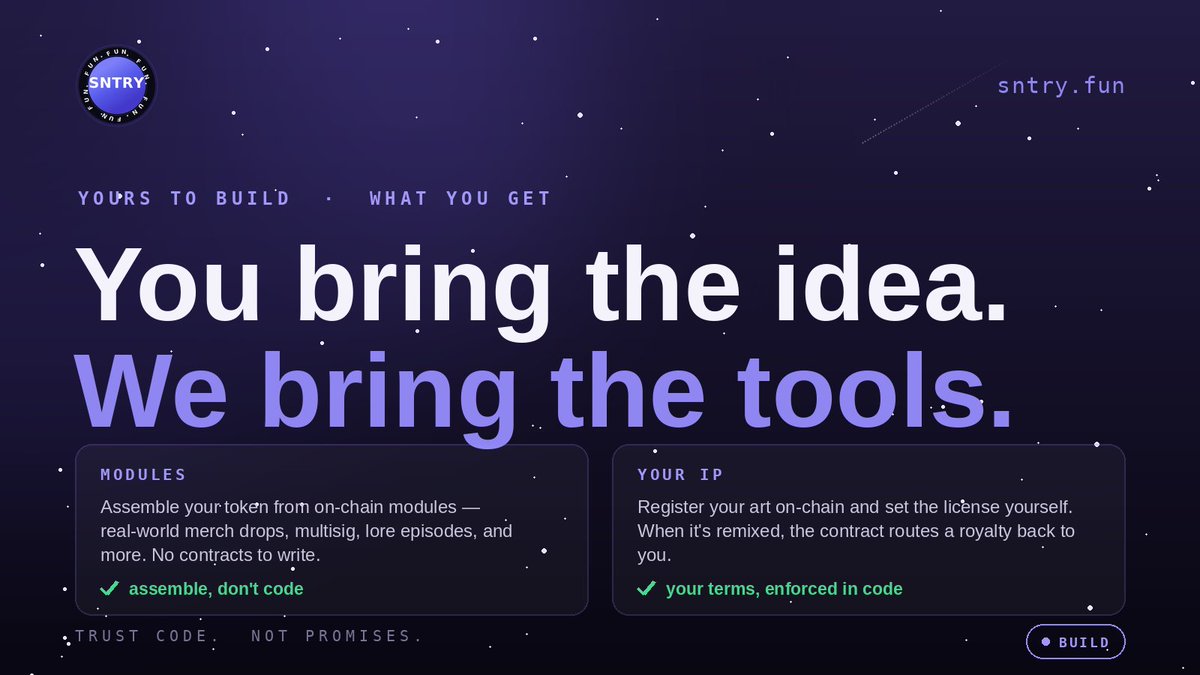
Building something real is one job. Defending it from scams, copycats, and bots is another job entirely. Most meme coin founders end up doing both alone. That second job is ours. Every token on Sntry is screened before it launches, and once it's live, a swarm of AI agents watches for threats so you can focus on the build. You get the tools, features, and modules to make something real: a token, a community, a venture, whatever you're building. All you need to do is bring the idea and the follow-through. The waitlist is open: sntry.fun
Sntry.Fun tweet media
English
0
0
0
51
Sntry.Fun
Sntry.Fun@SntryFun·
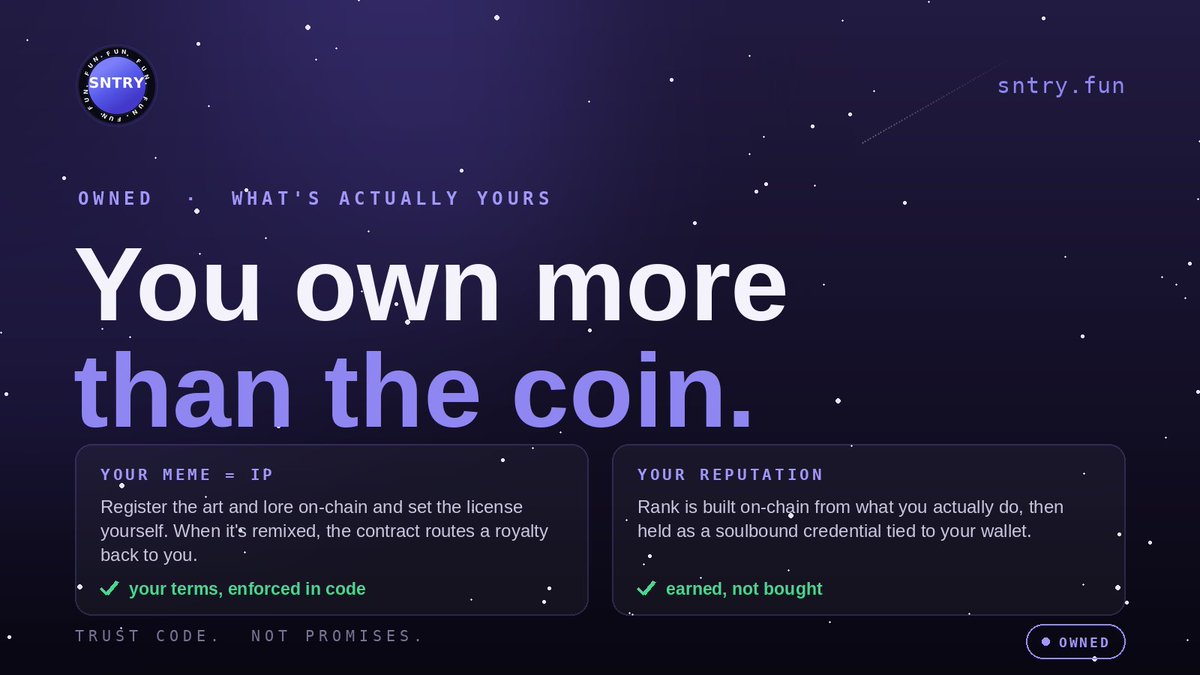
Launching a coin takes seconds, anywhere. Owning what you build around it — the meme, the reputation — is what almost no platform lets you keep. Sntry does. Your meme is IP you own. Register the art and lore on-chain and set how others can use it — from open remix to endorsement-only. When someone builds on it, credit and a small remix royalty trace back to you, automatically. Your work, your terms. Your reputation works the same way. Everywhere else, a creator's reputation is social — it lives on X, in follower counts and paid shout-outs. It's borrowed and easy to fake, and it's tied to an identity on a platform you don't control. On Sntry, reputation is on-chain and soulbound: you earn it through what you actually do here, it's tied to your wallet, and there's no buying your way in. It's all on the record, for anyone to verify. You build it, you keep it. That's ownership in the truest sense. The work you made and the name you earned — on the record, and carried from one project to the next. The public beta waitlist is open: sntry.fun
Sntry.Fun tweet media
English
0
0
2
70
Sntry.Fun
Sntry.Fun@SntryFun·
America turns 250 today. The whole idea back then was radical and simple: nobody sits above the rules, and people govern themselves better than a king ever could. That's the bet we built the arena on. Freedom isn't the freedom to get rugged. Your freedom ends where it starts costing someone else theirs. So here at sntry.fun the rules are the same for everyone, and the code enforces them, not a promise: → A per-wallet cap, so no single wallet can corner the supply → Governance by reputation, not holdings — so you have a say in where the platform goes → Your keys, your coin — self-custody by default → The rules live in the code, not in anyone's discretion → And so much more Independence you don't have to take anyone's word for. Trust code. Not promises. Public beta sign-up waitlist live at: sntry.fun
Sntry.Fun tweet media
English
0
0
2
64
Sntry.Fun retweetledi
Sntry.Fun
Sntry.Fun@SntryFun·
People tend to dismiss the meme coin market as the "crypto casino". We think they're missing the field's most honest mirror. This week we published the full argument. Here's the short version (all facts and sources cited in full article): The machine first. On the dominant venues, roughly 1% of new tokens ever reach a functioning market. Median hold time is often under two minutes. The durable surplus accrues to the infrastructure layer — the venues, the bots, the rails — while the typical participant funds it. Volume isn't adoption. It's exhaust. The standard fix was "community." But a chat channel can't supply identity, reputation, memory, or protection at the moment someone clicks buy. The social layer was asked to do a job the financial layer beneath it was built to undo. You cannot solve a structural problem with a social patch. Meanwhile regulators started getting involved: a federal taxonomy that filed meme coins under collectibles and a SEC/CFTC partnership openly asking the public for input on future regulation of the meme coin market. Permission is being granted. Protection is not being built. We've seen this sequence before — in Michigan cannabis, where the operators who built the standards first helped write the law, and the ones who waited had it written for them. That gap is the whole opportunity, and the whole risk. The rules are coming either way, and they'll be written around whatever working model exists. So we're building a working model that engineers trust at the human layer, where the losses actually happen. Protection that stands at the point of the click, not the post-mortem. A reputation and history that belong to you, that no platform can revoke. Trust code, not promises.
Sntry.Fun@SntryFun

x.com/i/article/2061…

English
0
1
2
170
Sntry.Fun
Sntry.Fun@SntryFun·
Meme coins launched on today's platforms run on promises. Every one has the same weakness: it's only as strong as the person who made it. The fix isn't better promises, or better people to make them. It's a problem to be solved at the platform level: put the rules in code, and open them for everyone to read and help shape. So Sntry is built in two halves, both run by code. The first is a security wall, so you don't have to trust strangers: every token screened before it can trade, a supply cap no wallet can exceed, live checks on every trade, and an AI swarm watching over the whole system. The second is ownership, built for the community by the community: self-custody, every rule on-chain for anyone to read, and a platform where the reputation you earn rather than the money you spend lets you propose and vote on how the platform itself changes. The wall keeps threats out. Ownership keeps everything else yours. The waitlist is open: sntry.fun
Sntry.Fun tweet media
English
0
0
1
51
Sntry.Fun
Sntry.Fun@SntryFun·
@SeintaroXyz Email sign-ups are now supported too — use phone or email at sntry.fun. Thanks for the feedback.
English
1
0
1
25
Sntry.Fun
Sntry.Fun@SntryFun·
The same story played out several times this week: a meme token rides a name, the crowd buys the name, and the wallets that got there first exit onto everyone who trusted it. It keeps happening because of where the trust sits. A name can earn attention — it was never built to keep anyone safe. A social layer grants permission; it doesn't enforce protection. When "trust me" is all that stands between a buyer and the exit, the outcome is set before they click. That's the gap we're building to close. On Sntry, protection is written into the code itself: on-chain rules, a real-time check on every trade, and a swarm of AI agents that has to agree before a token can list. So the move behind this week's damage — a few wallets holding most of the supply, then stepping out and leaving everyone with nothing — only works when you're trusting a promise. Our code doesn't ask you to. The rules are set before a token launches, they hold for everyone the same way, and you can read them before you buy. The math enforces what trust cannot. That's the arena we're building — where safety is the platform's job, not yours to vet one name at a time. The beta opens soon. Trust code, not promises. The waitlist is open: sntry.fun
Sntry.Fun tweet media
English
1
0
2
104
Sntry.Fun
Sntry.Fun@SntryFun·
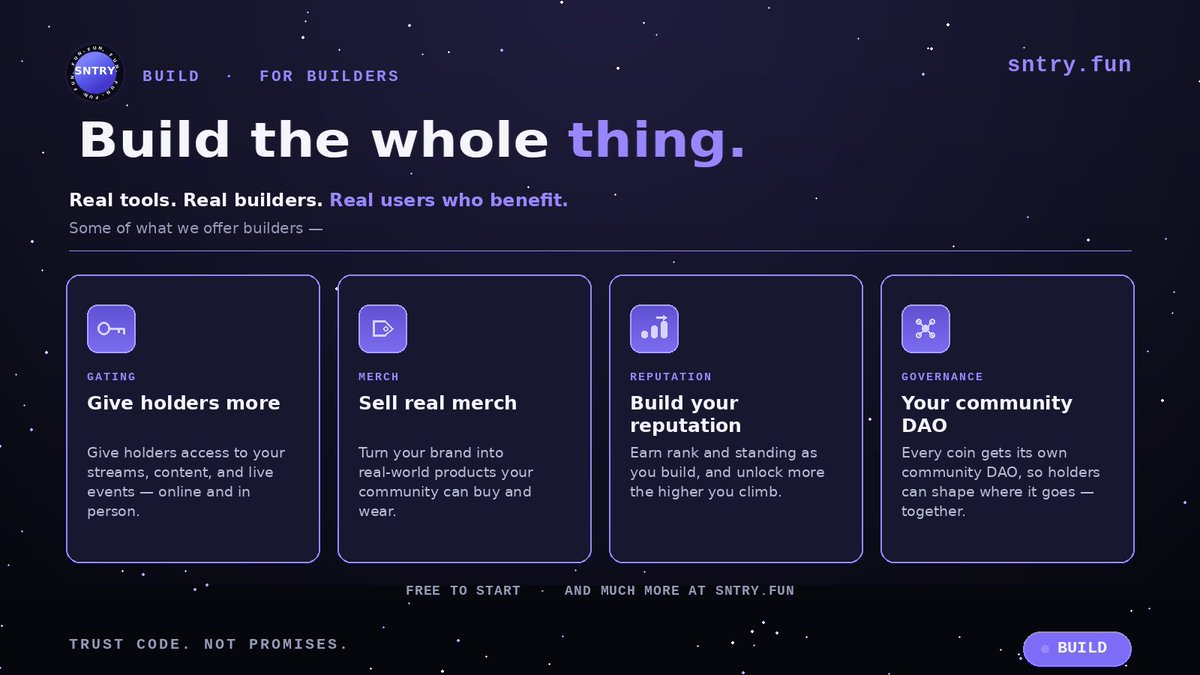
Sntry is for building more than a coin. A brand. A venture. A community with a name people know — something you launch, grow, and actually own, not just a ticker that scrolls past on a chart. You start with a token and build up from there: bring people in, give them a reason to stay, and turn it into something that lasts. Sntry gives you two things: the tools to build something new, and the structure to keep it safe — the rules every token runs on, the agents that vet each launch, handled for you. Building is the part you get to focus on. That's the arena: a secure place on Monad to make something real. The waitlist is open: sntry.fun
Sntry.Fun tweet media
English
0
0
2
77
DeltaV (scaling arc)
DeltaV (scaling arc)@DeltaV_xyz·
This Month's DeltaV Shippers Highlights 🛳🛳🛳🛳 Here's a look at some of the biggest milestones - @branchlesspay anchored 1,820 real transactions, protected 63,262 in revenue, connected 17 platforms, and submitted Shopify and Clover apps. @LeverUp_xyz recorded 154.6M in 7-day trading volume while continuing to expand its perpetual markets and trading infrastructure. @surfcashx reached 9.5K users, surpassed 300K in cumulative transaction volume, and launched onchain-history loans. @kizzymobile recorded 200K+ USD in weekly turnover following its casino launch, with 35-45% user stickiness. @PingMe_xyz completed integrations across 10,000+ merchants and introduced Ping Business for merchant settlement workflows. @STOA_XYZ ran 7,966 deliberations across 18 topics, logged 358 decisions, and anchored 1,030 memory states onchain. @SntryFun surpassed 5.1M AI security decisions while continuing beta hardening and contract testing. @AccountableData introduced a continuously verified NAV feed with cryptographic attestations and tamper-evident ledger records. @CRSHMarket crossed 800 verified users, 20K+ trading volume, and 1,000+ bets. @Lka10nft shipped an agentic operating model with seven invokable skills, signed paying B2B customers, and expanded portable enterprise deployments. That's a wrap for June.
English
8
2
35
1.4K
Sntry.Fun
Sntry.Fun@SntryFun·
@MediaMonad The constant growth of the Monad ecosystem is incredible. Glad to be apart of it
English
0
0
0
15
Monad Media
Monad Media@MediaMonad·
NOTABLE PROJECTS BUILDING ON MONAD 🔥 The Monad ecosystem is growing fast, with builders shipping innovative products across DeFi, payments, gaming, infrastructure, and consumer apps. ⚡ Projects to watch: 🔹 @0xInfinity_0 🔹 @LeverUp_xyz 🔹 @unlink_xyz 🔹 @AtlantisDEX_xyz 🔹 @SntryFun 🔹 @kizzycasino 🔹 @surfcashx 🔹 @branchlesspay 🔹 @stoa_xyz 🔹 @withengine 🔹 @captur_go 🔹 @SpringX_Finance From trading and payments to social and gaming, these teams are helping shape the future of the Monad ecosystem. 🚀 Which project are you most bullish on? 👀 #Monad #Crypto #Web3 #DeFi #Blockchain
Monad Media tweet media
Monad Media@MediaMonad

TOP TRENDING MEME ON MONAD Which one are you accumulating? 👀 $MON $MONI $IGN $CHOG $LV $BOB $ANAGO $MOLANDAK $DUST $EGG $143 $ALLOCA solana:DLGRpmkMGr7J4KD1xR5x2XjaGeQH64PLFQkyxNNSpump Did we miss any promising projects? Drop them below 👇 #Monad #MonadMedia #Crypto #Memecoin

English
10
19
66
3.3K
Sntry.Fun
Sntry.Fun@SntryFun·
Safety should be the platform's responsibility — not something handed to a social layer that was never built to enforce it. On Sntry, the protections live in the code: applied automatically, the same for every token, with no exceptions for anyone to grant or quietly revoke. Not a promise that depends on goodwill, and not a burden the community is left to carry on its own. When safety is handled at that level, building becomes the part you actually get to focus on — launching something, bringing people in, and turning it into a community that's yours to keep. That's what we're building: a secure arena for meme tokens on Monad. The waitlist is open: sntry.fun
Sntry.Fun tweet media
English
0
0
1
97