We evaluate coins all wrong.
We love to talk about protocol revenue like we’re analyzing stock market tickers.
“Look at the fees.”
“Look at the revenue.”
“Look at the fundamentals.”
Cool.
But these are not shares of a company.
Most protocols do not pay dividends. Most tokens do not entitle holders to cash flow. Most “governance” is an illusion of shareholder rights, except without the shareholder rights.
So why are we larping as TradFi analysts?
If a token captures no revenue, controls no meaningful value, and gives holders no enforceable economic claim, then protocol revenue may be great for the protocol, great for insiders, great for validators, great for market makers…
But what exactly is it doing for the token holder?
That is the question nobody wants to ask.
“Utility” gets thrown around the same way.
Utility for whom?
Utility for the average holder?
Utility for the protocol?
Utility for the team?
Utility for liquidity providers?
Utility for insiders who already own the supply?
Utility only for the scarce few B2B customers?
Because "utility" without broad usage is not a scaleable argument for adoption.
A protocol can be useful while its token is structurally useless.
A chain can have activity but yet gas fees are so low it doesn't even matter if everyone uses that chain. Not when a $50 purchase of the native coin can be a lifetime of gas fees for the average user.
A governance token can have billions in FDV while giving holders the sacred right to vote on proposals that insiders, foundations, delegates, and whales already effectively control.
That is not ownership.
The real question is not, “Does this protocol make money?”
The real question is:
Does the token own anything?
Does it control anything?
Does value actually flow back to the asset?
Is there a structural reason the token must appreciate if the protocol succeeds?
Or are you just donating exit liquidity to people who figured out token design better than you did?
The next phase of crypto valuation needs to move past surface-level “revenue” hype and start asking harder questions about ownership, control, value capture, dilution, supply structure, and who actually benefits when the machine works.
Because in crypto, the protocol can win while the token holder loses.
And once you see that, you stop asking, “What does this protocol do?”
You start asking, “What does this token own?”
If a token:
Does not act as a scarce store of value
Does not have a case for mass-market utility
Does not share revenue with holders
Then:
Be aware you are only bidding on the belief that other bidders will come after you to make the price go up.
If you find yourself doing mental gymnastics about what a token actually is in order to justify your bullish posture, it may be time to reevaluate your trade thesis.
🫡 From the depths —
The White Whale 🐋
Going forward, I will be even more vocal about @risedotrich until everyone gets tired of seeing me talk about it 😁
All my years in this space, I ve always been an advocate of innovative and exciting token models and the AVM from @nirvana_fi creates for me the absolute peak of that excitement.
This account exists for one reason: to share my opinion on anything I believe is truly groundbreaking and revolutionary and yea, I know those words are cliché in the industry but this time, I mean it literally.
What we are witnessing right now is quite unbelievable; a self sufficient protocol that combines trading and lending seamlessly and even more shockingly, for zero utility tokens. Lol
Name me a serious lending market protocol that has the confidence to whitelist their own freshly launched native token as a collateral in their lending market. NONE
The reason is simple: Volatiity concern which will ultimately lead to a lot of liquidations and the token being completely obliterated even before anyone that matter hears about it.
The AVM already makes this possible for memecoins, imagine what it could achieve for utility tokens whose underlying products generate proper revenue 😉.
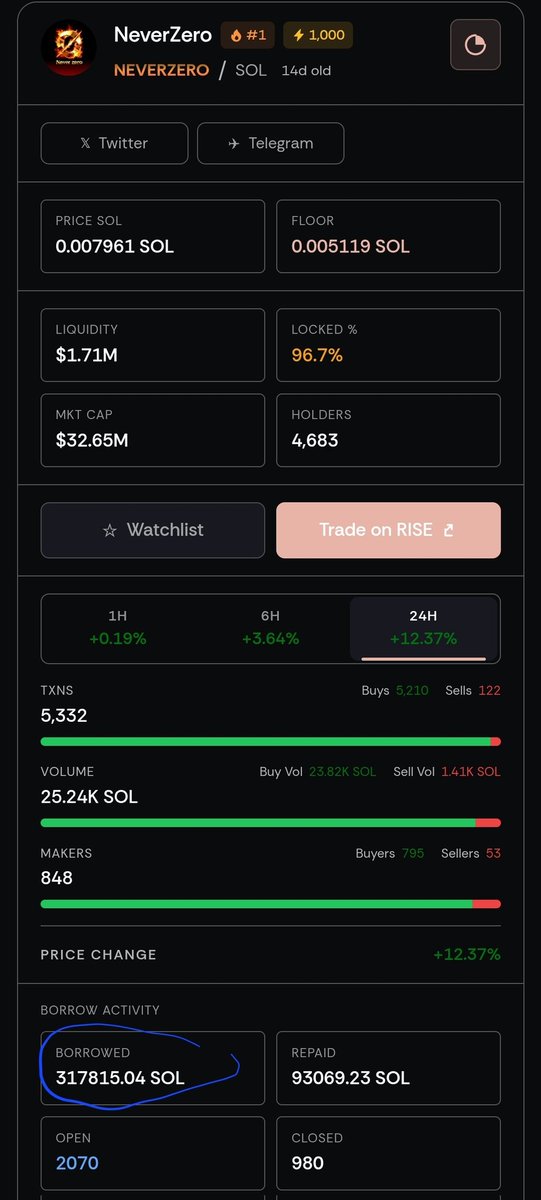
This is @NeverZeroGlobal, the biggest token on RISE by MC, it has processed over $25m loans in less than a month and nobody even knows about it (apart from the chads grinding in the Rise trenches). Protocol in turn generated over $375k in revenue just from this token.
RISE is currently the 6th largest revenue generating protocol on @solana in the last 30 days (revenue from both swaps and loans) but again, people aren't paying attention or maybe they are intentionally ignoring it lol
Everything will begin to make even more sense soon and I'll be there with my Rise affiliate badge watching the chaos unfold 😁
We’ve made our first investment in @SolveraHQ.
We see strong potential in what they’re building, real AML detection for the @risedotrich ecosystem.
Big step for safer and smarter infrastructure.
Fully bullish on their direction.
9 typologies in my engine.
Three of them are Solana-native:
LP rug removal timing.
Dev dump cadence.
Crowd escalation (the moment retail piles in
before the dump starts).
Most enterprise tools don't have these.
I built them because Solana needed them.
Every rug pull leaves the same fingerprints.
Dev wallet seeded LP from a fresh address.
Sniper bots in the first 30 seconds.
Holder count grows, then plateaus.
LP removed 4 hours later, dev wallet drains.
The pattern is older than Solana.