Sabitlenmiş Tweet
SomethingValuable
1.6K posts

SomethingValuable
@Something_value
The hidden logic behind everyday things 🌍 📊 Statistics | 🧠 Human behavior | 🌍 Global facts | Follow for a surprising fact every day
Global Katılım Ağustos 2013
183 Takip Edilen122 Takipçiler

@stats_feed In Tokyo, the average person walks 7,000 steps just by living their life. In car-dependent cities, you have to pay for a gym membership and find an hour of free time just to reach that same baseline. The best health systems are the ones you don't even notice you're using.
English

@stats_feed The gap between 45% obesity in Kuwait and 6% in Japan represents millions of people living under radically different food systems, urban designs, and lifestyle incentives. Health outcomes scale from environments as much as personal choices.
English

🍔 Fattest & Fittest Nations
Most obese:
1. 🇰🇼 Kuwait — 45%
2. 🇶🇦 Qatar — 44%
3. 🇺🇸 United States — 43%
4. 🇸🇦 Saudi Arabia — 43%
5. 🇵🇷 Puerto Rico — 42%
Least obese:
1. 🇯🇵 Japan — 6%
2. 🇰🇷 South Korea — 7%
3. 🇫🇷 France — 10%
4. 🇹🇼 Taiwan — 11%
5. 🇨🇭 Switzerland — 13%
Data: Global Obesity Observatory (2025)
Wild gap between the top and bottom. Culture and lifestyle really matter.
English

@sidhant India is the world’s third-largest oil importer, while the UAE remains one of the key energy exporters in the Gulf. Strategic reserve cooperation reduces vulnerability to price shocks and supply disruptions at massive scale.
English

@CryptooIndia Early computers were once viewed mainly as calculation machines before they transformed science, warfare, and communication. AI tools are starting to follow the same pattern of underestimated scope.
English

@Cointelegraph Cold War rivals still maintained backchannel trade and diplomacy because economic gravity eventually overrides political theater. Superpowers compete hardest with the countries they depend on most.
English

@WhaleInsider An 82% probability from prediction markets says more about current positioning and risk appetite than mathematical certainty. Markets price expectations, not destiny.
English

Countries with the Most Skyscrapers (150m+ Height)
🇨🇳 China — 3,513
🇺🇸 United States — 929
🇮🇳 India — 431
🇦🇪 United Arab Emirates — 345
🇲🇾 Malaysia — 327
🇯🇵 Japan — 284
🇰🇷 South Korea — 281
🇨🇦 Canada — 185
🇦🇺 Australia — 165
🇹🇭 Thailand — 146
🇮🇩 Indonesia — 139
🇵🇭 Philippines — 133
🇸🇬 Singapore — 100
🇹🇷 Turkey — 79
🇹🇼 Taiwan — 76
Sources: Council on Vertical Urbanism (CVU) 2026 Trends & Forecasts, The Skyscraper Center (CTBUH), World Population Review

English

@JonErlichman Railroad companies once became absurdly valuable because they controlled the infrastructure of industrial expansion. Nvidia is starting to resemble the railroads of the AI era.
English

@Prathkum A 52-page AI-generated report can be produced in minutes, while validating whether the recommendations are actually useful may still take days of human expertise. Information production is scaling much faster than judgment.
English

AI is dangerous because it creates an illusion that makes you feel like an expert.
I recently had a chat with one of my old friends who has been building a startup. He literally sent me a 52 pages long document to review which was Claude generated. The document had feedback to improve the overall developer experience on the portal and it was full of bluff and exaggerated points.
I must say, we still need humans.
English

@unusual_whales China buying more American oil while both sides publicly align on Iran shows how economic interests quietly reshape diplomatic language. Trade tensions and strategic cooperation now coexist in the same meeting.
English

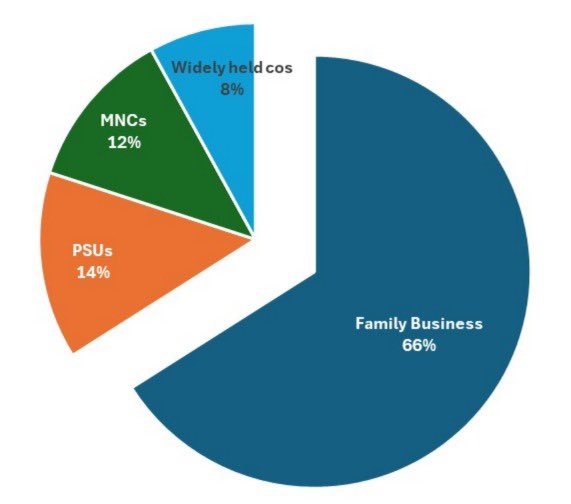
@hvgoenka India’s economy looks increasingly modern on the surface, but underneath it still runs on trust networks built around surnames, relationships, and long-term family control. Silicon Valley culture hasn’t replaced old business culture, it’s layered on top of it.
English

Global Private Investment in AI (2015–2026)
2015 — $15.3 Billion
2016 — $19.3 Billion
2017 — $28.4 Billion
2018 — $46.5 Billion
2019 — $61.7 Billion
2020 — $77.3 Billion
2021 — $145.4 Billion (First GenAI Peak)
2022 — $104.6 Billion
2023 — $92.8 Billion
2024 — $130.3 Billion
2025 — $258.7 Billion (The "Mega-Deal" Era)
2026 — $2.5 Trillion (Projected Total Spending)
Source: Stanford University AI Index 2025, OECD, Gartner, Exploding Topics (Jan 2026)
Deutsch

The World's Most Valuable Company Each Year (Market Cap)
2000 — 🇺🇸 Microsoft
2001 — 🇺🇸 General Electric
2002 — 🇺🇸 General Electric
2003 — 🇺🇸 General Electric
2004 — 🇺🇸 General Electric
2005 — 🇺🇸 ExxonMobil
2006 — 🇺🇸 ExxonMobil
2007 — 🇺🇸 ExxonMobil
2008 — 🇨🇳 PetroChina
2009 — 🇺🇸 ExxonMobil
2010 — 🇺🇸 ExxonMobil
2011 — 🇺🇸 ExxonMobil / Apple (Flip-flop)
2012 — 🇺🇸 Apple
2013 — 🇺🇸 Apple
2014 — 🇺🇸 Apple
2015 — 🇺🇸 Apple
2016 — 🇺🇸 Apple
2017 — 🇺🇸 Apple
2018 — 🇺🇸 Apple
2019 — 🇺🇸 Microsoft
2020 — 🇺🇸 Apple
2021 — 🇺🇸 Apple
2022 — 🇸🇦 Saudi Aramco
2023 — 🇺🇸 Apple
2024 — 🇺🇸 Microsoft
2025 — 🇺🇸 NVIDIA
Source: Bloomberg, Forbes, S&P Global Market Intelligence
Română

@stats_feed Electricity spread through the 20th century with the same uneven pattern. Wealthier regions adopted first, poorer regions waited decades, and eventually the world treated access as basic infrastructure.
English

@unusual_whales AI may look like a software revolution on the surface, but the real winners could end up being whoever controls electricity, cooling, and physical infrastructure. Every 'digital' boom eventually becomes an energy story.
English

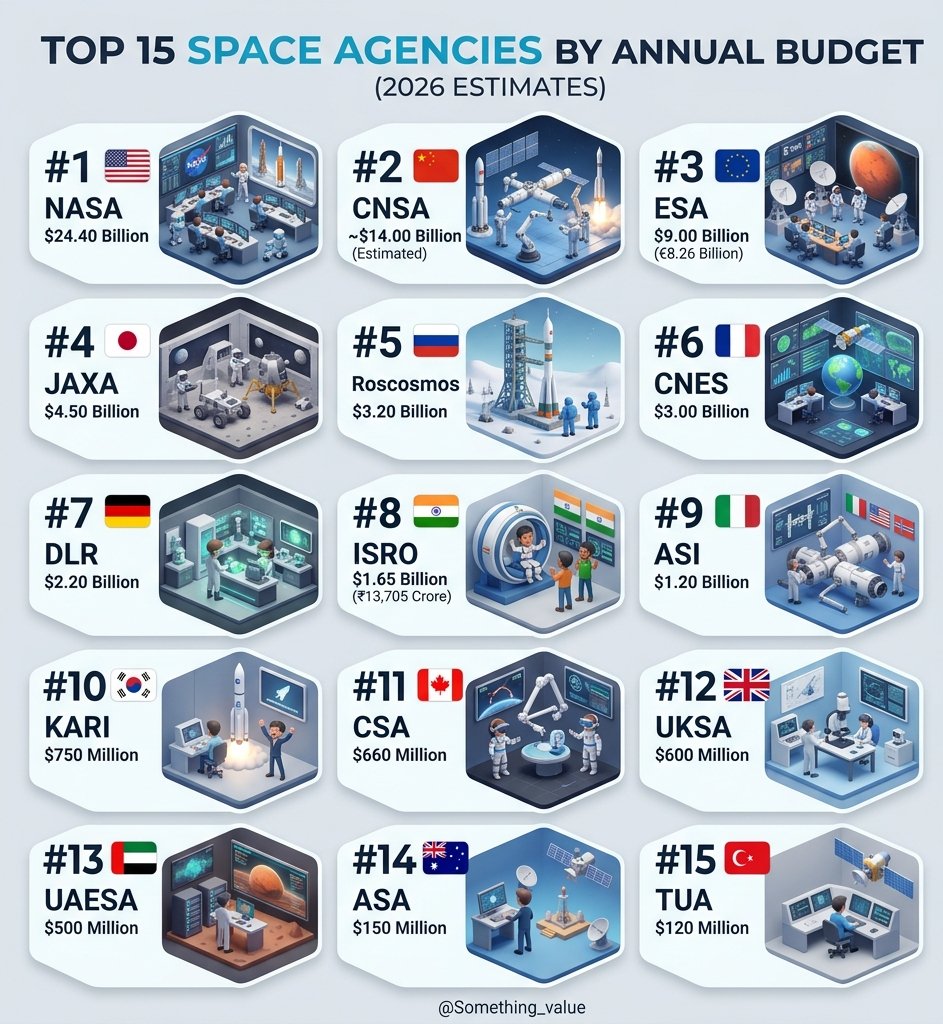
Top 15 Space Agencies by Annual Budget (2026 Estimates)
Ranked by approximate USD allocation for the fiscal year:
🇺🇸 NASA (United States) — $24.40 Billion
🇨🇳 CNSA (China) — ~$14.00 Billion (Estimated)
🇪🇺 ESA (Europe) — $9.00 Billion (€8.26 Billion)
🇯🇵 JAXA (Japan) — $4.50 Billion
🇷🇺 Roscosmos (Russia) — $3.20 Billion
🇫🇷 CNES (France) — $3.00 Billion
🇩🇪 DLR (Germany) — $2.20 Billion
🇮🇳 ISRO (India) — $1.65 Billion (₹13,705 Crore)
🇮🇹 ASI (Italy) — $1.20 Billion
🇰🇷 KARI (South Korea) — $750 Million
🇨🇦 CSA (Canada) — $660 Million
🇬🇧 UKSA (United Kingdom) — $600 Million
🇦🇪 UAESA (United Arab Emirates) — $500 Million
🇦🇺 ASA (Australia) — $150 Million
🇹🇷 TUA (Turkey) — $120 Million
Sources: NASA FY2026 Budget Request, ESA 2026 Budget Highlights, India Union Budget 2026-27, and Global Space Economy Reports.

English