Planetary Sunshade Foundation

75 posts

Planetary Sunshade Foundation banner
Planetary Sunshade Foundation

Planetary Sunshade Foundation

@SpaceSRM

Going to space to heal earth ☂️
Katılım Mart 2023
52 Takip Edilen118 Takipçiler
Scott Manley
Scott Manley@DJSnM·
So it’ll miss the moon by 40 minutes. But if we changed the orbital velocity by about 10cm/sec in 2028 we could make it hit the moon.
English
90
62
1.2K
86.4K
Planetary Sunshade Foundation
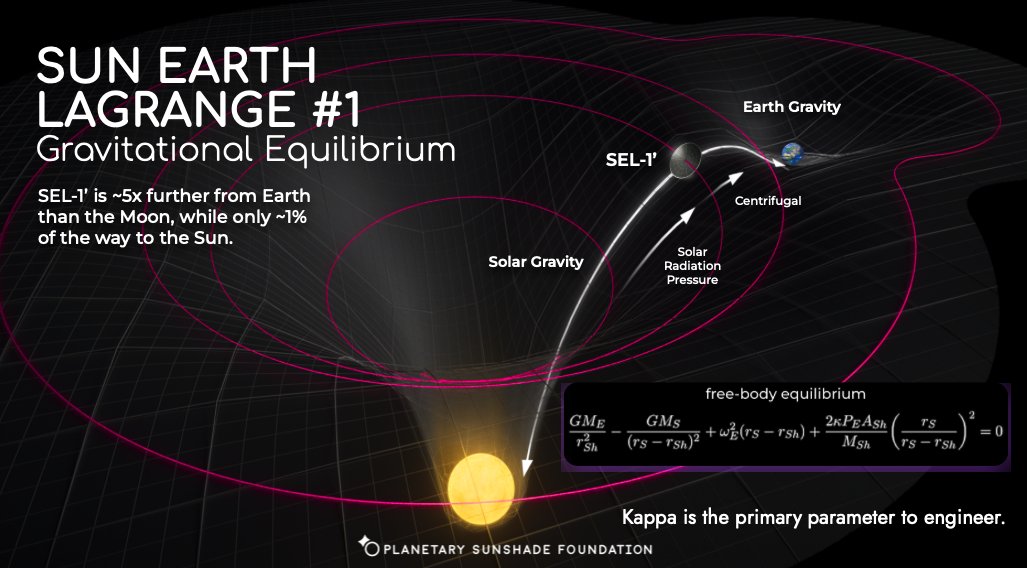
@paulgambill @jasonp One more thing Claude missed, which is important: The Solar-radiation-pressure-adjusted equilibrium point is about 50% further away from earth than the SEL1 point. This matters because further away requires more surface area for the same shading.
Planetary Sunshade Foundation tweet media
English
0
3
2
119
Paul Gambill
Paul Gambill@paulgambill·
I was talking to @jasonp the other day about the concept of a planetary sunshade for global cooling, and used the term “space mirror.” He asked why a mirror, specifically, doesn’t it only need to shade? So while asking Claude to help me understand the whole thing better, I had it make this neat little explainer for the concept. Turns out the reason is that reflective surfaces don't absorb heat, which makes them lighter and more stable. Solar sails using this principle have already been flown in space. claude.ai/public/artifac…
English
2
3
1
104
Planetary Sunshade Foundation
@paulgambill So the engineering challenge is to find a material that’s stable under the heat and radiation of space, while being minimally reflective, while also being abundant and manufacturable. A big part of what we’re working on!
English
1
1
1
50
Planetary Sunshade Foundation
@paulgambill In fact, maximizing lightness is counterproductive. The ‘balance point’ where solar radiation pressure and gravity balance gets further away if it’s too light, requiring more surface area (and mass) than if the sail was at the optimum distance for a given kappa. As shown here:
Planetary Sunshade Foundation tweet media
English
1
3
2
138
Elon Musk
Elon Musk@elonmusk·
For those unaware, SpaceX has already shifted focus to building a self-growing city on the Moon, as we can potentially achieve that in less than 10 years, whereas Mars would take 20+ years. The mission of SpaceX remains the same: extend consciousness and life as we know it to the stars. It is only possible to travel to Mars when the planets align every 26 months (six month trip time), whereas we can launch to the Moon every 10 days (2 day trip time). This means we can iterate much faster to complete a Moon city than a Mars city. That said, SpaceX will also strive to build a Mars city and begin doing so in about 5 to 7 years, but the overriding priority is securing the future of civilization and the Moon is faster.
English
26.1K
25.2K
258K
46.7M
Planetary Sunshade Foundation retweetledi
Geoengineering Info
Geoengineering Info@geoengineering1·
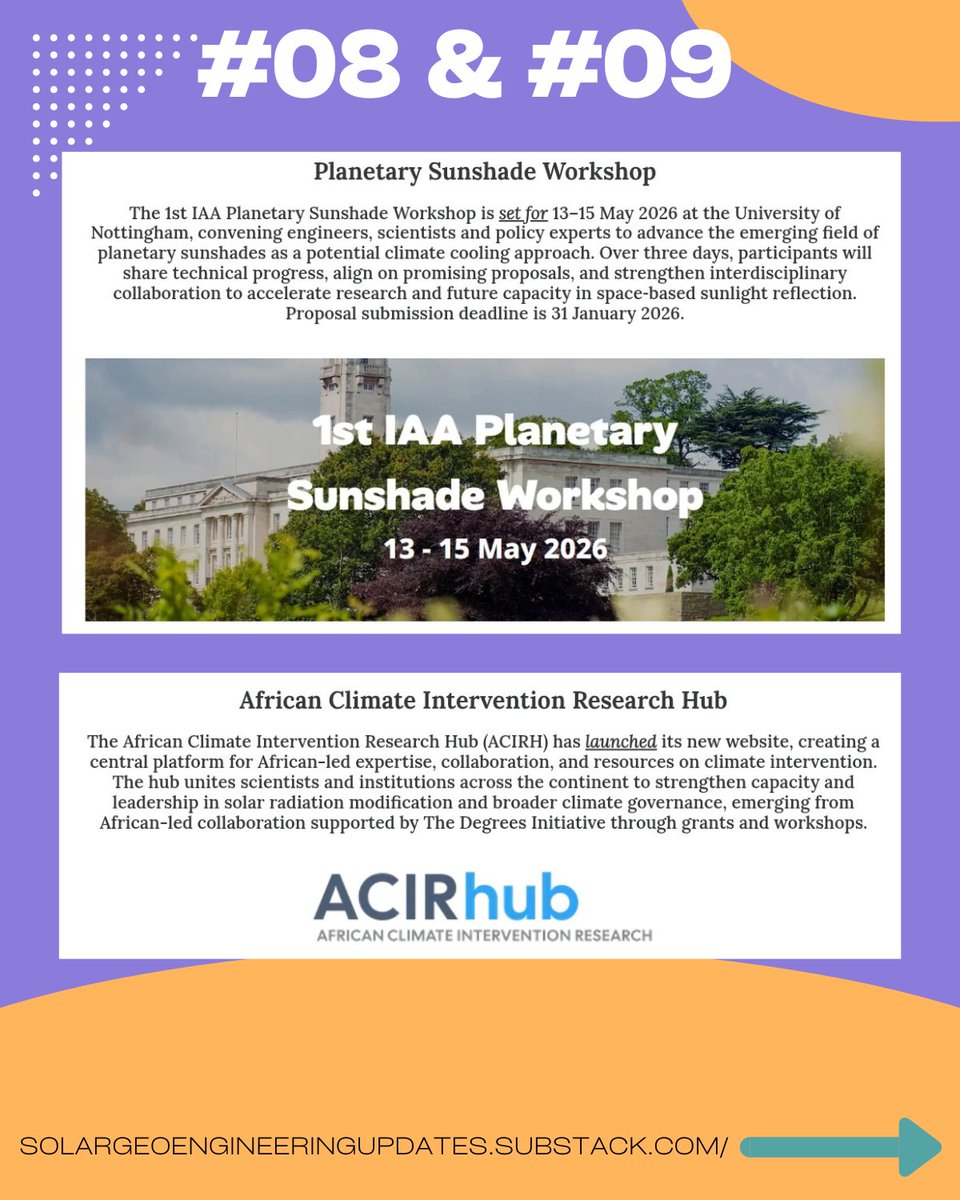
8️⃣ 1st IAA Planetary Sunshade Workshop set for May 2026, aiming to advance space-based climate cooling research and collaboration. 9️⃣ African Climate Intervention Research Hub (ACIRH) launches its website, centralizing African-led SRM expertise, collaboration, and resources. 6/
Geoengineering Info tweet media
English
1
3
2
116
Planetary Sunshade Foundation
@Sol4tr33s @satofishi Great questions. GHGs would depend on whether any of the material could be lunar. 1% sunlight reduction equals about 1 degree C global average temp, so 1% less photosynthesis in ideal conditions. But heatwaves and droughts are far from ideal conditions. So a balance.
English
0
0
0
19
Cosmic Squirrel 🌰✧🌳
Cosmic Squirrel 🌰✧🌳@Sol4tr33s·
@satofishi Interesting idea! How much greenhouse gas would be released to do that, assuming fossil fuel is used? Also, how would that impact photosynthesizers and other organisms that rely on sunlight for their natural cycles?
English
1
0
1
43
Chun
Chun@satofishi·
If we build an AI data center with total area equal to that half of the United States, it will reduce incoming sunlight enough to cancel out all current greenhouse effect from human CO₂ and other gases (~+2.2 W/m² as of 2025). If we build an AI data center at the Sun–Venus L1 point that large enough to completely block the planet from the Sun, Venus will cool down to an Earth-like ~15 °C average surface temperature in ~50000 years, with pressure dropping to ~5–20 bar as CO₂ partially condenses. Venus then becomes viable for atmospheric processing, microbial seeding, and eventual full terraforming into a third habitable world, after the Earth and Mars. The AI bubble will never burst.
Scott Manley@DJSnM

Just look at the massive radiators that aren't on there, because the whole thing is running on solar power anyway.


English
101
84
1.2K
209.3K
Jesse Peltan
Jesse Peltan@JessePeltan·
@satofishi Is this assuming L1 for Earth also? I think most plans are for SSO.
English
1
0
23
5.8K
Planetary Sunshade Foundation
@satofishi That’s if the data centers are at Sun earth L1, and it just SSO. CO2 has other negative impacts which should still drive cleaning up the atmosphere. But in the meantime…
English
0
0
0
22
Planetary Sunshade Foundation
@dranthonygustin @satofishi Reflecting 1% sunlight corresponds to about 1 degree C global average temperature. Climate scientists aren’t sure if this is a good idea but there’s a lot of research happening to try and answer that question. It might not be a stupid idea after all.
English
0
0
0
33
Anthony Gustin
Anthony Gustin@dranthonygustin·
@satofishi But what if blocking the sun from reaching the earth is really stupid?
English
5
0
12
2K
Planetary Sunshade Foundation retweetledi
Geoengineering Info
Geoengineering Info@geoengineering1·
🚨 UPCOMING EVENT 🚨 1st IAA Planetary Sunshade Workshop by @SpaceSRM 🗓️13 - 15 May 2026 📍 University of Nottingham, UK 🚨Proposal Submission Deadline: 31 January 2026 🔗sunshadeworkshop.com
English
0
3
2
116
Planetary Sunshade Foundation
Really enjoyed our conversation!
Paul Gambill@paulgambill

I spoke to @SpaceSRM this week and now I am way more hyped about how cool this could be. Gigantic space mirror fans with 40km long blades and you’d need thousands of them. 😱 No wonder everyone thinks it’s sci-fi. At the same time, all you need is financial incentive alignment and human ingenuity would take care of the rest. I’m now bullish space-based SRM in the multi-decade timeframe

English
0
0
2
100
Planetary Sunshade Foundation
@elonmusk re: SEL1 vs. LEO, it’s easier to get to L1 than LEO from the moon. L1 is the obvious place to reflect sunlight. Building out lunar industrial infrastructure, enabled by Starship, is the keyhole that we pass through on the way to Kardashev 2 while repairing the Anthropocene 8/8 🧵
English
0
0
4
119
Planetary Sunshade Foundation
@elonmusk Back to how planetary sunshades and Dyson swarms are the same thing; you’ve also been talking about the need to use lunar resources to make hundreds of terawatts of compute. This is the same scale that’s required to build a planetary sunshade to reverse global warming. 7/8 🧵
English
1
0
2
106
Elon Musk
Elon Musk@elonmusk·
A large solar-powered AI satellite constellation would be able to prevent global warming by making tiny adjustments in how much solar energy reached Earth
English
28.3K
9K
108.9K
26.4M