Spragg Performance

7.6K posts

Spragg Performance banner
Spragg Performance

Spragg Performance

@Spragg_Perform

Applying the science to the individual l Sports Science & High Performance Coaching I PhD

Austria Katılım Nisan 2016
1.2K Takip Edilen3.8K Takipçiler
Spragg Performance retweetledi
Dnlbenson
Dnlbenson@dnlbenson·
If you’re a WorldTour or ProTeam rider and still out of contract for 2026 please DM me and I’ll add you to my next feature.
English
4
11
173
30.5K
Spragg Performance
Spragg Performance@Spragg_Perform·
@SophieRHerzog @Scienceofsport An opportunity was missed by her fellow colleagues and competitors to highlight how Prévot has done things the correct way.... instead they chose a very different path
English
6
0
3
110
Sophie Herzog
Sophie Herzog@SophieRHerzog·
The weight debate in cycling is back.
Yes, it’s an important topic. But I wonder: in Men’s cycling, would we debate so much about how someone looks, instead of celebrating an incredible win? 👇🧵
English
2
0
14
1.6K
Spragg Performance
Spragg Performance@Spragg_Perform·
@MrMoelmen Always good to see more studies into training adaptations, but, 'moderate exercise' has a very specific meaning in exercise physiology - the exercise done here was not 'moderate' in nature, it was 'heavy'. Let's all please get on the same page with the terminology we use!
English
2
0
14
576
Knut Sindre Mølmen
Knut Sindre Mølmen@MrMoelmen·
1/4 🚴‍♂️ New study from @UInnlandet and #LabRønnestad in Med Sci Sports Exerc! A 7-day block of moderate-intensity intervals (MIT), followed by 6 days of active recovery, led to greater endurance adaptations than regular training in well-trained cyclists. 🔗 journals.lww.com/acsm-msse/abst…
English
4
7
45
4.2K
Spragg Performance retweetledi
Alex James Welburn
Alex James Welburn@Alex_Welburn·
A small thread on the data we presented at the cycling science conference ‘The Effect of Rate of W′ Utilisation and Acute Fatigue on W′ Reconstitution’ happy to share the presentation if anyone wants a copy as well, the abstract paper will be out later and the full paper too.
English
5
5
21
2.5K
Spragg Performance
Spragg Performance@Spragg_Perform·
@arjona_manu understand at an individual level the performance capacity at that point in time, and start to predict differences in performance between individuals
English
0
0
3
95
Spragg Performance
Spragg Performance@Spragg_Perform·
@arjona_manu Where I agree is that 'relative durability' might not reflect real world performance. The inter-individual differences in the PD relationship at a given point of fatigue does however. If we know the starting point (fresh PD) and the work accumualted then we can
English
1
0
1
155
Manuel Sola Arjona
Manuel Sola Arjona@arjona_manu·
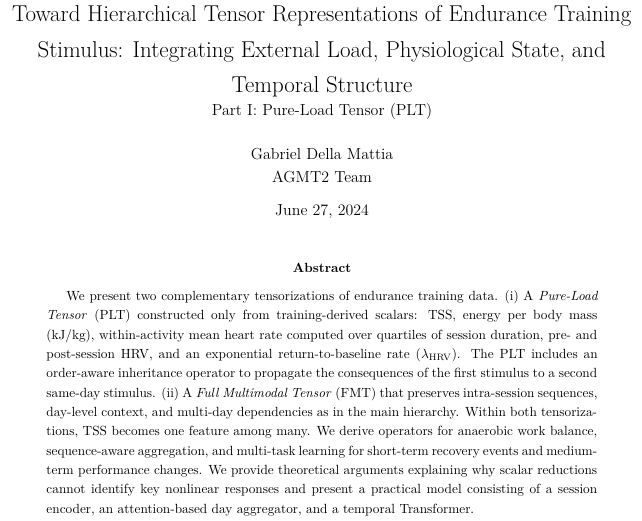
Why don’t scientific studies on durability find clear relationships between physiological variables and durability, or identify which training types improve it? Because they mostly focus on measuring relative (internal) durability.
Manuel Sola Arjona tweet media
English
2
1
28
2.3K
Manuel Sola Arjona
Manuel Sola Arjona@arjona_manu·
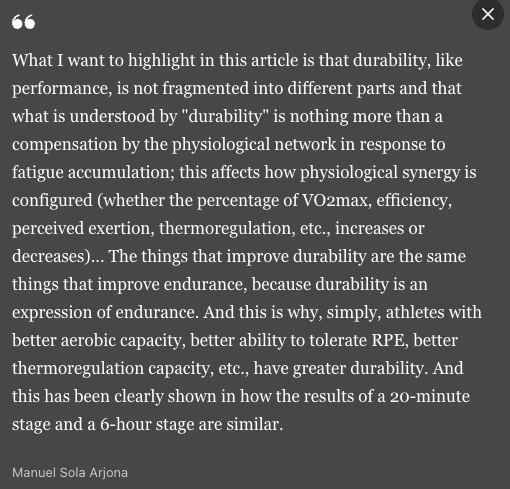
Durability is just an expression of endurance. And this is why, simply, athletes with better aerobic capacity, ability to tolerate RPE, thermoregulation, etc., have greater durability. And this has been shown in how the results of a 20m and a 6h stages are similar...
Manuel Sola Arjona tweet media
English
9
5
62
9.9K
Spragg Performance
Spragg Performance@Spragg_Perform·
@arjona_manu to complicate things, over time we see a drop in all physiological thresholds. My PhD mainly focused on CP and W' (as these are the race-winning efforts) but LT1 also decreases over time - likely this is correlated better to 'fresh' CP/LT1 values, but I don't have this data
English
1
0
1
261
Spragg Performance
Spragg Performance@Spragg_Perform·
@arjona_manu yes exactly, we see the race-winning efforts in cycling are >CP - so a mix of 'anaeorbic' and 'aerobic pathways (sic). The determinants of these >CP efforts are not the same as longer duration efforts at or <CP
English
2
0
1
392
Spragg Performance
Spragg Performance@Spragg_Perform·
@arjona_manu Therefore, with fatigue, we can see a decrease in the ability to produce these race-winning efforts >CP while still being able to produce good power at or <CP. Thus we see correlation between longer power outputs and CP but not necessarily the ability to produce >CP efforts
English
0
0
1
119