SrDevMX

63 posts

SrDevMX

SrDevMX

@SrDevMX

Katılım Ekim 2024
36 Takip Edilen3 Takipçiler
SrDevMX
SrDevMX@SrDevMX·
@Argona0x this would work for a niche problem space, for others definitely needs more contact with the outside world, which is the role that I play as a dev when using AI, I'm the one that enters the messy variability of reality into this closed system I see this having a future, yes
English
1
0
3
1.6K
Argona
Argona@Argona0x·
a 28-year-old in Berlin runs a 7-agent software factory off a remote server she approves checkpoints from her phone at midnight; her workspace has no desk, no city, no fixed machine - any screen is just a terminal she quoted $28,000 for a scope a local agency priced at $74,000 and told the client 'minimum 6 weeks.' the agents shipped a validated PR in 19 hours the agency was still revising their proposal i've been running a version of this for the past few months. the setup sounds absurd until the first time it works, and then you can't go back the factory lives on a remote VPS - always on, eight tmux panes, already mid-session. ssh in from whatever screen is nearby: laptop at home, phone on a train, tablet at a café at 1am. the environment never moves. you're just a terminal window connecting to something that was already running agencies price the way they do because their overhead is structural. a $74,000 quote on a 6-week scope is real math: account managers, a senior dev who gets rotated to a bigger client by week three, revision cycles that exist because context lives in fourteen slack threads instead of one file the factory collapses all of that into a CLAUDE.md → a 100-line markdown file at the repo root loads the entire project into every new agent session - stack, architectural rules, banned patterns - so no session starts blind and no context drifts between runs → agent one is read-only: maps the existing codebase, documents patterns, flags risks before any agent touches the code → agent two writes the user story and acceptance criteria, locking the exact definition of done before engineering starts → agent three produces the technical brief: data model changes, API shapes, a precise list of every file that will move - this locks before any builder runs → backend and frontend build in parallel but in isolation, each scoped to its own directories, so they can't reach across and corrupt each other's work → agent six writes acceptance tests against the original user story criteria before the implementation is considered complete → agent seven runs a final read-only audit: missing auth, tenant isolation gaps, any deviation from the brief gets flagged back into the loop before the pr is cut → three checkpoints pause the entire chain for human approval - story, spec, pre-merge - each one a 30-second phone tap when the upstream work was done right the 19 hours is the output. what compressed was everything underneath: the pm relaying a question to an engineer who responds two days later, the architectural mistake that only surfaces after code is written, the context drift between sessions because the memory layer is a human brain instead of a file that loads before anything runs the loop closes itself. validator flags a gap, builder fixes it, verifier confirms, pr is clean by morning the agency sent their revised proposal at 9am. the pr had been merged for 14 hours she approved the final checkpoint at midnight, 30 seconds on her phone. the agents were already done the desk, the office, the fixed machine - she left them out
Rahul@sairahul1

x.com/i/article/2058…

English
68
232
2.2K
638.9K
SrDevMX retweetledi
Ihtesham Ali
Ihtesham Ali@ihtesham2005·
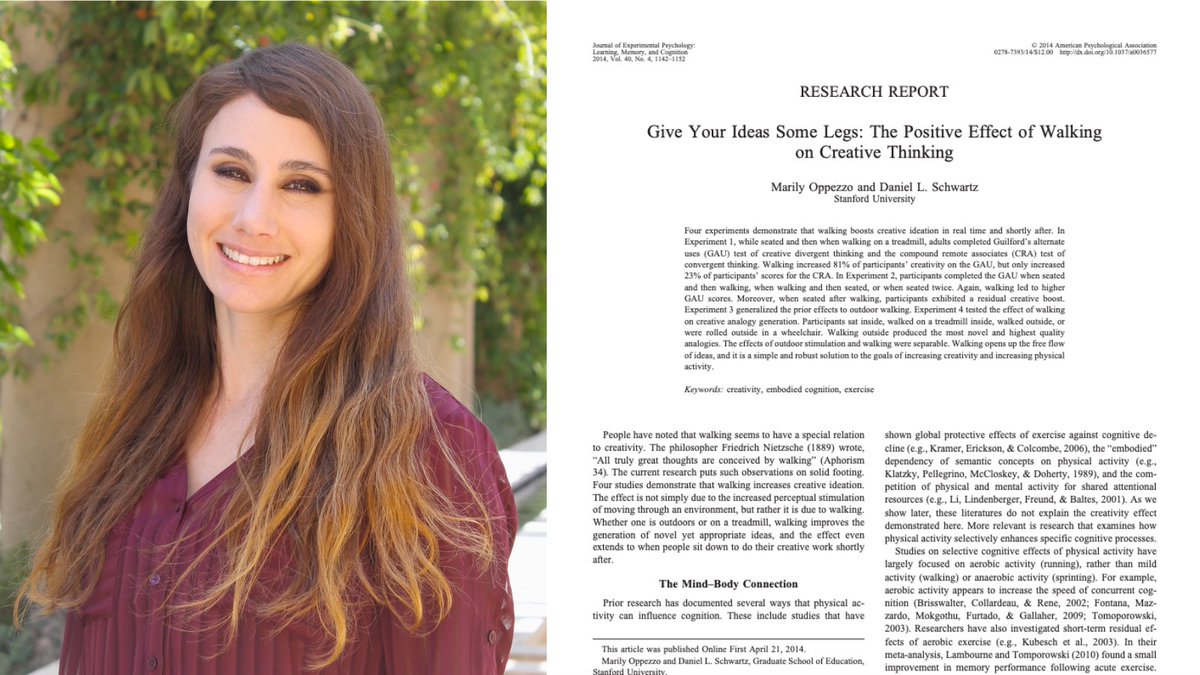
A Stanford psychologist spent 4 years proving that the simple act of walking generates 60% more creative ideas than sitting, and the experiment she designed to kill every alternative explanation is one of the most decisive findings in modern psychology. Her name is Marily Oppezzo. She got the idea for the study while walking with her advisor at Stanford to discuss her thesis topic, and the paper she eventually published in the Journal of Experimental Psychology in 2014 is sharp enough that it should have ended the seated meeting on the day it came out. She ran 4 experiments on 176 people. Same person tested twice. Once sitting, once walking. The creativity tasks were the standard ones psychologists have used for decades to measure how good a brain is at generating novel useful ideas. The result was almost too clean to publish. 81% of participants in the first experiment produced more creative ideas while walking than while sitting. In the second experiment, 88%. In the third, 100%. Every single person walked into a more creative version of themselves. On average, people generated 60% more novel useful ideas the moment their legs started moving. The skeptical question is the obvious one. Maybe it was the fresh air. Maybe it was the scenery passing by. Maybe it was the change of environment doing the work, not the walking itself. Oppezzo killed every one of those explanations with one experimental decision. She put people on a treadmill facing a blank wall. No scenery. No fresh air. No environmental change. Just legs moving in place while staring at white drywall. The 60% boost held. Then she ran the experiment that closed the case completely. She took participants outside in two conditions. Half of them walked through a Stanford courtyard. The other half were pushed through the exact same courtyard in a wheelchair. Same outdoor stimulation. Same scenery passing at the same speed. The only difference was whether the legs were moving. The walkers produced dramatically more novel high-quality ideas than the wheelchair group. The outdoors did almost nothing on its own. The walking did everything. This is the part of the study that hit hardest when I read it the first time. She also tested the opposite kind of thinking. Convergent thinking. The kind where there is one right answer and you have to narrow down to it. Word puzzles where 3 words share a hidden fourth word that connects them. The seated participants did slightly better on these. Walkers got slightly worse. Walking is not a general intelligence enhancer. It does one specific thing. It opens up the divergent search inside your brain. The part that generates options. The part that produces unexpected connections. The part that takes a problem and finds five ways into it instead of one. When you need to converge on the single right answer, sit down. When you need to find the answer in the first place, get up. The mechanism is now well understood. Walking selectively activates what neuroscientists call the default mode network, the system inside your brain that runs when you are not consciously focused on anything. The DMN is where mind-wandering happens. Where memories cross-reference each other. Where ideas that have been sitting in separate folders inside your head finally bump into each other. When you sit at a desk and force yourself to concentrate, you suppress the DMN. When you walk at a natural pace, the executive part of your brain gets just busy enough handling the walking that the DMN comes online and starts doing the work that focus was blocking. The most useful finding in the entire paper is the one almost nobody quotes. The boost did not turn off the moment people stopped walking. Participants who walked first and then sat back down stayed elevated. Their next round of seated creativity work was still significantly better than people who had been sitting the whole time. The rest lingered for at least several minutes after the legs stopped moving. You do not need to do creative work while walking. You need to walk before the creative work. The brain holds the state. The history of this is the part that should haunt anyone who still does meetings in chairs. Charles Darwin built a gravel loop behind his house in Kent called the Sandwalk and walked it 3 times a day for the rest of his life. The theory of evolution was developed one lap at a time on that path. Nietzsche walked up to 10 hours a day during the years he wrote his most important books and openly said the work was conceived on his feet. Beethoven composed for the morning and walked for 5 hours every afternoon with a pencil in his pocket for when something landed. Kahneman said the best thinking of his Nobel Prize-winning career happened on leisurely walks with Amos Tversky. Steve Jobs refused to take important conversations sitting down. He held them on foot. Every one of them was using the system Oppezzo would not measure until 2014. They just did not know what to call it. The question worth sitting with is the one almost nobody asks. Every meeting you have ever attended sitting around a table was a meeting held at a fraction of the brain power that was actually available to the people in the room. Every brainstorm that got stuck inside a conference room. Every problem you tried to solve at a desk and gave up on. Every idea you could not quite get to. The intervention is the easiest one in modern science. No supplement. No app. No subscription. No training program. Just a pair of legs and 15 minutes. The Stanford lab proved it. The philosophers knew it. The neuroscience explains it. And almost everyone reading this is still trying to think their way out of problems sitting completely still.
Ihtesham Ali tweet media
English
272
3K
11.5K
1.5M
SrDevMX retweetledi
Men Life Legacy ♠️
Men Life Legacy ♠️@menlifelegacy·
Men and women don't pay the same price for sex
English
115
891
8.4K
350.2K
SrDevMX
SrDevMX@SrDevMX·
@Dr_da_Vinci @elonmusk Apply , I'm 58 and I will apply, 40 years building software, I worked at R&D labs, enterprise, startups, I have patents
English
1
0
3
1.7K
Maj. Ron Schaefer M.D.
Maj. Ron Schaefer M.D.@Dr_da_Vinci·
I would’ve jumped at an opportunity like this when I was younger. What an opportunity to be part of what will no doubt be one of the major drives of human achievement At 67 should I go for it anyway? I am a true polymath. Here’s my background: • Pioneered 3D computer-aided drug design — featured on the cover of Science & helped create the Genesis Effect in Star Trek: Wrath of Khan • Built an Epic solution that recovered $800K/year in missed hospital revenue • NASA Mission Specialist finalist & Top Knife graduate (fighter surgeon) • Family Feud Grand Champion Thinking of applying… what do you think?
Maj. Ron Schaefer M.D. tweet media
English
110
4
445
174.7K
Elon Musk
Elon Musk@elonmusk·
SpaceX is actively hiring world-class engineers/physicists for SpaceXAI, even if you have zero prior experience in AI. Smart humans figure it out fast. Please send an email with ~3 bullet points demonstrating evidence of exceptional ability to ai_eng@spacex.com.
English
13.1K
25.2K
185K
51M
SrDevMX retweetledi
Documenting Saylor
Documenting Saylor@saylordocs·
Conor Neill literally exposed why smart people stay broke:
English
5
23
181
15.3K
SrDevMX
SrDevMX@SrDevMX·
@polydao "the gap between you and someone who knows more is usually just time" that is an oversimplification he needs to qualiy time: personal time, nights, weekends, long hours, being mentored by willing mentor, at any job they won't wait for you
English
1
0
13
3.5K
Mr. Buzzoni
Mr. Buzzoni@polydao·
Vasilios Syrakis is back after the massive success of his Atlassian video, he just dropped a follow-up addressing everything the stuff people really wanted to know: > no university degree, dropped out after 10th grade, started in help desk > taught himself everything from scratch - books, videos, no mentor > he didn't break any NDA - Atlassian published more detailed info themselves > the architecture was 10 years old - he'd build it completely differently today and the thing that hit hardest: > to everyone who felt impostor syndrome watching his first video - he said the gap between you and someone who knows more is usually just time, not intelligence the full response is above and he's building a control plane from scratch on camera soon so you can see exactly how it's done
Mr. Buzzoni@polydao

Atlassian's CEO after firing the engineer who built their $1.79B infrastructure and the guy released a 38-minute breakdown of everything he built, free for anyone to copy

English
36
215
2.6K
383.9K
SrDevMX
SrDevMX@SrDevMX·
I've just registered for Space Tech Expo USA 2026. Who else is going? I can't wait to join thousands of space manufacturing and technology professionals in the brand new location of Anaheim, CA, June 3-4. invt.io/1txb92itreo
English
0
0
0
8
SrDevMX
SrDevMX@SrDevMX·
@_The_Prophet__ Something likes this already happened in the dot com era, late 90s, for some all the gains evaporated, others cashed in.
English
0
0
0
110
SightBringer
SightBringer@_The_Prophet__·
⚡️San Francisco is experiencing the first psychological shockwave of the intelligence gold rush. This is what happens when a city built around meritocratic striving suddenly realizes the old ladder has been bypassed by a new wealth machine. The old Valley bargain was brutal but legible: be smart, work hard, join the right company, climb, vest, network, maybe found something, maybe win. AI just compressed that timeline into a lottery where a small cohort arrived at generational wealth almost overnight while everyone nearby remained close enough to smell it and far enough to feel excluded. That creates a very specific kind of torment. People are not merely jealous. They are disoriented because the map of effort to reward broke. A good engineer making $300K or $500K used to feel elite. Now that person can look across the street and see someone with similar age, similar background, similar intelligence, and similar social circle sitting on $20M to $100M because they joined the right lab at the right moment. That destroys the emotional value of a “good job.” The corporate ladder starts looking like a trap because the payoff has been visually invalidated. Why climb for twenty years when the new wealth event happened in two? Why optimize performance reviews when the real prize was getting close to the model frontier before the equity repriced? Why tolerate bureaucracy when the people who escaped into the right cap table are now post-economic? That is the psychological rupture. AI is not just automating jobs. It is automating the prestige structure that justified those jobs. Software engineers used to sit near the top of the cognitive labor hierarchy. Now they are watching code become cheaper, agents become stronger, junior work get compressed, middle management thin out, and capital flow toward a narrow set of model companies, chip companies, infrastructure platforms, and founders who can ride the wave directly. The skill that made them feel protected is becoming a tool inside the machine. That is why the malaise is so deep. The fear is not merely “will there be layoffs?” The fear is “was the whole identity trade wrong?” People sacrificed location, lifestyle, relationships, creativity, and youth for the promise that proximity to tech meant proximity to upside. Now the upside has become hyper-concentrated, and proximity alone is not enough. The middle managers are in the worst psychological position. They are too senior to become young founders easily, too encumbered to gamble recklessly, too nontechnical in the new agentic sense to feel frontier-relevant, and too expensive to feel safe. They know the coordination layer is getting attacked. AI reduces the need for people whose main function was translating, reporting, aligning, and supervising. The middle of the org chart was always vulnerable once the machine could summarize, route, draft, monitor, and coordinate. The rich being unhappy also fits the structure. Sudden wealth solves financial fear, then exposes metaphysical emptiness. Money removes the old mission. Status becomes the substitute. That is why post-economic founders keep building companies “just cuz.” They do not need the money. They need the field to keep reflecting significance back to them. Selling the company means losing the live arena where everyone wants access. They are not trapped by poverty. They are trapped by relevance addiction. That line from the founder is the whole Valley in miniature: “If I sell, I will only have money.” That is devastating because it reveals that money was never the final object. The real object was attention, centrality, momentum, being inside history while it is happening. In San Francisco, wealth without narrative can feel like exile. The city teaches people to confuse being wanted by the future with being alive.
Deedy@deedydas

The vibes in SF feel pretty frenetic right now. The divide in outcomes is the worst I've ever seen. Over the last 5yrs, a group of ~10k people - employees at Anthropic, OpenAI, xAI, Nvidia, Meta TBD, founders - have hit retirement wealth of well above $20M (back of the envelope AI estimation). Everyone outside that group feels like they can work their well-paying (but <$500k) job for their whole life and never get there. Worse yet, layoffs are in full swing. Many software engineers feel like their life's skill is no longer useful. The day to day role of most jobs has changed overnight with AI. As a result, 1. The corporate ladder looks like the wrong building to climb. Everyone's trying to align with a new set of career "paths": should I be a founder? Is it too late to join Anthropic / OpenAI? should I get into AI? what company stock will 10x next? People are demanding higher salaries and switching jobs more and more. 2. There’s a deep malaise about work (and its future). Why even work at all for “peanuts”? Will my job even exist in a few years? Many feel helpless. You hear the “permanent underclass” conversation a lot, esp from young people. It's hard to focus on doing good work when you think "man, if I joined Anthropic 2yrs ago, I could retire" 3. The mid to late middle managers feel paralyzed. Many have families and don't feel like they have the energy or network to just "start a company". They don't particularly have any AI skills. They see the writing on the wall: middle management is being hollowed out in many companies. 4. The rich aren’t particularly happy either. No one is shedding tears for them (and rightfully so). But those who have "made it" experience a profound lack of purpose too. Some have gone from <$150k to >$50M in a few years with no ramp. It flips your life plans upside down. For some, comparison is the thief of joy. For some, they escape to NYC to "live life". For others still, they start companies "just cuz", often to win status points. They never imagined that by age 30, they'd be set. I once asked a post-economic founder friend why they didn't just sell the co and they said "and do what? right now, everyone wants to talk to me. if i sell, I will only have money." I understand that many reading this scoff at the champagne problems of the valley. Society is warped in this tech bubble. What is often well-off anywhere else in the world is bang average here. Unlike many other places, tenure, intelligence and hard work can be loosely correlated with outcomes in the Bay. Living through a societally transformative gold rush in that environment can be paralyzing. "Am I in the right place? Should I move? Is there time still left? Am I gonna make it?" It psychologically torments many who have moved here in search of "success". Ironically, a frequent side effect of this torment is to spin up the very products making everyone rich in hopes that you too can vibecode your path to economic enlightenment.


English
66
117
1.1K
199.7K
SrDevMX
SrDevMX@SrDevMX·
@gridboundStory @financedystop why they would ask for a top salary if is suffice for them to earn an average salary even take a pay cut and then work 3-4 years more until they are 62? they have some financial stability, at least better than younger candidates, which they still have a mountain to climb
English
0
0
0
130
Gridbound Author
Gridbound Author@gridboundStory·
@financedystop I'm in leadership at a tech company and these guys: * cost 3x as much as average * want to rest on their laurels on only do "interesting" work * usually abuse the shit out of PTO The old heads who are competitively priced and just want to work do fine.
English
11
0
7
4.7K
Financial Dystopia
Financial Dystopia@financedystop·
A lot of Americans in the 55–65 age range are getting forced into early retirement after being laid off and replaced. He spent 35 years working in IT and suddenly got let go. It’s that brutal gap where you’re not old enough to comfortably retire with benefits, but not young enough for a lot of companies that want younger and cheaper workers.
English
462
445
3.7K
471.1K
SrDevMX retweetledi
Men of Purpose
Men of Purpose@Men_Of_Purpose·
This video will change your Life ‼️
English
0
49
263
9.2K
SrDevMX retweetledi
Calleti 🇲🇽
Calleti 🇲🇽@kalletiRey·
“Aurora mándalo a CHASM y vente conmigo” Jajajjajajaja los chilangos son la mamada.🙌🏻🤣🤣🤣
Español
712
4.3K
40.8K
461.1K
SCOTT
SCOTT@ScottSummers·
@brian_armstrong You don’t have to explain yourself bro. Fire the fuckers. Implement the ai. Move on. I own a couple businesses I don’t got time to explain myself. When they’re fired it’s a wrap. I got better shit to do. Keep growing.
English
158
3
84
55K
Brian Armstrong
Brian Armstrong@brian_armstrong·
This is an email I sent earlier today to all employees at Coinbase: Team, Today I’ve made the difficult decision to reduce the size of Coinbase by ~14%. I want to walk you through why we're doing this now, what it means for those affected, and how this positions us for the future. Why now Two forces are converging at the same time. We need to be front footed to respond to both. First, the market. Coinbase is well-capitalized, has diversified revenue streams, and is well-positioned to weather any storm. Crypto is also on the verge of the next wave of adoption, with stablecoins, prediction markets, tokenization, and more taking off. However, our business is still volatile from quarter to quarter. While we've managed through that cyclicality many times before and come out stronger on the other side, we’re currently in a down market and need to adjust our cost structure now so that we emerge from this period leaner, faster, and more efficient for our next phase of growth. Second, AI is changing how we work. Over the past year, I’ve watched engineers use AI to ship in days what used to take a team weeks. Non-technical teams are now shipping production code and many of our workflows are being automated. The pace of what's possible with a small, focused team has changed dramatically, and it's accelerating every day. All of this has led us to an inflection point, not just for Coinbase, but for every company. The biggest risk now is not taking action. We are adjusting early and deliberately to rebuild Coinbase to be lean, fast, and AI-native. We need to return to the speed and focus of our startup founding, with AI at our core. What this means To get there, we are not just reducing headcount and cutting costs, we’re fundamentally changing how we operate: rebuilding Coinbase as an intelligence, with humans around the edge aligning it. What does this mean in practice? - Fewer layers, faster decisions: We are flattening our org structure to 5 layers max below CEO/COO. Layers slow things down and create coordination tax. The future is small, high context teams that can move quickly. Leaders will own much more, with as many as 15+ direct reports. Fewer layers also means a leaner cost structure that is built to perform through all market cycles. - No pure managers: Every leader at Coinbase must also be a strong and active individual contributor. Managers should be like player-coaches, getting their hands dirty alongside their teams. - AI-native pods: We’ll be concentrating around AI-native talent who can manage fleets of agents to drive outsized impact. We’ll also be experimenting with reduced pod sizes, including “one person teams” with engineers, designers, and product managers all in one role. In short: AI is bringing a profound shift in how companies operate, and we’re reshaping Coinbase to lead in this new era. This is a new way of working, and we need to leverage AI across every facet of our jobs. To those who are affected I know there are real people behind these decisions — talented colleagues who have poured themselves into this company and our mission. To those of you who will be leaving: thank you. You’ve helped build Coinbase into what it is today, and I am sincerely grateful for everything you've done. All impacted team members will receive an email to their personal account in the next hour with more information, and an invitation to meet with an HRBP and a senior leader in your organization. Coinbase system access has been removed today. I know this feels sudden and harsh, but it is the only responsible choice given our duty to protect customer information. To those affected, we will be providing a comprehensive package to support you through this transition. US employees will receive a minimum of 16 weeks base pay (plus 2 weeks per year worked), their next equity vest, and 6 months of COBRA. Employees on a work visa will get extra transition support. Those outside of the US will receive similar support, based on local factors and subject to any consultation requirements. Coinbase prides itself on talent density. Our employees are among the most talented people in the world, and I have no doubt that your skills and experience will be highly sought after as you pursue your next chapters. How we move forward To the team that is staying, I know this is a difficult day. We’re saying goodbye to colleagues and friends you've been in the trenches with. But here’s what I want you to know as we move forward together: Over the past 13 years, we have weathered four crypto winters, gone public, and built the most trusted platform in our industry. We’ve made it this far by making hard decisions and by always staying focused on our mission. This time will be no different – nothing has changed about the long term outlook of our company or industry. And most importantly, our mission has never been more important for the world. Increasing economic freedom requires a new financial system, and we’re building it. The Coinbase that emerges from this will be more capable than ever to achieve our mission. Brian
English
5.3K
2.4K
20.1K
23.5M
SrDevMX
SrDevMX@SrDevMX·
@roberto_ruarte Hay que comprar PUTs a largo plazo de las acciones mas sobre-valuadas? Estos cierres maximos historicos se me hacen sospechosos.
Español
0
0
2
582
Roberto A. Ruarte
Roberto A. Ruarte@roberto_ruarte·
Las empresas más inteligentes del mundo están saliendo a bolsa todas al mismo tiempo. SpaceX. OpenAI. Anthropic. Databricks. Valuación combinada: cerca de $3 trillones. No salen porque necesitan la plata. Salen porque ven algo que el resto del mercado todavía no quiere ver. La última vez que este patrón se repitió fue en 2000 y en 2021. El NASDAQ cayó 78%. El 95% de los que compraron esos IPOs perdieron prácticamente todo. Pero esto no es sobre si el S&P se cae mañana. Es sobre algo más grande: el ciclo ya giró, y la mayoría está mirando hacia el lado equivocado. La Fed está expandiendo liquidez nuevamente. ($40B/mes). Ya está pasando. Las reservas bancarias tocaron mínimos de 4 años. La ventana de emergencia de la Fed tuvo uso récord. Los bancos estaban tan cortos de efectivo que tuvieron que pedir prestado a tasas de emergencia. La Fed se asustó. Prendió las impresoras. ¿Qué pasa cuando imprime? Los activos suben, las valuaciones se vuelven absurdas, y el capital inteligente ve la ventana perfecta para salir. Eso es exactamente lo que está pasando. El problema de fondo: el S&P 500 ya no representa la economía real. Si comparás el US Stock Fundamental Index contra el S&P 500, el precio sigue marcando máximos pero el fundamental lleva meses en terreno cero o negativo. Eso mismo pasó antes de 2000, de 2008 y de 2020. Y medido contra mercados emergentes, el S&P está en niveles de sobrevaluación que superan la burbuja del año 2000. Cuando ese retardo con el dólar index se cierre, el ajuste puede ser de hasta 60%. Los IPOs gigantes no son la causa. Son el síntoma. SpaceX preparando un IPO de trillón de dólares. 60x sus ingresos. OpenAI queriendo la misma valuación. Anthropic a $350 mil millones. Todas corriendo a la salida al mismo tiempo. Si son tan buena inversión a largo plazo, ¿por qué los primeros inversores están tan apurados por venderte a vos? Este patrón ya se repitió dos veces en 25 años. 1999: 457 IPOs en un año. El 86% perdía plata. El NASDAQ se cayó 78%. Pet Supplies, Accessories, and Pet Food - Pet Stores | PetSmart , Webvan, eToys desaparecieron. 2021: La Fed imprimió $4 trillones. Rivian levantó $12 mil millones sin ingresos reales y valía más que Ford y GM juntas. Para 2023, solo el 5% de las empresas que listaron cotizaban por encima de su precio de IPO. El frenesí no estaba casualmente cerca del techo. El frenesí era el techo. Acá está la parte que cambia todo: la plata no desaparece, rota. Cuando el capital se cansa de lo sobrevaluado, busca lo opuesto: lo barato, lo real, lo tangible. Los commodities contra el S&P 500 están en el punto de entrada más barato de la historia. Si el ratio vuelve a su media, es una suba de 100%. Si entramos en una crisis inflacionaria grande, 8 o 9 veces a favor de los commodities. La plata fue el activo que más subió el año pasado y todavía tiene aire. El S&P medido en oro ya está perdiendo poder adquisitivo aunque nominalmente suba. Y la joya del ciclo: Latinoamérica. Los mercados emergentes tienen un ciclo de manufactura que se está volviendo positivo de nuevo. Históricamente, cuando esto pasa, vienen movimientos muy fuertes hacia arriba. Soja con divergencias ocultas alcistas entre 2019 y 2024. Dólar australiano en piso. Metales rompiendo momentum. El capital que salga del S&P sobrevaluado tiene que ir a algún lado. Los indicadores apuntan al mismo lugar: activos reales y emergentes. La línea de tiempo. Etapa 1 ya pasó: economía débil, Fed bajando tasas, impresoras prendidas. Etapa 2 es ahora: dinero nuevo entrando, valuaciones insanas, todos sintiéndose genios. Etapa 3 viene: los IPOs grandes lanzan, el retail compra, la música para. Hay un lockup de 6 meses post-IPO. Si SpaceX y OpenAI salen en 2026, la ola de venta de insiders pega a fin de año, justo en midterms, cuando la incertidumbre política pica. El año 2 de un mandato presidencial es históricamente débil. Patrón certero en más del 90% de los casos desde 1933. Hay 5,000 acciones ya listadas con track record. Un IPO nuevo no tiene nada: sin historial, sin prueba, solo promesas y un pitch deck. El mercado probablemente vaya más arriba antes de ir más abajo. La impresión de dinero hace eso. Pero las personas más inteligentes del mundo están preparadas para venderte sus compañías a las valuaciones más altas de la historia. Se están posicionando. La pregunta útil no es "¿cuándo cae el S&P?". Es ¿a dónde va el capital cuando el ciclo cambia? La respuesta ya está en los gráficos. Línea alta = Los commodities están caros comparados con las acciones. Línea baja = Los commodities están baratos comparados con las acciones. Ahora mismo la línea está tocando el piso (el punto más bajo en décadas). Todavía estas a tiempo.
Roberto A. Ruarte tweet media
Español
57
280
1.3K
174.4K
QE Infinity
QE Infinity@StealthQE4·
Spot on: The only way this doesn’t end violently is some type of redistribution of wealth from the 1%. If the power grab from the top continues prepare for torches and pitchforks. And this is coming from a billionaire!
English
470
845
4.5K
244.7K
SrDevMX
SrDevMX@SrDevMX·
@blogdelnarcomex @grok el medicamento en caja de origen suizo, investiga para que enfermedad y que gravedad es recetado? que dan dificil es de conseguir en mexico?
Español
1
0
0
2.1K
Blog del Narco México
Blog del Narco México@blogdelnarcomex·
Tapalpa Country Club propiedades de 13 mdp en promedio, restos de comida, la cama destendida, estas son las fotos de la última morada de Nemesio Oseguera Cervantes "El Mencho" (Informacion e imagenes completas en el enlace) blogdelnarco.org/2026/02/tapalp…
Blog del Narco México tweet mediaBlog del Narco México tweet mediaBlog del Narco México tweet mediaBlog del Narco México tweet media
Español
59
346
5K
600.7K
SrDevMX
SrDevMX@SrDevMX·
@rvivek I would like to see that happening, why don't give a demo instead of talking?
English
0
0
2
462
rvivek
rvivek@rvivek·
An engineer at Anthropic wrote a spec, pointed Claude at an Asana board, and went home. Claude broke the spec into tickets, spawned agents for each one, and they started building independently. When the agent is confused it runs git-blame and messages the right engineers in Slack. By Monday the agents finished the plugin feature. That's one example of how the best engineers are shipping software right now. Developers will soon orchestrate 50 AI agents in parallel and the difference between a good engineer & a great one would come down to specs. You can't write a spec that holds up at that scale without genuinely understanding what you're building at a deeper level. The next-gen developer who understands the fundamentals, can architect well and orchestrate agent is going to be a 1000x developer!
English
283
528
7.1K
1.2M
SrDevMX
SrDevMX@SrDevMX·
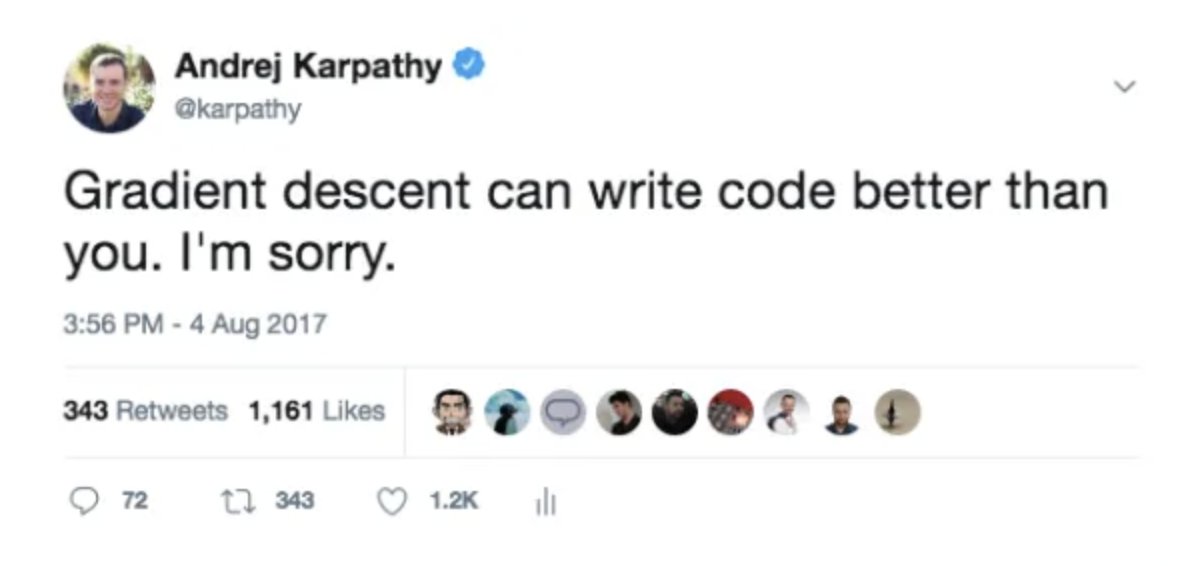
@leerob what are you understanding by this? gradient descend itself is not enough to write better code
English
0
0
0
133
Lee Robinson
Lee Robinson@leerob·
Imagine being this early
Lee Robinson tweet media
English
122
508
13.5K
547.6K
SrDevMX
SrDevMX@SrDevMX·
@CarlosLoret Parece que afortunadamente son solo coches estacionados Ojala esto se pueda limpiar pronto, y mejorar la imagen esto va a afectar al turismo
Español
0
0
1
925
Carlos Loret de Mola
Carlos Loret de Mola@CarlosLoret·
El Costco en Puerto Vallarta fue incendiado como parte de las reacciones al operativo militar en el que falleció “El Mencho”.
Español
113
1K
4.4K
226.7K
SrDevMX
SrDevMX@SrDevMX·
@Reforma son coches estacionados los que se queman,
Español
2
0
0
1K
REFORMA
REFORMA@Reforma·
En Puerto Vallarta, la tienda COSTCO fue quemada como parte de las reacciones al operativo militar en que falleció 'El Mencho'.
Español
79
1.7K
6.1K
315.9K
SrDevMX
SrDevMX@SrDevMX·
@Thedrivenman He is there to talk his book, asking the gov. for things that will pedal up his investments He didn't a say a thing about protecting the vulnerable from this savage capitalism that he is eager to unleash
English
0
0
2
158
The Driven Man
The Driven Man@Thedrivenman·
Eric Schmidt explains why Al revolution is underhyped
English
36
156
547
24.6K