
Star Walk

19.9K posts

Star Walk banner
Star Walk

Star Walk

@StarWalk

This is the official Twitter presence for Vito Technology, Inc. that developed the night sky app Star Walk! #GoStargazing with #StarWalk #AstronomyApp

Alexandria, VA Katılım Ocak 2009
447 Takip Edilen39.6K Takipçiler
Star Walk
Star Walk@StarWalk·
Ever looked at the Milky Way and realized… you’re looking at home?⁠ ⁠ That glowing band across the night sky is our galaxy seen from the inside — a vast barred spiral galaxy filled with stars, planets, gas, dust, and dark matter.⁠ ⁠ A few mind-blowing Milky Way facts:⁠ ⁠ ✦ It contains about 100–400 billion stars⁠ ✦ It stretches about 105,700 light-years across⁠ ✦ Our Solar System sits in the Orion Arm, about 27,000 light-years from the Galactic Center⁠ ✦ At the center lies Sagittarius A*, a supermassive black hole about 4 million times the mass of the Sun⁠ ✦ One orbit around the Milky Way takes the Sun about 225–250 million years⁠ ⁠ Want to see the brightest part of our galaxy? Look for the Galactic Center during Milky Way season — from March to October in the Northern Hemisphere and from February to October in the Southern Hemisphere.⁠ ⁠ For the best view: find a dark sky, avoid moonlight, check the weather, and use Sky Tonight to locate the Milky Way Center from your exact location.⁠ ⁠ Learn more about our fascinating home: starwalk.space/news/the-milky… Clear skies! 🌌⁠ ⁠ #MilkyWay #NightSky #Stargazing #Astronomy #StarWalk
Star Walk tweet mediaStar Walk tweet mediaStar Walk tweet mediaStar Walk tweet media
English
0
18
66
2.1K
Star Walk
Star Walk@StarWalk·
How You’d Die on Every Planet 🪐💀 Space is beautiful… but most of it is extremely bad at keeping humans alive. Here’s what would happen if you tried to survive on each Solar System planet without serious protection 👇 1. Mercury 🔥❄️☢️ No atmosphere means no air to breathe and almost no protection from the Sun’s radiation. During the day, you’d be roasted by extreme heat; at night, you’d freeze in brutal cold. A very efficient planet for dying in multiple ways. 2. Venus 🌫️🔥💀 Venus looks pretty, but it’s basically a planetary pressure cooker. Its thick toxic atmosphere would suffocate you, the crushing pressure would feel like being deep under the ocean, and the surface temperature is hot enough to melt lead. 3. Earth 🌦️🥴🚗 The only planet where you can breathe, drink liquid water, and complain about the weather. You’re safe here… relatively. Just watch out for stairs, showers, traffic, suspicious leftovers, and your own life choices. 4. Mars 🥶☢️🏜️ Mars is the “most survivable” after Earth, which is not saying much. Its air is too thin to breathe, the pressure is dangerously low, the cold is deadly, and the surface gets blasted with radiation. Romantic red planet, terrible vacation spot. 5. Jupiter 🌪️⚡🌀 Jupiter has no solid surface to stand on. You’d fall deeper and deeper into its atmosphere while pressure and temperature increased around you. Add violent storms, insane winds, and crushing gravity, and it’s a very dramatic one-way trip. 6. Saturn 💍🌪️🔥 Saturn may have gorgeous rings, but it also has no solid ground. Like Jupiter, it’s a gas giant: you’d sink into layers of atmosphere, get battered by extreme winds, and eventually be destroyed by pressure and heat. 7. Uranus 🧊🌫️🥶 Cold, distant, and deeply unfriendly. Uranus has an icy atmosphere made mostly of hydrogen, helium, and methane. You’d have no breathable air, and deeper layers would bring crushing pressure and freezing temperatures. 8. Neptune 🌊🌪️🥶 Neptune is the windiest planet in the Solar System, with supersonic winds that can reach around 2,000 km/h. You’d face freezing cold, no oxygen, violent storms, and crushing pressure. Beautiful blue planet, absolutely not habitable. ✨ Conclusion: Earth is not just “home” — it’s the only planet in the Solar System that doesn’t immediately try to kill you. 💬 Which planet’s death sounds the worst? 😅 #SolarSystem #SpaceFacts #Astronomy #Planets #SpaceLovers #StarWalk
Star Walk tweet media
English
3
26
115
4.7K
Star Walk
Star Walk@StarWalk·
When the Milky Way and Andromeda finally collide, what should we call the new galaxy? 👀✨ MilkyMeda? AndroWay? Or do you have a better name? These two giant spiral galaxies are expected to begin a head-on collision in about 4 billion years, and around 6 billion years from now they may merge into one huge elliptical galaxy 🌌 This simulation shows Triangulum surviving the Milky Way-Andromeda merger as a companion galaxy — although other models predict it may later become part of the crash as well. So, what’s your name for our future galaxy? Drop it in the comments 👇 Credits: Frank Summers (STScI), Gurtina Besla (Columbia University), and Roeland van der Marel (STScI) #MilkyWay #Andromeda #Space #Astronomy #StarWalk
English
6
12
41
2K
Star Walk
Star Walk@StarWalk·
Space isn’t as empty as it looks 🌌 It has no air and is almost a vacuum, but it still contains particles, radiation, gas, dust, magnetic fields, and cosmic rays. And the strangest part? Everything visible makes up less than 5% of the Universe 🤯 So what is the other 95% — and what else is hiding in the dark? Find out here: starwalk.space/news/what-is-s…
Star Walk tweet media
English
2
12
37
952
Star Walk
Star Walk@StarWalk·
☀️ One Sun. Two planets.⁠ ⁠ On Earth, it appears red at sunset — through thick air and oceans.⁠ On Mars, it appears blue — through thin dust and silence.⁠ ⁠ But it's the same Sun. Our Sun. 🌍❤️🔴⁠ ⁠ One day, humanity will live on both worlds. Not because one is better — but because people are different.⁠ ⁠ Some will stay on Earth 🌿🌊 — for the forests, the rain, the green hills.⁠ Others will go to Mars 🏜️🌌 — for the canyons, the stillness, the darker sky.⁠ ⁠ Two homes. One light. And someday — flights between them, just to visit friends who chose the other horizon.⁠ ⁠ Same Sun. Two chances.⁠ ⁠ #Sun #Mars #Earth #BlueSunrise #StarWalk
Star Walk tweet media
English
2
28
88
2.6K
Star Walk
Star Walk@StarWalk·
The world’s best Milky Way photos are in 🌌 These 5 shots are part of the 2026 Milky Way Photographer of the Year, an annual astrophotography competition celebrating some of the most stunning images of our galaxy captured around the world. This year’s selection features 25 photographs taken under some of the darkest and most breathtaking skies on Earth. But this collection is about more than beautiful pictures. It’s about the planning, patience, travel, and skill it takes to capture the Milky Way at just the right moment — over deserts, mountains, coastlines, islands, and other remote places where the night still shines brightly. It’s also a reminder that truly dark skies are becoming harder to find. As light pollution grows, photos like these show not only what is still out there, but also what we risk losing. Here are 4 stunning images from this year’s selection: 1️⃣ The Milky Way Over a Field of Lupines — Alvin Wu 2️⃣ Geminid Symphony Over La Palma’s Guardian of the Sky — Uroš Fink 3️⃣ Galactic Gandalf — Evan McKay 4️⃣ Botswana Baobabs by Night — Stefano Pellegrini Which one is your favorite? 👇 You can find more on the Capture the Atlas website.
Star Walk tweet mediaStar Walk tweet mediaStar Walk tweet mediaStar Walk tweet media
English
3
18
53
1.7K
Star Walk
Star Walk@StarWalk·
From May 13 to 15, enjoy a lovely pre-dawn lineup of the Moon and planets 🌙✨⁠ ⁠ A thin crescent Moon will appear near Saturn, Mars, and Neptune in the early morning sky. Look low above the eastern horizon before sunrise.⁠ ⁠ 🔭 Neptune will be the tricky one — at mag 7.9, you’ll need a small telescope to spot it.⁠ 👀 Saturn will be much easier to see with the naked eye, shining at mag 0.9.⁠ ❤️ Mars will also be nearby, visible to the naked eye.⁠ ⁠ A nice little morning lineup for early risers 🌌⁠ Learn more: starwalk.space/news/moon-in-c…#Moon #Saturn #Mars #Astronomy #StarWalk
Star Walk tweet media
English
5
48
97
3.4K
Star Walk
Star Walk@StarWalk·
Comet Encke is coming back ☄️ This tiny comet is one of the Solar System’s fastest regular visitors — it orbits the Sun every 3.3 years. In 2027, it will pass closest to Earth on February 3 and reach perihelion — its closest point to the Sun — on February 10. The best time to observe it is in January, when you’ll likely need a telescope. In February, Encke may become bright enough for binoculars, but it will also appear close to the Sun, making it trickier to spot. Before perihelion, Encke will be visible from both hemispheres, with better views in the Northern Hemisphere. After perihelion, it will mostly become a Southern Hemisphere target. Save this so you don’t miss it ✨ #comet #cometencke #astronomy #stargazing #starwalk
Star Walk tweet media
English
4
15
50
1.9K
Star Walk
Star Walk@StarWalk·
A realistic size comparison of the Sun and the planets of our Solar System ☀️🪐 We all know the Sun is huge — but seeing it next to the planets really puts things into perspective. Which size difference surprised you the most? 👀✨ #SolarSystem #Sun #Planets #Astronomy #StarWalk
English

3
11
32
1.4K
Star Walk
Star Walk@StarWalk·
🌍 Ever wondered where Earth ends and space begins? Let's take a quick journey up through the atmosphere: ✈️ Troposphere (0–11 km) — where we live, breathe, and where planes fly. 99% of all weather happens here. ☁️ 🚀 Stratosphere (11–50 km) — home to the ozone layer that protects us from UV rays. Commercial jets cruise at its bottom edge. 🔥 Mesosphere (50–90 km) — the "meteor burner." This is where most shooting stars burn up. Also the coldest layer: down to -90°C! ❄️ 🛸 Kármán line (100 km) — the official (unofficial) boundary of space. Above this line, aerodynamic lift becomes ineffective. Wings are useless — you need rockets. Two cool facts: 🧠 1. The Kármán line is named after physicist Theodore von Kármán. But he actually proposed ~84 km. The 100 km mark was chosen as a nice, round number! 🛰️ 2. Even at 400 km (where the ISS orbits), the atmosphere isn't completely gone. The ISS loses about 2 km of altitude every month and needs regular boosts! So next time you look up at the sky — space is just 100 km above your head. You could drive there in about an hour… if there was a vertical road. 🚗⬆️ #KarmanLine #WhereSpaceStarts #AtmosphereLayers #Astronomy #StarWalk
Star Walk tweet media
English
6
28
70
7.8K
Star Walk
Star Walk@StarWalk·
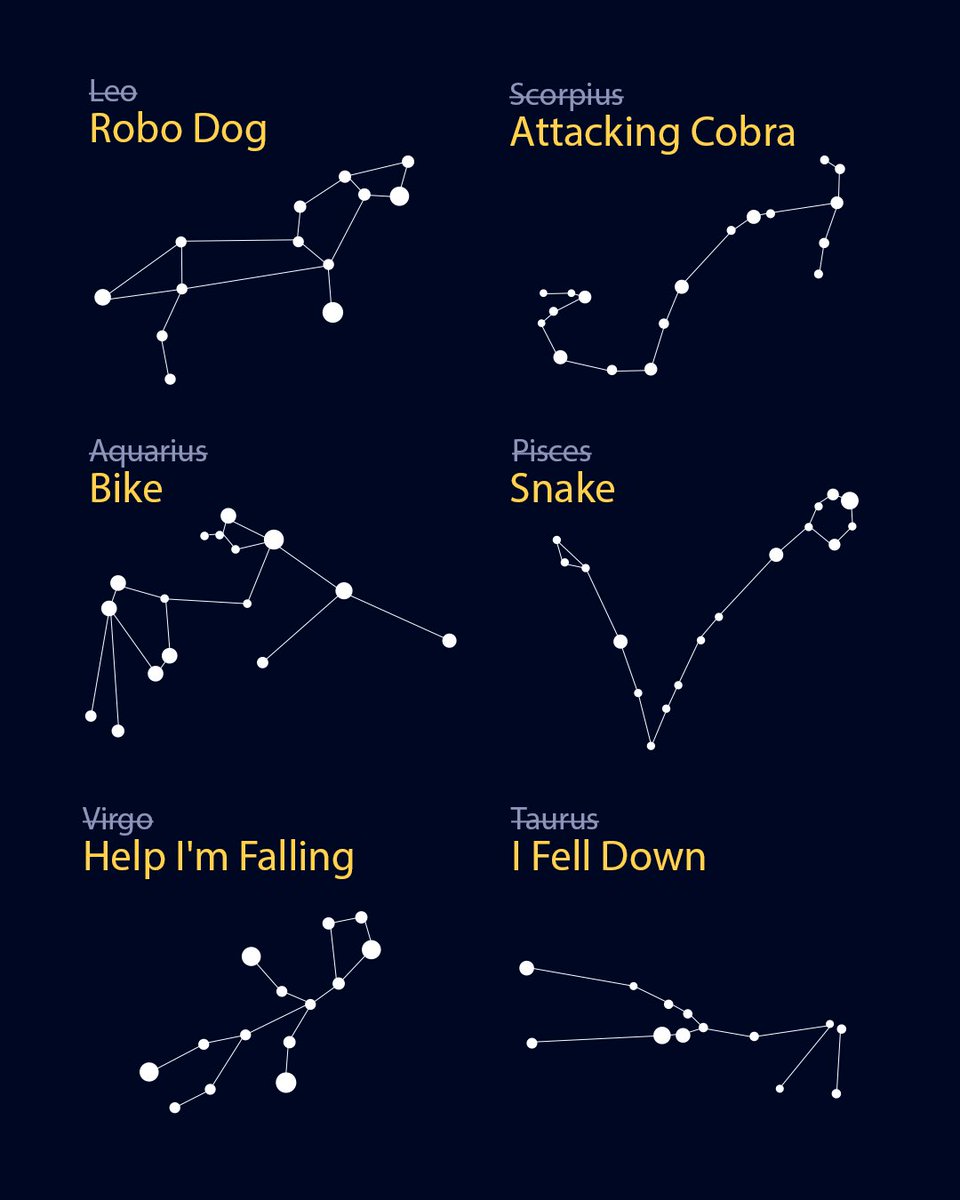
Imagine all the conversations Vincent and Jules could’ve had in that car if they were into astronomy 🚗✨ It's so cool how we all look at the same sky and somehow come up with completely different names for it 🌌 If you know any weird, beautiful, or ridiculously literal names for familiar things in the sky in other languages, drop them in the comments 👇
Star Walk tweet mediaStar Walk tweet mediaStar Walk tweet mediaStar Walk tweet media
English
0
5
26
1.3K
Star Walk
Star Walk@StarWalk·
The Eta Aquariids peak around May 6 🌠 This is May’s biggest meteor shower, best seen before dawn. Under ideal conditions, observers in the Southern Hemisphere may spot up to 50 meteors an hour, while those in the Northern Hemisphere can expect fewer. Read the guide to catch the most Eta Aquariid meteors: starwalk.space/news/eta-aquar…
Star Walk tweet media
English
0
26
66
2.5K
Star Walk
Star Walk@StarWalk·
✨ May 4: Venus, Jupiter & 8 Brightest Stars ✨ On May 4, step outside about an hour after sunset and look up — the evening sky will gather Venus, Jupiter, and eight of the sky’s brightest stars visible from mid-northern latitudes in one view. Start in the west: 💛 Venus shines low in the west-northwest 🪐 Jupiter glows higher to its upper left ⭐ Around them, you can spot Aldebaran, Betelgeuse, Sirius, Capella, and Procyon. Then sweep your gaze east: ✨ Arcturus rises in the east ✨ Spica glows low in the southeast ✨ Vega appears above the northeast horizon. Would you try to spot all of them in one evening? ⭐
Star Walk tweet media
English
0
24
75
2K
Star Walk
Star Walk@StarWalk·
📱 Modern Beliefs Be Like We question real achievements backed by science and history… but accept the most random things online without a second thought. Shrimp Jesus approves. 🦐🙏 💬 Why do you think we’re like that?
Star Walk tweet media
English
0
2
16
1.1K
Star Walk
Star Walk@StarWalk·
5 deep-sky treasures of May 🔭✨ Ready to leave the Solar System for a night? Add these targets to your observing list: 🌻 M63, Sunflower Galaxy — a bright spiral in Canes Venatici 🌀 M99, St. Catherine’s Wheel Galaxy — a grand-design spiral in Coma Berenices 💫 NGC 5882 — a tiny planetary nebula in Lupus 🌺 NGC 7023, Iris Nebula — faint visually, stunning in photos ⭐ M80 — a dense globular cluster near Antares Pick a dark spot, let your eyes adjust, and start hunting! 🌌 Find more May targets here: starwalk.space/news/deep-sky-…
Star Walk tweet media
English
2
16
51
1.6K
Star Walk
Star Walk@StarWalk·
Planets in May 2026: a quick guide 🪐✨ This month, the planets are split between the evening and morning sky: some are easy to see, while others are playing hide-and-seek with the Sun. 🌅 Evening planets Venus shines brightly in the evening sky. Jupiter is also visible a little higher up, but it gets lower toward the horizon as the month goes on. 🌄 Morning planets Mars and Saturn appear low in the morning twilight and slowly becomes easier to catch through the month. Neptune can be seen before sunrise too, but don’t expect to casually spot it: this one needs a telescope. 🙈 The tricky ones Mercury gets harder to see as it moves closer to the Sun, reaches conjunction on May 14, and then starts shifting into the evening sky. Uranus is also difficult this month: it reaches solar conjunction on May 22 and spends much of May too close to the Sun’s glare. ⏰ A quick note about the times on the slides: The Northern Hemisphere slide uses New York as the reference location, and the Southern Hemisphere slide uses Sydney. Exact viewing times depend on where you are. Save this for your May planet hunt — and may your horizon be clear 👀✨
Star Walk tweet mediaStar Walk tweet media
English
2
31
94
3.2K
Star Walk
Star Walk@StarWalk·
May 2026 starts with a Full Moon, ends with a Full Moon, and brings a few lovely highlights in between ✨ 🌕 May 1 — Full Flower Moon May begins with the Flower Moon — the Full Moon traditionally named after all the blooming happening in spring. This one is also a Micromoon, so it may look a tiny bit smaller than usual. ☄️ May 6 — Eta Aquariid meteor shower peaks This shower is created by dust from Halley’s Comet and can bring up to 50 meteors per hour. The Moon will be 83% illuminated, so its bright light may wash out some meteors. Still worth a try — especially if you can hide the Moon behind a tree, hill, or building. 🌑 May 16 — New Moon No moonlight means darker skies — perfect for deep-sky observing. It’s also a great moment to wrap up galaxy season and enjoy those faint fuzzy beauties before summer objects fully take over. Look for the Sunflower Galaxy, the Black Eye Galaxy, M106, or the Cat’s Eye Galaxy. ✨ May 20 — A lovely lineup in Gemini After sunset, Gemini puts on a small but very pretty show: Venus shines near the open star cluster M35, while Jupiter, Pollux, and the thin crescent Moon gather nearby. Easy naked-eye sight with bonus points for binocular observers. 🌕 May 31 — Blue Moon May ends with another Full Moon — a Blue Moon, meaning the second Full Moon in one calendar month. It’s also a Micromoon and the smallest Full Moon of 2026. Sadly, it won’t actually be blue… astronomy names do love a plot twist. Save this for your May sky plans — and don’t forget to look up 👀✨
Star Walk tweet media
English
1
43
104
3.9K
Star Walk
Star Walk@StarWalk·
May’s first Full Moon is here! 🌕🌸 The Flower Moon reaches its peak on May 1, 2026. Look for it in Libra and get ready for a second Full Moon coming later this month! Read more: starwalk.space/news/full-moon…
Star Walk tweet media
English
0
13
50
1.6K
Star Walk
Star Walk@StarWalk·
✨ What are the best constellations to see in May? May’s night sky brings some beautiful targets — from famous patterns like Crux and Virgo to fainter gems like Canes Venatici and Coma Berenices 🌌 In our guide, we’ve collected 7 constellations (+ a bonus asterism) best seen this month, their brightest stars, notable deep-sky objects, and a helpful May night sky map. Learn more: starwalk.space/news/may-const… #Stargazing #Astronomy #NightSky #Constellations #StarWalk
Star Walk tweet mediaStar Walk tweet mediaStar Walk tweet mediaStar Walk tweet media
English
1
26
90
2.9K
Star Walk
Star Walk@StarWalk·
Space tourism is real in 2026 — but it’s still very far from an ordinary vacation.⁠ ⁠ Today, there are two main ways private travelers can “go to space”:⁠ ⁠ Suborbital flights take passengers to the edge of space, about 80–100 km above Earth. The trip is short, with a few minutes of weightlessness and a view of our planet from above. Prices start at around $750,000 per seat.⁠ ⁠ Orbital missions are much longer and more complex. Travelers spend several days in orbit or even visit the ISS — but the price can reach $55–70 million.⁠ ⁠ So yes, space tourism is no longer science fiction. But for now, it remains a rare and expensive experience for a very small number of people.⁠ ⁠ Would you take a flight to space if you could? 🚀⁠ Learn more: starwalk.space/news/space-tou…#SpaceTourism #SpaceTravel #Astronomy #SpaceNews #StarWalk
Star Walk tweet media
English
0
4
23
1K