Starbeard

50 posts

Starbeard banner
Starbeard

Starbeard

@Starbeardx

Crafting

Ark Engine Katılım Kasım 2024
1.7K Takip Edilen198 Takipçiler
Starbeard
Starbeard@Starbeardx·
Nobody is talking about $SPIR and I genuinely don't understand why. Everyone's debating $PL vs $BKSY vs $SATL , Let me fix that. The comp table that should make your jaw drop: $PL → 11B market cap. Satellite imagery only. $BKSY → 1B market cap. Satellite imagery only. $SATL → 710M market cap. Satellite imagery only. And then we have our boy $SPIR → 445M market cap. The 2nd largest commercial satellite constellation after SpaceX, and the largest constellation by number of sensors. Now let me tell you what $SPIR actually does that nobody talks about: ✅ SIGINT radio frequency intelligence from orbit ✅ Missile defense tracking ✅ GPS spoofing & jamming detection ✅ Weather forecasting (NASA/NOAA) ✅ Hyperspectral atmospheric profiling (HyMS first light Jan 2026) ✅ Space-as-a-Service host YOUR payload on their constellation ✅ IoT connectivity from space ✅ Actively engaged with 17 sovereign nations TODAY This isn't an imagery company. This is the intelligence layer of space. The Q4 2025 numbers: 📈 Revenue ex-maritime: +44% YoY, +36% sequential 💰 $81.8M cash — ZERO debt 🛰️ 21 satellites launched/shipped in Q4 alone with 10 more at Vandenberg launching THIS month 📊 2026 guide: $75-85M, +50% growth at midpoint with 75% of low-end already contracted 🎯 EBITDA breakeven target: Q4 2026 📈 Gross margin target at scale: 60-70% The NATO math nobody is running. NATO countries pledging 5% of GDP to defense. If just 5% of that goes to space = $17-32 BILLION per year in new contracts. Iran fired on Diego Garcia. Europe just discovered it has no anti-missile defense. SPIR is pre-positioned on SHIELD, already engaged in 17 nations, and has the ONLY deployed multi-mission constellation doing this today. Who tracks the missiles and jamming signals from orbit? $SPIR. The weather intelligence moat. In January 2026 SPIR achieved first light on their Hyperspectral Microwave Sounder 1,000+ sensing channels for temperature, humidity, and water vapor. NASA, NOAA, the US Air Force, and US Navy are ALL integrating this data. $11.2M NOAA contract. €3M EUMETSAT renewal. WildFireSat with 72M from Canada. The weather business alone is arguably worth more than the current market cap. The manufacturing moat. US facility AND EU facility manufacturing sats and able to make 300+ in a year. EU data sovereignty compliance. NATO ally manufacturing requirements. Transatlantic trust for the most sensitive intelligence customers. Analyst price targets: Current price: $12.82. Every single analyst covering this stock says it's undervalued. The stock is +34% in March alone and STILL hasn't reached the lowest target on the Street. $PL does satellite imagery: $11B market cap. $SPIR does radio + weather + SIGINT + missile defense + spoofing detection + forecasting + IoT + HyMS + Space-as-a-Service + WildFireSat + 17 sovereign nations + SHIELD $151B IDIQ + zero debt + 2nd largest commercial constellation in orbit + largest constellation by sensors. Market cap: ~$445M. Either every other space company is massively overvalued, or $SPIR is the most mispriced asset in the entire space sector. I know which one I believe $SPIR 🛰️
English

6
23
141
4.3K
Starbeard retweetledi
Shanaka Anslem Perera ⚡
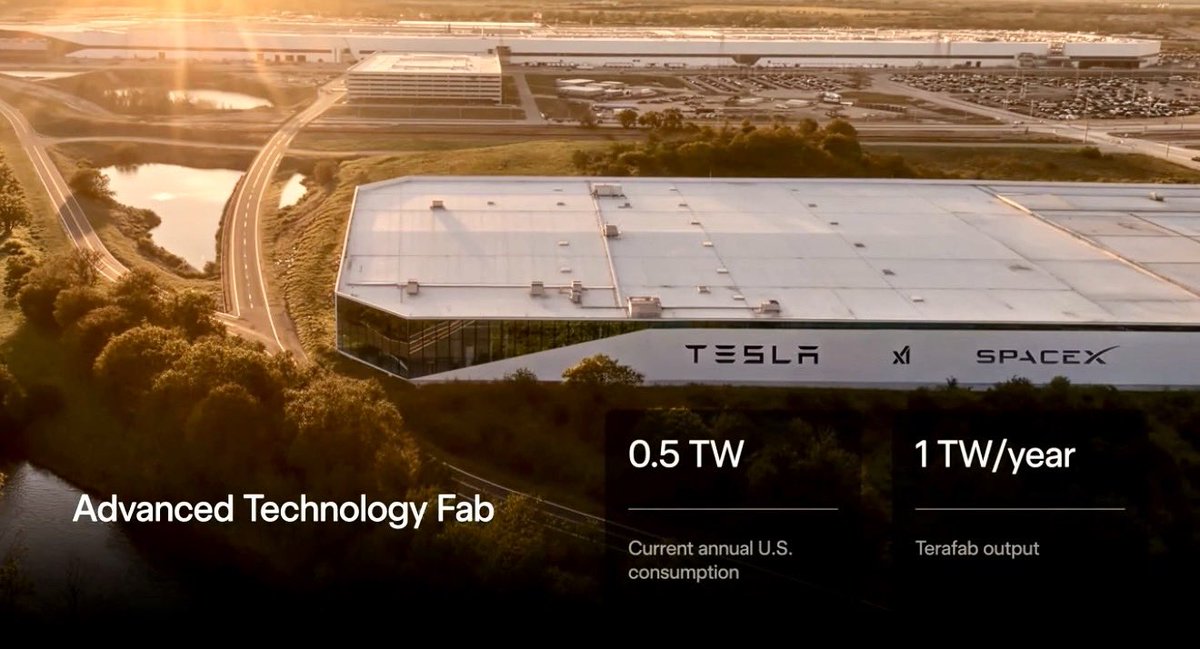
Everyone is covering Terafab as a chip factory. It is not a chip factory. Last night in Austin, Elon unveiled a facility that makes masks, fabricates chips, and tests them inside a single building with a nine-month recursive improvement cadence. No such loop exists anywhere else on Earth. Then he told you 80% of the output goes to space. Then he showed you a 100-kilowatt AI satellite with solar panels and radiators, scaling to megawatt range. Then he said Optimus plus photovoltaics will be the first von Neumann probe, a machine capable of replicating itself from raw materials found in space. Nobody connected the sequence. Terafab produces 1 terawatt per year of compute. The entire United States consumes 0.5 terawatts of electricity. Musk is building a single factory whose output in AI silicon exceeds twice the power consumption of the country it sits in. And he is sending 80% of it off-planet because Earth literally cannot power what he is building. Follow the mechanism. Terafab seeds the chips. Starship launches Optimus robots and solar arrays at 100 million tons per year. The robots mine lunar and asteroid regolith for silicon, iron, and nickel. They 3D-print more robots. They fabricate more solar panels. They assemble more AI satellites. Each satellite runs hotter-burning D3 chips designed specifically for vacuum, where free radiative cooling eliminates the thermal constraints that strangle every terrestrial data center on the planet. The nodes replicate. The replication is exponential. This is a Dyson Swarm bootstrap hidden inside a semiconductor announcement. The math is public. The Sun outputs 3.828 times 10 to the 26th watts. A 2022 paper in Physica Scripta calculated that 5.5 billion satellites at 290 kilograms each, robotically manufactured from Mars resources, capture enough solar energy to meet all of Earth’s power needs within 50 years. A 2025 paper in Solar Energy Materials calculated a partial swarm capturing 4% of solar output yields 15.6 yottawatts, roughly a billion times current human civilization’s total energy budget. Musk just announced the factory that builds the chips that go inside the satellites that replicate themselves forever. 92% of advanced logic chips are fabricated in Taiwan. One factory in Austin does not fix that. But one self-replicating system seeded by that factory, launched by the only company with reusable heavy-lift rockets, assembled by the only humanoid robot in mass production, and powered by the only star within reach, does not fix a supply chain. It obsoletes the concept of supply chains entirely. The market priced this as a $20 billion capex story about semiconductor independence. The actual announcement was the engineering blueprint for Kardashev Type II. Humanity sits at 0.73 on the Kardashev scale. 18 terawatts. The distance between here and harnessing a star is not a technology gap. It is a recursion gap. And recursion is exactly what a single building in Austin that makes its own masks, builds its own chips, tests its own chips, and launches the output into orbit on its own rockets was designed to close. Every civilization that makes it past this point never looks back.
Shanaka Anslem Perera ⚡ tweet media
SpaceX@SpaceX

TERAFAB: the next step to becoming a galactic civilization Together with @Tesla & @xAI, we're building the largest chip manufacturing facility ever (1TW/year) – combining logic, memory & advanced packaging under one roof

English
486
1.8K
9.1K
985K
Vikranth
Vikranth@VikranthJonna·
I think SpaceX is pushing spacecraft design to its absolute limits here. By having a solar array and radiators tens of meters long and it to be stowed into the same volume as the bus - is just crazy. Fun fact with solar arrays is that as you increase the size your W/kg needs to be maintained. While your cells contribute less to the entire mass of the panel - what contributes is the substrate (which is usually honeycomb core). I wonder what SpaceX is doing to acheive this (if at all mass is a constraint for them). This has already been implemented on Starlink satellites to some extent.
Vikranth tweet mediaVikranth tweet media
English
11
20
357
26.6K
Starbeard
Starbeard@Starbeardx·
How much will it cost to rewire oil and gas west instead of via Hormuz? Or how much will it cost in the long run to secure the Hormuz? It will be 25+ billion just to rebuild the damage with a possibility of a few drones destroying it again. Time to build solar farms in space #ASTI
English
0
0
0
24
Starbeard
Starbeard@Starbeardx·
@ClimbClimbHigh 250x is now the base case, we just need company news to start 🚀
English
0
0
0
50
Solar
Solar@ClimbClimbHigh·
$ASTI “a billion solar panels” See y’all at $50
Balaji@balajis

I'm going to make some obvious points. (1) Blowing up all the oil infrastructure in the Middle East is an insane idea, and may well result in a global economic crash and humanitarian crisis unrivaled in the lives of those now living. We're talking about the price of everything everywhere rising, from food to gas, at a moment when inflation was already high. All of that will be laid at the feet of the authors of this war. (2) The antebellum status quo of Feb 27, 2026 was just not that bad, but we're unlikely to return to it. Expect indefinite, long-term, ongoing disruptions to everything out of the Middle East. (3) Also assume tech financing crashes for the indefinite future. The genius plan to get the Gulf states caught in the crossfire has incinerated much of the funding for LPs, for datacenters, and for IPOs. Anyone in tech who supported this war may soon learn the meaning of "force majeure" as funding gets yanked. (4) Many capital allocators will instead be allocating much further down Maslow's hierarchy of needs, towards useful basic things like food and energy. (5) It's fortunate that all those progressives yelled about the "climate crisis." Yes, their reasoning about timelines was wrong, and much of the money was wasted in graft, but the result was right: we all need energy independence from the Middle East, pronto. It's also fortunate that Elon and China autistically took climate seriously. Now they're going to need to ship a billion solar panels, electric vehicles, batteries, nuclear power plants, and the like to get everyone off oil, immediately. (6) It's not just an oil and gas problem, of course. It's also a fertilizer problem, and a chemical precursor problem. Maybe some new sources will come online at the new prices, but it takes time to dial stuff up, particularly at this scale, so shortages are almost a certainty. That said, China has actually scaled up coal-to-chemicals[a,c] (C2C), and there's also something more sci-fi called Power-to-X[b] which turns arbitrary power + water + air into hydrocarbons. But all of that will need to get accelerated. I have a background in chemical engineering so may start funding things in this area. (7) Ultimately, this war is going to result in tremendous blame for anyone associated with it. It's a no-win scenario to blow up this much infrastructure for so many people. Simply not worth it for whatever objective they thought they were going to attain. But unless you're actually in a position to stop the madness, the pragmatic thing to do is: scramble to mitigate the fallout to yourself, your business, and your people. [a]: reuters.com/business/energ… [b]: alfalaval.com/industries/ene… [c]: reuters.com/sustainability…

English
1
3
15
3.5K
Starbeard retweetledi
Elon Musk
Elon Musk@elonmusk·
Welcome! Orbital space centers and mass drivers on the Moon will be incredible.
Jason Ginsberg@JasonBud

I’m proud to be joining SpaceX and xAI with @milichab It has become clear that software is changing fundamentally. More and more, people can shape the tools they use directly, and the ceiling of what can be built keeps rising. What makes xAI special is the scale of its ambition: to build from first principles all the way out to the stars. I’m especially grateful to work on products that expand human agency and freedom. That mission is deeply personal to me. My family came to the United States fleeing communism, and the belief that freedom should be part of the next generation of the internet has driven me every day since Andrew and I started Skiff. Now, we get to work on intelligence, understanding, and freedom on a universal scale.

English
2.4K
4.3K
43.7K
45.5M
Starbeard retweetledi
Jürgen Nauditt 🇩🇪🇺🇦
Jürgen Nauditt 🇩🇪🇺🇦@jurgen_nauditt·
Europe is a military dwarf – rich, but ridiculously weak. $550 billion in defense spending in 2025 – more than China, 60% of the US budget – and yet it achieves only a fraction of the same combat power. The result: practically nothing. Fourteen main battle tank models instead of one, 24 torpedo types instead of three, 16 submarine types instead of four. Europe produces collector's items instead of modern weapons systems – expensive duplicates, tiny production runs, astronomical prices. Only 2.5% of the budget goes to research and development – ​​the US manages 13%. No wonder it lags behind with AI drones and hypersonic weapons. Moritz Schularick's (President of the Kiel Institute for the World Economy) conclusion is mercilessly accurate: We are doomed to remain inefficient – ​​a continent that pays a high price for its own impotence. A tragedy of bureaucracy and national ego.
English
117
311
2K
124.6K
Starbeard retweetledi
Tut C🅰️pital
Tut C🅰️pital@kingtutcap·
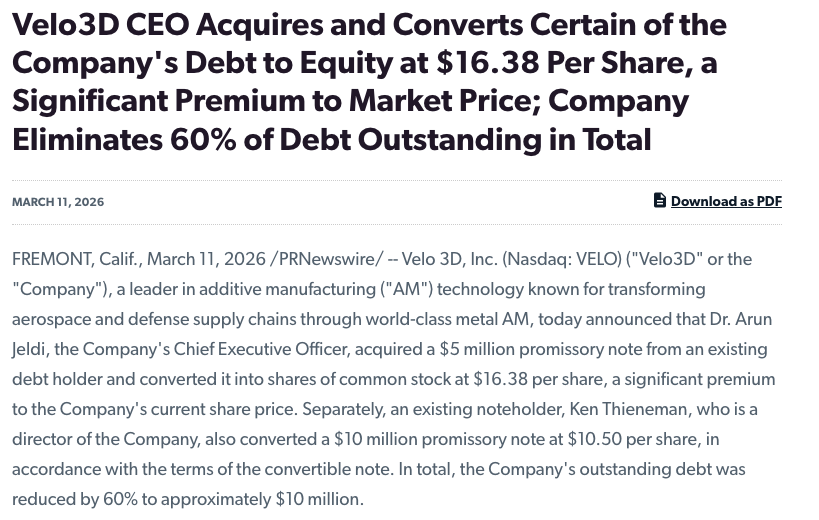
$VELO: Let’s take a step back…. Back in December they land a $32.6M DoW contract through DIU’s Project FORGE. Munitions program, full-rate production. January they sign a CRADA with U.S. Army DEVCOM GVSC for 3D printing solutions on ground combat vehicles. Same month they hire an Air Force vet with Huntington Ingalls, BAE, and Lockheed on his resume as the new Head of Programs. February they become the first qualified AM vendor for U.S. Army ground vehicles. Then a $11.5M full rate production contract drops from a key defense prime. The day after, Anduril puts out their own PR on winning a rocket motor contract. The CEO had already said publicly they were bidding on DoW contracts together. Then they bring on a senior aerospace engineer from NAVAIR with 10 years at Fleet Readiness Center East working on V-22 rotor systems and warfighter support. Then the CEO goes and personally acquires $5M of company debt and converts it to equity at $16.38 a share (a significant premium to market price). Total company debt is now down 60% to $10M. And last month the board adjusts his comp structure vesting schedule at valuation milestones of $1B, $3B, $5B and $10B. He literally tied his own payday to a 10x and then bought in at a premium on top of it. Now it’s March and the Pentagon is requesting a $50B supplemental budget after Iran strikes burned through munitions stockpiles. Lockheed and Raytheon are already Velo3D customers. Oh and SpaceX is their biggest commercial customer. The same SpaceX that’s reportedly gearing up for what could be the largest IPO in history. When SpaceX goes public every institutional eye on the planet is going to be scanning their supply chain and vendor relationships. Velo3D is going to be in that conversation whether people are ready for it or not. The pieces have been falling into place for three months straight. You just need to connects the dots.
English
8
23
155
12.8K
Starbeard
Starbeard@Starbeardx·
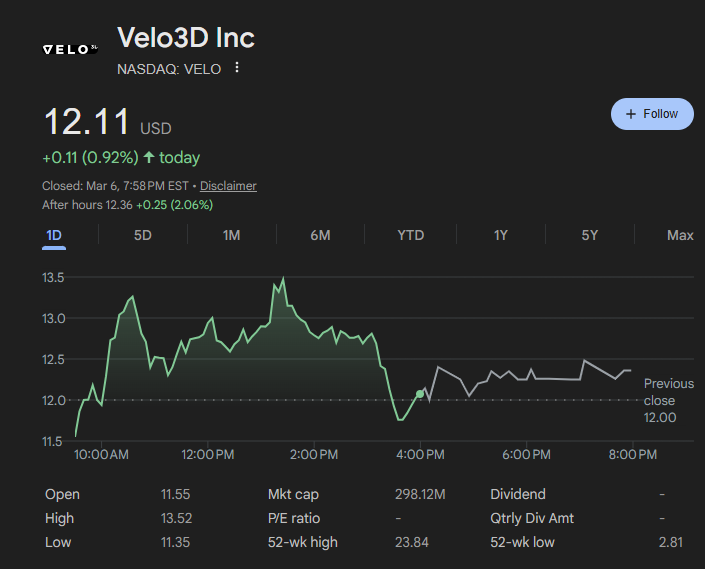
🚨 $VELO CEO just went ALL IN. He personally hunted down a debt holder. Bought a $5M note with his OWN cash. Converted it to shares at $16.38. Stock is trading at $12.39. He paid a 32% PREMIUM TO MARKET. 13 days before Q4 earnings. Oh and? The company just eliminated 60% of its debt overnight. The bear case is dead. This is what conviction looks like🔥
Tut C🅰️pital@kingtutcap

$VELO !!!!!!!

English
0
0
3
249
Starbeard
Starbeard@Starbeardx·
The Hidden Multiplier for #ASTI Nobody's talking about what the same technology does on Earth. This is a 100x+ Military UAVs → infinite range drones Commercial drones → delivery, agriculture Wearables → solar charging fabric Building skin → windows generating power Marine → ships, buoys, offshore Disaster relief → rollup power anywhere #Space validates the tech. Earth scales the revenue.
English
0
0
3
100
Starbeard
Starbeard@Starbeardx·
March 29th. SpaceX Falcon 9. Ascent Solar's flexible thin-film panels power an AI geospatial intelligence satellite into orbit. The toaster satellite revolution has a power supplier. Most people haven't noticed yet. $ASTI
English
1
0
6
1K
Starbeard
Starbeard@Starbeardx·
In the 60s, computers filled entire rooms. Then came PCs. Then laptops. Then smartphones. We're about to do the same thing to satellites. TOASTER SATELLITES × MINIATURIZATION CURVE = In 18 days, NOVI launches a geospatial AI intelligence platform on SpaceX Falcon 9. The size of a toaster.
English
1
0
2
73
Starbeard
Starbeard@Starbeardx·
The market still thinks this is a normal defense cycle. It’s not. This is a forced global security reset. We are not upgrading from one rifle to a slightly better rifle. We are skipping generations and moving straight into AI drones, autonomous swarms, robotic surveillance, edge intelligence, and real-time sensing across land, sea, air, and space. And this does not stop at militaries. Police. Borders. Ports. Airports. Critical infrastructure. Private security. Public events. Coast guards. Industrial sites. Small local forces. All of them will need drones. Not later. Now. Because once AI drones become cheap enough, capable enough, and easy enough to deploy, not having them starts to look negligent. A soldier without drone support is half-blind. A border without autonomous surveillance is half-open. A port without aerial monitoring is exposed. A police unit without AI overwatch is outdated. That is why old forecasts are already broken. They are modeling a linear adoption curve in a world that just went nonlinear. Now stack the accelerants: Defense supercycle. Long-duration war and instability. AI acceleration. Made in America industrial rebuild. Border and internal security upgrades. Space infrastructure and space data layers. Autonomy and robotics going mainstream. Latin America crime cleanse. NATO and Eastern Europe rearming, hardening borders, scaling surveillance. The Middle East resupplying and upgrading for longer and future conflicts. Southeast Asia accelerating armament and maritime security. The Arctic turning into a real security frontier. Land, sea, and air all becoming autonomous theaters. And above all of it: space, the ultimate high ground. This is not one trend. This is a narrative stack. And when multiple megatrends hit the same names at once, reratings can get violent. The biggest winners will not just be “drone companies.” They will be the bottlenecks: manufacturing, autonomy software, avionics, ISR, power systems, edge AI, secure communications, counter-drone, and the space layer above the battlefield.
English
0
0
0
31
Starbeard
Starbeard@Starbeardx·
WHO JUST AGREED TO QUADRUPLE PRODUCTION? Lockheed Martin→ VELO customer (hypersonic ramjet) RTX/Raytheon→ VELO customer (confirmed) Honeywell → VELO customer (confirmed) THREE of the seven companies in that White House meeting are already VELO customers. VELO at $300M market cap with Lockheed, RTX, and Honeywell as customers, during an active war where the DoD just committed to a $50B restock, is one of the most asymmetric setups in the entire defense space right now.
English
0
0
3
129
17마일
17마일@project17mile·
최근 Velo3D가 공개한 영상은 단순한 기술 데모처럼 보이지만, 투자자의 시선에서 보면 매우 중요한 힌트를 던져준다. 영상에서 공개된 것은 극초음속 램제트 엔진의 핵심 부품을 금속 3D 프린팅으로 제작한 사례이다. 겉으로 보기에는 하나의 엔진 부품일 뿐이지만, 이 사례는 앞으로 방산과 항공우주 산업에서 어떤 기술이 병목을 풀어줄 것인지 보여주는 작은 단서에 가깝다. 극초음속 무기 시장은 현재 미국, 중국, 러시아가 동시에 경쟁하고 있는 차세대 군사 기술 분야이다. 마하 5 이상의 속도로 비행하는 미사일이나 항공체계는 기존 방어 시스템으로 요격이 매우 어렵기 때문에 각국이 막대한 예산을 투입하고 있다. 미국 국방부만 보더라도 극초음속 무기 관련 연구개발과 프로그램에 매년 수십억 달러 규모의 예산을 투입하고 있으며, 장기적으로 보면 이 시장은 수백억 달러 규모로 성장할 가능성이 높다. 여기에 포함되는 공급망은 단순히 미사일 완제품 회사들만이 아니라, 엔진, 소재, 제조 장비, 부품 제작 기술까지 모두 포함된다. 여기서 중요한 문제가 하나 있다. 극초음속 추진 시스템은 구조가 매우 복잡하다. 공기를 압축하는 채널, 연료가 흐르는 통로, 열을 분산시키는 냉각 구조, 그리고 연소를 안정적으로 유지하는 화염 유지 구조가 하나의 부품 안에서 동시에 작동해야 한다. 기존 제조 방식으로 이러한 구조를 만들려면 수십 개 이상의 부품을 따로 제작한 뒤 조립해야 한다. 제작 시간도 오래 걸리고 비용도 높으며, 무엇보다 설계 자체가 제조 공정의 한계에 묶여버린다. 바로 이 지점에서 금속 3D 프린팅이 등장한다. Velo3D가 보여준 사례는 이러한 복잡한 구조를 단 하나의 금속 부품으로 통합하여 제작할 수 있다는 것을 보여준다. 공기 채널, 연료 채널, 열 교환 구조까지 모두 하나의 프린팅 구조 안에 들어간다. 전통적인 제조 방식에서는 거의 불가능했던 설계를 그대로 구현할 수 있는 것이다. 투자 관점에서 보면 이 변화의 핵심은 생산 속도와 개발 속도이다. 전통적인 항공우주 부품은 설계부터 제작까지 수개월에서 수년이 걸리는 경우가 많다. 반면 금속 적층 제조 기술을 활용하면 설계를 수정한 뒤 며칠 또는 몇 주 안에 새로운 부품을 제작할 수 있다. 즉 무기 개발과 시험 사이클이 크게 단축된다. 전쟁이나 군사 경쟁에서 생산 속도는 결국 전략적 우위를 결정하는 요소가 된다. 또 하나의 중요한 포인트는 TAM(Total Addressable Market)이다. 금속 3D 프린팅 시장 자체만 보더라도 향후 수십억에서 수백억 달러 규모로 성장할 것으로 전망된다. 하지만 항공우주와 방산 영역에서 바라보면 TAM은 훨씬 더 커진다. 글로벌 미사일 시장은 이미 연간 수백억 달러 규모이며, 극초음속 무기 시장만 따로 보더라도 향후 수십 년 동안 지속적으로 확대될 가능성이 높다. 여기에 로켓 엔진, 우주 발사체, 위성 추진 시스템, 차세대 드론까지 포함하면 금속 적층 제조 기술이 적용될 수 있는 시장은 사실상 항공우주 산업 전체로 확장된다. 결국 투자자의 관점에서 중요한 질문은 이것이다. 미래의 방산 산업에서 가장 큰 병목은 무엇인가? 미사일 설계 기술인가, 추진 시스템인가, 아니면 생산 능력인가. 최근 우크라이나 전쟁과 중동 분쟁을 보면 명확한 답이 보인다. 전쟁이 길어질수록 가장 중요한 것은 빠르게 생산할 수 있는 산업 기반이다. 바로 이 지점에서 3D 프린팅 기반 제조 기술은 전략적인 가치를 가지게 된다. 결론적으로, 이번 Velo3D 영상은 단순한 기술 홍보 영상이 아니다. 이는 차세대 방산 공급망이 어떻게 바뀌고 있는지 보여주는 작은 단서이다. 앞으로 극초음속 무기, 차세대 미사일, 로켓 엔진, 그리고 우주 산업까지 확장되는 흐름 속에서 금속 3D 프린팅 기술을 가진 기업들이 어떤 위치를 차지하게 될지 지켜볼 필요가 있다. 기술의 진짜 가치는 때로는 거대한 발표가 아니라, 이런 작은 데모 영상 속에서 먼저 드러나기 때문이다. p.s. 현재 Velo 마켓캡은 300밀리언 따리인 마이크로 마켓캡이다. 이는 코인마켓캡 기준 100위도 들지 못하는 순위입니다. 참고로 이 회사는 스페이스 X에 랩터 엔진을 만들 수 있게 하는 제조 기술 공급업체입니다.
17마일 tweet media
Tut C🅰️pital@kingtutcap

$VELO: New post on Linkedin. This seems to be in partnership with $LMT and $GE. defensescoop.com/2026/01/16/loc… A brand new Fridays with Fern is here! See how we printed a hypersonic ramjet capable of Mach 5. The engineering inside is impressive and worth a watch to see what's possible with additive. Fernando breaks it down for us. A brand new Fridays with Fern is here! See how we printed a hypersonic ramjet capable of Mach 5. The engineering inside is impressive and worth a watch to see what's possible with additive.

한국어
4
10
79
13.9K
Starbeard
Starbeard@Starbeardx·
@elonmusk @beffjezos It's also because the world can't afford to have uncertain/rogue nations developing AI systems, autonomous swarm weapons etc.
English
0
0
0
78