Stedi

779 posts

Stedi banner
Stedi

Stedi

@stedi

The only programmable healthcare clearinghouse | https://t.co/EIG41pbRBm

Distributed Katılım Aralık 2016
0 Takip Edilen1.9K Takipçiler
Stedi
Stedi@stedi·
We just released a reference implementation for a real-time eligibility integration with @Amazon Connect Health. Connect Health is a managed service for building AI agents that handle common healthcare tasks. One of the things Connect Health's agents can do is schedule patient appointments when a patient calls in. If the agent is integrated with a real-time eligibility vendor – like Stedi – it can also verify the patient's insurance and quote a co-pay before scheduling the visit. Our latest guide walks you through the ins and outs of the reference implementation – with things to know before you start. hubs.la/Q04rjzPT0
English
0
0
2
93
Stedi
Stedi@stedi·
Patient engagement platforms keep providers connected to patients between visits. They help providers do things like schedule appointments, handle intake, and send payment reminders. Many platforms now do that over SMS. Unlike a phone call, a text doesn't need the patient to pick up at a specific time. Most of the work that a patient engagement platform does depends on the patient's insurance. Providers want coverage verified before the visit, and they want to know what the patient owes before asking for payment. Our latest guide covers how to get both answers from Stedi – across thousands of payers, in a format your platform can parse and text to patients: hubs.la/Q04r72Dn0
English
0
2
3
67
Stedi
Stedi@stedi·
The Stedi Payer Network site now lets you filter payers by the insurance programs they participate in, such as Medicare or Medicaid. Each payer's programs were already listed on the site, but filtering on them required the Payers API. The Programs filter closes that gap. It combines with the other filters. For example, setting Coverage Type to Dental and Programs to Medicare returns only dental payers that participate in Medicare. More details in the changelog. Link below.
English
1
0
4
94
Stedi
Stedi@stedi·
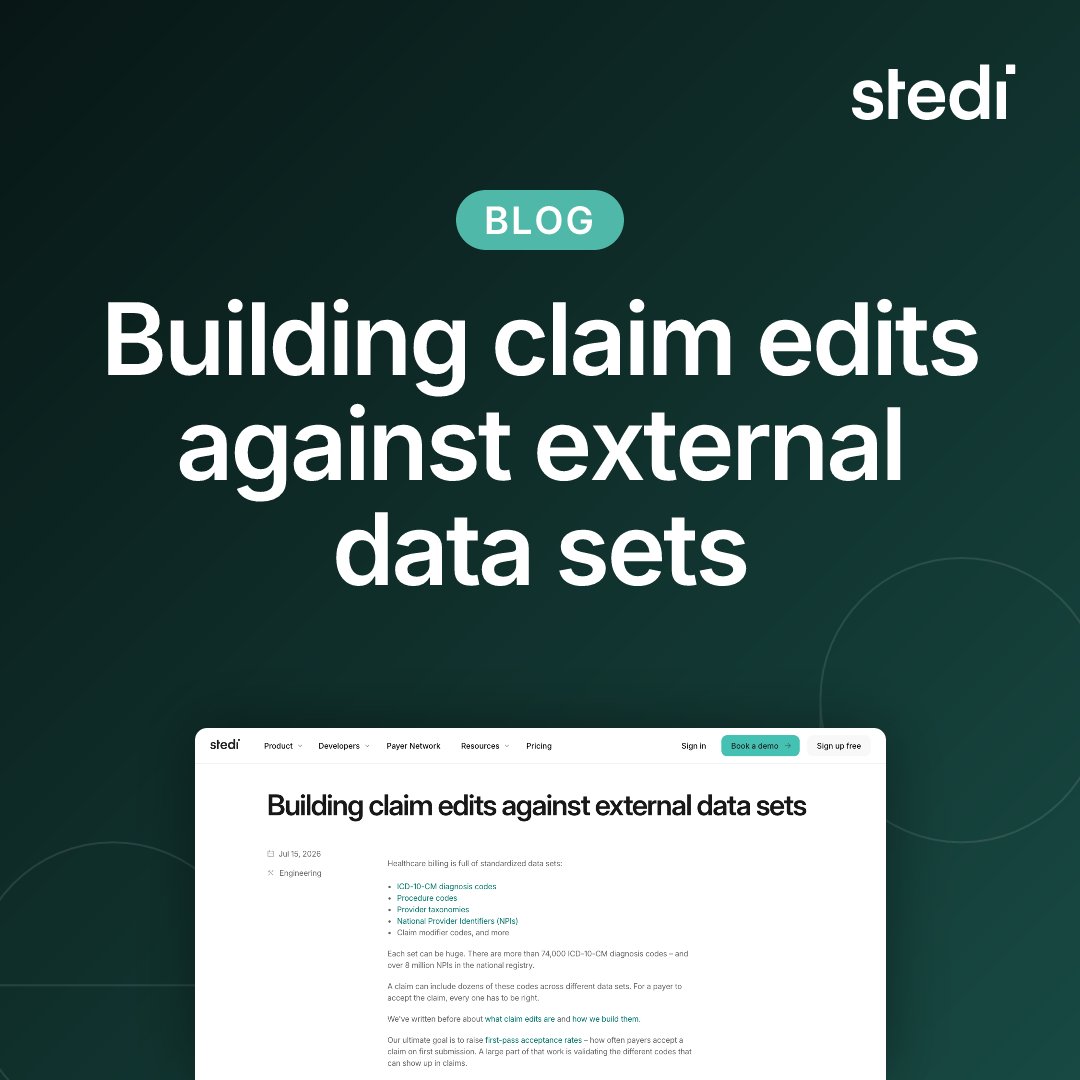
Healthcare billing is full of standardized data sets: - ICD-10-CM diagnosis codes - Procedure codes - Provider taxonomies - National Provider Identifiers (NPIs) - Claim modifier codes And plenty more. A single claim can include dozens of those codes across different data sets. For a payer to accept the claim, every one has to be right. We've written before about how we build claim validation checks – called claim edits – at Stedi. One of our latest blog posts covers how we validate the different codes that can show up in claims: the edits we've shipped, the problems we hit, and how we solved them.
Stedi tweet media
English
2
0
3
130
Stedi
Stedi@stedi·
Televero Behavioral Health is an online behavioral health practice built for speed. Their patients start care the day they reach out. There are no referrals or weeks-long waits. Every new patient visit with Televero starts with an eligibility check that confirms insurance coverage and benefits before care begins. Because coverage can change, Televero refreshes that check before each follow-up appointment. What sets Televero apart is coordination. A doctor leads each patient's care team of licensed therapists and psychiatrists. Therapy, psychiatry, and testing stay under one team, not scattered across providers the patient has to manage themselves. Coordinated care makes this harder than a standard eligibility check. Payers require a Service Type Code (STC) that tells them which benefits you're asking about. Televero's previous vendor could only run one STC per patient. That meant staff saw a fraction of each patient's coverage and had to track down the rest manually. As Televero grew, that manual work became the bottleneck. With Stedi, Televero runs multiple eligibility checks at once, a different STC for each, same patient and payer. Verification that used to need manual follow-up now finishes in seconds. Their team had Stedi in production within a day. Televero now onboards 1,500 new patients a month and re-checks another 3,000 twice a month, across 43 states and more than 200 insurance plans, without adding headcount. "In behavioral health, when a patient is ready, you have to be ready. Any friction, any break in that momentum, and you risk losing them before they get care. Stedi removed friction we could actually measure." – Brian Tucker, Chief Digital Officer at Televero Full case study linked below.
Stedi tweet media
English
1
0
2
89
Stedi
Stedi@stedi·
Claim status codes tell you where a claim stands: accepted, rejected, pending, paid, denied. On their own, they're terse and easy to misread. But once you know how to interpret them, you can build automated workflows that respond to each status. Our latest guide covers what claim status codes are, how to read them, and how to act on the most common ones. Link below.
Stedi tweet media
English
1
0
2
85
Stedi
Stedi@stedi·
Most claims don't go straight from provider to payer. They may pass through several systems – billing software, one or more healthcare clearinghouses, the payer network – first. Some of those systems may reject the claim without sending back an acknowledgment. In those cases, it can look like the claim was "lost." You don't know where the claim is or its current status. If you're a provider or biller trying to track down a claim that seems to have vanished, our latest guide covers the common reasons a claim might get lost and what to do when it happens. Link below.
Stedi tweet media
English
1
0
3
128
Stedi
Stedi@stedi·
Could healthcare billing ever be fully automated? In our latest podcast, Ayo Omojola, CEO of Substrate, explains why he thinks the manual work in healthcare admin isn't a technology gap – it's built into the system by design. In this clip, he illustrates his point by explaining that many payers still mail paper letters – even when the same information could be sent electronically. As he puts it, "the friction that requires a human in the loop is a feature, not a bug."
English
1
4
8
272
Stedi
Stedi@stedi·
Stedi is sponsoring the @ycombinator x @Medplum1 Agentic Healthcare Hackathon in San Francisco on August 1. Developers who sign up will get to spend the day building AI-enabled healthcare apps alongside some of the world's best. The top prize is a YC interview. Applications are still open. Link below.
Stedi tweet media
English
2
0
2
214
Stedi
Stedi@stedi·
A denied dental claim isn't automatically lost revenue. But when one comes back, most practices don't have a clear next step. In this webinar, Arna Meyer (Stedi) and Anna Pogliano (@zentist_io) will walk through a simple framework for triaging dental claim denials. You'll learn how to read the remittance advice the payer sends back, when an appeal is worth building, and how to turn denials into a feedback loop instead of a recurring cost. The webinar is Thursday, July 23 at 11 AM PT / 2 PM ET. It's free to attend. Registration link is below.
Stedi tweet media
English
1
0
2
105
Stedi
Stedi@stedi·
You can now see which insurance programs a payer participates in – like Medicare or Medicaid – using the Stedi Payer Network or our Payers API. When you submit a professional claim, you can set an insurance type, which tells the payer the kind of health insurance plan being billed. That insurance type usually maps to one of the payer's programs. For Medicare and Medicaid, the mapping is one-to-one. Previously, you had to pick the right insurance type yourself. Now, when you submit a professional claim using the Stedi portal's CMS-1500 form, we auto-select the insurance type for Medicare and Medicaid payers, based on their programs. If you submit claims using the API or SFTP, you can look up a payer's programs with the Payers API and set the insurance type yourself. More details are in our changelog. Link below.
English
1
0
6
325