@ahall_research To figure out what kind of work that will be displaced, it might be useful to consider what KIND of cognitive/embodied work an AI can do - Combined with an consideration of how MUCH of that work will be moved to AI. AND, of how much of that AI work humans still need to monitor.
My new research piece: what the politics of jobless prosperity might look like in an AGI world, why the real political backlash to AI hasn’t started yet, and how the labs should prepare.
1. The backlash to AI isn’t here yet. There is anxiety among American voters, but there is no populist backlash yet, because the job losses haven’t started yet—and we don’t even know if they ever will. AI is not in the top 20 issues Americans say they care most about, and the AI policy issue with the most energy right now, data center opposition, reflects not just AI but also NIMBYism, as @mattyglesias has pointed out.
2. Real backlash will happen if and when unemployment climbs by two percentage points, because that’s where data shows we tend to see meaningful electoral effects of unemployment. At that point, if we do not have a good inventory of smart policy ideas ready, we could be overwhelmed with bad ones.
3. The labs should focus more on measurement, and less on dreaming up New Deals. There is tremendous uncertainty about what kind of job displacement there’s going to be. Instead of attempting to write a new social contract from the top down before Americans are even asking for one, the labs should be helping us all get more intel on whether, when, and how job displacement is occurring—building from the helpful data sharing they’ve already started piloting. This will put society in a better position to design policies that make sense for everyone.
In doing the research for this piece, I came to two broader realizations.
First, there is way more uncertainty than I appreciated about how the economics of AGI might play out, and there is stronger evidence than I appreciated that job losses from AI have not meaningfully started yet.
And second, if AGI plays out the way the labs are predicting, the politics will be very hard to forecast, because it will be the politics of “jobless prosperity,” with jobs falling while the economy grows. We have very little experience with this happening at this kind of scale, and it will break our typical models of politics.
For both of these reasons, we should all be really humble in making pronouncements about the politics of AGI. I hope my piece will be read in this light, as an attempt to reason about something that is super important but also super hard to forecast accurately.
You can check out a lot more in the piece here:
freesystems.substack.com/p/the-politics…
Beyond basic “Levels of Automation”: new LACC-LOA matrix asks what kind of cognitive work AI is doing (plans, goals, framing…).
Applied to aviation digital assistants — super useful for human-AI design in safety-critical domains.
New paper (today): tandfonline.com/doi/full/10.10…
All industries that (try to) use AI to achieve autonomous operations, use something called Levels-of-automation to determine the degree of autonomy.
BUT - All these “classic” approaches boil down to
the question “who’s in charge?” However, not every task is equally difficult to automate. We might also want to insert some human control of (potentially) autonomous operations. Therefore, going toward autonomy, we also have to ask “in charge of what?”
We have proposed a new way of describing both these dimensions, in a new paper "Levels of Autonomy in Cognitive Control (LACC-LOA): Bidimensional Assessment Method Applied to Six AI Assistant Concepts and Scenarios in the Aviation Domain"
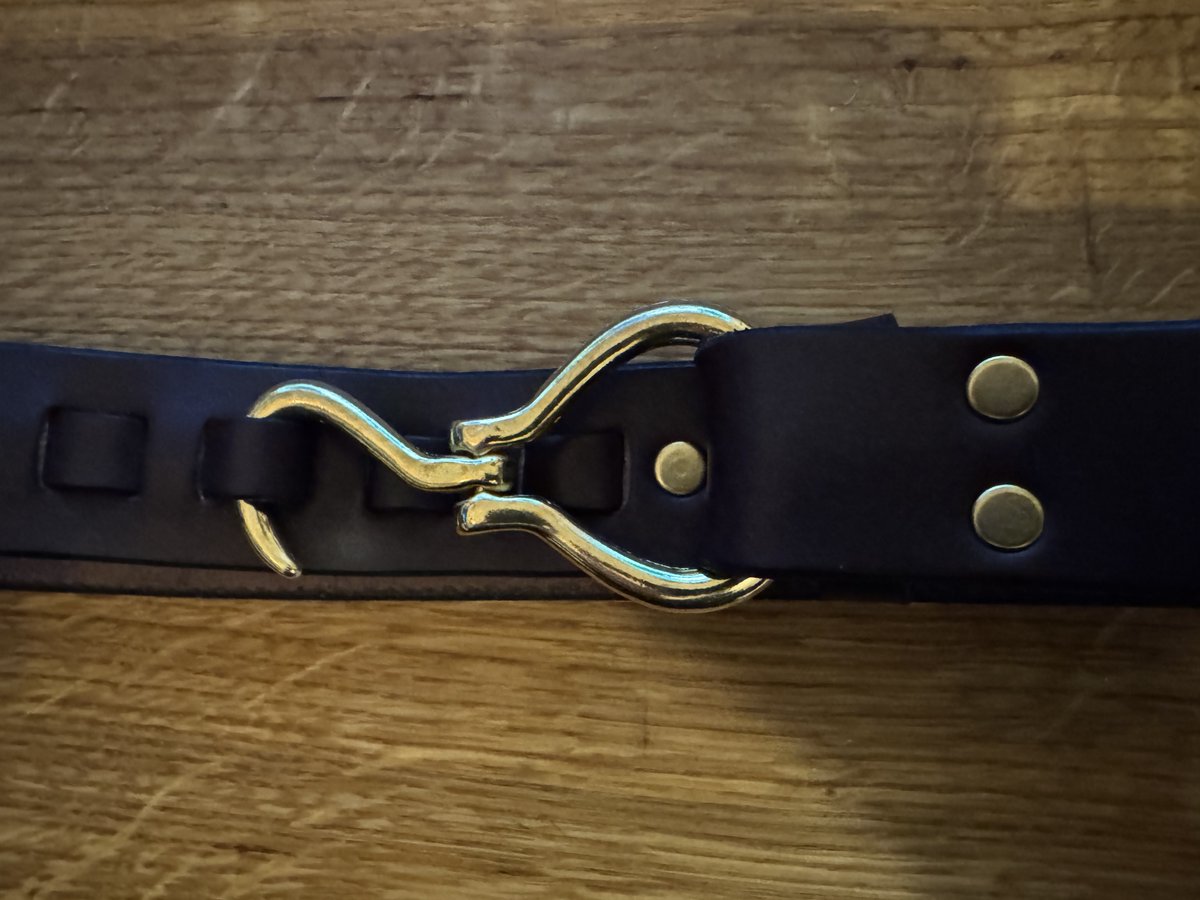
Got this fine belt from Narragansett leathers. Thank's @dieworkwear for the tip. Surprisingly (to me) cheap for a hand made high quality belt, even considering import fees and shipping to EU.
Det blir inga AI-datacenter i Sverige för att det finns ingen billig el. Sverige är och förblir fattigt och arbetslöst under många år framåt p g a de fruktansvärda beslut som drevs fram av S, V och Mp i slutet av 1990-talet, när kärnkraften stängdes ned under vänsterns jubel.
Disagree with this take.
My impression is that people are putting too much on the separation between humans and AI. In the future, this line will blur, much like how people 30 years ago mistakenly drew a hard line between online and "the real world." With dating apps and online friend meet-ups, that border got destroyed a long time ago.
IMO, the title of this clip already suggests why the viewpoint is wrong. "Will AI End the Influencer Era" assumes that influencers started with the internet. In reality, influencer marketing goes way back.
In the 18th century, English potter Josiah Wedgwood promoted his products by giving members of British aristocracy free products that they could display, such as earthenware tea sets, ornamental vases, and fancy plates. Since his products were associated with the British ruling class, he eventually commanded a premium from members of the lower class who wished to copy them. In fact, if you look up "Wedgwood plates" online, you'll probably see them as "refined" and "tasteful." His product seeding — not unlike how fashion brands give Kim Kardashian free clothes — can still be felt today. The reason why you see them as "tasteful" is purely about their association with British aristocracy.
I disagree with this take because it misunderstands the motivations behind much human consumption. The man in the video suggests that AI in the future can help us personalize products to fit our desires, rather than the preferences of another person (a designer or influencer). However, this assumes that your desires are independent and not couched in a broader social framework. I'd argue that people's consumption habits are more often about social relations.
I'll give you an example. When I was on a menswear forum, a well-respected member touted this beautiful light-blue shirt fabric he got from his far-flung bespoke tailor in Naples. It had unique mottling, which allowed it to sit somewhere between the formality of dressy white poplins and the light blue chambray workwear cloths. Later, another well-regarded member found the company that made the fabric: the oldest mill in France, founded in 1787, known for its fine textile weaving and lacework. He bought a few bolts and sold cut lengths to American customers. The fabric soon became popular with other influential members on the board.
Another member later discovered that this fabric was not pure cotton. Instead, it contained a bit of polyester, which accounts for why some members boasted about the fabric's seemingly natural ability to resist wrinkles. This caused a fire sale among the remaining boutique retailers, and I bought as much as I could.
I will always love this cloth, despite its small percentage of synthetics, because of what it represents in a broader social context. It reminds me of a funny story about some memorable people in the social group I was part of. AI will never be able to replicate this feeling in me because it can't create that situation.
The same is true for a lot of stuff I consume. I'm enamored with Norwegian split-toe derby shoes because they are worn by people I admire, such as menswear writer Bruce Boyer and Japanese clothier Yukio Akamine. I like raw denim jeans because there's an online social group that talks about "sick fades." I hope to one day buy a Rolex 1016 underline gilt dial with a chapter ring because it was recommended to me by someone I consider to have good taste.
There are large online economies centered on consumer products, such as fountain pens, mechanical watches, menswear, audio systems, and perfumes. People engage with these things partly because they love the product in question (e.g., a fountain pen hobbyist obviously loves fountain pens). But they are also in it for the *community.* They buy things because an influential person in that community — let's call them an influencer — recommended it. Then they show off their purchase to their online hobbyist friends (e.g., "In my experience with Nakaya toki-tamenuri cigar pen, the nib is too stiff."). This garners them social capital in the community, making them feel like they belong and are respected.
Clothes perform certain utilitarian functions, such as protecting us from cold and wind. But their most important function is signaling to a group, such as saying "I'm nerdy," "I'm countercultural," or "I'm artistic." They signal belonging to a group and our individuality within that group (e.g., "I'm a punk rocker, but I'm also a very unique person within this broader social group"). AI can never completely replace the influencer because it can't hold cultural capital within a group, as it's not a member of that group.
Casual consumers may turn to purely AI-driven systems for product recommendations in the future. I sometimes use the NYT's Wirecutter to figure out which spoon to buy, even though I'm not in a spoon community and don't care what my spoon signals. But there are many products oriented around groups, and this is where the influencer will continue to thrive, just as people bought Wedgwood plates after seeing them on Queen Charlotte's shelf.
@dieworkwear How about the Davek UK umbrellas, you don't mention them here? Got one when I needed something that could hold up to a bit of poor weather without falling apart at once. Are there better US options? (I am in the EU, so tax/import costs are about the same as for UK)
Of course, there are still people making quality umbrellas. Among them are Fox Umbrellas, Swaine London (formerly Swaine Adeney Brigg), James Smith & Sons, Mario Talarico, Francesco Maglia, and Parasolerie Heurtault.
A video of the Fox workshop:
A couple of weeks ago, Trump struggled with a broken umbrella as he boarded Air Force One.
Let me tell you how we got to this point — and the tragic downfall of the noble umbrella. 🧵
Lmao I've been working so much on finishing edits and formatting for THE SHADOW OF ARCADIA, now I don't know how to tweet about it.
It's done.
I plan to send ARCs out this weekend. If you would like an ARC but haven't signed up yet the form is in the link in my bio 👍🏻
In the future, pilots and AI-controlled drones may be flying toghther in various missions. To do that, coordinating intent is useful - keeping mutual track of what all agents are up to. To enable a machine to fo this a model is needed. Read more here:
tandfonline.com/doi/full/10.10…
@Nick_A_Writes@cmcaplanwrites My brother used a briefcase. All the kids did. Then they did not. It was in 92-93. Possibly though, the windy farmlands of Skövde Sweden were a bit behind in the times already back then.....
Under två års tid har jag följt den islamistkopplade vänsterextremisten Bilan Osman och fick tillslut henne att falla för mig. Jag har minst sagt tagit en för laget och har således en del att berätta...
Nu är det dags för bokslut där en rad intressanta uppgifter har framkommit om uthängningssajten Expo, propagandakanalen ETC och det islamistiska studieförbundet Ibn Rushd samt hur deras kopplingar ser ut.
Trots att Bilan Osman kallar sig för journalist är det grundlagsfästa källskyddet inget som hon klarar av att hålla sig till. Gång på gång, har Osman, avsiktligen röjt uppgiftslämnare till den vänsterextrema uthängningssajten Expo. Ett brott med fängelse i straffskalan.
Imorgon avslöjar jag identiteten på en av Expos främsta samarbetspartners inom den sverigevänliga rörelsen. En förrädare med en hel del gemensamt med Bilan Osman.
▹ Läs mer här: assarchristian.se/p/bilan-osman-…
▹ Stötta min journalistik genom att swisha ett valfritt bidrag till 123-697 89 69, märk insättningen med "bidrag". Tack på förhand!
▹ Prenumerera för att ta del av morgondagens granskning: assarchristian.se/subscribe. Det går även bra att swisha 720 kr till 123-697 89 69 för en årsprenumeration. Märk insättningen med "prenumeration" och din mejladress.
@dieworkwear Perhaps you need a house in Sweden, we have walkable cities. In fact, you could even get a boat (or paddle, swim, whatever your preferred move), and float your boat/body to a nice publicly accessible island, and have a relaxing day in the sun.
thank you for retweeting this. i suspect, but do not know for certain, that a higher number of clicks signals to my editors that people appreciate my stories, allowing me to earn more jobs and hence more money to someday buy a home in a walkable neighborhood.