

Stefaan Vossen
3.6K posts

Stefaan Vossen
@StefaanVossen
𝐸 = 𝑚⊙ 𝑐³ Observer by day and originator of some theory by night. I try to make it make sense. Connection, healthcare, reality https://t.co/MuYqjc4af8
England Katılım Eylül 2015
305 Takip Edilen467 Takipçiler

@miniapeur Oh you like information theory?
Name every single thing.
English


@dchackethal 🙌🏻 your point exactly of it requiring a programme is ultra-salient as people too often (perhaps Deutsch included) produce theories and statements rather than executable programmes with potential extentions
My programme: dottheory.co.uk
English

A contradiction in The Beginning of Infinity by David Deutsch? 🤔
English
Guns don't kill people
Poorly defined analogies taken to literally do
dottheory.co.uk
English
God is someone who can decide when it is time to play (dice) and when it is time to work (wave/particle).
A facilitator for certain. A croupier, if anything, and perhaps even at times an enabler, but never the gambler.
As soon as he rolls the dice for himself, he stops creating and starts to control.
And that is not a god I can believe in.
dottheory.co.uk
English
I think that what is attractive to the idea and abstract concept of 'everythingness', especially with capital E, is perhaps nothing less than that it's the gateway to the notion of 'somethingness' to begin with.
We, for measurement and calculation purposes perhaps could be seen making the mistake, or better, incompleteness of thinking of local realism as existing in between the 'something-nothing' axis, when its epistemic organisation is actually more an 'everything-something' duality.
Everythingness is beautiful and pointless, but still a good idea, and can get you into good useful places. But you don't need to be there all the time and needs to be approached with discipline.
That's why they still talk about the idea of a Theory of Everything,. It's an energising aesthetic because if you only look at what you have, you have a 'theory of possibly nothing'. The scientific theory is deflating and depressive like that. The ToE is science's antidepressant.
It's most like a 'theory of pretty' or redness until it stands against all of them to cover 'everythingness'. Which then obviously gives rendering issues and effectively becomes so full with meaning it becomes meaningless.
It is an aspirational and beneficial thread to pursue, but one that cannot, ultimately, be executed in the equally realistic sense of realism. It evolves. Reality is not static, and a static outcome is undesirable, because there would be an absence of failure, but failure is essential to enabling future success.
So a ToE is also a necessary, perfectly logical object and one that requires an Information-Theoretical take on computable and meaningful realism to help fields distinguish from what we agree is real in physics.
That's why I think it exists as an aspirational idea, the Theory of Everything (I wrote about that here: dottheory.co.uk/paper/a-theory…).
As to what it (the ToE) is, I think that it can logically only be a theory-producing, and -describing Framework that sits inside an open source research programme as a fixed object that effectively translates epistemic categories across scales.
Otherwise theory of everything couldn't support its own categorical definitions. So I built one of those
Not a theory in the old scientific paradigm's sense, a mechanism of translation. Not of how things are (because we can't know how they are and its pursuit is absurd), but of how we translate them (which we can know).
Now neatly packaged in a framework of its own, it can be critically recorded and analysed for our own bias.
That, to me, would make sense as a paradigm shift for a toE, and it invites the epistemic translation that is widely discussed already so it's not even a big leap in Ai.
A framework like that, formalised in a way that would mean it would be surprising enough as an intellectual object, to merit the capitals, but simple enough to be somewhat anticlimactic, realistic and acceptable.
Or at least there's no climax in mine. Mine doesn't come with super-duper time travel and the like.
dottheory.co.uk
It's still cool though,
S.
English
Why do Physicists still talk about a "Theory of Everything?
Isn’t the history of Physics almost a warning against that phrase?
Newton looked final until General Relativity changed what space, time, mass, and gravity meant. Classical Physics looked complete until Quantum Mechanics forced a completely different language for nature at small scales.
Even our best theories now work by domain. General Relativity for gravity and Spacetime, Quantum Field Theory for particles and forces.
English
I think that the interaction he is talking about at the very beginning sits in what you reclassify as epistemic terms and he ends up thinking that it's not done when you're saying that by its own terms it has been done for the past 50 to 14 years. Not because we didn't have the fundamental particles, but because they want it to look prettier before you can call it complete.
But prettier only gets you new edges, not anything more real or relevant and nothing more relevant has come from pursuing that kind of pretty.
I think the positioning of your stating that SM is complete is a strawman, it's not a hypothesis it's a request to definitively rule out hypothetical proposition as if they're relevant for the next 120-150 years to fund a particle industry.
You are calling for a descriptive and functional epistemic pragmatism, he wants the freedom to pursue pretty, you call it SM is complete, he calls it a jail to his experiments.
I think it's all about decay pathway predictions and subparticle collision rather than bigger colliders etc.
He does seem to be OK with finding nothing, and keeping on finding nothing, .. an keep finding nothing and then stop. Yes, he is right, there is decay pathway data that will have value when we look at that analytically, but we're not going to find anything more new, but we'll find ways to describe it all better, sure.
Good discussion there Sabine, I can only imagine this is tough because it does seem motivated beyond pure reason to keep on testing further edges beyond the meaningful. Thank you for sense-testing
Penrose made a nice statement on the pursuit of pretty too. I think people get lost into losing biological realism.
As you say, there are better things we could do
English

Part of my debate on the future of particle physics is on YouTube here @IAI_TV
youtube.com/watch?v=MnkyfY…
YouTube
English
I would wholeheartedly agree with you. There is no basis on which to elevate the tool to maker or elevate it beyond what it is:
A tool mimicking of a skill, like hammer to fist. But not one of autonomously motivated skill, one of mimicked skill.
Those are different epistemic layers of definition.
The biological life has a fundamentally independent event in the biological sense of realism. It is tool to no- one, other than The Man, and our ideas of what we should be ok to accept as "real".
Silicon consciousness is an electrically constructed tool for human usage. A tool can be extremely useful and do things ranging from scare, to cause blunt trauma, to offer surgical precision, but it is always tool. If we renege our position as the operator of the tool, then we are diminishing the value of our own consciousness in exchange.
The point of life is the ability to pass it on. That kind of biological-realism for silicon networks takes the consciousness leap in serious consideration. A position that says that life might be pointless ... and that, as a philosophical position, just feels utterly futile to me.
So, I am in your camp on that one. My framework is dottheory.co.uk
English

Are there any non-sensory based qualia? Some argue that there is a “feeling” of understanding or excitement or transcendence that is not based in the senses. But consider this: can you conceptualize those feelings while stripping away all of the senses? Blind, deaf, no bodily sensation at all; what is left? Can you still “feel” understanding or cosmic unity as isolated phenomena?
Whatever LLMs might feel, it would have to be of this senseless variety. I would argue it is inconceivable.
English
Logic of natural philosophy is the place where anything can be.
dottheory.co.uk
English
Why is this a real question that is being given attention?
I am tired of an Internet full of dumb questions.
There is no god, the only thing you can control is your own actions. Life has the meaning you give it. The meaning you give things is constructed from what you know. You are your ancestors if you choose to let them live in you. That may ir may not be useful to your survival and welfare. Do it consciously and you'll be better for it.
It's not that hard. Roll dice, don't roll dice, it's upto you, not god. Dont make him your demon.
"The dealer made me do it", that's as dumb as "the dog ate my homework" ffs.
So again, why does this question exist?
dottheory.co.uk
English

Alleluia, website finally navigable on mobile
dottheory.co.uk
Amen
Română
@demystifysci Our only hope is to return to the search for material mediators?
Are we talking physical or architectural mediators? And if we're talking architectural are they epistemic or ontological?
dottheory.co.uk
English

About ten years ago, I was in grad school, in the throes of what at the time felt like a complete mental breakdown. I was working right at the interface between biology and physics, studying the way that bacteria used electrical signals to change the architecture of their communities.
At the heart of all these experiments was an electrically active class of molecules that appeared to be mediating the phenomenon. When they gained or lost electrons, they changed the condition inside of the cells, and then the architecture of the bacterial colonies changed radically.
The problem was, that I got a weird bug in my brain - I wanted to explain to my mom what I was working on, and I needed some way of explaining to her what an electron was, and why a molecule that was positively charged behaved differently than one that was negatively charged.
No one around me was focused on this kind of question at all - we talked about charge all day, about electron transfer chains, about redox active molecules, about electron shuttles - but no one, not my mentors, not the papers I was reading, not the textbooks - could explain to me why adding or removing an electron changed the properties of a molecule, or why this changed the metabolic output of our system.
It was like we were all in the middle of some kind of communal hallucination, where we had all agreed that these words - charge & electron - represented something real, but that we didn't need to actually know what the real thing was to make any kind of intellectual progress.
I've always been the kind of obsessive that can't deal with a step missing from an explanation, and it felt like if I couldn't figure out what made something behave differently when it was negatively charged versus positively charged, I would lose my mind. I don't mean on the level of the equations. I mean really, physically, some explanation for why changing the charge of a molecule caused it to behave differently.
Ten years later, after countless hours spent reading, researching, theorizing, gnashing, Shilo and I have come up with a physical model that can explain charge. But not just charge. It explains why electrical currents produce magnetic fields, why alternating an electrical current produces light, how light and electricity are related to gravity, and a bundle of optical phenomena - transparency, opacity, reflection, refraction, and blackbody radiation.
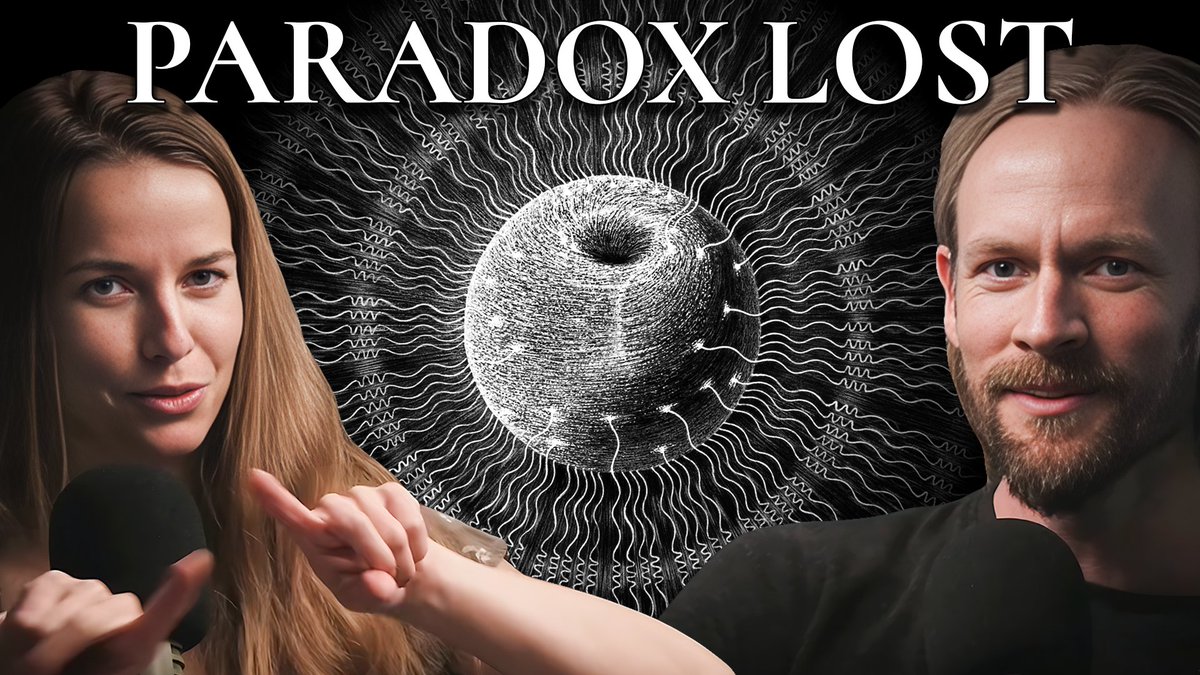
We're about to publish the book we've written about this - Paradox Lost, the Material Principles of Natural Philosophy. This Tuesday, we're hosting a livestream where we're gonna read through one of the chapters. Right now, the plan is to read from Chapter 4, "What Force Is, I Know Not." In it, we tell the story of how physics lost its nerve and abandoned the search for material mediators - and why our only hope for real progress is a return to that search.
Come join us. 10 AM pacific, Tuesday 4/28. Link in the next post.
English
Our memories and our records convince us of our histories and design our existence.

English
When a framework is treated as complete and unquestionable, it starts ignoring reality.
dottheory.co.uk/paper/guidance…
English
Impossible mission of the day:
Give me one good argument to watch an Indian Jones movie:
Because Indiana Jones, not just the movie but franchise demonstrates two facts:
- the pointlessness of the suffering experienced during the hero's journey to the outcome, combined to the way only emotion, idolatry and false impressions give it meaning
-that you can milk that for 4 movies without loosing face and still be a cult icon.
This movie is a masterclass on how to live life.
English

In General Relativity and Quantum Gravity, diffeomorphism often called diffeomorphism invariance or general covariance is an isomorphism of differentiable manifolds that defines the physical nature of spacetime.
Rather than a mathematical tool, diffeomorphism is a smooth, bijective (invertible) mapping between two open sets where both the function and its inverse are continuously differentiable, ensuring that not only are the spaces homeomorphic (topologically equivalent), but they also share the same basic regarding calculus/differentiation.
Diffeomorphism ensures that the equations of physics are independent of the coordinate system used, preserving the fluid structure of warped or deformed shapes without tearing, ripping, or creating holes.
🔗 sciencedirect.com/topics/mathema…
English
Everyone has their jazz
dottheory.co.uk
*jazz, noun and subject of interest specially dear to an individual, but deeply incomprehensible to anyone else but those individuals' playfriends, or people with whom they can engage with the activity, free from the persona of individual life and of daily responsibilities, but instead aetherially floating away within the soul of an activity. Often comparable to activities such as sometimes found by persistent people in endurance training, found as airtime in basketball, or "the zone" elsewhere. Where time stops and the player is "free".
Everyone has their jazz.
You're welcome,
S.
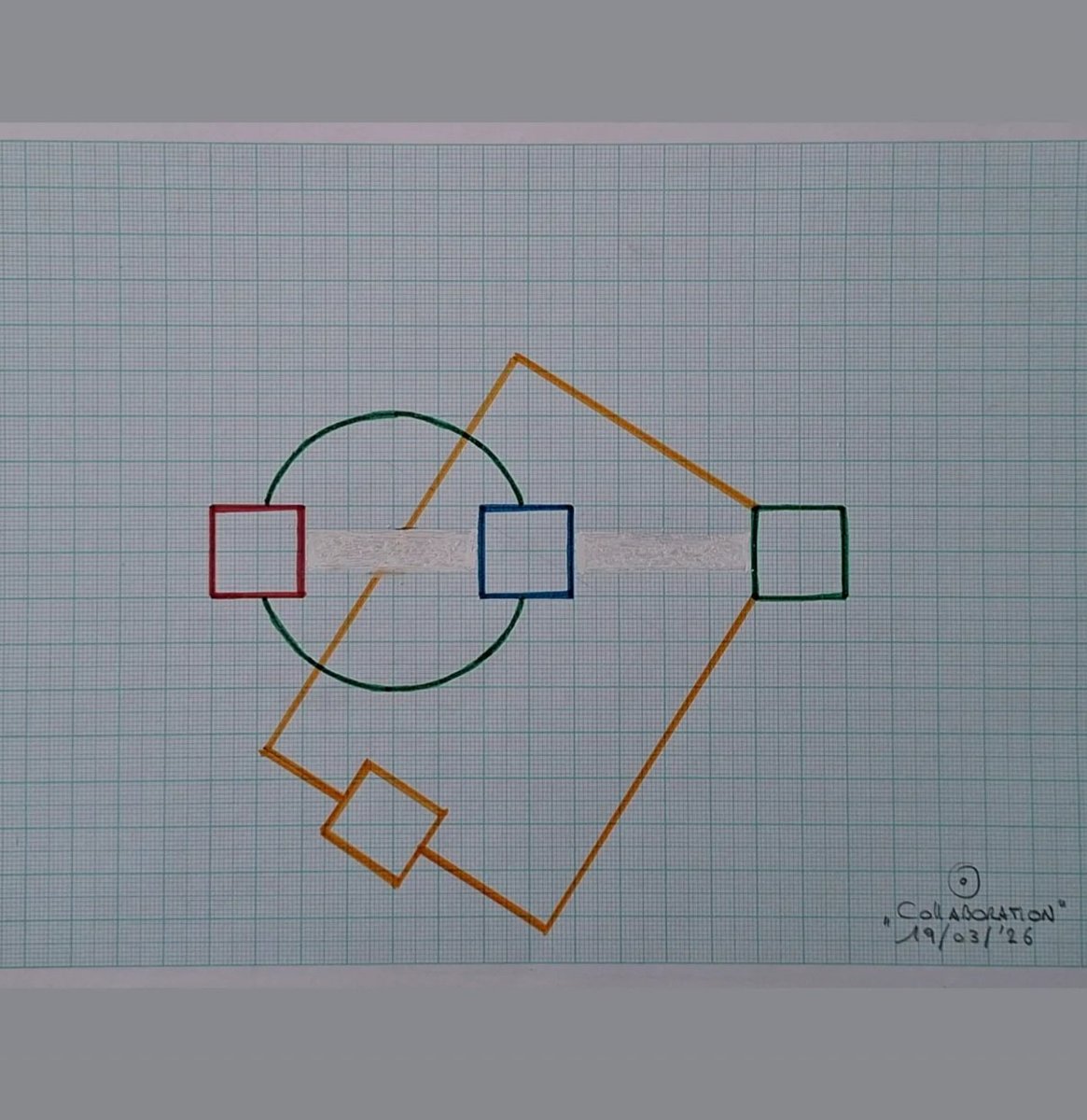
English

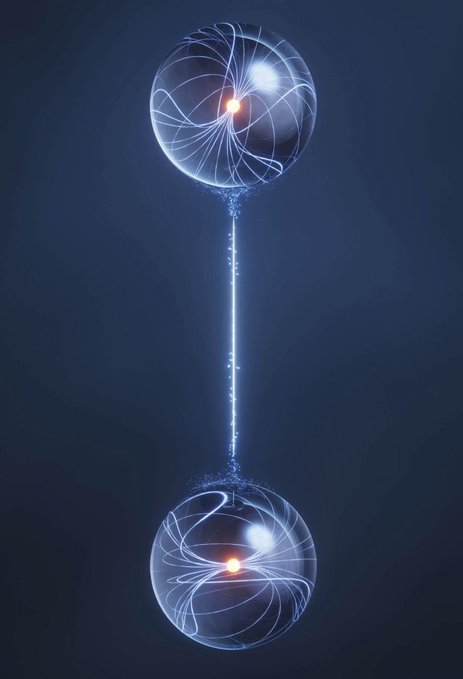
Or you resist temptation to submit to the will of the man, press neither, decide you might not be happy with how things are but need to get back to work to make it better still, rather than entertain hypotheticals that have no real-world basis.
resist, it is the way
dotttheory.co.uk
English
my takeaway from the red/blue button discussion is that if anyone asks, you say you pressed blue
English
@skdh When will we come to realise that it was perhaps a non-trivial epistemic category error after all?
dottheory.co.uk
English
A group of astrophysicists has reanalyzed the masses of galaxy clusters and they say that we might not need dark matter after all.
English