Steve Foot

4.6K posts

Steve Foot banner
Steve Foot

Steve Foot

@StephenCFoot

Messianic Believer waiting for Hashem and His Shalom, coming your way very soon. Crazy-in-love with the Jewish people, their Land, their Book and ADONAI.

England Katılım Mart 2018
2.1K Takip Edilen684 Takipçiler
Sabitlenmiş Tweet
Steve Foot
Steve Foot@StephenCFoot·
Pretrib Concurrent. I believe we live in the later days of the First 5 Seals (small ’T’ Tribulation). The Sixth Seal is the Resurrection/Rapture/DOTL. The subsequent 7 Years are the Great Tribulation. The Final Day Messiah crushes the Rebellion and sets up His Millennial Kingdom.
English
2
0
3
405
Steve Foot
Steve Foot@StephenCFoot·
@TheBelieverJC The commanding voice of G-D is often likened to a trumpet blast, but it doesn't always infer the context of a Rapture. It often refers to imagery symbolising power, a warning, a convocation or divine encounter. In John's case it was an invitation to the throne room of heaven.
English
0
0
0
2
Benjamin Rapture Ready
Benjamin Rapture Ready@TheBelieverJC·
"Proof" of the pre-tribulation Rapture. In Revelation 4:1 I saw afterwards, and behold, a door was opened in heaven. And the first "voice" I heard was like a trumpet that spoke to me, and said, "Come here," and I will show you the things that must happen next. In Numbers 10, the Lord commands Moses to make two silver trumpets. The trumpets symbolize the "voice" of God. There is talk of blowing silver trumpets to call the congregation together. "And the first "voice" I heard was like a trumpet speaking." Revelation 4 clearly shows that it is about the trumpet of God. We can also read this in 1 Thessalonians 4:16, the "voice" of the archangel and the trumpet of God. So Revelation 4:1 is about the Rapture of the church. And it cannot be otherwise than that it is true. Because in Revelation 5, the church of Christ is described as sing a new song and being purchased out of every tribe and tongue and people and nation by the blood of Christ, which is a description of the glorious, raptured church in heaven. This passage in Revelation 5, along with other passages in Revelation, speaks of the church as a heavenly church, a community of believers gathered together in heaven. And if we read further in Revelation chapter 6-19 is about this great tribulation, about this "time of Jacob's trouble." In these chapters of Revelation we do not encounter the church anywhere on earth. So it's very clear that the Church is Raptured. It is therefore impossible that the seven trumpets is about the Rapture, they are divine disasters, as described in the book of Revelation, that unleash God's wrath on the earth and lead to natural disasters and demonic plagues during the Great Tribulation, such as a meteor destroying the oceans, a solar and lunar eclipse, a plague of demonic locusts, and a demonic army that will kill a part of humanity. These seven trumpets have nothing to do with the Rapture.
English
3
0
1
36
Benjamin Rapture Ready
Benjamin Rapture Ready@TheBelieverJC·
🚨 I HAVE SOME VERY GOOD NEWS‼️ We won’t be here on earth to see the fulfillment of Revelation 6 till 19! So NOTHING that is written there regarding the tribulation has anything to do with us! Neither the beast nor the mark of the beast are going to be part of our lives here!
English
35
61
451
12.5K
Steve Foot
Steve Foot@StephenCFoot·
@TheBelieverJC “LIKE a trumpet that spoke to me” There are 2 moments in Revelation which may point to the rapture; one is crystal clear, the 6/7th Seal, the other depends on a faint foreshadow, a personnel allusion in the experience of John, why build a whole doctrine around the weaker passage?
English
0
0
0
2
Steve Foot
Steve Foot@StephenCFoot·
@TheBelieverJC In the meantime. If Rev 4 describes the time of the rapture then this scene in heaven must be in our future, yes? If so, then the angels must still be looking for the one worthy to open the seals, yes? Must rush...
English
0
0
0
12
Steve Foot
Steve Foot@StephenCFoot·
@TheBelieverJC Thanks Benjamin, I appreciate the reply. I will respond when I'm back from bible study & prayer at our Gospel Hall tonight/tomorrow night.
English
1
0
0
22
Steve Foot
Steve Foot@StephenCFoot·
@TheBelieverJC The rapture is preceded by the resurrection of the dead in Messiah, yes? The resurrection is accompanied by a global earthquake and signs in the heavens, yes? The wrath of the lamb follows these events, yes? Why are these things missing from Rev 4?
English
1
0
0
52
✝️ Lanette ✝️
✝️ Lanette ✝️@_Lanette_R1·
So? What are your thoughts on this growing alliance between certain Protestants, Roman Catholics and Muslims as they align together against Israel and the Jewish people?
English
48
0
20
1.6K
Steve Foot
Steve Foot@StephenCFoot·
@TheBelieverJC It's my personal belief that the rapture is at the 6th Seal, I realise others disagree. I'm kind of a hybrid Pre-Wrath/Pre-Tribber, so not that confusing! Chapters 18 to 19, maybe not. I feel the term "Great Tribulation" is a misnomer and the cause of Great Confusion! Blessings
English
1
0
0
24
Steve Foot
Steve Foot@StephenCFoot·
Dire straits. Something else to add to the mix...
James E. Thorne@DrJStrategy

Food for thought. Trump’s Deal With Indonesia: Mahan at the Strait of Malacca Hu Jintao warned China about this moment more than twenty years ago. In 2003, the then Chinese president coined the phrase “Malacca dilemma” to describe a simple, brutal fact: the country’s economic rise depended on foreign oil sailing through a narrow strait that other powers could, in a crisis, choose to close. Most of China’s imported crude and gas still squeezes through that same bottleneck between Indonesia, Malaysia and Singapore. The US has just moved to wire that vulnerability, and it is no accident this is happening on Donald Trump’s watch. Washington’s new Major Defense Cooperation Partnership with Indonesia is being sold in the usual diplomatic euphemisms: capacity building, maritime security, joint training. Strip away the boilerplate and you see something far sharper. The agreement’s focus on maritime domain awareness, subsurface and autonomous systems, and special forces training is about giving Indonesia and by extension the U.S. and its allies, a far richer picture of everything that moves between the Indian Ocean and the South China Sea, and greater ability to shape it in a crisis. As with Trump’s broader Indo‑Pacific posture, this is one more move to reassert the US as the pre‑eminent maritime power of the age, and to ensure China feels that reality every time a tanker clears the Strait. Hu’s “Malacca dilemma” was never only about a single shipping lane. It was about the geometry of China’s energy dependence. Oil from the Gulf and Africa has to arrive by sea. The shortest, cheapest route runs past India, through Malacca and adjacent Indonesian straits, and then up into waters where the U.S. Navy and its partners have operated for decades. A coalition that can see, track and, if necessary, interdict that flow holds a lever over China’s economy that no amount of rhetoric about multipolarity can wish away. More than a century ago, Alfred Thayer Mahan argued that sea power, fleets, chokepoints and maritime commerce, would decide the fate of great powers. The Malacca dilemma is Mahan’s theory rendered in modern energy terms: a continental power whose trade and fuel move by sea lives or dies by access to narrow maritime bottlenecks policed by others. Trump’s Indonesia move is pure Mahan: rather than chasing dominance on land, Washington is tightening its grip on the sea lanes and straits through which China’s economic lifeblood must flow. Beijing has spent two decades trying to escape this trap with pipelines from Central Asia and Russia, a corridor through Myanmar and a “string of pearls” of ports from Gwadar to Djibouti. Yet the volumes tell a less reassuring story: overland routes move at the margin, while the bulk of China’s energy still comes by tanker and still passes through Southeast Asian chokepoints. The dilemma has been managed, not resolved. That is why Indonesia matters. Jakarta insists it is not choosing sides and will continue to balance between Washington and Beijing. It doesn’t have to do more than that for this pact to bite. As Indonesian officers train with American counterparts and integrate U.S.‑supplied surveillance and patrol systems, the operational environment quietly changes. Chinese planners contemplating a crisis over Taiwan, the South China Sea or even a clash around Hormuz now have to assume that traffic through Malacca and its alternatives will unfold under a web of sensors and partnerships that lean, in practice if not in rhetoric, toward Washington. Another move by President Trump, in other words. From rebuilding American shipyards to pouring money into Indo‑Pacific maritime forces, the pattern is clear: the United States intends to remain a maritime superpower, and to make China live with Hu Jintao’s old nightmare instead of escaping it. Mahan would have recognised the logic instantly: in the end, it is the power that commands the sea, and the straits, that sets the terms for everyone else.

English
0
0
0
5
Steve Foot
Steve Foot@StephenCFoot·
So there is a plan... ?
Ken Gardner@KenGardner11

I’m going to make many of you spitting mad at me for pointing this out, but now that we have started the naval blockade, Iran’s strategic position (which was already hopeless) has become terminal. They are soon going to run out of storage space for their oil. And we haven’t even yet taken Kharg Island. This will force them to shut down current oil production, which itself is a drastic step that will further wreck their economy. Without their oil money, they’re finished. And no one is coming to save them, either. Nobody wants to mess with the two best militaries on the planet. Meanwhile, pretty much the entire rest of the globe is demanding that Iran reopen the strait. And because markets always adjust, the Gulf states are already adopting workarounds in order to avoid this same problem in the future. When the history of this war is written, it will be recorded that the regime’s decision to close the strait was a colossal miscalculation that relied too heavily on short term consequences (a hike in the price of oil, coupled with the belief that nations would unite against us rather than them). In chess, there is a famous quote to the effect that the threat is always stronger than the execution. Here, the threat to close the strait was stronger, especially with Trump and with countries in Europe and the Far East. The decision to close the strait was never going to work as long as we refused to budge. And it has greatly weakened Iran’s position. The same point applies to Iranian attacks on energy structure and desalination plants. Once they went beyond mere threats to actual attacks, they weakened their position and strengthened our resolve and those of our allies. Now everyone fully understands the risk of the regime’s ability to blackmail the global economy on top of all their other shit. The Gulf states now understand the folly of hoping that the alligator would eat them last, and are now working on a closer alliance with U.S. and Israel. I don’t know how much longer this war will last. But don’t bitch at me when I say that we have had a clear strategic plan from the beginning and that it is playing out. Once we decided that Iran was not going to surrender immediately, we decided to begin the death grip with the blockade. The rest is now a matter of time, patience, and persistence.

English
0
0
0
10
US Holocaust Museum
US Holocaust Museum@HolocaustMuseum·
These Holocaust survivors lost nearly everyone they loved—just because they were Jewish. It's not a conspiracy. There is no debate. Reply with a candle to show you will remember. 🕯️
English
2.8K
2K
8.4K
124.9K
Steve Foot retweetledi
Imtiaz Mahmood
Imtiaz Mahmood@ImtiazMadmood·
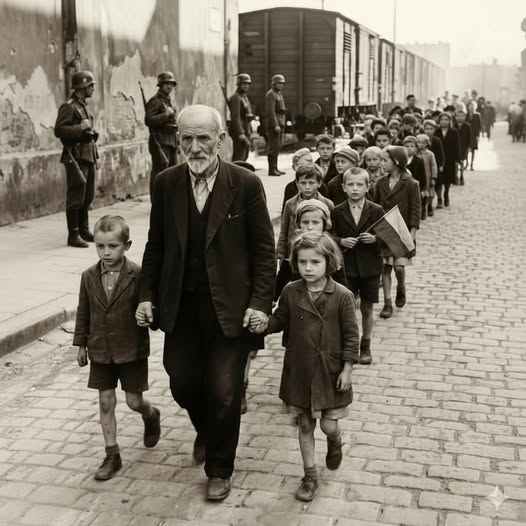
THE JEW'S HOLOCAUST;He was offered his life, his freedom, and a way out, but he chose to walk into the fire because he couldn't bear the thought of a child being afraid in the dark alone. They went to their deaths not as prisoners, but as a family, following the only man who ever told them they were loved. Janusz Korczak, the famous Polish-Jewish doctor, author, and director of a large orphanage in Warsaw, dedicated his life to fighting for children's rights. When the Nazis invaded Poland, he moved his 200 orphans into the cramped, starving Warsaw Ghetto. On August 5, 1942, as the orphanage faced "liquidation" and the children were to be sent to Treblinka, Korczak was offered a "Sanctuary" pass by Nazi authorities, which he tore to pieces, refusing to abandon his children. He led them on a "trip to the countryside," dressed in their cleanest clothes, holding two of the youngest children's hands as they marched through the ghetto toward the trains. Even at the station, a German officer's attempt to pull him from the line was met with a simple shake of his head before he stepped into the airless cattle car with his children. He stayed with them until the very end, comforting them in the darkness of the gas chambers, telling them stories until the air ran out, choosing to die as a father to the fatherless. This image captures the "Final Walk of the Just"—a poignant testament to human goodness, a story that breaks the heart but heals the soul, proving that the light of one man’s love can outshine the darkness of a thousand cannons. Today, against the Jew, the same annihilation is crafted every other day. THE ISLAMIC WORLD, LEFTIST REGIMES AND REST OF THE DEMONISED BEINGS HAVE CONNIVED AGAINST ISRAEL. IT'LL NOT HAPPEN!
Imtiaz Mahmood tweet media
English
874
4.1K
10.5K
223.3K
Steve Foot
Steve Foot@StephenCFoot·
One to follow.
Zineb Riboua@zriboua

The Arab Word is Watching a Different War: Three reasons why it has been difficult to understand the Arab position: The first is the Arab relationship with Iran. From the vantage point of Brussels or London, Iran presents itself as a resistance movement with a grievance against American hegemony and Israeli occupation, and this presentation maps comfortably onto familiar Western anticolonial frameworks. What it does not map onto is the lived experience of Arab populations in Lebanon, Iraq, Yemen, Bahrain, Syria, and across the Gulf. In those countries, Iran's presence meant Hezbollah holding the Lebanese state hostage to Tehran's decisions, thirty-five armed factions in Iraq drawing salaries from Iranian funds channeled through the Iraqi national treasury, and Houthi commanders answering to the Islamic Revolutionary Guard Corps while firing on Arab civilians from Yemeni soil. Freedom is not the word any serious Arab observer would use for what Iran brought. Indeed, the Arab world's quarrel with Iran runs far deeper than American bases or Israeli airstrikes. What drives it is the systematic subversion of Arab sovereignty by a foreign power that uses the language of Islamic solidarity as cover for an imperial project conducted through proxies. The second dimension is the proxy question itself, where Western analysis fails most comprehensively. Iran goes far beyond supporting armed groups. Parallel state structures get built inside Arab countries, financial systems get captured, and political figures get installed who owe their existence and survival entirely to Tehran. The Iranians who have administered this project understand it as the export of a revolution, but what Arab populations have experienced is closer to a colonial occupation conducted through intermediaries, and as of now, they’re not mourning the Islamic Republic. When Westerners treat these proxy networks as instruments of legitimate resistance rather than as mechanisms of subjugation, they endorse an imperial project while believing themselves to be opposing one, and as a matter of fact, make themselves the legitimizing force behind Iran’s war against the Arab world. The third dimension is the most counterintuitive for a Western audience, and it is the one most consequential for how the current war is understood and misunderstood. For Arab nationalists, including secular nationalists and even those with deep reservations about Israeli policy, Iran represents a greater and more immediate threat than Israel does. This is a position that Western media are structurally ill-equipped to render intelligible, because Western discourse on the Middle East has been organized for decades around the Israeli-Palestinian conflict as the primary axis of regional injustice. The result is that when Western governments and Western publics take strong positions against Israel’s actions against Iran’s operations, they believe themselves to be standing with the Arab world. In reality, they are advancing a position that the Arab world does not share and has not asked for, while ignoring the threat that Arab governments and Arab populations actually live with. The rhetorical use of Israel as a perpetual alibi for Iranian aggression has been one of the Islamic Republic’s most durable tools, and Western opinion has served as the unwitting amplifier of that tool across the entire duration of the Islamic Republic’s existence. open.substack.com/pub/zinebribou…

English
0
0
0
2
Steve Foot retweetledi
Bechara Gerges
Bechara Gerges@BecharaGerges·
🚩 Peace with Israel is the single most terrifying word in Lebanese politics, not because it threatens Lebanon, but because it threatens every faction that has built its empire on the permanent absence of it. I have watched this country for decades, and I will tell you what no one on a podium has the courage to say: the people who oppose peace are not protecting Lebanon; they are protecting their own relevance. Hezbollah cannot exist without the “enemy” at the gate. Iran cannot justify its corridor to the Mediterranean without a front line that never closes. And every warlord turned statesman who laundered a militia past into a cabinet future needs permanent instability the way a parasite needs a host. That is why they prefer death over peace. Not Lebanese death, which has never cost them a single sleepless night, but the death of the system that feeds them. Christians watched their presidency hollowed into a rubber stamp issued from Dahiyeh. Sunnis watched Rafik Hariri assassinated and his political heirs forced to coexist with the architecture of his assassination. The Druze watched their autonomy reduced to a phone call from a handler. Every community outside Hezbollah’s orbit has been living under undeclared occupation disguised as national unity, and the absence of peace is the lock on the cage. Sixty years of rejectionism didn’t liberate a square meter, didn’t build a single power plant, and didn't secure a future. It buried 200,000 people, bankrupted a nation, exiled a generation, and delivered total strategic control to a militia that answers to Tehran and calls it sovereignty. Anyone still defending this isn’t a patriot. They are either an operative, or a hostage so conditioned by captivity that they have mistaken the warden for a guardian. This is why peace isn’t just a diplomatic position; it is the single act capable of collapsing the entire architecture of Lebanese captivity. The moment the war justification disappears, Hezbollah loses its veto, Iran loses its last ideological foothold on the Mediterranean, and every political actor in Beirut is forced to stand naked, stripped of the conflict they’ve hidden behind for half a century. And then, only then, the Lebanese can finally have the conversation that’s been strangled since Taif: what does this country actually look like when no one holds a gun to the table? Perhaps it’s federalism. Perhaps it’s partition. Perhaps it’s a model no one has written yet. But that conversation is impossible as long as one armed faction holds the permanent right to override every community in the name of a resistance that resists nothing except Lebanon’s own survival. The opponents of peace know this perfectly well. They know that the day Lebanon signs, their operating myth dies. That’s why they will fight it with every tool they have: religious guilt, nationalist shame, sectarian fear. Because peace doesn’t just end a conflict with Israel; it starts a reckoning with them. And they would rather bury another generation than face that reckoning. Enough. The absence of peace has already cost Lebanon everything except its last heartbeat, and the men who caused it are now asking for more time. They’ve had a century. The answer is no.
English
181
1.2K
4K
197.8K
Steve Foot
Steve Foot@StephenCFoot·
Here's one to bookmark.
Amit Schandillia@Schandillia

“But there was no Hezbollah when Israel occupied Lebanon in 1982!” True. But you don’t get to draw lines wherever it helps your case. Chronology doesn’t work that way. So here’s a quick timeline for you: 1943: Lebanon is born. 1948: Arabs invade Israel. 100k Palestinians flee to Lebanon. Jordan occupies Judea and Samaria, names it West Bank. Egypt occupies Gaza. 1950s-60s: Lebanon prospers. Beirut the “Paris of the Middle East.” 1964: PLO is born in Jerusalem. 1967: Six-Day War. Aggressors lose, Israel gets control of Judea and Samaria, Gaza, Sinai, and Golan Heights. 300k Palestinians flee to Lebanon. Arafat and PLO expelled from Israel for collaborating with the invaders during war, flee to Jordan. 1970-71: PLO “state within a state” in Jordan. Attempts to assassinate King and overthrow government. Crushed by Jordanian forces with help from Pakistan’s Zia ul Haq. Expelled from Jordan. 1971: PLO relocates to Southern Lebanon. Another “state within a state,” named “Fatahland.” Sudden demographic shift in Lebanon. Resented by the natives. 1970s: Regular artillery and rocket launches and border raids from Southern Lebanon into Israeli border towns. Avivim School Bus Massacre (1970), Kiryat Shmona Massacre (1974), Ma'alot Massacre (1974), Kibbutz Shamir Attack (1974), Savoy Hotel Attack (1975), Coastal Road Massacre (1978), Nahariya Attack (1979)... 1975: Start of Lebanese civil war between Muslims and Christians, largely fueled by the sudden influx of Muslim refugees from Israel eroding Lebanon’s own sovreignty. 1982: PLO splinter Abu Nidal Organization attempts to assassinate Israel’s ambassador to the UK in London. Israel demands destruction of “Fatahland” to eliminate the nuisance once and for all. Lebanon helpless. IDF invades Lebanon. Occupies Southern Lebanon. Massive cleanup operation, Arafat and PLO expelled. But this didn’t end the civil war. PLO was then about 14k terrorists in Southern Lebanon. Even after their expulsion, the region still had more than 300k Palestinians who were not “officially” PLO but a nuisance all the same. That’s when Ayatollah Khomenei steps in. Hezbollah is born to occupy the militant leadership space left vacant by Arafat. Yes, Hezbollah was born AFTER Israeli occupation. Which happened AFTER a decade of terrorism by PLO jihadis in Lebanon. Do not confuse cause with effect. It’s dishonest and in this day and age, impossible to get away with. x.com/HadiNasrallah/…

English
0
0
0
14
Steve Foot retweetledi
Sama Hoole
Sama Hoole@SamaHoole·
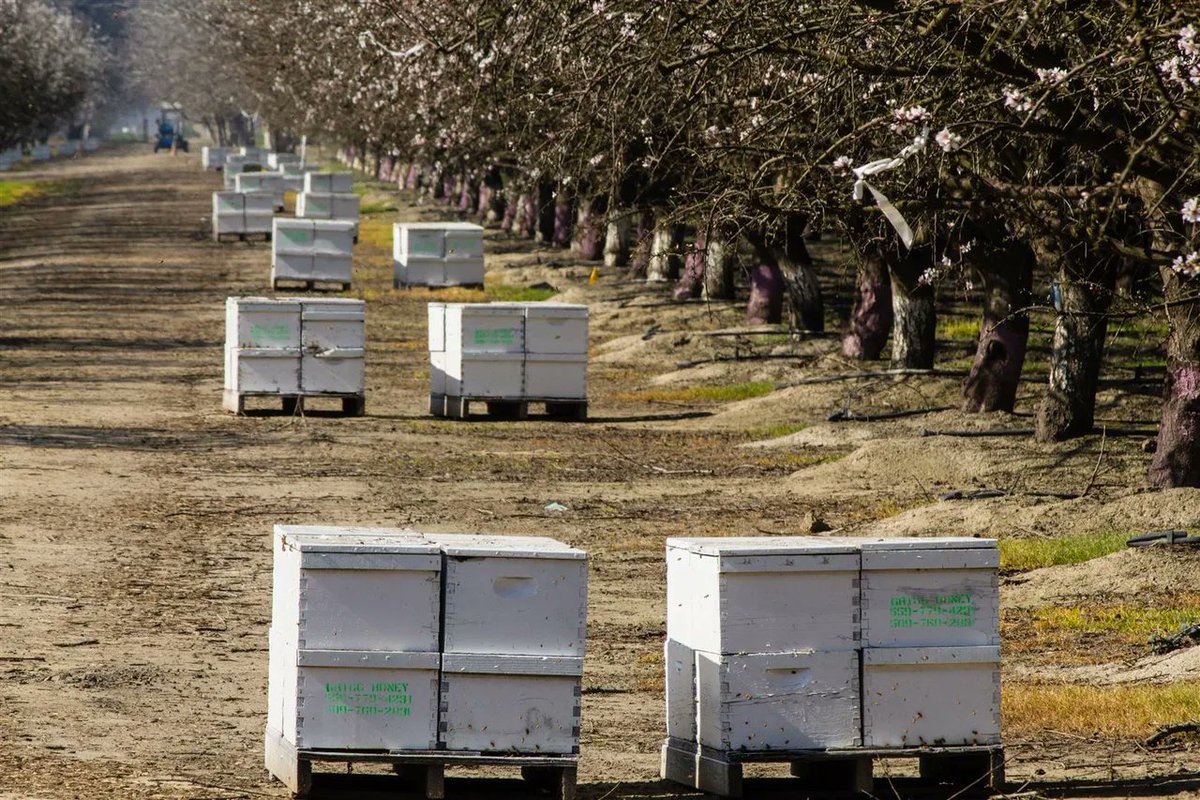
Every February, 70% of the commercial honey bees in the United States, roughly two million colonies, are loaded onto lorries and driven to California. They are going to pollinate the almonds. 80% of the world's almonds come from one valley in California. Over 1.3 million acres of nothing but almond trees, blooming for three weeks in monoculture, requiring more pollinators than the state can produce on its own. So the bees are trucked in from every corner of the country. Florida. New York. Montana. The bees are fed sugar water for the journey because their own honey has been removed to lighten the load. They arrive in the Central Valley to a landscape that is, for three weeks, pink and white blossom, and for the other forty-nine weeks of the year, dead. Nothing to eat. No forage. No diversity. Just almond trees and bare dirt, sprayed regularly with fungicides and insecticides that were deemed bee-safe in adult bees but turn out to be lethal to larvae when combined. In February 2025, commercial beekeepers reported the worst die-off on record. Around 60% of commercial honey bee colonies in the United States dead in a single pollination season. Financial losses estimated well over $139 million. Some beekeepers lost 90 to 100% of their colonies. The almonds are marketed as plant-based. Clean. Ethical. The preferred alternative. The preferred alternative requires the single largest managed pollination event in human history and it is quietly killing the pollinators faster than they can be replaced. Every glass of almond milk is, statistically, a small contribution to the largest pollinator die-off on record. This is not in the advertising.
Sama Hoole tweet media
English
361
4K
11.3K
511.6K