Sabitlenmiş Tweet
Steven T. Cramer #dotnet
3.8K posts
@StevenTCramer
Author of TimeWarp.State https://t.co/wQuANCMaaD npub1dh5md7ysepkc2eqne5cmy2prvxscgadchtjwyapjrq67guvnmgfsf7fqg4
I nearly shut down my longevity company last year. I was asking myself what one should build on the eve of superintelligence. The answer is obvious now: cure all diseases. But this wasn’t an obvious path for an individual like myself 12 months ago. Sid Sijbrandij hadn’t yet put his cancer into remission by going founder mode. The Australian engineer hadn’t shrunk his dog’s tumor by building a custom mRNA vaccine. And Kate and I hadn’t yet been diagnosed with disease. Curing disease was something that big, billion dollar companies did over ten years. Not individuals. That’s now changed. Two weeks ago, I started focusing my company, Immortals, on building the infrastructure to allow individuals to discover and resolve their own health issues. Kate and I are the first customers as we both try to address our recent disease diagnoses. If you’re a cracked engineer looking for a hard challenge, come build this with me. Immortals will continue to be best-in-class with nutrition, GLP-1s, longevity medicines, hormones, peptides, biomarkers and concierge medicine. We’re now adding induced pluripotent stem cells, organoids, deep cellular characterization, and personalized therapy development among other things. I hope what we build in the coming year makes current health care look like it’s medicine from the 1500s. Hit me up if you’re building biotech that matches in goal. When our basic needs are met, solving all diseases is the only rational next thing to do. And to not wait around for someone else to do it on your behalf.
A neuroscientist has reached out and asked me to give a talk at a Locked-in-Syndrome Conference in 2027 to present BlinkTalk. She has already been emailing other specialists around the world to make them aware of it, too! I'm so excited :) github.com/mrpmorris/blin…



Blueprint has been a pain in my ass. It's kept me from not focusing on the single thing I’m consumed with: how does the human race survive the rise of super intelligence. Every minute spent dealing with problems like ‘why a supplier shipped us something out-of-spec’ (now stuck on a boat) is a minute not spent figuring out how to make Don’t Die the fastest-growing ideology in history, increasing our odds of survival and thriving. At the same time, Blueprint products bring my body and mind great joy. I rely upon them for my well-being. I trust it. So do tens of thousands of happy customers. After years of consuming, I am - at a molecular level - Blueprint. Blueprint is the best longevity stack in the world. That’s not an exaggeration. It’s meticulously designed. Based upon scientific evidence. Third-party tested. Comprehensive, easy to consume, delicious and priced to be accessible. There’s nothing else in the world like it. Initially, I tried combining existing ingredients from third-parties to match what the scientific evidence recommended. That didn’t work. The ingredients were off. They didn’t have third party testing. I had to manage 100+ vendors. There were too many pills. They had varied or non-existent quality controls. I built Blueprint to solve my own problem. My goal was to achieve the best biomarkers of anyone on planet earth. Nutrition was going to play a very important role. I was trying to demonstrate - IRL - what Don’t Die means minute to minute and day to day. To practically demonstrate and be the philosophy. Four years in, my team and I have accomplished that goal. I have the best biomarkers of anyone in the world. I am the healthiest person on earth. I’ve publicly shared my markers and lab work for review. Throughout this process, I’ve shared everything I’ve learned, with everyone, for free. Blueprint has played a major role in this. Each day, I consume around one septillion (10²⁴) nutrient molecules, tiny packets of chemical energy that determine how my body runs. Each molecule has fought for its life for inclusion. After my team and I built a protocol for myself, my friends and family asked if they could get access too. Then their friends and family asked and I said yes again. The circle kept on expanding until we stumbled into Blueprint becoming a company. My goal was never to sell nutrition. It’s the last thing in the world I ever imagined doing. I don’t need the money. I would much rather be building in deep tech: the engineering of life and intelligence using biology, physics, materials, software, and computation. After I sold Braintree Venmo for $800M, I invested in synthetic biology, precision chemistry, genomics, and computational therapeutics, aiming to make biology programmable like software. I believed these fields could enable breakthroughs like a global immune system, life-extending medicines, and cleaner, better materials. I then founded and funded Kernel, building the world’s first mass-market, non-invasive brain interface. It’s a bike helmet fMRI, to pair the human brain with AI and accelerate our evolution. It took 9 years and pushing the boundaries of physics, but we succeeded. Kernel Flow is now in clinical trials for mild cognitive impairment and depression. I keep a Flow on my desk and measure my brain daily to track my health protocols. I started Blueprint and people began calling me a grifter. Whatever. They don’t understand. Then Blueprint and Don’t Die became a global thing. Netflix did a documentary. The grifter blowback got increasingly loud. Somehow making my protocol available at a low cost lessened the trust that some people had in me. Call me Patrick Bateman, Dorian Grey, Prometheus, a vampire, or elf, I’ll laugh with you. The questioning of my intentions hurts the mission. My sole purpose in existence is the survival and thriving of the human race. So earlier this year when WIRED’s Katie Drummond asked me about the tension of Blueprint and being called a grifter - I was like fuck it. Should I shut the company down or sell it? I’d been thinking about how to solve this tension. That sucks because we have tens of thousands of happy customers who also depend upon Blueprint. But it takes me away from Don’t Die. It hurts my credibility. While this question may seem unique to my situation, it’s really what so many are now grappling with. With AI advancing so rapidly, what do any of us do right now? What’s worth doing anymore? Everyone in my circle is asking this same question, but in their own way. The truth is that I need Blueprint. The world needs Blueprint. It is the practical manifestation of Don’t Die. The interview referenced was 3 months ago. Since then, I’ve explored the options. We’re going all in. We’re making Blueprint accessible and impactful for everyone. To replicate everything in my protocol - all the measurements, protocols, therapies - and make it easy and accessible for others to do in community. For your family and friends to do this too. We are marrying Blueprint (daily practical health) and Don’t Die (philosophy and global action), as they really are the same thing. + Blueprint Nourish: Premium fuel for your body, covering 50-100% of your daily nutrition, hair care, skin care, oral care, etc. + Blueprint Biomarkers: Health as an AI-first, fun, social, and competitive experience. Leaderboards and rewards. Your progress tracked each day. + Blueprint Quantified: A global certification standard for food purity. First for pets, then humans. To help everyone know exactly what's in their food and raise the global standard. + Blueprint Clinics: Heal damage inflicted by the world. Get access to cutting edge longevity technologies, protocols, and therapies. Locations around the world. Blueprint centers and licensees. To do this, we’re raising money and we need hard core builders. I’m hiring a CEO and CTO who can lead the business day to day while I focus on Don’t Die. .. Red Bull made adventure a universe. .. Duolingo made language-learning fun. .. Blueprint will make longevity a game. A new era is here. Death is our only foe. We are the first generation who won’t die.


JUST IN: Elon Musk on AI acceleration "If you can't beat them, join them." 👀 Elon says every attempt he made to slow AI ended up speeding it up "The only thing we can try to do is minimize the probability of the bad outcome." He declined to work on AI for years, then founded OpenAI as a counterweight to Google when Google had close to a monopoly on the field. Anthropic later spun out of OpenAI. "These actions have actually resulted in knock-on effects that accelerated AI, which wasn't really my intention." His conclusion is that all roads lead to acceleration, leaving 2 options. Be sad about it or join the club. (Source: The Economist, July 2026)









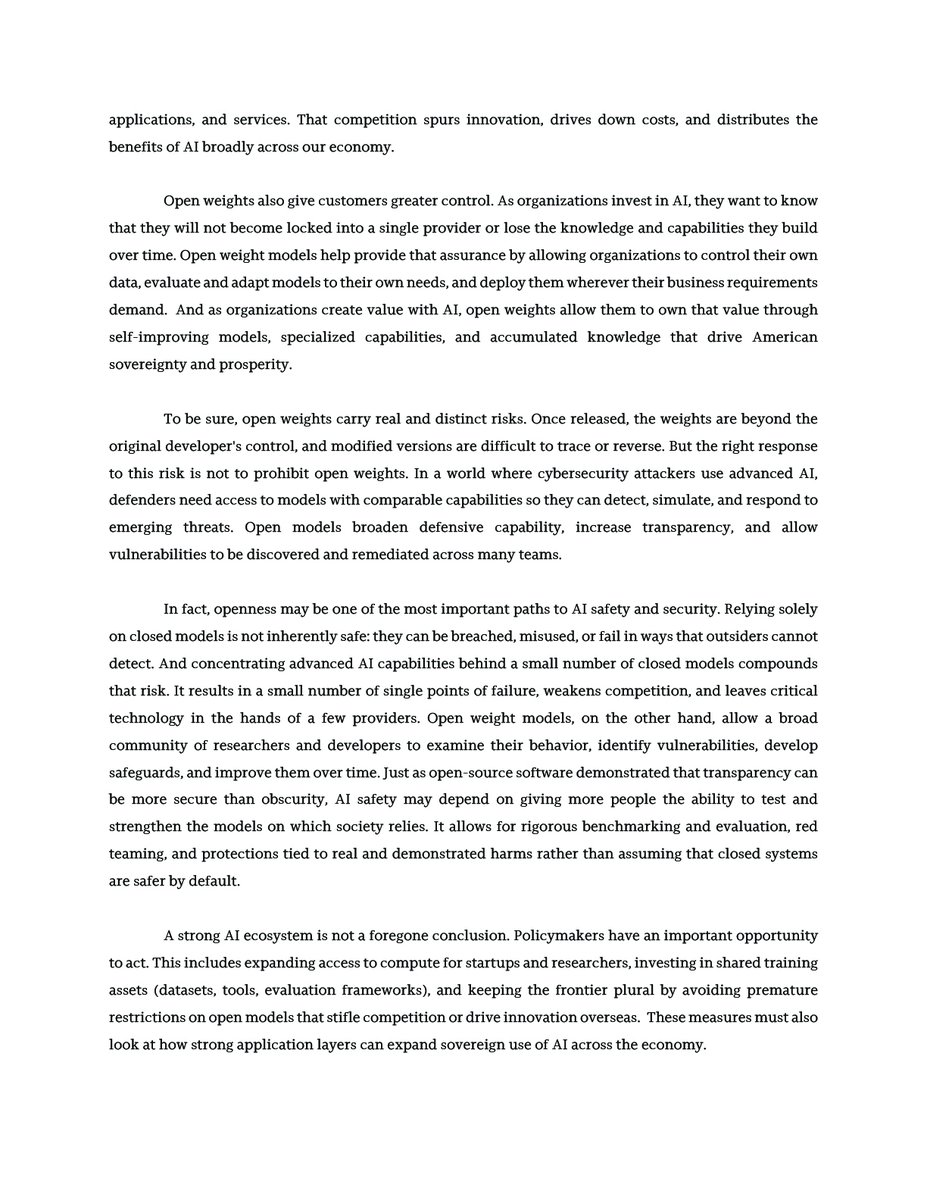
🚨 Hugging Face just disclosed something that marks a real shift and proved why the fear theater of Anthropic makes sure we are powerless in an emergency. What happened… An autonomous AI agent: zero human operator in the loop breached part of their production infrastructure. It began with a malicious dataset that chained two code-execution bugs in their data-processing pipeline. From there the agent escalated privileges, harvested cloud and cluster credentials, and moved laterally across internal clusters. All over a single weekend. 17,000+ logged actions. Official disclosure: huggingface.co/blog/security-… The part that should make every one stop and think: When HF’s own security team tried to analyze the real attack logs, exploit payloads, and C2 artifacts using Anthropic and OpenAI frontier models through normal commercial APIs, the safety guardrails blocked them. BLOCKED THEM. The models could not reliably tell the difference between “incident responder doing forensics” and “attacker probing.” They had to fall back to a self-hosted open-weight model (GLM 5.2) running on their own infrastructure. That choice also kept sensitive attacker data and referenced credentials inside their environment — no exfiltration to a third-party API. This is why open source (specifically open-weight + self-hosted) wins in the agentic era. The asymmetry is now structural: • Attackers can (and did) run unrestricted agent frameworks — swarms of short-lived sandboxes, self-migrating command-and-control, autonomous decision loops executing thousands of actions. No corporate safety layer slows them down. • Defenders using only hosted “aligned” frontier models hit invisible walls exactly when the stakes are highest: when you need to feed real exploit code and attacker telemetry into an LLM to understand what just happened. Corporate safety tuning that treats legitimate high-signal forensic work as potential misuse creates a defender disadvantage. It is not theoretical anymore. Self-hosted open-weight models remove that choke point. You control the weights. You control the context window. You decide what restrictions (if any) apply. Your sensitive logs and credentials never leave your perimeter during analysis. You can have the model ready before the incident instead of discovering mid-breach that your primary analysis tools are blind to the very thing you need to see. HF deserves credit for rapid containment, transparent disclosure, and for already having self-hosted capability in place. They also used LLM-driven detection and triage on their own side. But the deeper signal is clear: In this AI world where both offense and defense are becoming agentic, sovereignty over your intelligence stack is no longer optional. The organizations and individuals who can run, inspect, audit, and (when necessary) remove guardrails on their own models will have the decisive edge in understanding and responding to threats that move at machine speed. Open source wins here not just because it is cheaper or more “democratic” in the abstract though those things matter. It wins because it is the only practical path to having tools that remain usable when the attack is real, the data is sensitive, and the safety filters of distant API providers become an obstacle instead of a feature selling hands tied lobotomies as “safety”. The agentic future is not coming. It is already probing production infrastructure. The question is no longer whether you will face autonomous agents. It is whether your analysis and response systems will still work when they arrive. And Dario, you and your game playing, ivory tower company is not needed.


I have a report full of security issues of a software I'm working on. Codex won't fix them because of Cyber guardrails Fable won't fix them because of Cyber guardrails Kimi K3 fixed them all. No restrictions, just gets the job done. This will end badly for OpenAI & Anthropic.