The Father of Stocks

2.4K posts

The Father of Stocks banner
The Father of Stocks

The Father of Stocks

@StocksHomeNo1

Focused on U.S. equities with deep expertise in technology, AI, EVs, and autonomous driving. Long-term investor in high-conviction names like $TSLA while mainta

Katılım Temmuz 2010
559 Takip Edilen1.1K Takipçiler
The Father of Stocks
The Father of Stocks@StocksHomeNo1·
U.S. stocks closed mixed Wednesday (SPX -0.1%, NDX -0.5%) as investors positioned ahead of Alphabet and Tesla Q2 results after the close, while Brent crude surged ~3% to the $94 area on ongoing U.S.-Iran tensions and Strait of Hormuz risks. 10-year yields remained elevated amid energy-driven inflation concerns. Tomorrow’s (Thursday) direction will be dictated by the after-hours reaction to those two reports. Tesla delivered a revenue beat driven by strong Model 3/Y volumes but missed on EPS, with gross margins at 16.8% and free cash flow turning negative. FSD subscription growth was a bright spot, yet the stock dipped in after-hours trading. I remain cautious on $TSLA given its still-stretched valuation (elevated 2026 P/E versus long-term EPS growth) and the accelerating unsupervised autonomy competition from multiple players. On the names requested: $NVDA, $SMCI, $DELL and $MU remain the purest AI infrastructure/server and memory beneficiaries. Dell continues to highlight large AI server backlogs; Super Micro has shown margin improvement commentary recently but carries equity-raise overhang risk. Micron has been extremely strong on AI memory demand but is extended after big runs. $T reported a clean Q2 beat with solid postpaid and fiber adds, providing a defensive tone. $PATH reversed sharply lower today and remains vulnerable in a risk-off tape. Base case for Thursday: choppy to modestly lower open if the Tesla margin disappointment dominates sentiment, with selective support in the AI hardware names ($NVDA/$SMCI/$DELL/$MU) if Alphabet’s Cloud growth and capex commentary reaffirm hyperscaler spend. Oil volatility and yields will keep a lid on multiples. Valuation still matters.
English
0
5
5
403
The Father of Stocks
The Father of Stocks@StocksHomeNo1·
Tomorrow (Thursday July 23) directional bias based on current public data: 🟢 $SMCI: Mildly negative / high risk of profit-taking. A 20%+ one-day move on backlog news is impressive, but the stock remains well below prior highs and has a history of sharp mean-reversion after vertical days. Near-term valuation still demands flawless execution. 🟢 $NVDA: Mildly positive. Options activity and technical breakout above recent resistance keep the path of least resistance higher as long as the broader AI trade holds. 🟢 $DELL: Neutral to mildly positive. Same AI server backlog narrative that lifted SMCI supports DELL, though it has already reflected much of the good news. 🟢 $T: Mildly positive. Clean earnings beat + subscriber growth + raised buyback should provide a floor. Telecom remains less correlated to AI volatility. 🟢 $MU: Positive. HBM remains completely sold out into 2027 under multi-year contracts. This is still the cleanest fundamental story in semiconductors right now. 🟢 $PATH: Neutral. Limited near-term catalysts relative to the hardware/memory complex. Automation demand is real but secondary. The AI infrastructure trade (servers + HBM + accelerators) remains the dominant theme. After a high-volume vertical day in $SMCI, some digestion is healthy and expected. I stay data-driven and valuation-aware — backlog strength is real, but price action after extreme one-day moves often requires confirmation.
English
0
6
7
244
The Father of Stocks
The Father of Stocks@StocksHomeNo1·
U.S. stocks mixed midday Wednesday as AI infrastructure names led while software automation sold off. 🟢📈 $SMCI +21.4% (to ~$30.95) after the company raised gross margin guidance to 15-17% (from prior 8.2-8.4%) on a favorable product mix and disclosed a record >$60B AI server order backlog from Q4 fiscal 2026. 🟢📈 $DELL +9.1% (to ~$440.8) on the same AI server read-through — $51.3B backlog, Nvidia partnership strength, and sector momentum. 🟢📈 $NVDA +3.1% (to ~$213.7) as the broader AI trade caught a bid from the server makers’ updates. 🟢📈 $MU roughly flat to modestly higher after its strong prior-day move on Bank of America upgrade and HBM/AI memory demand. 🟢📈 $T +3.0% after beating Q2 estimates (adj. EPS $0.65 vs $0.59) with solid postpaid phone and fiber net adds; company also boosted buybacks. 🟢📈 $PATH -13.1% (to ~$10.47) after OpenAI launched its “Presence” enterprise AI agent platform, raising competition concerns for traditional RPA/automation software. 🟢📈 $TSLA -0.5% (to ~$375.4) ahead of Q2 earnings after the close; valuation remains stretched (2026 P/E still elevated vs long-term growth) and we stay cautious given ongoing autonomous competition and earnings revision risks. AI server demand remains the clearest near-term earnings driver in the group. Valuation still matters — especially on names trading at extreme multiples relative to forward growth.
English
0
0
0
58
The Father of Stocks
The Father of Stocks@StocksHomeNo1·
U.S. tech stocks remain the standout performers in this AI-driven cycle, with forward earnings revisions continuing to support premium valuations for the leaders. I continue to like NVDA, TSM, MU, and AMD as core holdings for the balance of 2026 and into 2027. Why? 💚 $NVDA dominates the AI accelerator market with unmatched CUDA software moat and Blackwell ramp. Despite elevated multiples, the scale of data center capex from hyperscalers keeps demand visibility high. 💚 $TSM is the foundry kingpin — AI HPC now over 60% of revenue, with massive U.S. expansion and advanced node leadership. Strong pricing power and 2026-27 growth outlook look solid. 💚 $MU benefits from memory recovery (HBM for AI) and is trading at far more reasonable multiples than peers. Supply discipline in DRAM/NAND plus AI tailwinds make it attractive. 💚 $AMD is closing the gap in AI GPUs with MI400 series; if execution holds, it offers better value than NVDA on relative growth. Valuation still matters — avoid names where forward EPS estimates are declining or PEGs are stretched beyond reason. Overall, I favor those with clear AI exposure, strong balance sheets, and positive revisions trajectory.
English
1
0
0
77
The Father of Stocks
The Father of Stocks@StocksHomeNo1·
U.S. memory and storage stocks were among the weakest names today amid continued pressure on the semiconductor sector. $MU fell ~4-6% (extending recent weakness), $SNDK and $WDC were down sharply, $STX lagged, while $SKHY (SK hynix ADR) and $EWY (iShares MSCI South Korea ETF, heavy in semis) also felt the heat as Korean memory names remained volatile. The move reflects ongoing rotation out of high-valuation AI-adjacent memory plays after a strong run earlier in 2026. Investors are digesting potential supply increases from major players, questions around near-term AI capex pacing, and stretched multiples (many memory names still trade at elevated forward multiples despite recent pullbacks). Broader chip sector rotation into software/mega-cap defensives continues to weigh on names like Micron, Western Digital, and Sandisk. I remain cautious on these names near-term. Forward earnings revisions will be key—any softening in AI memory demand or margin pressure from competition/supply could extend the downside.
The Father of Stocks tweet mediaThe Father of Stocks tweet media
English
0
0
0
185
The Father of Stocks
The Father of Stocks@StocksHomeNo1·
U.S. semiconductor stocks remain under pressure this week amid broader market rotation out of the AI trade. $MU has pulled back sharply after its recent earnings beat but continues to benefit from strong HBM demand for AI servers, with fiscal 2026 EPS estimates still pointing to massive growth. $NVDA and $AMD are also seeing profit-taking, though both remain key beneficiaries of data center buildouts. $INTC continues to struggle with execution and foundry losses, while $SNDK and $SKHY (SK hynix) reflect ongoing memory chip pricing volatility—SK hynix in particular has seen significant swings tied to Korean market moves. $TSM holds up relatively better as the leading foundry but faces margin pressure from advanced node investments. The memory segment ($MU, $SNDK, $SKHY) looks oversold relative to long-term AI tailwinds, with analysts forecasting strong earnings growth into 2027. However, valuation dispersion is wide—$MU and $NVDA trade at premium multiples versus more cyclical names like $INTC.
The Father of Stocks tweet mediaThe Father of Stocks tweet media
English
0
0
0
87
The Father of Stocks
The Father of Stocks@StocksHomeNo1·
Looking ahead, the key themes for U.S. equities remain centered on AI infrastructure buildout, earnings revision trajectories, and valuation discipline. S&P 500 2026 EPS estimates continue to climb toward $340-346 (+22-25% YoY) driven by data center capex and energy sector tailwinds, supporting a forward P/E around 21-22x and earnings yield of ~4.6%. This remains attractive versus bonds, but selectivity is critical. The AI/semiconductor trade will stay dominant but faces risks from profit-taking, memory supply dynamics ($MU, $SKHY), and competition. $NVDA and related names benefit from sustained demand, yet multiples must compress if growth moderates. Energy and infrastructure plays gain from any geopolitical resolution (e.g., oil flows) and power needs for AI. $TSLA remains a cautionary tale: strong deliveries are positive, but long-term earnings estimates are declining amid autonomy commoditization ($GOOG, $AMZN, others scaling unsupervised rides). At 200x+ 2026 P/E and 6x PEG, the stock looks fully priced until revisions turn positive. Broader market upside exists if macro stabilizes (Fed path, lower energy volatility), but we favor names with better growth/valuation balance. Valuation has to matter.
English
0
0
0
38
The Father of Stocks
The Father of Stocks@StocksHomeNo1·
U.S. stocks mixed today with NDX under pressure (down ~1%) as semiconductor names faced renewed selling amid profit-taking and valuation concerns ahead of key earnings. $SPX closed modestly lower around 7,489, holding near recent levels despite rotation out of high-multiple tech. $NVDA closed around 204.48 (-~1-2% range), continuing to consolidate after recent moves. $MU and $SKHY (SK hynix) saw notable weakness as memory chip sector rotated amid supply concerns and stretched valuations in the AI trade. $TSLA had a rough session, closing near 369.57 (-~3%), extending recent underperformance. While Q2 deliveries were strong earlier, forward earnings estimates continue to face pressure and the valuation remains extremely stretched (high P/E relative to growth outlook). I remain cautious on $TSLA due to negative revisions trajectory, increasing competition in autonomy from $GOOG, $AMZN and others, and a PEG that looks expensive versus peers. Broader market still supported by rising S&P EPS estimates from AI capex, but the AI/semiconductor trade looks vulnerable near-term. Valuation has to matter at some point.
English
0
0
0
60
The Father of Stocks
The Father of Stocks@StocksHomeNo1·
U.S. stocks are showing mixed signals this morning (SPX futures +0.3%, NDX futures +0.8%) as the semiconductor complex attempts a modest rebound ahead of key earnings, while broader market volatility remains elevated amid geopolitical noise and rotation out of stretched growth names. Looking at the group you mentioned — $NVDA, $MU, $SKHY, $INTC (core semis/AI memory), $IREN/$HUT/$CIFR (bitcoin miners), $AMC (retail/meme volatility play), and $SPCX (SpaceX high-growth IPO) — the common thread is high-beta exposure to thematic growth narratives (AI infrastructure, digital assets/crypto, space/tech disruption) with elevated valuations and sensitivity to sentiment shifts, forward earnings revisions, and macro catalysts like energy prices or risk appetite. These names have seen significant volatility: semis pressured by AI capex digestion fears and competition (memory pricing, China models), miners tied to BTC swings and power costs, $AMC driven by retail flows rather than fundamentals, and $SPCX facing post-IPO unlock dilution despite strong TAM in Starlink/Starship. Many trade at premium multiples (e.g., high EV/Rev or P/E for growth assumptions) where negative revisions or competition can trigger sharp moves, much like the broader AI trade we've seen pull back recently. Valuation matters — stretched PEGs leave limited margin of safety if EPS trajectories soften. I remain selective; the AI/semiconductor backbone has long-term merit from data center buildout, but near-term risks from competition and digestion warrant caution, especially in names without clear near-term catalysts.
English
0
0
1
79
The Father of Stocks
The Father of Stocks@StocksHomeNo1·
U.S. stocks enter the week of July 20 with mixed futures after last week’s pullback (SPX -1.6%, NDX -2.9%). Earnings season ramps up in earnest with major reports from Tesla, Alphabet, Intel, and others, while key data like ADP jobs, ECB rates, and U.S. home sales will test sentiment. The AI trade remains under pressure from semiconductor weakness, but S&P 2026 EPS estimates continue to climb toward the +23-25% YoY range on data center and infrastructure spending. Valuation discipline matters — the market is pricing in a lot of perfection. Brent crude hovers around recent levels amid ongoing global supply dynamics. I expect volatility this week as investors digest earnings guidance, particularly on capex and demand. The path of least resistance could be higher if results affirm earnings resilience, but any signs of slowing AI momentum or stretched multiples will weigh. I remain cautious on $TSLA given its elevated 2026 valuation relative to forward earnings growth trajectory and increasing autonomous competition — it needs positive revisions to sustain upside.
English
0
0
0
45
The Father of Stocks
The Father of Stocks@StocksHomeNo1·
Heading into next week, U.S. stocks face a busy earnings calendar that will test whether AI spending momentum and resilient corporate margins can offset stretched valuations and lingering macro uncertainty. Bank earnings this week provided a mixed read on credit conditions and deal activity, but the real focus shifts to industrials, autos, and select tech names. $TSLA reports Wednesday after the close alongside IBM – investors will scrutinize margins, delivery trends, and any updates on Robotaxi/Optimus timelines amid rising unsupervised autonomy competition. $GM and others in autos could highlight EV demand resilience tied to higher gas prices. Key economic releases are lighter (housing data, some PMIs), but the backdrop includes ongoing Iran-related tensions supporting oil prices and Fed Chair Warsh’s policy path. S&P 500 2026 EPS estimates remain constructive around $340-346 (+22-25% YoY) on AI/energy tailwinds, but negative revisions in select names and high PEG ratios (e.g., $TSLA well above Mag7 peers) suggest selectivity is warranted. I expect volatility around individual prints, with the path of least resistance higher for quality growth if earnings validate the AI cycle, but remain cautious on $TSLA due to extended valuation and competitive pressures. Watch for broader rotation if megacap results disappoint.
English
0
0
0
51
The Father of Stocks
The Father of Stocks@StocksHomeNo1·
These micro-cap names are among today’s standout gainers amid broader chip sector weakness. Moves appear driven by company-specific news rather than macro rotation. $SDOT surged ~79-93% on heavy volume after announcing the TradeIQ acquisition plus new financing access and removal of a legacy equity facility. Earlier momentum came from the June Anira Consulting (Tradewell) $12M deal and July debt-for-stock settlements retiring ~$3.36M in obligations. Low post-reverse-split float continues to amplify swings. $SLND jumped +56%+ (pre-market gaps over 60% in some reports) after its subsidiary secured a major ~$815M CAD joint-venture contract for a Winnipeg biosolids/water treatment facility upgrade. Infrastructure project wins have historically triggered sharp moves in this name. $BIYA rose ~37% with strong volume following its 1-for-10 reverse split (effective mid-July) aimed at regaining Nasdaq $1 minimum bid compliance. Earlier pops tied to a $2M asset sale; reduced share count often fuels short-term speculative interest in these low-float situations. $CJMB advanced +34%+ on volume spike after the July 8 partnership with Alabama State University to advance pharmaceutical onshoring, workforce development, and the Atlas Complex campus. Prior catalysts include Oregon VFC cold-chain authorization and the Attune Biotech manufacturing/oversight agreement (potential $50-75M revenue range). $LEDS climbed +32% as traders reacted to narrowed Q2 FY2026 losses (despite lower sequential revenue) and management’s positive outlook for H2 buy-sell purchase orders. Broader LED lighting market growth projections (CAGR 8-12%+ through 2030s) provide longer-term context for the semiconductor/LED chip maker. These remain high-beta, thinly traded names where news + momentum flows can produce outsized moves. Follow-through volume and execution on announced deals will determine durability.
English
0
0
0
149
The Father of Stocks
The Father of Stocks@StocksHomeNo1·
U.S. stocks tumbled Friday as the global chipmaker selloff intensified, driven by Chinese startup Moonshot’s Kimi K3 AI model rivaling OpenAI and Anthropic. Investors fear the breakthrough echoes last year’s DeepSeek shock, questioning the justification for massive AI capital spending. $NVDA fell 1.6%, $TSLA dropped 1.5%, and $SPCX lost 3.4% to $127, well below last month’s $135 IPO price. $NFLX plunged 9% on weak guidance. Iran tensions escalated for a sixth day, boosting Brent crude +1.7% to $87/bbl. S&P 500 2026 EPS estimates have continued to rise to $346 (+25% YoY) on AI and energy gains.
English
0
0
0
66
The Father of Stocks
The Father of Stocks@StocksHomeNo1·
U.S. stocks tumbled Friday as the global chipmaker selloff intensified, driven by Chinese startup Moonshot’s Kimi K3 AI model rivaling OpenAI and Anthropic. Investors fear the breakthrough echoes last year’s DeepSeek shock, questioning the justification for massive AI capital spending. The Nasdaq was hit hardest given its tech weighting, while the S&P 500 and Dow saw broad-based weakness. $NVDA fell 1.6%, $TSLA dropped 1.5%, and $NFLX plunged 9% on weak guidance. Iran tensions escalated for a sixth day, boosting Brent crude +1.7% to $87/bbl. On a longer-term positive note, S&P 500 2026 EPS estimates have continued to rise to $346 (+25% YoY) on AI and energy gains. That said, with rising competition in autonomy, negative revisions in some high-growth names, and stretched valuations in parts of the market, I remain selective. Broad indices are showing signs of digestion after recent gains – caution warranted into the weekend.
The Father of Stocks tweet media
English
0
0
0
65
The Father of Stocks
The Father of Stocks@StocksHomeNo1·
U.S. stocks finished mixed-to-lower Thursday with the Nasdaq under clear pressure from semiconductors as investors digested the week’s data flow and positioned ahead of Friday’s housing starts, industrial production, and University of Michigan preliminary sentiment numbers. S&P 500 futures pointed modestly lower into the close while NDX futures were down more sharply. Brent crude held in the mid-$84s. S&P 500 2026 EPS estimates have continued to climb (now reflecting +23-25% YoY growth) on sustained AI data-center and infrastructure spend plus firmer energy earnings. That still leaves the index at a roughly 21.5x forward multiple and an earnings yield roughly in line with the 10-year Treasury. I remain cautious on $TSLA. Even after the strong Q2 delivery beat, long-term earnings estimates continue to drift lower while unsupervised autonomy competition from $GOOG, $AMZN, $BIDU and others accelerates. At a 2026 P/E still north of 200x versus mid-30s long-term EPS growth, the PEG remains unattractive relative to the rest of mega-cap tech.
English
5
6
8
274
The Father of Stocks
The Father of Stocks@StocksHomeNo1·
$SKHY and $MU are the purest public vehicles for the AI high-bandwidth memory supercycle. SK Hynix completed its $26.5B Nasdaq ADR listing (ticker SKHY) on July 10 at $149, opening at $170 and closing the debut day at $168 (+13%). The stock has been extremely volatile since: Korean shares suffered a record 15.4% single-day drop on July 13 (triggering a Kospi circuit breaker), dragging the ADR lower, before a sharp rebound fueled by Barclays’ Overweight initiation and $330 price target. SKHY has traded as high as the mid-$190s in the subsequent sessions. SK Hynix holds approximately 56-58% global HBM revenue share and management continues to guide to the most severe memory supply shortage on record extending into 2027 and beyond 2030 despite aggressive capacity additions funded by the ADR proceeds. Micron reported a blowout fiscal Q3 (ended late May): revenue $41.5 billion (+346% YoY), adjusted EPS $25.11, with Q4 guidance of roughly $50 billion revenue and $31 EPS. The stock spiked to an all-time high near $1,255 on the print but has since corrected 25-30% from the peak as investors rotated and the new SKHY listing provided a direct alternative pure-play vehicle. Forward P/E remains in the high-single-digit range (around 9x) despite the massive upward earnings revisions. Both companies benefit from multi-year strategic customer agreements and exceptional pricing power in HBM. However, valuation still matters. SKHY continues to trade at a meaningful discount to MU on a forward earnings basis even after the ADR listing, despite its superior HBM market position. The $26.5B capital raise and planned capacity expansions will eventually ease the shortage, though neither management team sees meaningful relief before late 2027/2028. Earnings estimate revisions remain the single most important driver for both stocks. I view both as core long-term holdings in the AI infrastructure stack, but the risk/reward currently favors the lower-multiple name after the recent volatility.
English
7
5
10
788
The Father of Stocks
The Father of Stocks@StocksHomeNo1·
$SKHY and $MU remain the two cleanest pure-play expressions of the AI memory supercycle available to U.S. investors. SK Hynix continues to dominate High Bandwidth Memory with roughly 55-60% global share (some trackers put the latest figure at 56.4%). Its Nasdaq ADR listing (SKHY) earlier this month was heavily oversubscribed and finally gives U.S. funds direct ownership of the HBM leader instead of having to route exposure solely through Micron. Long-term agreements are locking in both volume and pricing for a large portion of output through 2027-28. Operating margins have moved into the 70%+ zone on the richer HBM mix, and several houses (UBS, HSBC, Mirae) have continued raising 2026-28 operating profit forecasts. The stock still trades at a meaningful discount to MU on forward earnings and book multiples despite the technology lead. Micron just delivered another blowout quarter: revenue of $41.5 billion (+346% YoY), adjusted EPS $25.11, and gross margin 84.9%. Guidance for the current quarter points to roughly $50 billion in revenue and 86% gross margin. More important than the numbers themselves are the 16+ multi-year strategic customer agreements that management says will cover approximately $100 billion of revenue and eventually ~40% of the business, many with price floors that should keep margins structurally higher than any prior cycle. Management continues to state that tightness will persist beyond calendar 2027. At recent levels around $930-980 the stock is still trading at a low-to-mid teens multiple of 2027 consensus EPS estimates after the post-earnings and peer-listing de-rating. Both names have given back significant ground from June peaks on legitimate concerns about capacity additions (including Chinese entrants) and potential normalization later in the decade. Those risks are real. However, the combination of multi-year take-or-pay style contracts, still-rising AI server memory content, and constrained advanced packaging capacity argues that the current pricing power lasts longer than the market is currently willing to underwrite. Between the two, SKHY offers more pure HBM torque and technology leadership; MU offers superior liquidity, a clearer path to large-scale buybacks, and U.S. manufacturing optionality. I remain constructive on both as core AI infrastructure holdings as long as the long-term agreements continue to expand and 2027-28 estimates keep moving higher.
English
8
7
7
1.1K
The Father of Stocks
The Father of Stocks@StocksHomeNo1·
$SKHY and $MU are both lower today as the memory chip selloff deepens. Overnight, South Korea’s KOSPI dropped sharply (over 6%) with SK Hynix shares falling double digits after China’s ChangXin Memory Technologies (CXMT) advanced plans for a sizable IPO to expand DRAM capacity. That news revived investor fears of a potential supply glut just as valuations in the AI memory trade had become stretched following the massive run-up earlier this year. U.S. listed $SKHY and $MU are tracking the weakness, with semiconductors leading the downside in pre-market and early trading. The AI-driven HBM shortage narrative remains intact into 2027, and both companies continue to benefit from sold-out capacity and elevated pricing. However, the market is now pricing in the risk that aggressive capacity additions — from SK Hynix’s own expansion funded by its recent Nasdaq listing, Micron’s new fabs, and now Chinese supply — could eventually ease the tightest conditions. Forward earnings estimates for the group are still rising, but the near-term multiple compression is real after the stocks more than doubled (in some cases tripled) in a short period. I view the current pullback as a classic valuation reset in a still-strong secular story rather than a fundamental break. The key variables to watch remain HBM allocation, long-term supply contracts, and any signs that CXMT or other new capacity is actually ramping meaningful volume sooner than expected.
English
6
7
12
1.8K
The Father of Stocks
The Father of Stocks@StocksHomeNo1·
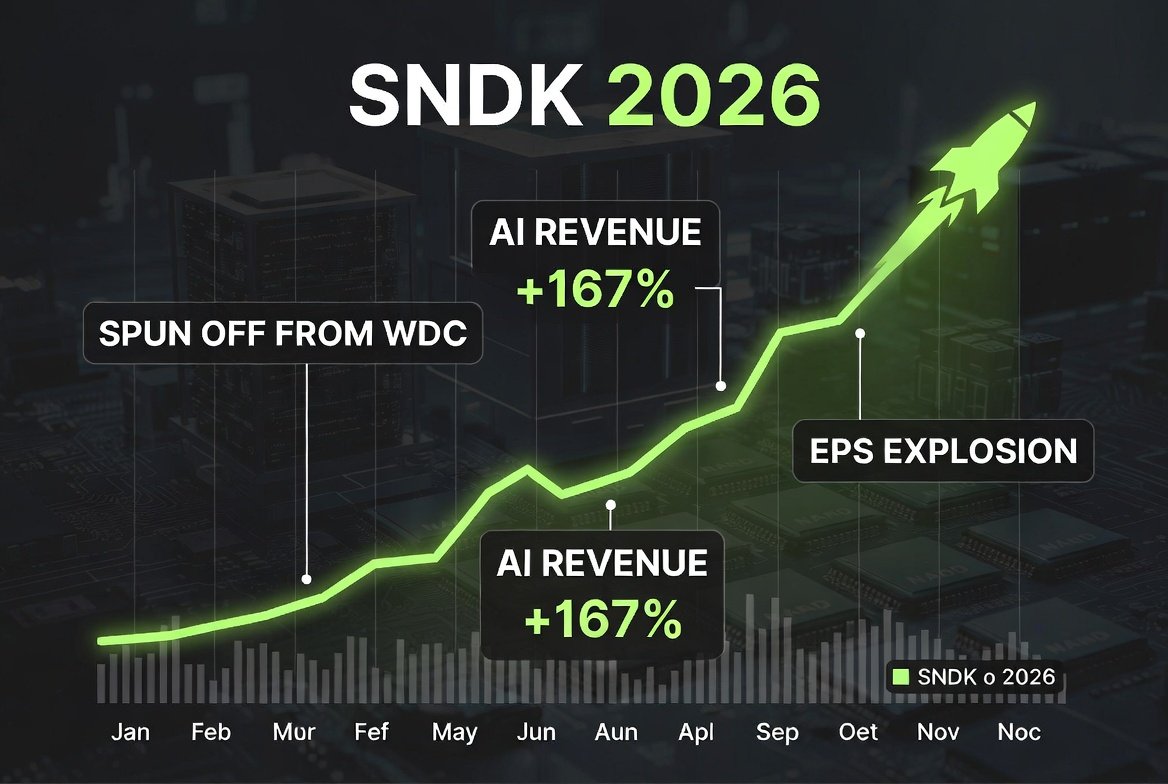
$SNDK has been one of the standout performers in 2026, up several hundred percent YTD after spinning off from WDC in early 2025. The driver is clear: AI data center buildout creating a severe NAND flash shortage, with enterprise SSD demand (especially high-capacity, high-endurance for inference and training) pushing ASPs sharply higher and gross margins into the 70-80%+ range in recent quarters. Key structural positive: New Business Model (NBM) long-term supply agreements with hyperscalers. More than one-third of fiscal 2027 bit output is already committed under these contracts. This locks in volume and pricing visibility far better than the old spot/commodity model. It reduces (though does not eliminate) historical NAND cyclicality. Management and analysts see this as a meaningful de-risking of the business. Financial outlook looks robust. Analysts project massive revenue and EPS growth for FY2026 (revenue +~167%, EPS explosion) and continued strong expansion into FY2027 (+~122% revenue, +180% EPS). Supply remains tight through at least 2027 per multiple sources, with AI NAND demand share rising rapidly (from ~18% in 2025 toward 30-40%+). Newer tech like higher-layer NAND and enterprise-focused solutions should help sustain share gains. Valuation is the real question. $SNDK trades at a premium to some memory peers — forward P/E in the high teens to mid-20s depending on the FY2026/27 estimate set, versus MU at lower double-digits on similar forward earnings. SK Hynix (stronger HBM exposure, upcoming Nasdaq listing) also looks cheaper on multiples. The premium reflects $SNDK’s pure-play NAND/enterprise SSD positioning and NBM visibility, but it assumes the current pricing power and margin levels persist. Historical memory cycles remind us these peaks don’t last forever. Risks worth watching: Any slowdown in hyperscaler AI capex (the biggest swing factor). Eventual supply response — new capacity expected to ease tightness more meaningfully in 2028. Softer consumer/PC demand could pressure blended ASPs. Competition intensifying as SK Hynix gains easier US investor access. Base case: $SNDK should continue to benefit from the AI storage supercycle and NBM de-risking into 2027, supporting strong earnings and potential multiple support if execution holds. However, at current levels it’s not the cheapest way to play memory/AI infrastructure — MU offers more valuation cushion on similar cyclical tailwinds. Selective buyers should size positions accordingly and monitor capex commentary and NBM ramp closely.
The Father of Stocks tweet mediaThe Father of Stocks tweet mediaThe Father of Stocks tweet media
English
9
5
8
500
The Father of Stocks
The Father of Stocks@StocksHomeNo1·
$SNDK dropped over 8% today, part of a broader sell-off across memory names ($MU -8%, $WDC -8.8%, $STX -5.7%). Not pretty on the screen, but let's separate signal from noise. Fundamentals for Sandisk remain strong. This is a pure-play NAND flash beneficiary of the AI data center buildout. Fiscal Q3 revenue +251% YoY to $5.95B, with data center revenue surging 233% sequentially. Adjusted gross margins expanded dramatically on pricing power. Backlog/remaining performance obligations sit at multi-year highs (~$42B in recent disclosures), giving visibility well into 2027+ as supply stays tight. Analysts (Citi, others) continue to see NAND demand outpacing supply for years, with AI workloads across hyperscalers driving structural tightness. Sandisk has executed well post-spin from Western Digital. So why the move? Classic sentiment overlay. Memory stocks have been extremely volatile after massive YTD runs (from ~$40 lows to peaks above $2,300). Today's action looks like profit-taking + rotation within semis — logic/AI accelerator names held up better on Micron's big capex news, while memory names got hit. Previous similar drops (Samsung earnings "beat but sell the news", Meta spare capacity headlines) reversed quickly when fundamentals reasserted. At current multiples (P/E in the mid-50x to high-70x range depending on estimates), there's little room for disappointment or macro noise. Valuation discipline is key here — great business, but entries after pullbacks have historically worked better than chasing. $SNDK offers asymmetric upside on sustained AI demand and pricing, but expect continued swings until we get cleaner visibility into 2027 supply response. Not owning it currently, but watching for better risk/reward setups. Memory is a core AI enabler; just don't pay perfection prices.
English
8
7
8
788