Sabitlenmiş Tweet
Tami 🏴☠️🌹
42.9K posts

Tami 🏴☠️🌹
@SuggestionsWTF
Ultimately, the truth will come out in all of this and I will be standing on the right side of the roaring rapids. I hope other people will be too. ~Johnny Depp
SoCal Katılım Ekim 2011
2.4K Takip Edilen4.3K Takipçiler

@blonde_watch @YouTube @PopcornedPlanet @andysignore 47.1 is not in jeopardy if Lively doesn't statutorily qualify for it ...
English

Blake Lively LOST SO BAD! She Called in Ex-CIA For DAMAGE CONTROL!? youtu.be/4X8VgHm91rc?si… via @YouTube @PopcornedPlanet @andysignore BLAKE LIVELY FILED HER CASE FIRST AND SHE PUT 47.1 LAW IN JEOPARDY NOT JUSTIN.

YouTube
English

Do you have Welcome Back on your playlist, @DieterRuehle ...?
youtu.be/IhzzAUaOzsk?si…

YouTube
English
Tami 🏴☠️🌹 retweetledi


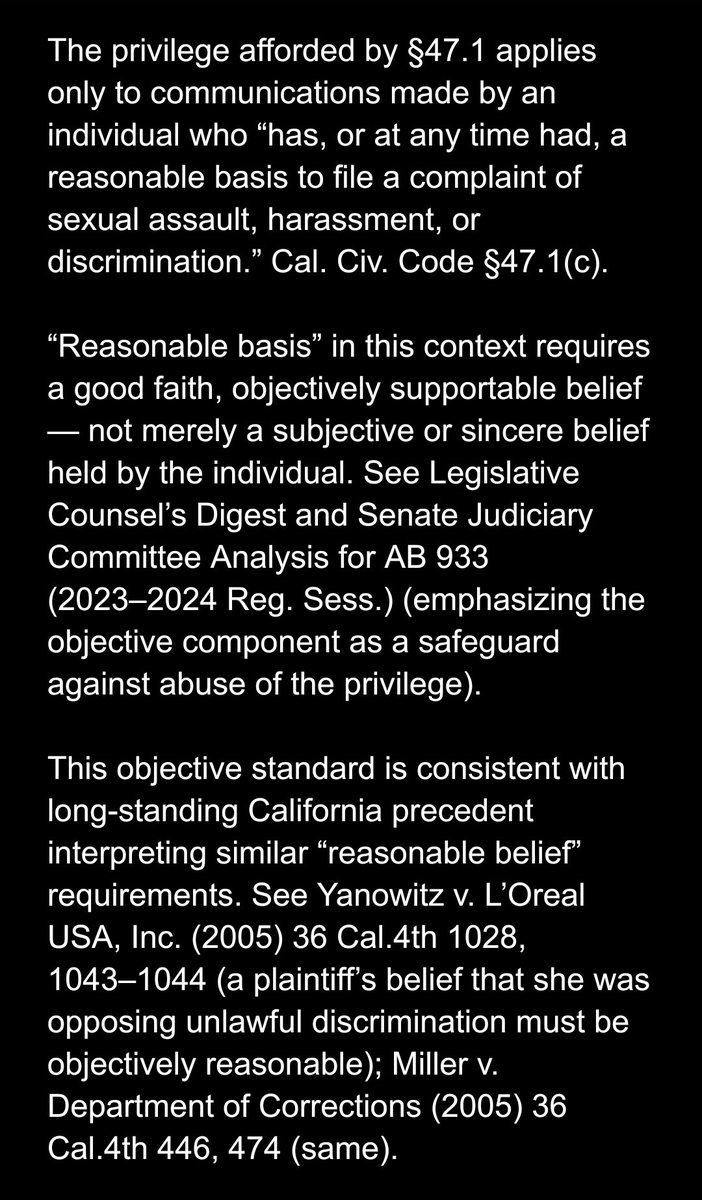
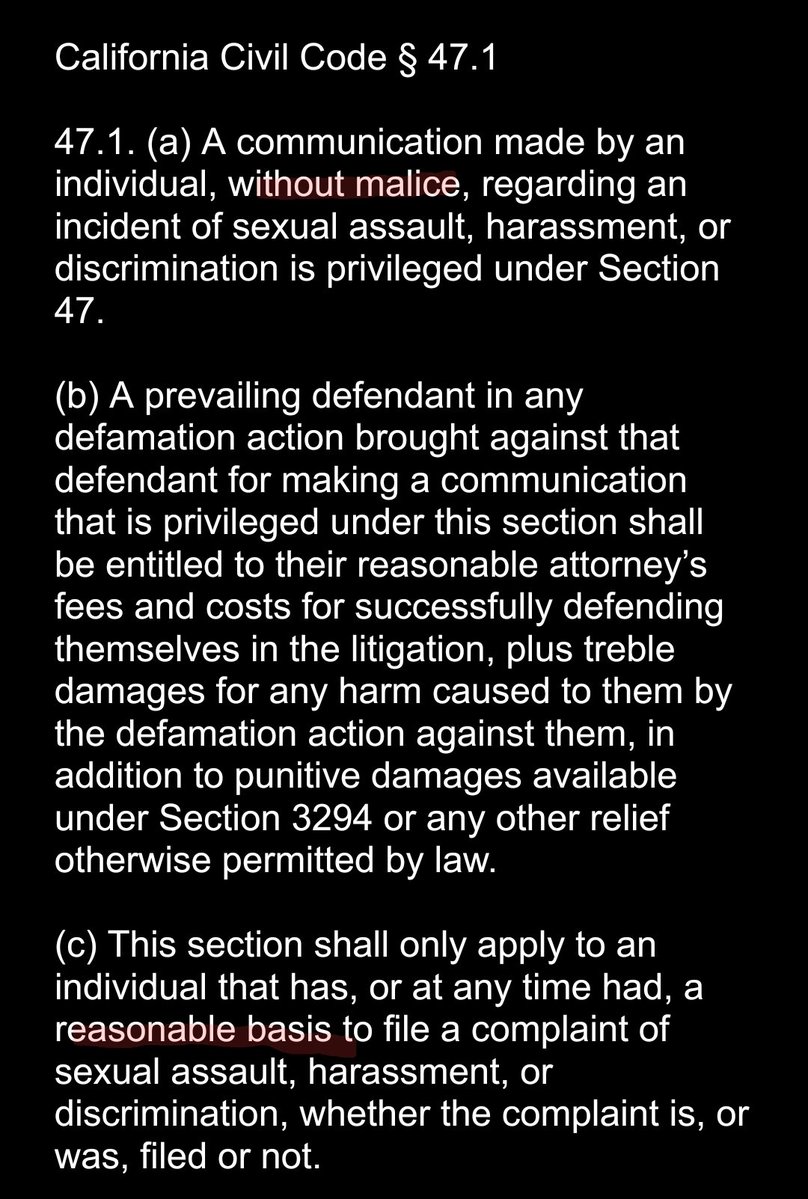
@schatow @blakelively Apparently, neither you nor Wayfarer have read the statute ... "reasonable basis" ...in this context requires a good faith, objectively supportable belief — not merely a subjective or sincere belief held by the individual.

English

@schatow @blakelively I read the statute ... 47.1(b) ONLY applies if her complaints were made with a reasonable basis (c) and without malice (a). And look up the legal definition for "reasonable"

English

Not really.
If you remember, three claims proceeded to trial. Regardless of whether she won or lost, the motion for fees under 47.1 would still have been adjudicated.
VANZAN has nothing to do with this. Judge Liman hasn’t issued any ruling on it, and WF didn’t even address VANZAN in their opposition. So I’m not sure why you keep bringing it up.
I think you should actually read WF’s opposition. At this point, I’d rather wait for the judge to rule on the matter than continue speculating.
English

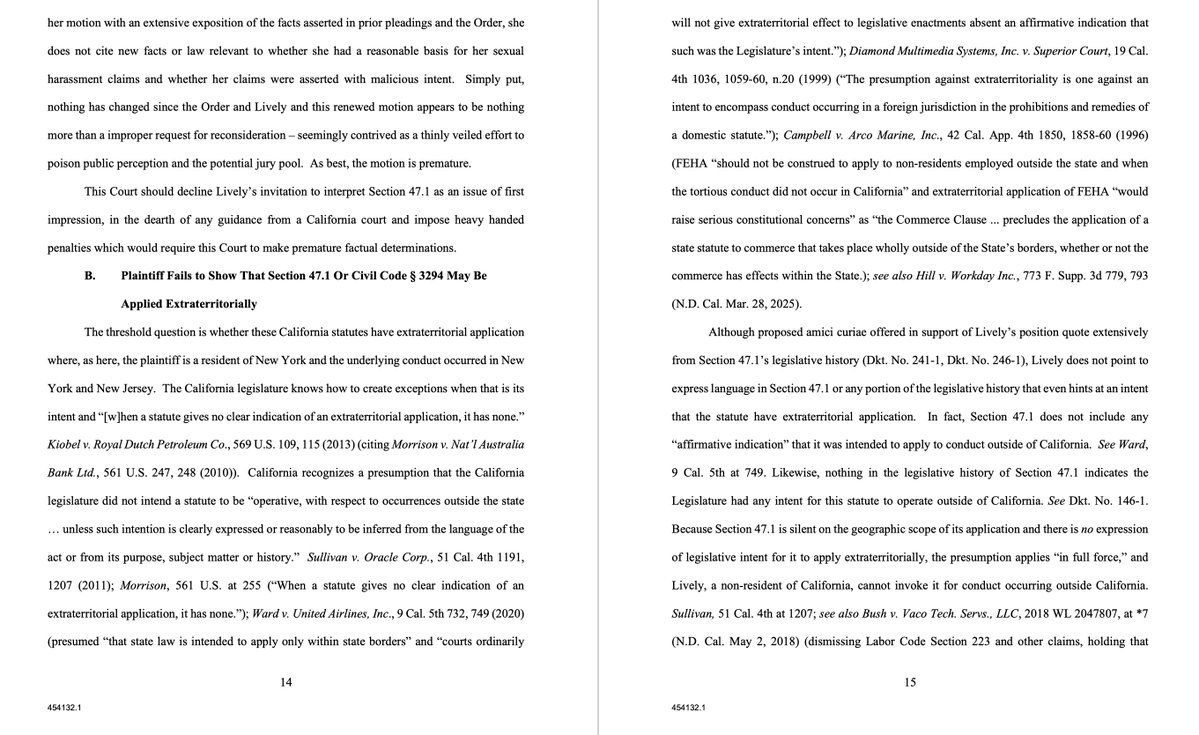
WF’S OPPOSITION TO BL’S MOTION FOR COSTS & ATTORNEYS’ FEES RE: 47.1 — The Extraterritoriality Argument
Defendants (WF) argue that California Civil Code § 47.1 and § 3294 should not apply because the case involves a New York resident and alleged conduct centered in New York and New Jersey, and the statutes contain no clear legislative indication they reach conduct outside California.
“Lively does not point to express language in Section 47.1 or any portion of the legislative history that even hints at an intent that the statute have extraterritorial application. In fact, Section 47.1 does not include any “affirmative indication” that it was intended to apply to conduct outside of California.”
1️⃣ OVERVIEW OF WF’S EXTRATERRITORIALITY ARGUMENT
WF’s framing frame extraterritoriality: as a question: whether California’s statutory privilege/remedies scheme (§ 47.1) and punitive damages statute (§ 3294) can govern a dispute where the legally relevant conduct happened primarily outside California.
WF argue the answer is no, because:
— There is a strong presumption against extraterritorial application of California statutes.
— § 47.1 is silent on geographic reach and its legislative history allegedly contains no affirmative indication of extraterritorial intent.
— Even if silence does not end the inquiry, Plaintiff ((@blakelively (BL)) must show a substantial connection between California and the “core” wrongful conduct—and BL has not done so.
2️⃣ PRESUMPTION AGAINST EXTRATERRITORIALITY
WF cite federal and California authorities for a core rule: if a statute gives no clear indication of extraterritorial application, it has none.
WF then cite California cases emphasising California courts generally presume state statutes apply only within California’s borders unless the Legislature clearly indicates otherwise.
Key points:
— Silence in statutory text generally means no extraterritorial reach.
— courts will not give extraterritorial effect absent an affirmative indication of legislative intent.
3️⃣ APPLICATION TO § 47.1: STATUTORY TEXT & LEGISLATIVE HISTORY ARE SILENT
WF argue BL cannot overcome the presumption because:
— BL does not point to any express language in § 47.1 indicating it applies outside California.
— BL also does not identify anything in the legislative history that “even hints” at extraterritorial operation.
WF contrast this with situations where the Legislature does intend extraterritorial reach and says so explicitly (they give a workers’ compensation example).
Bottom line (their position): because § 47.1 lacks any affirmative geographic signal, the presumption applies “in full force,” and a non-California resident cannot invoke it for out-of-state conduct.
4️⃣ THE “SUBSTANTIAL CONNECTION” / “CORE CONDUCT” NEXUS REQUIREMENT
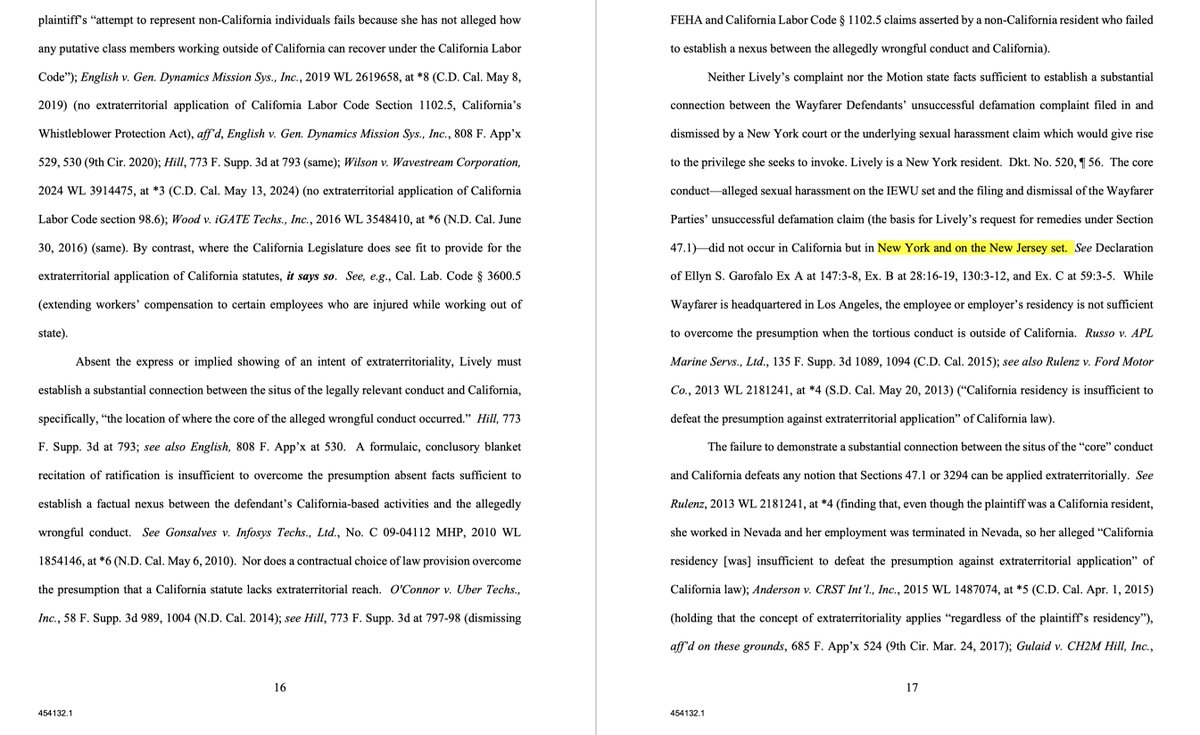
WF add that, absent express extraterritorial intent, BL must still establish a substantial connection between California and the core of the alleged wrongful conduct—not merely incidental ties.
WF characterise the required showing as fact-intensive and not satisfied by:
— conclusory allegations (e.g., “ratification” language) without facts connecting California-based activity to the wrongful conduct.
WF also argue that a contractual choice-of-law provision does not, by itself, overcome the presumption against extraterritorial application of California statutes.
5️⃣ SPECIFIC FACTS: WHY WF SAY THE NEXUS IS MISSING
WF claim the relevant facts cut against applying California law extraterritorially:
— BL is a New York resident.
— The “core conduct” occurred in New York and on a New Jersey film set (alleged harassment), and the defamation action at issue was filed and dismissed in New York.
— A defendant’s presence in California (e.g., Wayfarer being headquartered in Los Angeles) is not enough to overcome the presumption when the tortious conduct is outside California.
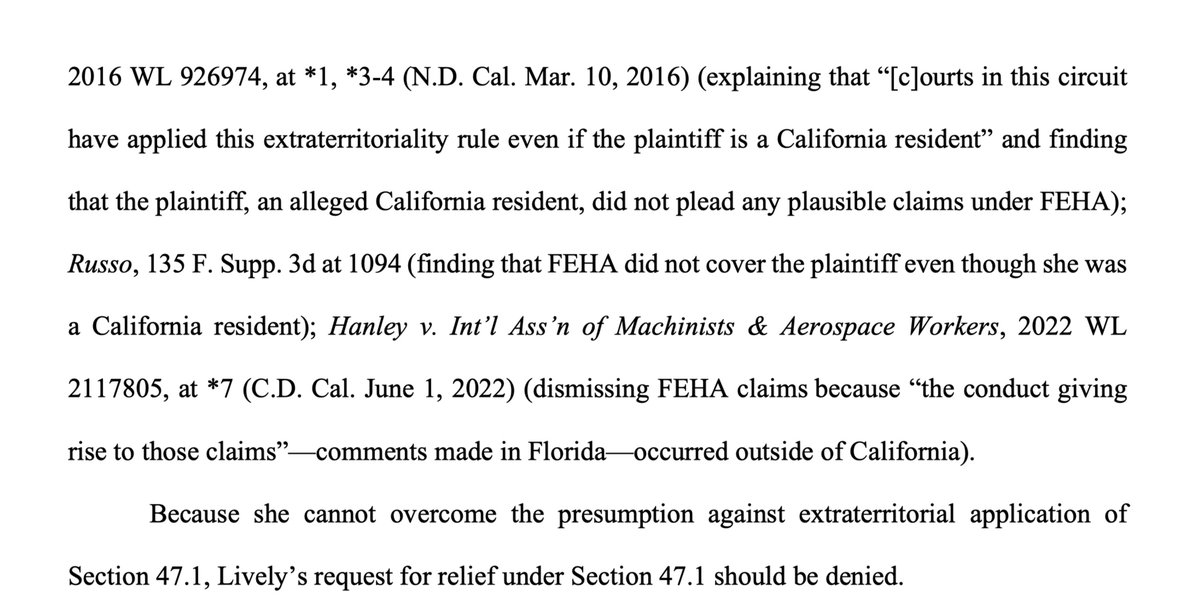
From these facts, WF conclude BL has not shown the required substantial connection between California and the dispute to justify applying § 47.1 or § 3294.
6️⃣ WHY § 3294 IS INCLUDED IN THIS EXTRATERRITORIALITY ARGUMENT
Although WF focus heavily on § 47.1, WF repeatedly pair it with § 3294 and contend BL similarly fails to show either statute can be applied extraterritorially.
WF argue the same logic applies: without statutory or legislative indication and without a strong California nexus to the legally relevant conduct, punitive damages under California’s punitive damages statute should not be available for out-of-state conduct.
7️⃣ WF’S REQUESTED OUTCOME
Because BL allegedly cannot overcome the presumption and cannot show a substantial California nexus, WF argue the court should deny the requested remedies under § 47.1 (and, by implication, § 3294) on extraterritoriality grounds.
#blakelively #justinbadloni #livelyvsbaldoni


Roman Schatow@schatow
5/9/26 Lively v. Wayfarer - long story long on CA Civ Code 47.1 youtu.be/jAkcpQxmVHA?is… via @YouTube #blakelively #justinbaldoni #livelyvsbaldoni
English

@schatow @blakelively Lively doesn't qualify for 47.1 ... all of her original causes of action were dismissed ... where's the reasonable basis for her complaint? Vanzan subpoena? Looks like malice.

English

WF’S OPPOSITION TO BL’S MOTION FOR COSTS & ATTORNEYS’ FEES RE: 47.1 — Legal Conflicts with BL’s Dragon-ian Penalties
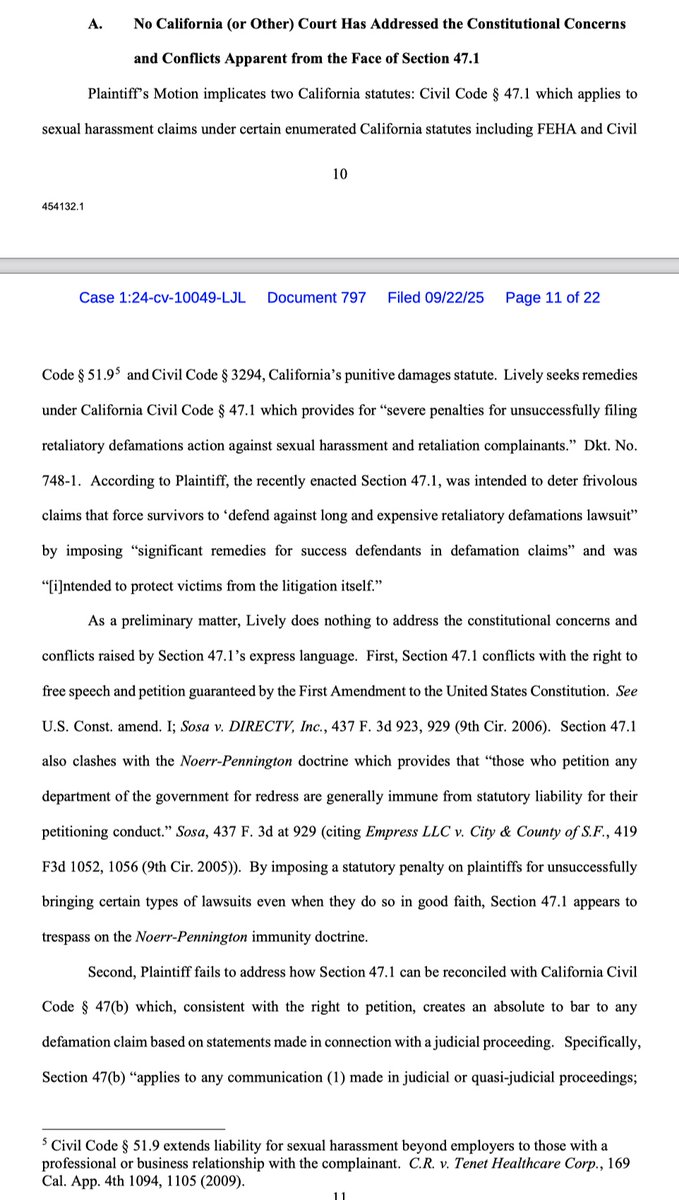
Defendants’ (WF) argue that Civil Code § 47.1 is a brand-new, untested statute that—on its face—creates serious constitutional conflicts (especially with the First Amendment and doctrines protecting petitioning activity), and also collides with California’s long-standing absolute litigation privilege in § 47(b). Because no court has yet reconciled these conflicts, WF urge the SDNY to decline to apply § 47.1 as a matter of first impression to impose “draconian” or maybe “dragon-ian” penalties.
1️⃣ SECTION 47.1 IS “NEW,” “DRAGON-IAN,” & JUDICIALLY UNTESTED
WF argue that § 47.1 as a recently enacted statute (effective Jan. 1, 2024) that has not been addressed in any published decision, so any ruling would be first impression. WF also characterise the statute’s remedies—attorneys’ fees, treble damages, and punitive damages—as “severe” or “dragon-ian,” and argue that before imposing such penalties, courts need interpretive guidance that simply does not exist yet.
2️⃣ CONSTITUTIONAL CONFLICT #1: FIRST AMENDMENT / PETITIONING RIGHTS & NOERR–PENNINGTON
(A) How WF connect § 47.1 to the First Amendment: WF argue § 47.1 “conflicts with” the First Amendment rights of free speech and especially the right to petition the government (i.e., to file lawsuits). The statute is portrayed as imposing statutory penalties on plaintiffs for bringing certain types of claims (defamation claims against harassment complainants) even when those claims may be brought in “good faith,” which WF suggest is constitutionally problematic.
(B) Noerr–Pennington doctrine as the doctrinal vehicle: WF invoke Noerr–Pennington as a petitioning-immunity doctrine: parties who petition the government for redress are “generally immune” from statutory liability for that petitioning conduct. WF argue § 47.1 “appears to trespass” on that doctrine by attaching liability/penalties to the act of suing (defamation) where the suit is unsuccessful, thereby chilling petitioning conduct.
3️⃣ LEGAL CONFLICT #2: SECTION 47.1 / CALIFORNIA’S ABSOLUTE LITIGATION PRIVILEGE IN § 47(B)
(A) What § 47(b) does: WF emphasise that California Civil Code § 47(b) provides an absolute privilege that bars defamation (and many other tort) claims based on communications made in connection with judicial proceedings. WF underscore that:
— It applies broadly to communications in judicial or quasi-judicial proceedings and related publications.
— It is absolute and applies regardless of maliciousness.
(B) The asserted collision: WF argue BL fails to explain how § 47.1 can be reconciled with § 47(b). There is a problem:
— § 47(b) is a sweeping shield for litigation-related communications.
— § 47.1 is being deployed to impose penalties/remedies triggered by defamation litigation outcomes involving harassment complainants.
If the same statements are already protected by § 47(b), WF suggest it’s unclear how § 47.1’s scheme is supposed to function coherently alongside that absolute privilege.
4️⃣ PROCEDURAL CONFLICT: APPLYING § 47.1 AFTER A PLEADING-STAGE DISMISSAL, BEFORE FACTFINDING ON MALICE/REASONABLE BASIS
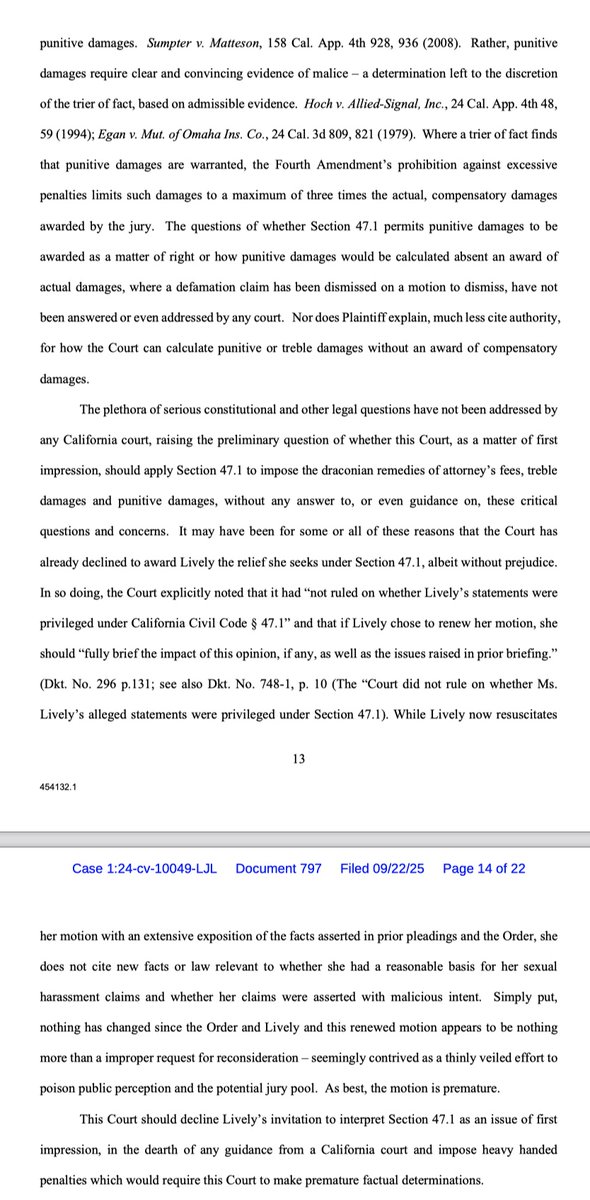
WF also argue BL does not explain how § 47.1 should work when the defamation claim is dismissed at the pleading stage, before the fact-intensive issues § 47.1 itself appears to require—malice and reasonable basis—are resolved by the trier of fact.
5️⃣ SPECIAL “TROUBLING” ASPECT: § 47.1’S INTERACTION WITH PUNITIVE DAMAGES PRINCIPLES (VIA § 3294)
WF single out punitive damages as “particularly troubling” under this statutory regime. WF argue California has a “long-standing rule” that:
— There is no right to punitive damages.
— Punitive damages require clear and convincing evidence of malice, and the decision is left to the trier of fact (discretionary).
6️⃣ THE “NO GUIDANCE” CONCLUSION: WHY WF SAY THE SDNY SHOULD NOT DECIDE THIS NOW
WF conclude that because no California court has addressed these issues, there is a “preliminary question” whether the SDNY should apply § 47.1 at all—especially to impose severe penalties without answers or guidance on these constitutional and doctrinal problems. WF bolster this by pointing to the court’s earlier position that it had not ruled on § 47.1 privilege and had asked BL to “fully brief” the issues if renewing the motion—suggesting the issues remain open and undeveloped. And, WF characterise the renewed motion as premature and argue the court should decline BL’s invitation to interpret § 47.1 as a matter of first impression in the absence of California guidance.
#blakelively #livelysdragons #ryanreynolds_dragon #justinbaldoni #livelyvsbaldoni


English

@dontfckwjustice "Hope none of your loved ones are ever falsely accused in CA!" ... specious and argumentative ...
English

@SuggestionsWTF WHAT? You went from normal cordial to totally off the rails lady- so much for context. 🤦🏼♀️
English

This is a great discussion on CA statute 47.1 which basically prohibits those accused of SA/SH from filing defamatory countersuits- even if FALSELY accused.
Thanks @aldavlaw for diving into this.

Albertson & Davidson | Ask 2 Lawyers@aldavlaw
NEW TWIST in the Blake Lively v. Justin Baldoni case! Advocacy groups are backing Lively’s motion to dismiss with amicus briefs citing California's new Section 47.1. What does it all mean? We’re breaking it down LIVE at 2pm PT/5PM ET: youtube.com/live/LCOeUn-9Y… #LivelyVBaldoni
English

@dontfckwjustice "Hope none of your loved ones are ever falsely accused in CA!"
That sounds a lot like the Heard/Lively playbook — turning a legal disagreement into ‘think of the victims.’ We’ll have to agree to disagree until Liman rules.
English

@SuggestionsWTF I'll agree to disagree.
I see the law as problematic, you don't.
Hope none of your loved ones are ever falsely accused in CA!
English

@dontfckwjustice Fair enough. We’ll agree to disagree.
I support the goal of protecting real victims. I just don’t think §47.1 should protect allegations that were largely dismissed on substantive legal grounds, especially when key claims were strategically withdrawn to avoid discovery.
English

@dontfckwjustice 2/2 You can’t use the privilege as a shield to prevent anyone from challenging whether the privilege should exist in the first place. That would make the ‘without malice’ requirement meaningless
English

@SuggestionsWTF Again, you're missing the entire point- he can still lose because the evidence he would need to prove malice is "privileged" under section 47.1.
English

@ashleybrianaeve Isn't that her view on getting into character?
English

Blake’s idea of image rehab is fashion. Not helping women. She doubles down with every event.
E! News@enews
Blake Lively arrives at FENDI's celebration of the Baguette® 26424 Re-Edition.
English

@dontfckwjustice They wrote it that way on purpose — as a qualified privilege with a ‘without malice’ and reasonable basis requirement. That’s not a bug, it’s the feature designed to filter out false or reckless allegations. The authors’ current spin doesn’t override the text of the law.”
English

@SuggestionsWTF And last time we had this conversation I was right, Liman dismissed Baldoni's lawsuit when you swore he would not.
I am saying the writing of the law is problematic because the people who wrote it intentionally made it that way.


English

@dontfckwjustice We clearly see this differently. You’re going by the authors’ current opinion on this case. I’m going by the actual text of §47.1(b) — which requires ‘without malice’ and a reasonable good-faith basis — and the court record Liman has already built. We’ll see what Liman decides
English

@SuggestionsWTF Did you write 47.1? I'm sure that would be a normal person's intent, but the people who wrote it- which is what I am trying to explain to you- do not have that intent hence why they are saying Lively qualifies.
English

@schatow I wonder who rattled her cage to suddenly start posting about this very old case.
English

Dr. Jenny Thatcher assuring the public that Amber Heard “deserves her peace — just like all survivors” is certainly… a contribution. Especially considering her academic background is apparently wedding dresses, aesthetic labour, and a paper called Keeping it Classy.
Interesting choice to weigh in so confidently on a defamation trial she has zero legal expertise in — particularly one where a jury found, 24 times, that Amber Heard’s statements were false and defamatory.
But maybe next she’ll explain constitutional law through the symbolism of lace veils and bridal aesthetics, LMAO!!


English