
Sunishth Goyal
2.9K posts

@SunishthGoyal
Punjabi, Criminal Lawyer; Assistant Prof @NALSAR_Official; Alum NALSAR & Maastricht; Like/RT sans comment ≠ endorsement.All views expressed are personal


So what if they are all similar worded? Bail orders are not rocket science unless the state can show the exception to the rule should apply. Perhaps the Indian Express should hire some competent legal reporters for once.

The Indian Express has done a good job by reporting on the orders passed by an Allahabad High Court judge who granted bail in dowry death cases through cryptic, mostly similarly worded orders. Of late, there has been a tendency to trivialise offences against women, be it allegations of dowry harassment or dowry death. No doubt, bail is the norm and jail the exception. However, that does not mean an accused in a dowry death case should walk out of jail the very next day after the crime. It is no rocket science to identify the accused in dowry death cases. If bail must be granted, the court should explain the reasons for doing so and it must ensure that the trial isn’t thwarted by the accused.

#BREAKING Centre revokes Ladakh Activist Sonam Wangchuk’s detention order under the National Security Act. The #SupremeCourt has been hearing his wife Gitanjali Angmo's petition challenging the detention since last October. SC is schedueld to hear the matter on March 17.

Allahabad High Court rejects UP administration's decision to restrict the number of persons offering namaz in a mosque in #Sambhal. Bench of Justice Atul Sreedharan and Justice Siddharth Nandan says if the SP and District Collector cannot ensure law and order, then they should either resign or seek transfer. "If the local authorities i.e. Superintendent of Police and Collector feels that the law and order situation could arise because of which they want to limit the number of worshipers within the premises, they should either resign from their post or seek transfer out side Sambhal if they feel they are not competent enough to enforce the rule of law. It is duty of the State to ensure that every community is able to offer worship peacefully in the designated place of worship and if it is a private property as already been held by the Court earlier, to perform worship without any permission from the State."

NCERT book row: SC says its orders not intended to prevent any healthy and objective criticism of institutional function of judiciary

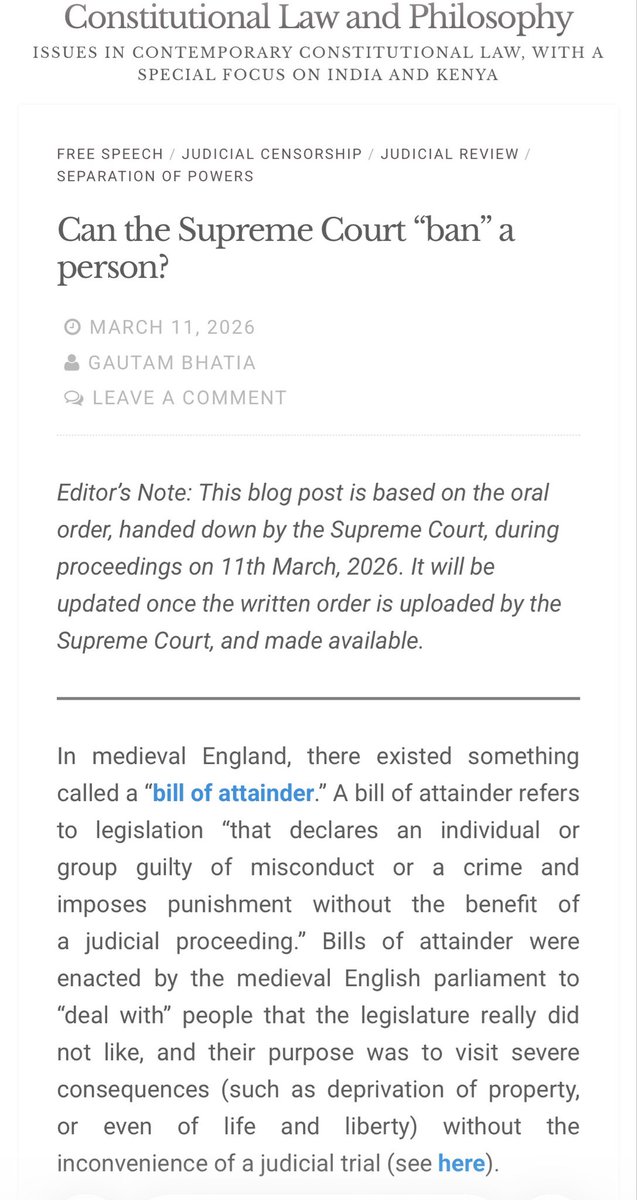
The Supreme Court has directed the Centre and all State governments along with all institutions receiving public funds, either partially or fully, to dissociate the chairperson of NCERT social science curriculum, Professor Michel Denino and his two other associate members who were behind the Sub-chapter in part 2 of the Class 8 NCERT Social Science textbook 'Corruption in the Judiciary', in any manner for the purpose of preparation of curriculum or finalisation of text book for the next generation. A bench led by the Chief Justice of India (CJI) Surya Kant also directed all of the aforesaid authorities to disassociate Professor Denino, along with his team, from the preparation and inclusion of the Chapter, from rendering any service in any institution, which would mean payment to them from public funds. “At the outset we have no reason to doubt that professor Michel Danino along with Ms Diwakar and Mr Alok Prasanna Kumar either does not reasonable knowledge about Indian judiciary or they deliberately knowingly misrepresented the facts in order to project a negative image of Indian judiciary before students of Class 8 who are at an impressionable age. There is no reason as to why such persons be associated in any manner with preparation of curriculum or finalisation of text book for the next generation. We direct union, all states, all institutions recieving state funds, to disassociate them from rendering any service which would mean payment to them from public funds”, the Court noted.