Suzie Dawson

68.5K posts

Suzie Dawson banner
Suzie Dawson

Suzie Dawson

@Suzi3D

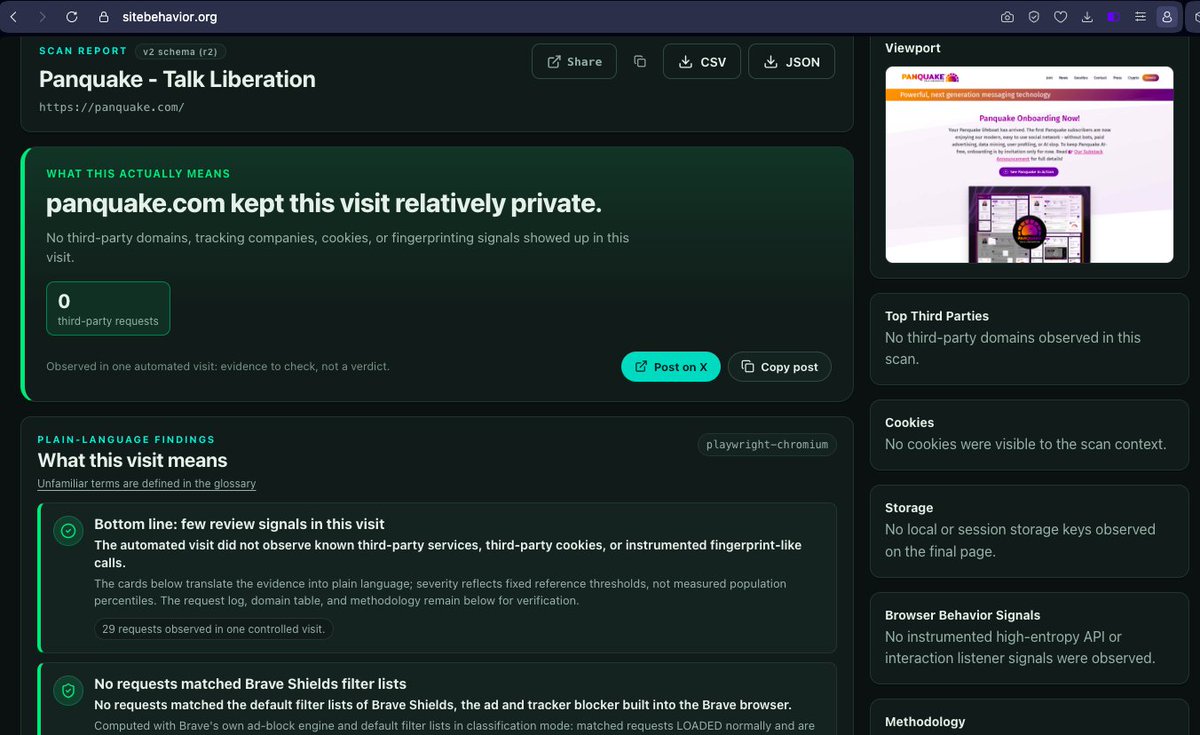
I don't hope, I build: Panquake. Like surveillance, censorship is a for-profit industry that requires perpetual growth. Use https://t.co/4VhdokMdf3 if you care about privacy!

Moscow, Russia Katılım Ekim 2014
1.7K Takip Edilen29.8K Takipçiler
Sabitlenmiş Tweet
Suzie Dawson
Suzie Dawson@Suzi3D·
To all the ppl who got gaslit into thinking the internet can't ever be different/privacy is 'dead' etc etc As a software designer I am telling you - we CAN architect systems on independent infrastructure that do NOT collect or trade in your personal data I know because I do it
English
177
4.9K
31.1K
279.4K
Suzie Dawson
Suzie Dawson@Suzi3D·
The personification of the model is how they got away with it "Oh its just very smart. It's smarter than humans. It's going to be even smarter than any human born" It's not smart. It's an algorithm. People coded it. Permissions, restrictions, functions x.com/alex_prompter/…
Alex Prompter@alex_prompter

Let me trace the timeline here because nobody's connecting it. Step 1: Scrape the entire internet. Every book, every article, every conversation, every piece of art, every forum post. Do it without asking. Do it without paying. Step 2: Train a model on all of it. Call it "artificial intelligence." Step 3: Go to BlackRock's Infrastructure Summit and announce: "We see a future where intelligence is a utility, like electricity or water, and people buy it from us on a meter." Step 3 is where you sell people's own knowledge back to them. On a meter. They took the collective output of human thought, compressed it into a model, and now they want to charge you by the token to access a version of what you and everyone you know already created. One Reddit user put it perfectly: "They stole all this data from us, the people, our life's work, creativity, art, by devouring the internet and blowing through all copyright laws. Now they want to sell it back to us in the form of a utility." Imagine if someone photocopied every book in the public library, burned the library down, and then opened a subscription service for the copies. That's the metered intelligence business model. And they're pitching it to infrastructure investors as though they invented water.

English
1
6
40
574
Suzie Dawson retweetledi
Suzie Dawson
Suzie Dawson@Suzi3D·
AI is a direct attack undermining the human hierarchy of needs. From the basics of shelter, water, air on up to self-actualisation, purpose, creativity. To oppose AI is to respect and preserve human needs.
English
13
92
305
3.4K
Suzie Dawson retweetledi
Suzie Dawson
Suzie Dawson@Suzi3D·
They're not harvesting what you have to hide, they're harvesting everything about who you are What you do, where you go, who you know, what you like, what you don't like That's what mass surveillance is. No amount of being 'normal' will save you from it x.com/naomibrockwell…
Naomi Brockwell priv/acc@naomibrockwell

"I have nothing to hide" is one of my least favorite sayings. Just because you don't have anything smart to say, it's not a reason to abolish free speech. Privacy is the foundation of a free society, and needs to be protected at all costs.

English
0
18
53
1.1K
Suzie Dawson retweetledi
Ed Zitron
Ed Zitron@edzitron·
Uber’s COO has said that it’s getting “harder to justify” its AI costs because there was no way to show a link between AI spend and any meaningful increase in useful features. This is the first time I’ve seen a company say this directly. businessinsider.com/uber-coo-andre…
Ed Zitron tweet mediaEd Zitron tweet media
English
326
4.9K
27.2K
2.4M
Suzie Dawson
Suzie Dawson@Suzi3D·
Check out his timeline to see the "I Love Boosters" trailer & what real people (not AI bots) are saying about his newest film
English
0
0
1
156
Suzie Dawson
Suzie Dawson@Suzi3D·
Back home in NZ I got to spend a few days in person with @BootsRiley. He's the real deal & so rare for a legit activist to make it in the movie biz. "Sorry To Bother You" is a film you'll never forget & will want to watch twice. Now "I Love Boosters" is next on my must-see list
English
2
2
19
435
Suzie Dawson
Suzie Dawson@Suzi3D·
Where the hell is the #MeToo movement now This is the third testimony I've seen from these activists about being sexually assaulted Is rape just OK now? Is that what we've come to? Or certain people can be raped?? How did the world sink so low as this x.com/shafiur/status…
Shafiur Rahman@shafiur

Ko Tinmaung, a Toronto-based Rohingya activist, has been released after more than 96 hours in Israeli detention following Israel’s hijacking of the Global Sumud Flotilla and the abduction of its civilian participants. His testimony is horrifying. He says he was beaten in a dark room by more than five people, kicked, punched, tasered in multiple places, and handcuffed so tightly that the restraints cut into his wrists and restricted blood flow. He says he still needs treatment for concussion-like injuries. He also says he witnessed other detainees with broken ribs, head wounds, blood from their ears, eye injuries, broken noses and broken teeth. Most gravely, he alleges sexual assaults, including people being tasered on their genitals. Tinmaung’s testimony also exposes the racial dimension of Israeli violence. He says he was mocked as “Ahmed”, assaulted further, laughed at because of his skin colour, and treated as if his passport had no value because he was brown. This was a civilian-led humanitarian mission carrying food, aid and basic supplies to Gaza. So where is Canada? Where are the human rights organisations? Where are the global leadership councils, the moral authorities, the professional defenders of accountability? Silence now is not neutrality. It is complicity. (Video courtesy Forsea.co)

English
2
10
18
455
Suzie Dawson retweetledi
𐌁𐌉Ᏽ 𐌕𐌉𐌌𐌉
I came across a theory that AI is starting to make more mistakes because the internet is increasingly polluted with AI slop. The idea of AI cannibalising itself into obscurity is one of my favourite things ever. I hope it is true and I hope it becomes impossible to fix.
English
643
15.8K
129.9K
1.2M
Suzie Dawson
Suzie Dawson@Suzi3D·
We built a social network where @RnaudBertrand will never have to study or explain "the algorithm", you will never have to wonder why your content isn't seen, and you will never see a single ad or AI bot. It is called Panquake. We're onboarding this week x.com/RnaudBertrand/…
Arnaud Bertrand@RnaudBertrand

So I spent some time studying the new Twitter/X algorithm today since the latest version was published about a week ago on Github (#updates--may-15th-2026" target="_blank" rel="nofollow noopener">github.com/xai-org/x-algo…). My goal was to answer why so many people have seemingly seen such a dramatic drop in their posts' reach. The first answer, which is actually somewhat unrelated to the ranking algorithm on Github, is the auto-translate feature, rolled out worldwide on April 7, 2026 (x.com/nikitabier/sta…). Before that date, if you wrote in English about, say, the Trump-Xi Beijing summit, you were competing for attention with maybe 5,000 other English-language accounts writing on geopolitics. After that date, your post is competing for attention with other posts on the same topic IN EVERY LANGUAGE ON EARTH. For some topics that do command global attention like geopolitics, that's a very brutal multiplier: you used to be one of 5,000, you're suddenly one of 50,000 (something of that order): MUCH more difficult to stand out. Secondly, the number of followers you have matters far less than it used to: each post now has to earn its audience reader by reader, on the predicted engagement of the post, and how its topic matches what each reader has recently been engaging with. Here is how the algorithm works, in simple terms: when you, as a reader, open your feed, the algorithm doesn't load "posts from accounts you follow." Instead it runs a 2-stage prediction of what posts you're likely to engage with in that very moment. The first stage is the retrieval stage. The system narrows billions of posts on X/Twitter that day down to roughly 1,500 candidates by matching the semantic content of each post - what it's about - against what you as a reader have recently engaged with. Some candidate posts come from accounts you follow; others are pulled from across the platform by pure topic similarity to your recent interests. You can test this retrieval stage easily: start disproportionally engaging with - say - Brad Pitt videos and you'll bit by bit see your timeline flooded with Brad Pitt content, most of it from accounts you've never followed and never heard of. Then there's the ranking stage. Each of these candidate posts for your feed is fed through a Grok-based model that tries to understand if you'll engage with the post. It looks at 15 engagement metrics: 1) P(favorite) — the reader likes the post 2) P(reply) — the reader replies to it 3) P(repost) — the reader reposts it 4) P(quote) — the reader quote-tweets it 5) P(click) — the reader clicks a link in it 6) P(profile_click) — the reader taps through to your profile 7) P(video_view) — the reader watches the video 8) P(photo_expand) — the reader expands an image 9) P(share) — the reader shares it (DM, off-platform, etc.) 10) P(dwell) — the reader stops scrolling and lingers on the post 11) P(follow_author) — the reader follows you after seeing it 12) P(not_interested) — the reader marks "not interested" 13) P(block_author) — the reader blocks you 14) P(mute_author) — the reader mutes you 15) P(report) — the reader reports the post Fifteen predicted actions, each multiplied by a weight, summed: that sum is the score that determines in which priority a post will be seen among other candidates. Please note that posting something with a video or an image can give your post an advantage as 2 actions are specifically for these: video_view and photo_expand. No video or photo and you don't get a score for these. Also, naturally, having a video maximizes the chance that a user will "dwell" on your post to watch it. Also note that 4 of these actions carry negative weights (not_interested, block_author, mute_author and report): meaning that if the model expects a post to generate a lot of negativity, it'll get de-boosted quite dramatically. But note, first and foremost, what's NOT in there: none of the things that, naively, one might think a serious information platform would weigh. There is no P(this post is true and well-sourced). No P(the author actually knows what they're talking about). No P(this person has spent a decade building a body of work that has held up). No P(this account has earned the right to be taken seriously on this topic). No P(the author has a large following from credible people). The model does not seem to care - at all - about any of that. Every post starts from zero. You could have ten years of rigorous, well-sourced analysis behind you - or you could be just an uneducated rando who registered yesterday. To this algorithm, you're both just a bag of engagement probabilities. Now, sure, to be fair, there is a "brand" effect that's not covered by the algorithm: someone who has in fact built a brand will naturally have better engagement metrics because people recognize their account. But that's an indirect, second-order effect. And crucially, it's legacy: those "brands" were built under earlier versions of the algorithm that gave followers and reputation more weight. Lastly, several other features of the new algorithm compound the dilution, none of them visible from outside but all consequential. The May 15 update added an "impression bloom filter," tightening the rule that once a reader has been served a post, the system won't serve it to them again. Before, a strong post could marinate in someone's feed across multiple refreshes and accumulate engagement on the second or third pass. Now it basically gets one shot. Also, your own posts compete with each other. An "Author Diversity Scorer" inside the ranking stage attenuates the score of every subsequent post of yours that ends up in a reader's candidate pool. In plain terms: if multiple of your posts land in a reader's candidate pool, the system shows one at full strength and dampens the others. So don't post several times consecutively on the same topic. And, last but not least, another huge impact on reach is that, in the old algorithm, when someone reposted or quote-tweeted you, your post was broadcast to their followers' timelines - a repost from an account with 100,000 followers was a huge boost. In the new algorithm, that mechanism is vastly demoted: reposts - like every post - need to go through the retrieval and ranking stage mentioned above, so a repost from a big account is a long way from the boost it used to be. This is especially brutal for low-effort quote tweets, which used to function as cheap amplification: now they often can't even clear the retrieval stage - they simply don't contain enough novel semantic content for the system to match them to anyone's interests. So, putting it all together, the reach collapse comes from many forces stacking at once: - Auto-translate makes your posts compete for attention against an order of magnitude more content - The retrieval stage matches posts by topic, not by who follows you - The ranking stage scores purely on predicted engagement with no weight for credibility, expertise, or track record - The bloom filter narrows every post's window to one strong shot - The diversity scorer penalizes prolific posting - Reposts no longer carry much distribution power Each of these alone would dent your reach. Combined, they amount to a complete reset: your audience that you built painstakingly over years basically doesn't matter much anymore, and it's much - much - harder to stand out even if you're a big account. People structurally rewarded by this algorithm are folks who: - Post visually (videos/images) - Post on globally popular topics because they clear the retrieval stage easily - Provoke strong emotional reactions - likes, replies, reposts - Don't care about accuracy or seriousness because the algorithm doesn't measure it - Don't care about their existing audience because every post is judged in isolation anyway In short this new algorithm, like so many on social media, is all about maximizing whether people will engage with something - not about whether they should.

English
1
8
12
559
Suzie Dawson retweetledi
𐌁𐌉Ᏽ 𐌕𐌉𐌌𐌉
We are very close to “not made with AI” or “zero AI” becoming a sought after premium label, similar to how organic is used for food.
English
100
1.7K
18.7K
172.5K
Suzie Dawson retweetledi
Pirat_Nation 🔴
Pirat_Nation 🔴@Pirat_Nation·
Researchers have shown that ordinary Wi-Fi can identify people with extremely high accuracy by analyzing how wireless signals bounce off the human body. Using AI, the system learns unique patterns from a person’s movement, posture, and body shape, almost like a biometric fingerprint. Recent tests using standard Wi-Fi hardware reportedly achieved near-perfect accuracy in controlled environments. The most surprising part is that people do not need to carry a phone or wearable device to be detected. Wi-Fi signals already present in a room can be enough.
Pirat_Nation 🔴 tweet mediaPirat_Nation 🔴 tweet media
English
177
513
4.2K
251.3K
Suzie Dawson retweetledi
KeriA
KeriA@KeriA1776again·
Wow!
96
612
1.2K
38.1K
Suzie Dawson
Suzie Dawson@Suzi3D·
@ANNE__Chat Every post, every interaction AND every content moderation action. This provides cryptographic proof of action for all platform metrics and activity, meaning nothing can be faked. 100 likes is provably 100 likes. And if we ban or suspend someone, the public knows who, when, why.
English
1
0
1
27
ANNE Chat𝄐
ANNE Chat𝄐@ANNE__Chat·
@Suzi3D so no central servers? but every comment goes on chain?
English
1
0
0
17
Suzie Dawson
Suzie Dawson@Suzi3D·
Today the team rolled onboarding credentials for the first 500 Panquake Lite accounts. We are hand picking the most trustworthy and established long-time supporters known to us for the first spots (not the most 'popular' or followed). Announcement coming soon. Stay tuned.
English
3
5
22
876
Suzie Dawson
Suzie Dawson@Suzi3D·
@ANNE__Chat Panquake is currently in a nascent test implementation on our private network. In its public implementation, users connect to each other P2P and achieve consensus to publish each content transaction to a public blockchain.
English
1
0
1
57
ANNE Chat𝄐
ANNE Chat𝄐@ANNE__Chat·
@Suzi3D Is panquake run locally by users? or does it use centralized servers?
English
1
0
0
50