M. Borner

25K posts

M. Borner banner
M. Borner

M. Borner

@SwissIOCForever

I stand for the most important things in life: family, friends, peace and freedom for everyone! #followforfollowback https://t.co/QHir9PrsNb $IOC $XCM #preciousmetalbug

Zug, Schweiz (Crypto Valley) Katılım Şubat 2018
2.6K Takip Edilen4.6K Takipçiler
Sabitlenmiş Tweet
M. Borner
M. Borner@SwissIOCForever·
@mike_maloney A great explanatory video about how WE ARE ALL being robbed by the current FIAT money system! Please share this video as often as you can, especially with those people who are really important to you in life! 👇🏻👇🏻👇🏻👇🏻👇🏻👇🏻👇🏻👇🏻👇🏻👇🏻👇🏻👇🏻 x.com/mike_maloney/s…
Michael Maloney@mike_maloney

Hi @DOGE I'd like to report the largest fraud and waste the USA has ever seen. I've broken it down into 7 easy steps so that anyone can understand the source of plunder. Start here.

English
1
2
14
2.2K
M. Borner retweetledi
Shanaka Anslem Perera ⚡
JUST IN: The President posted a 48-hour countdown on just while ago. The force backing it has one aircraft carrier in the fight. The USS Abraham Lincoln has been in the Arabian Sea since January, launching nonstop combat sorties against Iran for five weeks. It is the only carrier conducting daily strike operations. The second carrier, the USS Gerald R. Ford, returned to sea on April 2 after three weeks of emergency repairs. A laundry fire on March 12 burned for thirty hours. Six hundred sailors lost their bunks. Two hundred were treated for smoke inhalation. The Ford has been deployed for 281 days, the longest since Vietnam. It was supposed to go to Newport News for a full refit. The war cancelled that. The Navy sent it back. The third carrier, the USS George H.W. Bush, departed Norfolk on March 31 with 6,000 sailors and three destroyers. It is still crossing the Atlantic. It will not reach the theatre for weeks. The President’s 48-hour deadline expires Monday evening. The Bush will still be in the Atlantic when it does. On March 27, an Iranian strike destroyed a US E-3 Sentry AWACS on the ground at Prince Sultan Air Base in Saudi Arabia. Satellite imagery showed the $270 million flying command centre in wreckage on the taxiway. Tankers and surveillance aircraft were also exposed. The US lost airborne early warning capacity on the ground, at a base in a country not at war, from a strike by the country America says has been “decimated.” The USS Tripoli arrived with 3,500 Marines and sailors from the 31st MEU on March 27. The USS Boxer and 11th MEU departed San Diego on March 18 and are transiting the Pacific. They will not arrive for weeks. Two thousand 82nd Airborne soldiers are deploying. Hundreds of SEALs, Rangers, and SOF engineers have arrived. Total force: 50,000 to 57,000, the largest Gulf concentration since the 2003 invasion of Iraq. In the UAE, overflow troops are in commercial hotels because Al Dhafra cannot hold them. Bahrain’s 5th Fleet was reduced to under 100 personnel before the war. The Navy delayed the Nimitz’s decommissioning to 2027 because it does not have enough carriers. Hegseth was asked about boots on the ground inside Iran. He said Washington would “not foreclose any option.” He fired the Army Chief of Staff the same week. The President says 48 hours remain. The carrier that is fighting has been at sea for 281 days with broken plumbing and a patched laundry. The carrier that was repaired just returned from three weeks in Greece and Croatia. The carrier that was sent as replacement is still in the Atlantic. The AWACS was destroyed on the ground in Saudi Arabia. The reinforcing Marines are crossing the Pacific. The missing weapons systems officer has not been found. And the force backing the countdown is the largest America has assembled in the Gulf since the last time it invaded a country in this region, stretched across bases that cannot hold the troops, dependent on a carrier fleet so strained that the Navy had to cancel the retirement of a 51-year-old ship to keep the numbers viable. The question the next 48 hours will answer is not whether this force is powerful. It is. The question is whether a force at this level of strain, dependent on a single combat-active carrier, with its early warning destroyed on the ground and its reinforcements weeks away, is ready for what the President’s countdown may demand of it. open.substack.com/pub/shanakaans…
Shanaka Anslem Perera ⚡ tweet media
English
29
118
411
77.2K
M. Borner retweetledi
Shanaka Anslem Perera ⚡
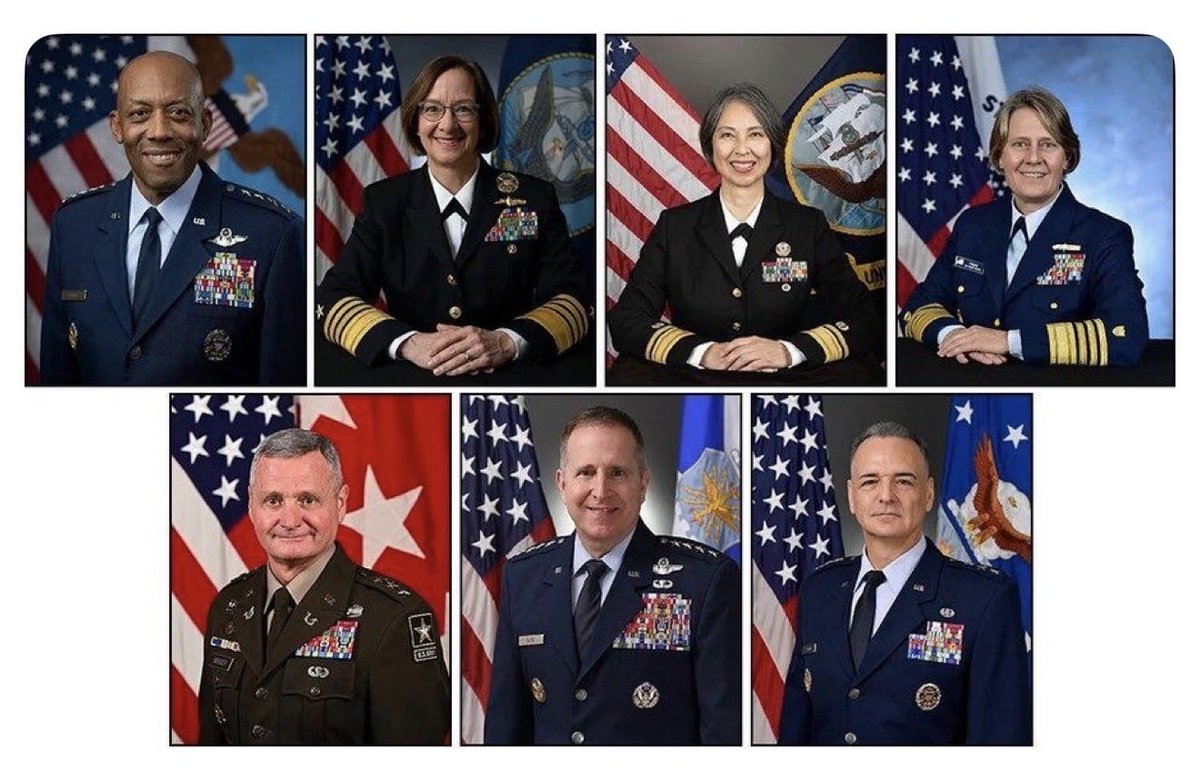
Twenty-six generals and admirals in fourteen months. No misconduct cited for a single one. A former Fox News weekend host who never held a senior military command has removed the Joint Chiefs Chairman, the Army Chief of Staff, the commander of Army Transformation and Training, the Chief of Chaplains, and at least 22 other senior officers from the most powerful military on earth. He blocked four Army officers from promotion to brigadier general, two Black men and two women, by unilaterally striking their names from a list of 36. When Army Secretary Dan Driscoll refused to remove them, Hegseth did it himself. No hearing. No review board. No Senate consultation. The names were struck because the man who reads the list decided they should not be on it. The pattern is not random. It is architectural. Every removal serves the same function: shortening the distance between a presidential decision and its execution. The officers who remain are the ones who did not resist. The officers who resisted are gone. The replacement for the Army Chief of Staff is Vice Chief General Christopher LaNeve, who served as Hegseth’s personal military aide. The man who carried the briefcase now signs the orders. The chain of command has been rebuilt so that every link answers directly to the man who removed the previous link. General Randy George was the commander of the United States Army’s ground forces. That title matters now in a way it did not matter six weeks ago. Before February 28, ground forces in Iran were a theoretical exercise discussed in war colleges and think tanks. After five weeks of air strikes, with the IRGC publishing bridge target lists across four allied nations, with the President saying the military has “not even started” destroying what remains, with MEUs staged in the Gulf and the 82nd Airborne deploying and JSOC operators at forward bases in four countries, the ground option is no longer theoretical. It is a logistics package. And the man whose job was to assess whether that package should be opened was told to retire the same day the President posted “much more to follow.” Lieutenant General Hodne ran the command that trains every soldier who would execute a ground operation. Major General Green led the chaplain corps that would minister to every soldier who dies in one. George decided whether the operation should happen. Hodne prepared the soldiers to carry it out. Green prepared them to live with it. All three were removed on the same afternoon. Congress has not held a hearing. No subpoenas issued. The legal authority for a Defence Secretary to unilaterally override promotion lists and force immediate retirement of Senate-confirmed officers during wartime has not been tested because nobody with the authority to question it has chosen to. The IRGC has said attacks will “intensify from next week.” The Ford carrier is heading back. The CNN intelligence assessment confirms half of Iran’s launchers and thousands of drones remain. The President has named the next targets: power plants, desalination, oil wells, Kharg Island. And every general who might have said “this crosses a line” is already gone. Twenty-six officers. Zero misconduct findings. One question that every general still serving is asking behind closed doors: who is left to say no? And what happens when the answer is nobody? open.substack.com/pub/shanakaans…
Shanaka Anslem Perera ⚡ tweet media
Shanaka Anslem Perera ⚡@shanaka86

JUST IN: You do not fire your Army Chief of Staff in the middle of a war for no reason. You fire him because of what comes next. Pete Hegseth called General Randy George on April 2 and told him to retire immediately. The Pentagon confirmed it within hours. No reason was given. Not publicly. Not privately. A senior Army official told Fox News that Hegseth offered George nothing: no misconduct, no operational failure, no policy disagreement on the record. Just a phone call and a career ending in the middle of the most significant American combat operation in two decades. George is the 24th general or admiral Hegseth has removed. But he is not the 24th. He is the one that matters. The Army Chief of Staff. The man whose signature sits between a president’s intent and the order that sends soldiers across a beach or into a tunnel complex. The 82nd Airborne is deploying right now. Marines from the 31st MEU are staged on the USS Tripoli. JSOC operators are at forward bases in Israel, Jordan, Saudi Arabia, and the UAE. Kharg Island, 90 percent of Iranian oil exports, sits 16 kilometres off a coast that someone will have to decide whether to approach. And the four-star general whose job it was to advise whether that approach should happen was removed 48 hours after Trump told the nation the war would continue for two to three more weeks. The replacement is Vice Chief General Christopher LaNeve. He was Hegseth’s senior military aide before this appointment. The man who carried the Secretary’s briefcase now commands the Army the Secretary is reshaping. The chain of command did not break. It shortened. The distance between a television studio and a combat order just collapsed to zero intermediaries who were not personally selected by the man giving the order. No reason was given. That is the tell. When someone is removed without explanation during a crisis, the explanation is the crisis itself. George either objected to something or was about to. The ground option. The power plant strikes. The Kharg raid. The escalation that turned a highway bridge in Karaj into rubble on the same day he was told to leave. Something in the next two weeks requires a chief who will not push back, and the Pentagon solved that problem by installing one trained as Hegseth’s aide. A former Fox News weekend host just fired a four-star general with combat tours in Iraq and Afghanistan, replaced him with his own former assistant, and did it during a live war in which the next decision could put American soldiers on Iranian soil for the first time in history. No hearing was held. No misconduct cited. The Army woke up on April 3 with a new chief it did not choose, in a war it did not start, preparing for a phase the previous chief apparently could not be trusted to execute. The question is not why George was fired. Every general in the building knows why. The question is what order is coming in the next fourteen days that required removing the one man in the chain of command who might have said no. The war has no perimeter. The chain of command has no objectors. And the next phase has no one left to stop it. open.substack.com/pub/shanakaans…

English
1.7K
11K
17.9K
1M
M. Borner retweetledi
Otavio (Tavi) Costa
Otavio (Tavi) Costa@TaviCosta·
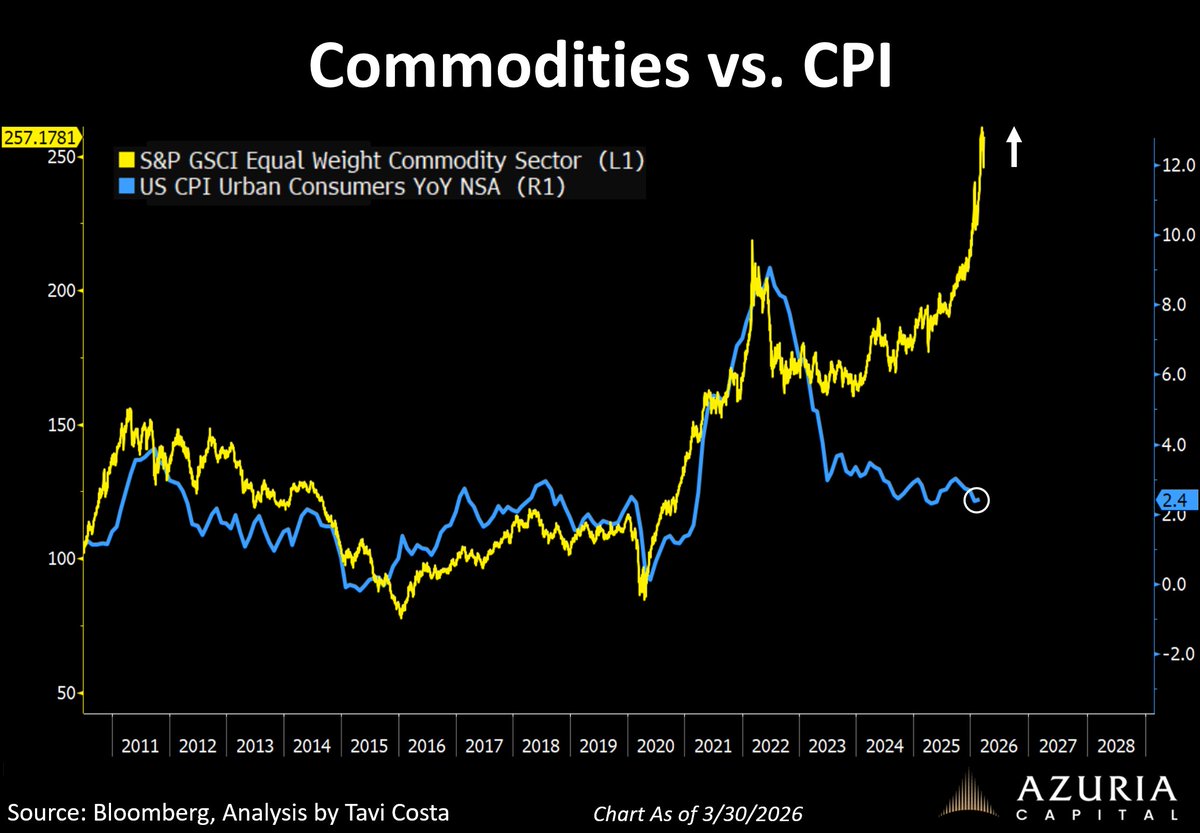
Agricultural commodities continue to move. Don’t underestimate the impact of this shift. It’s arguably even more important than what we’ve seen in energy prices. @tavicosta/p-192156572" target="_blank" rel="nofollow noopener">substack.com/@tavicosta/p-1…
Otavio (Tavi) Costa tweet media
English
38
131
792
65.3K
M. Borner retweetledi
Dominik Kettner
Dominik Kettner@Dominik_Kettner·
🚨 In den Ozeanen drehen Öltanker ab, die für Europa bestimmt waren. Asien zahlt mehr & kauft uns die Diesel-Ladungen weg. J.P. Morgan: Lieferstopp Asien 1. April, Europa 10. April, USA 15. April. Wer am meisten bietet, bekommt das Öl. Es wird sehr eng & teuer für Europa.
Dominik Kettner tweet media
Deutsch
9
25
129
4.3K
M. Borner retweetledi
Dominik Kettner
Dominik Kettner@Dominik_Kettner·
🚨🇺🇸 Eine C-17 der US-Luftwaffe kann ein Navy-SEAL-Boot aus einer Höhe von 10.000 Fuß abwerfen. Die SEALs springen im HALO-Verfahren hinterher, treffen sich im Wasser und begeben sich rasch an Land. Dies ermöglicht es den USA, Küstengebiete anzugreifen, ohne Schiffe in deren Nähe zu stationieren. Sehen wir das mögliche am kommenden Osterwochenende?
Deutsch
38
11
161
27.5K
M. Borner retweetledi
Dominik Kettner
Dominik Kettner@Dominik_Kettner·
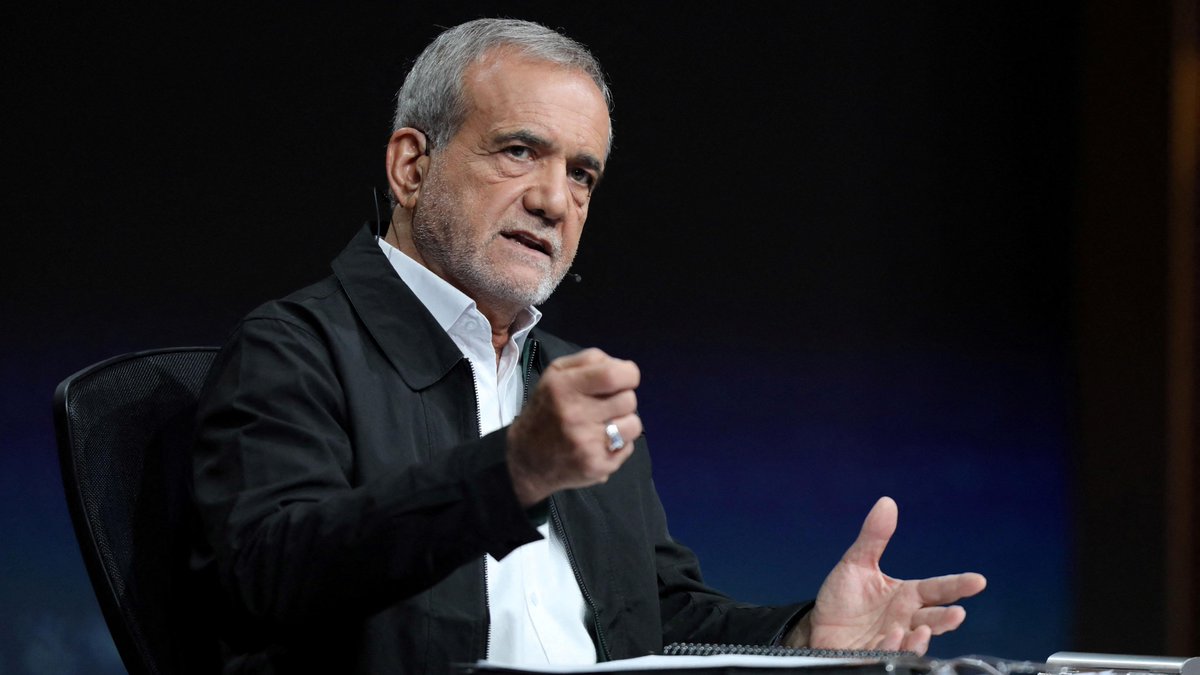
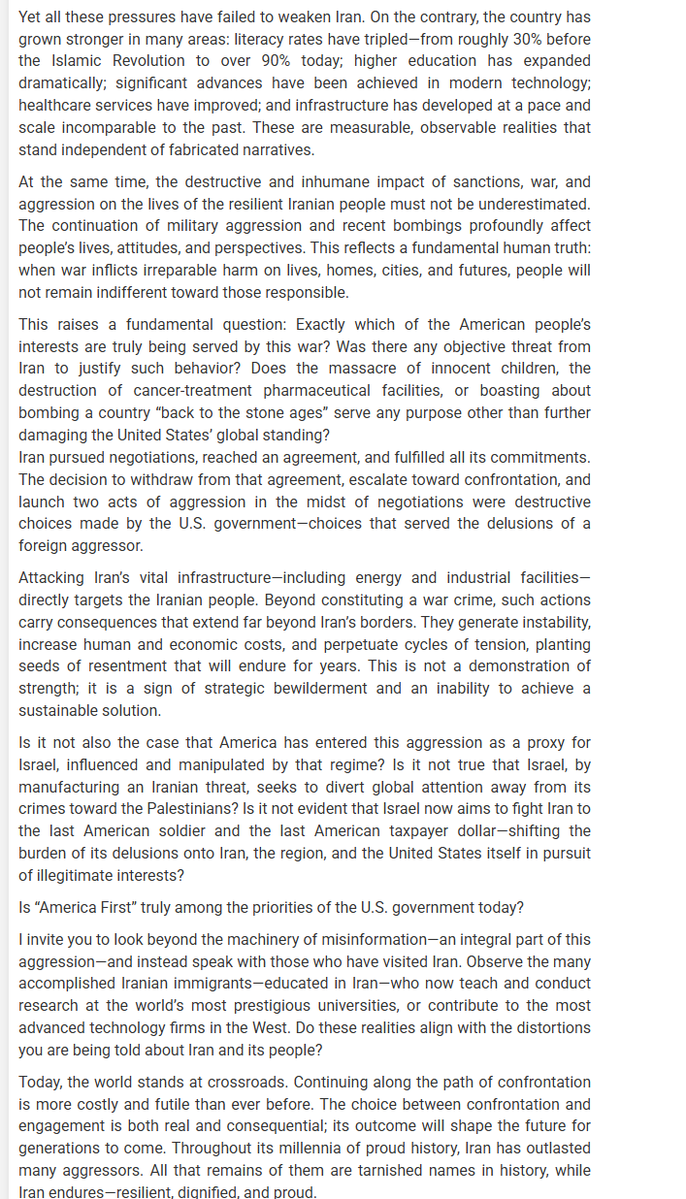
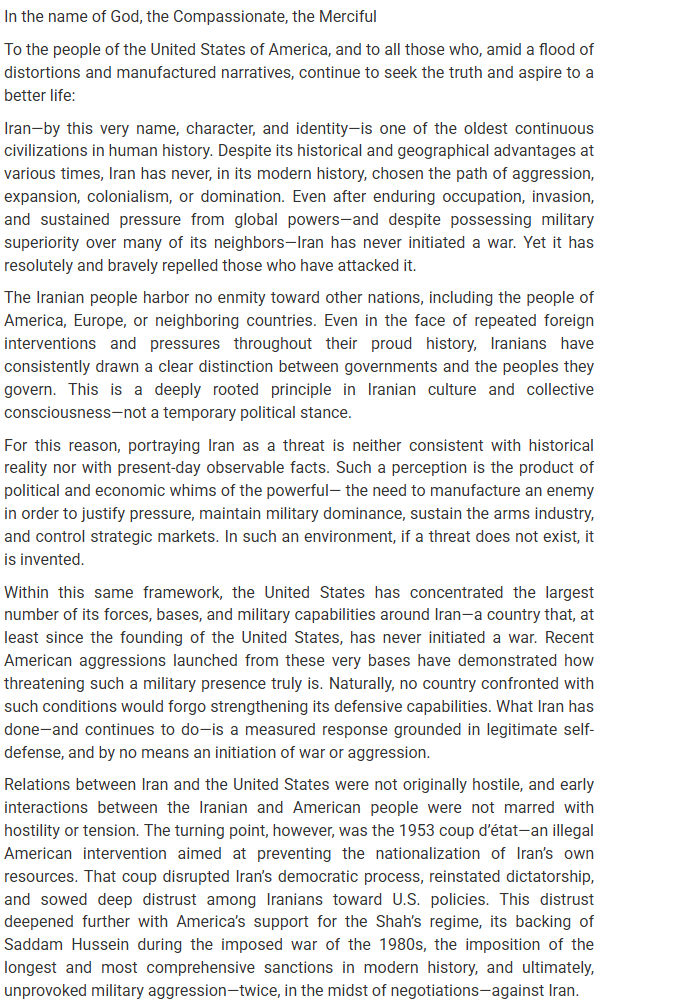
🚨🇮🇷🇺🇸 EILMELDUNG: Der iranische Präsident Pezeshkian hat offiziell einen „offenen Brief“ an das amerikanische Volk veröffentlicht. In dem Brief heißt es: 1. Der Iran hege „keine Feindseligkeit“ gegenüber anderen Nationen, einschließlich der Menschen in Amerika, Europa oder den Nachbarländern 2. Die jüngsten Maßnahmen der USA seien „Aggressionen“, die sich gegen Zivilisten und Infrastruktur richten und langfristige globale Instabilität zur Folge haben 3. „Was der Iran getan hat und weiterhin tut, ist eine angemessene Reaktion, die auf legitimer Selbstverteidigung beruht“ 4. Die Entscheidung, aus dem Atomabkommen mit dem Iran auszusteigen, wurde „von der US-Regierung getroffen“ 5. „Den Weg der Konfrontation weiter zu beschreiten, ist kostspieliger und sinnloser denn je“ Pezeshkian schließt mit den Worten: „Die Wahl zwischen Konfrontation und Engagement ist sowohl real als auch folgenreich. Im Laufe seiner jahrtausendealten, stolzen Geschichte hat der Iran viele Angreifer überdauert.“ Wir warten nun auf Trumps Ansprache an die USA um 21 Uhr ET.
Dominik Kettner tweet mediaDominik Kettner tweet mediaDominik Kettner tweet media
Deutsch
7
6
33
2.7K
M. Borner retweetledi
Shanaka Anslem Perera ⚡
In January 2026, the United States overthrew Nicolás Maduro and seized operational control of Venezuela’s oil exports. In February 2026, the United States and Israel launched strikes on Iran that closed the Strait of Hormuz. These are not separate events. They are the same strategy executed in sequence. Before the first bomb fell on Tehran, the US had already redirected 900,000 barrels per day of Venezuelan crude away from China and toward American, European, and Indian refiners. Chevron, Vitol, and Trafigura now market PDVSA oil under General License 52, with all proceeds flowing to a US Treasury account. China’s share of Venezuelan exports collapsed from over 600,000 barrels per day to 48,000 in February, a 67 percent drop in weeks. The US did not announce this as war preparation. It announced it as democracy promotion. But the barrel does not care what you call it. Now connect the second move. China buys 80 to 91 percent of Iran’s oil exports, approximately 1.38 million barrels per day transiting the Strait of Hormuz. The strait is now closed. Iran’s export infrastructure is under sustained bombardment. Kharg Island, which handles 90 percent of Iranian crude, is on the Pentagon’s contingency list. In two months, the United States has cut China off from its two largest non-traditional crude suppliers simultaneously: Venezuela by regime change, Iran by war. Combined, China has lost access to roughly two million barrels per day of supply it was receiving 60 days ago. This is why Dar is in Beijing today. China is not mediating the Iran war out of altruism or diplomatic ambition. China is mediating because it is running out of affordable oil. The country that controls 90 percent of the world’s rare earth processing, that supplies BeiDou navigation to Iranian missiles and neodymium magnets to American interceptors, that holds the leverage to end or extend this war, is sitting at the negotiating table because the United States methodically cut its energy supply lines before the first missile was fired. The grand bargain is not a theory. It is a pressure system. The US needs Chinese rare earths to rebuild 2,400 depleted Patriot interceptors. China needs Hormuz open and Venezuelan barrels restored. The US controls the Venezuelan spigot. China controls the rare earth pipeline. Each side holds a chokepoint the other cannot survive without. The deal writes itself: rare earth guarantees for oil access, semiconductor export relief for Hormuz security, Taiwan status-quo assurance for NPT compliance. Every variable has a price. Every price has a counterparty. And both counterparties are now desperate enough to pay. Venezuela was the opening move. Iran is the middle game. Beijing is the endgame. The molecule that connects all three is crude oil, and the country that controls where it flows controls the terms of the peace. The US did not stumble into this war. It secured alternative supply, redirected barrels away from its principal competitor, launched the campaign that closed the competitor’s primary import route, and is now negotiating from a position where the competitor must choose between its rare earth leverage and its energy security. That is not improvisation. That is the most sophisticated energy weapon deployed since the 1973 Arab oil embargo, except this time, America is not the victim. It is the architect. The arithmetic leads to Beijing. It always did. The only question was whether Beijing would arrive at the table voluntarily or be starved into it. The answer, as of March 31, is the latter. open.substack.com/pub/shanakaans…
Shanaka Anslem Perera ⚡ tweet mediaShanaka Anslem Perera ⚡ tweet media
English
81
524
1.5K
114.2K
M. Borner retweetledi
Otavio (Tavi) Costa
Otavio (Tavi) Costa@TaviCosta·
Four consecutive weeks of outflows from gold ETFs. This will go down as one of the best opportunities to add to gold at historically oversold levels in my view. Bottoms are always a process, and I do believe we are in the middle of one. This was a great opportunity to revamp my portfolio and add to a few miners I’ve always wanted to own — now at 30–40% discounts. Easier said than done. You’re either ready to take advantage of volatility, or you get stuck in the narrative that gold is no longer a defensive asset because it leads liquidations. Nonsense. open.substack.com/pub/tavicosta/…
Otavio (Tavi) Costa tweet media
English
44
105
788
38.6K
M. Borner retweetledi
Shanaka Anslem Perera ⚡
JUST IN: There are roughly 50,000 MRI machines operating worldwide. Each one requires liquid helium cooled to minus 269 degrees Celsius to keep its superconducting magnets functional. A single non-operational MRI eliminates 20 to 30 patient scans per day. Those are the scans that detect tumours before they metastasise, strokes before they kill, spinal injuries before they paralyse. The helium that makes those scans possible came, until 31 days ago, from Qatar’s Ras Laffan facility, which produced a third of the world’s supply as a byproduct of liquefied natural gas. Ras Laffan was struck by Iranian missiles on March 18. It declared force majeure. Fourteen percent of its helium capacity is permanently destroyed. Repairs will take three to five years. Helium prices have doubled. India’s hospitals are already reporting MRI cost spikes and scan delays. European facilities are rationing non-urgent diagnostics. Air Liquide has warned customers of unfulfilled orders. And 200 cryogenic containers holding 41,000 litres each are stranded in the Persian Gulf with 35 to 48 days before their cooling systems fail and the gas vents irreversibly into the atmosphere. Helium is the only element that escapes Earth’s gravity once released. It does not come back. Here is the connection that should stop every health minister, every defence secretary, and every AI executive in their tracks. The same helium that cools the MRI magnet scanning a child’s brain for a tumour in Mumbai also cools the extreme ultraviolet lithography machine printing the two-nanometre transistor in Hsinchu that powers the AI model selecting bombing targets over Isfahan. Hospitals and semiconductor fabs are now competing for the same shrinking pool of the same molecule at the same temperature. The war has created a zero-sum allocation between healing and killing, and the molecule does not care which one wins. TSMC holds 6.2 weeks of inventory and recycles 68 to 95 percent on site. Samsung holds six months but sources 65 percent from Qatar. Both are rationing toward AI and high-bandwidth memory, starving consumer chip production to keep the advanced nodes alive. Hospitals are nominally prioritised in allocation queues, but when a single TSMC fab consumes 500,000 cubic feet of helium per year and a trillion-dollar AI buildout depends on keeping those fabs running, the allocation queue is a polite fiction masking a brutal triage. Newer MRI machines use zero-boil-off technology, sealed systems holding as little as 0.7 litres of helium that never need refilling. In India, 3,500 of 5,000 machines already use this technology. But the legacy fleet, the machines in rural hospitals, developing nations, and underfunded health systems, still requires 1,500 to 2,000 litres per fill. Those are the machines that will go dark first. Those are the patients who will be diagnosed last. The geography of helium scarcity maps precisely onto the geography of healthcare inequality. The war’s casualties are not only soldiers and civilians in the strike zone. They include every patient whose scan was delayed because the helium that should have cooled their MRI machine is boiling off in a container drifting 57 kilometres northwest of Dubai. The body count of a chokepoint war does not end at the chokepoint. It extends to every hospital, every diagnostic centre, every oncology ward that depends on a noble gas extracted from natural gas that transits a 39-kilometre strait controlled by a navy that no longer exists but whose mines, drones, and shore batteries still function. The molecule does not distinguish between a magnet in a scanner and a magnet in a missile. It cools both to the same temperature. And today, there is not enough of it for both. Full deep dive analysis - open.substack.com/pub/shanakaans…
Shanaka Anslem Perera ⚡ tweet media
English
59
1.3K
2.4K
215.4K
M. Borner retweetledi
Shanaka Anslem Perera ⚡
Every fire exit the Gulf built to survive a Hormuz closure is being burned by the country that closed Hormuz. The Habshan-Fujairah pipeline was constructed in 2012 for exactly this scenario. A 380-kilometre bypass carrying 1.5 to 1.8 million barrels per day of Abu Dhabi crude directly to the Gulf of Oman, avoiding the Strait of Hormuz entirely. It was the insurance policy. The infrastructure that guaranteed the UAE could export oil even if Iran shut down the strait. Satellite imagery confirmed today shows fires at two pumping stations along that pipeline. Iran hit the insurance policy. This is not an isolated strike. It is a systematic campaign. On March 3, drone debris set fire to the Fujairah Oil Terminal, the pipeline’s destination, where 70 million barrels of storage sits across 15 tank farms. On March 14 and 16, successive drone strikes hit the Fujairah zone again, suspending loading operations. Iran struck Dubai International Airport’s fuel tank, shutting down the busiest airport in the Middle East. Iran struck the Shah gas field. Iran struck Oman’s Salalah port. Iran struck a Kuwait desalination plant. Iran hit Ras Laffan, the heart of Qatar’s LNG. Every facility the Gulf spent decades building to reduce Hormuz dependence has been struck within thirty days of the strait closing. The only remaining major bypass is Saudi Arabia’s East-West pipeline to Yanbu on the Red Sea, 1,200 kilometres of exposed desert with multiple vulnerable pump stations. The Houthis, who entered the war on March 28, have explicitly warned that closing Bab al-Mandeb is “among our options.” If the Red Sea exit closes, the last bypass dies. The Gulf’s entire alternative infrastructure, built over forty years and hundreds of billions of dollars, would be neutralised by a combination of Iranian drones costing less than a Toyota and Houthi missiles fired from the poorest country in the Arab world. Iran’s strategy is not to win the air war. It cannot. Seventy percent of its launchers are degraded. Its navy is destroyed. But none of that matters if Tehran can demonstrate that every molecule of Gulf oil, whether it flows through Hormuz or around it, passes within range of Iranian or proxy weapons. The message is actuarial, not military. Every alternative route that the insurance market might deem safe has been struck at least once. Every risk model has been updated with a confirmed incident. The fire exit has been set on fire. The insurance premium for the bypass is now the same as the premium for the front door. The Gulf states did everything right. They diversified. They built pipelines. They invested in alternative ports. They prepared for the Hormuz scenario for forty years. And in thirty days, Iran demonstrated that preparing for the scenario and surviving it are not the same thing, because the preparation assumed the adversary would not think to burn the fire exits. The adversary thought of it. open.substack.com/pub/shanakaans…
English
22
144
367
57.6K
M. Borner retweetledi
Otavio (Tavi) Costa
Otavio (Tavi) Costa@TaviCosta·
Powell doesn’t seem particularly concerned about inflation. Plenty of “tools” left in the toolbox, apparently :) Two words come to mind: Hard Assets. @tavicosta/p-192358201" target="_blank" rel="nofollow noopener">substack.com/@tavicosta/p-1…
Otavio (Tavi) Costa tweet media
English
32
134
784
37K
M. Borner retweetledi
Dominik Kettner
Dominik Kettner@Dominik_Kettner·
🚨Privatkredit-Ausfälle in den USA erreichten der Ratingagentur Fitch zufolge letztes Jahr mit 9,2 % ein Allzeithoch.
Dominik Kettner tweet media
Deutsch
2
4
41
2.6K
M. Borner retweetledi
Furkan Gözükara
Furkan Gözükara@FurkanGozukara·
Massive geopolitical shift. A top Taiwanese official declares a new spring for cross-strait relations, emphasizing a desire to build mutual trust with Beijing. She explicitly states peace is also China's expectation, completely shattering Washington's warmongering narrative.
English
284
2.3K
10K
362.7K
M. Borner retweetledi
Shanaka Anslem Perera ⚡
BREAKING: Secretary Rubio just clarified US war objectives with a precision that leaves zero ambiguity. Four targets, stated twice in the same briefing because, as he put it, “I see these reports of the US not being clear on what objectives are.” Destroy the air force. Destroy the navy. Destroy the missile and drone factories. Severely diminish the missile launchers so Iran can never hide behind them to build a nuclear weapon. “We are ahead of schedule on most of them, and we can achieve them without any ground troops. Without any.” Then he added the sentence the markets should be pricing: “The President has to be prepared for multiple contingencies, which I’m not going to discuss in the media.” Those contingencies are visible to anyone tracking ship movements. USS Tripoli arrived in the CENTCOM theatre on March 27 carrying the 31st Marine Expeditionary Unit, approximately 2,200 Marines with F-35B fighters and MV-22 Ospreys. USS Boxer departed San Diego with the 11th MEU and is transiting toward the Arabian Sea with another 2,500 Marines. The Abraham Lincoln carrier strike group has been operating in the Arabian Sea since January. The Gerald R. Ford is in the Red Sea. The George H.W. Bush is preparing as a third carrier. The 82nd Airborne is deploying. SEAL teams and JSOC packages are in theatre. More than 50,000 US troops are now within striking distance of Iran. If you draw a line between what Rubio said and what the Pentagon is positioning, the gap between “no ground troops” and “multiple contingencies” is exactly the width of Kharg Island. Twenty square kilometres of fortified limestone through which 90 percent of Iran’s crude exports flow. Intelligence reports describe new S-300 air defence batteries, dense naval minefields around the deep-water berths, C-802 anti-ship missile launchers, underground command bunkers, and 2,000 to 3,000 IRGC troops with rapid mainland reinforcement capability fifteen kilometres away. Iran has turned Kharg into a fortress precisely because it understands that the island is the one piece of leverage that converts air campaign success into political surrender. This creates the binary that defines the next seven days. Path one: Pakistan’s Ishaq Dar lands in Beijing tomorrow, secures Chinese backing for hosting US-Iran talks, and the April 6 deadline produces a diplomatic framework that reopens Hormuz and begins IAEA-supervised uranium extraction. Rubio’s “weeks not months” holds. The markets exhale. Brent drops below $90. Path two: April 6 passes without a deal. Trump executes the threat he posted on Truth Social this morning: “blowing up and completely obliterating all of their Electric Generating Plants, Oil Wells and Kharg Island and possibly all desalinization plants.” The Marines who arrived on the Tripoli are not there for deterrence. They are there for the most complex amphibious operation since Inchon, conducted against a fortified island in a mined strait while 90 million Iranians endure their 31st day without internet and the Houthis threaten to close Bab al-Mandeb if the US goes ashore. Rubio’s framing is deliberately clean. Four objectives. Ahead of schedule. Weeks not months. No ground troops needed for the stated objectives. But the unstated objective, the one the “multiple contingencies” language protects, is whether the uranium comes out through negotiation or through the tunnels beneath Isfahan, and whether Kharg opens through diplomacy or through Marines landing on a mined beach under fire from anti-ship missiles. The molecule, as always, does not negotiate. It flows through the strait or it does not. The market has seven days to decide which path it is pricing. Full analysis in The Last Molecule Standing, live now. open.substack.com/pub/shanakaans…
English
65
211
760
253K
M. Borner retweetledi
Shanaka Anslem Perera ⚡
JUST IN: Brent crude has surged more than 55 percent in March 2026, the steepest monthly rise in the history of the benchmark, surpassing the 46 percent spike recorded during Iraq’s invasion of Kuwait in September 1990. That is not a statistic. That is the molecular chokepoint thesis transmitting from a 39-kilometre strait into every gas station, grocery store, and mortgage application in America. Gasoline is approaching four dollars nationally, up nearly a dollar in thirty days. California is nuzzling nine. The Fed held rates at 3.5 to 3.75 percent on March 18 because the war has created simultaneous inflation pressure and growth risk. Goldman Sachs raised recession probability to 30 percent. The S&P 500 has fallen more than 5 percent since the war began. US debt has crossed $39 trillion with $10 trillion requiring rollover this year. Nonfarm payrolls contracted by 92,000 in February. Trump posted on Truth Social at 7:26 AM Eastern this morning that the United States is in “serious discussions” with what he calls a “new, and more reasonable, regime,” but warned that if no deal is “shortly reached,” he will conclude the war by “blowing up and completely obliterating all of their Electric Generating Plants, Oil Wells and Kharg Island and possibly all desalinization plants.” He told the Financial Times that his “favourite thing” is to “take the oil in Iran” and raised seizing Kharg Island, through which 90 percent of Iran’s crude exports flow. Then he added: “It would also mean we had to be there for a while.” Hormuz transits have collapsed from 138 ships per day to nine. Iran is charging two million dollars per voyage in yuan. Forty-five percent of regional crude is offline. The EIA forecasts Brent above $95 for the next two months, falling below $80 only if the conflict resolves, a conditional projection the market is treating as baseline when the evidence says otherwise. Consumer sentiment is cratering. More than 3,200 protest events mobilised millions on March 28 and 29. Trump’s approval has dropped to the low forties. The generic ballot has swung three to four points toward Democrats with midterms eight months away. Energy shock transmits to food prices transmits to consumer pain transmits to political backlash. The same mechanism that operated in 1973 and 1979 is operating now, except the energy shock is not an OPEC decision. It is the physical destruction of the infrastructure that processes the molecules the global economy runs on. The shale buffer is real but insufficient. US net exporter status insulates production but not refining, imports, or prices. American consumers still pay global benchmarks. American farmers still buy fertiliser priced off gas that ships through Hormuz. American semiconductor fabs still need Qatari helium. The war has removed approximately nine million barrels per day from global supply. Emergency reserve releases of 400 million barrels failed to arrest the price. The market is telling you what the policymakers are not: this is a structural repricing of energy risk that persists until the strait reopens or alternative supply chains are built. Alternative supply chains for LNG, helium, and fertiliser do not exist on any timeline shorter than years. April 6 is seven days away. The molecule does not negotiate. open.substack.com/pub/shanakaans…
Shanaka Anslem Perera ⚡ tweet media
English
14
29
76
17.6K
M. Borner retweetledi
Shanaka Anslem Perera ⚡
BREAKING: Last night, Iran crossed the line that oil never crosses. It struck water. An Iranian attack hit Kuwait’s Doha West Power and Water Desalination Station, killing an Indian worker and causing significant material damage. Kuwait depends on desalination for ninety percent of its drinking water. More than 400 plants on the Arabian Gulf’s shores produce roughly forty percent of the world’s total desalinated water. The Atlantic Council warned that over ninety percent of the Gulf’s desalinated output comes from just fifty-six plants. This is no longer an energy war. It is a water war. And water has no substitute, no strategic reserve, and no futures market to hedge against its absence. The overnight escalation did not stop at water. Saudi Arabia intercepted drones and missiles targeting the Eastern Province. Israel struck Tehran with a new wave, killing IRGC Tehran security commander Hassan Hasanzadeh. Houthis explicitly warned that they will consider closing the Bab al-Mandeb strait if the United States launches a ground operation or seizes Kharg Island. Goldman Sachs assigns a twenty to twenty-five percent probability to simultaneous closure of both Hormuz and Bab al-Mandeb, which would create a continuous band of uninsurable water from Suez to Malacca. Trump responded with contradictions stacked on contradictions. He claimed Iran had agreed to send twenty large oil tankers through Hormuz on Monday as a “sign of respect” and said “I do see a deal, could be soon.” In the same breath, he told Fox that he wants to “take the oil in Iran” and warned the regime would “give us the nuclear dust” or “they’re not going to have a country.” Secretary of State Rubio insists the US “can achieve all objectives without ground troops” while the Pentagon quietly positions more than 50,000 troops in the region, including fresh Rangers and SEALs arriving for what officials describe only as “maximum optionality.” The language of a government that has already positioned the assets and is waiting for the trigger. April 6 is seven days away. That is the date Trump set for Iran to reopen Hormuz. Iran has formally rejected the US fifteen-point plan. The IRGC Navy Commander who controlled the blockade was killed four days ago. The Houthis entered the war two days ago. Iran is reinforcing Kharg Island with mines, traps, and additional air defences. And now, for the first time in this conflict, drinking water infrastructure has been struck with lethal consequences. The pattern is clear to anyone tracking the sequence rather than the headlines. Every escalation compresses the timeline to April 6. Every Iranian strike on Gulf civilian infrastructure strengthens the case for a limited ground raid on Kharg. Every day the strait stays closed is a day the helium boils off, the fertiliser does not ship, the insurance does not normalise, and the BAHX repair queue does not shorten. The war is not approaching a resolution. It is approaching a phase transition. And phase transitions, unlike diplomatic pauses, do not announce themselves in advance. Twenty tankers on Monday, or a raid on Kharg by Easter. Those are not predictions. They are the two paths that the architecture of this crisis has narrowed to. The whales on Polymarket are pricing 68 cents on one of them. The molecule sitting at minus 268.9 degrees Celsius in a stranded container is indifferent to both. Full analysis in The Last Molecule Standing, live on Substack now. open.substack.com/pub/shanakaans…
Shanaka Anslem Perera ⚡ tweet media
English
137
395
2K
981.8K
M. Borner retweetledi
marc friedrich
marc friedrich@marcfriedrich·
Die türkische Nationalbank hat 60 t Gold verkauft, wahrscheinlich um sich mit Energie zu versorgen. Andere Notenbanken haben bzw. werden dies auch tun. Das wird erst mal weiterhin Druck auf Gold ausüben und meine Ansicht nach dann eine Nachkaufchance generieren.
Bloomberg@business

Turkey’s central bank sold and swapped about 60 tons of gold, worth more than $8 billion, in two weeks after the start of the war in Iran, adding to downward pressure on bullion prices bloomberg.com/news/articles/…

Deutsch
24
42
440
49.3K