Systems Innovation

6.1K posts

Systems Innovation banner
Systems Innovation

Systems Innovation

@Sys_innovation

Working on building the field of systems innovation by developing an open network for people to learn, connect and co-create... https://t.co/DMdu3q4PhY

Live from London Katılım Mayıs 2012
5.9K Takip Edilen16.4K Takipçiler
Sabitlenmiş Tweet
Systems Innovation
Systems Innovation@Sys_innovation·
Over the past year or so, the general quality of the Twitter/X platform has significantly degraded. For this we have made the decision to move to Bluesky, We welcome you to join us there: bsky.app/profile/sinetw…
Systems Innovation tweet media
English
2
0
6
2.2K
Helen Bevan
Helen Bevan@HelenBevan·
Let’s talk about “emergence” in organisational change initiatives. Emergence is when new ways of working & new forms of order grow out of the interactions of people, practices & structures, rather than through implementation of a fixed, top-down change plan. Top‑down, programme‑driven approaches assumes change is predictable & that leaders can design the route in advance. Research on emergent change shows our change environments are complex, fluid & cannot be fully understood or controlled in advance. It’s not surprising that, in many situations, top down approaches on their own are failing to deliver the outcomes we need. Emergent approaches (which blend strategic intent & accountability with high local autonomy on how to move things toward) are clearly the way to go. Yet organisational leaders are reluctant to adopt them. Why? · The wider accountability & governance systems we operate in expects linear plans, business cases & RAG reports, so leaders worry that explicitly adopting emergent approaches will be seen as vague, indecisive, or not having “management grip” of the change, even in obviously complex environments. · Under high levels of scrutiny & pressure, leaders may worry that inviting more emergent, adaptive ways of working will look like ‘losing control’ & create chaos, especially in cultures where it still feels unsafe for leaders to name fear, uncertainty, or not having all the answers. · Most leadership development does not include practices for emergence such as inquiry‑based facilitation, safe‑to‑fail experimentation, joint sense‑making & adaptive framing, so “emergence” is often heard as “no plan”. We can build emergence into our daily leadership practice by adding new ways of working around experimentation, learning & distributed leadership, without losing focus on accountability & delivery: 1) Take a “tight-loose-tight” approach: tight on strategic intent, loose on multiple local routes & experiments towards it & tight on accountability for results 2) Introduce safe‑to‑fail experiments: many small, parallel interventions around key priorities that enable learning & can fail without harm 3) Make experimentation routine: require major programmes to allocate a proportion of budget & capacity to designed experiments before any big‑bang roll‑out 4) Measure improvement in adaptability & collaboration - not just results: add measures for experimentation, collaboration & responsiveness (e.g., number of safe‑to‑fail tests, time from idea to first trial, cross‑team initiatives started) alongside traditional KPIs 5) Build the likelihood of emergence into the business case process: add “learning system design” to the template - how data, stories & signals will be gathered, discussed & used to pivot or stop; align incentives, risk & culture so people are rewarded for stopping or redirecting initiatives when evidence changes, not just for delivering the original plan 6) Institutionalise collective sense‑making: forums across the system where data, stories & experiment results are interpreted together, & next moves are agreed adaptively. 7) Replace blame or failure language with forward‑looking learning language (“what did we discover?”), especially in reviews & governance meetings 8) Develop leadership capabilities for emergence: build skills in inquiry, facilitation, “holding space”, & working with uncertainty, not just project & programme management & “technical” improvement methods. A favourite “classic” article on leading for emergence by Gervase Bushe & Robert J Marshak: gervasebushe.ca/otherdocs/Dial…. Graphic by Joss Colchester of @Sys_innovation: linkedin.com/posts/josscolc…
Helen Bevan tweet media
English
7
39
105
9.2K
Systems Innovation
Systems Innovation@Sys_innovation·
Over the past decade, our partner organization Endeva has been exploring and experimenting with different methods to facilitate system change Now they have developed a toolbox that supports different stages of the process Join this event to learn more: bit.ly/4ozmwPe
Systems Innovation tweet media
English
0
0
1
370
Systems Innovation
Systems Innovation@Sys_innovation·
In this how-to post, we will share with you the key aspects that you should be considering, as well as what this looks like for other organizations and the general practice out there in the field of systems innovation. lnkd.in/ejjM4tfx
Systems Innovation tweet media
English
0
0
0
291
Systems Innovation
Systems Innovation@Sys_innovation·
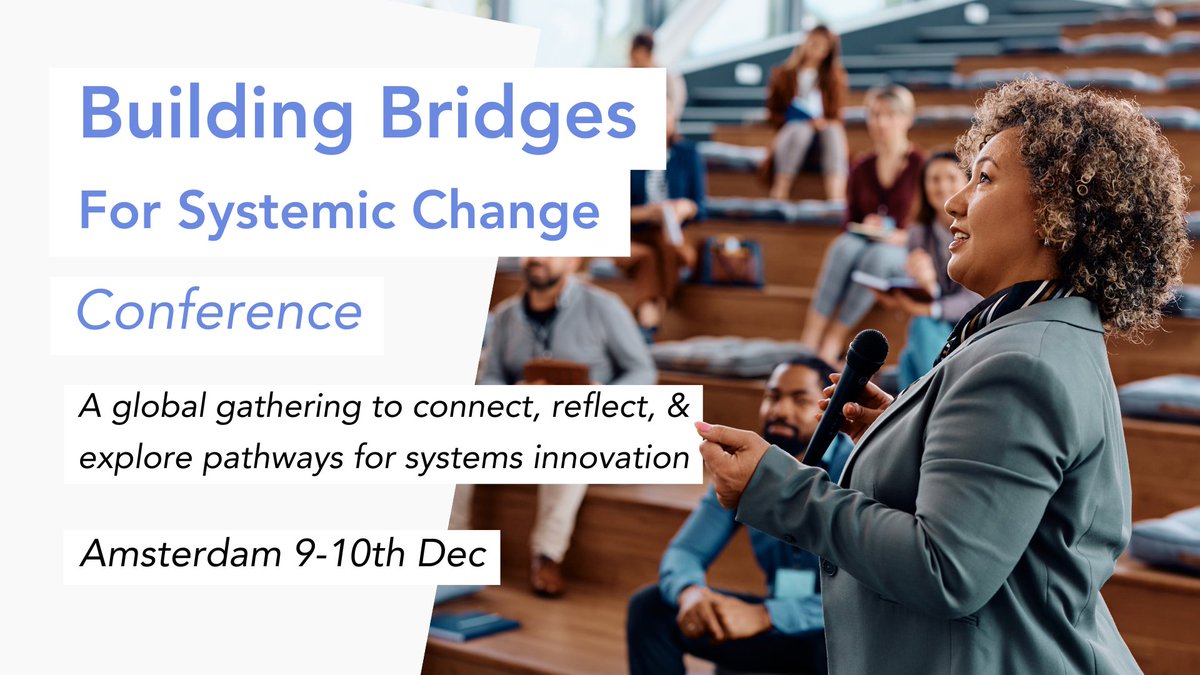
Very excited to announce that the Si Network and Oxfam Novib will be co-hosting this two-day in-person conference in Amsterdam. This will be a global gathering to reflect, connect, and explore pathways for systems innovation. Full info: luma.com/usuyqxzb
Systems Innovation tweet media
English
0
1
1
293
Systems Innovation
Systems Innovation@Sys_innovation·
Have you discovered the Si Social Hub space yet? Si Social Hub is a community for those interested in applying systems innovation ideas and methods towards addressing social challenges and better understanding social systems. You can learn more here: systemsinnovation.network/spaces/4547591
Systems Innovation tweet media
English
0
1
1
342