Tal Golan

682 posts

Tal Golan

Tal Golan

@TalGolanNeuro

Assistant professor @ Ben-Gurion University. Studies and tweets about human and machine vision.

Israel Katılım Temmuz 2016
875 Takip Edilen981 Takipçiler
Tal Golan retweetledi
Peter Holderrieth
Peter Holderrieth@peholderrieth·
🚀MIT Flow Matching and Diffusion Lecture 2026 Released (diffusion.csail.mit.edu)! We just released our new MIT 2026 course on flow matching and diffusion models! We teach the full stack of modern AI image, video, protein generators - theory and practice. We include: 📺 Videos: Step-by-step derivations. 📝 Notes: Mathematically self-contained lecture notes 💻 Coding: Hands-on exercises for every component We fully improved last years’ iteration and added new topics: latent spaces, diffusion transformers, building language models with discrete diffusion models. Everything is available here: diffusion.csail.mit.edu A huge thanks to Tommi Jaakkola for his support in making this class possible and Ashay Athalye (MIT SOUL) for the incredible production! Was fun to do this with @RShprints! #MachineLearning #GenerativeAI #MIT #DiffusionModels #AI
Peter Holderrieth tweet media
English
15
392
2.2K
513.2K
Tal Golan retweetledi
Kohitij Kar
Kohitij Kar@KohitijKar·
⭐️ New preprint — work led by @mdunnhofer , supported by Jean de Dieu U. biorxiv.org/content/10.648… In natural scenes, objects are often hidden by clutter, occlusion, or camouflage. Yet humans can suddenly “see” them the moment they move. To study this, we leveraged the 𝗠𝗢𝗖𝗔 (Moving Camouflaged Animals) dataset — a unique set of videos where objects are nearly invisible in static frames but become perceptually clear through motion. In our new work, we asked: 👉 Do modern AI systems rely on motion the same way we do? We brought together: • 🧑🏽‍💻👨🏽‍💻Human behavior • 🐒🧠Macaque IT neural recordings • 🤖Image-based and video-based neural networks Here’s the surprising part: Image-based neural networks are already very good at estimating object properties — even in these highly challenging, camouflaged scenes from MOCA. But that’s exactly the problem. Because they perform so well using static cues alone, they don’t need to rely on motion the way biological systems do. As a result, they fail to show the strong motion-dependent improvements seen in humans and the primate brain. Video models partially recover this behavior by integrating information over time — but still fall short of fully matching biological vision. The takeaway: Better performance does not mean better models of the brain. In fact, being “too good” at static recognition may push models toward the wrong computational strategies. Datasets like MOCA expose this gap clearly: 👉 Humans sometimes need motion to see. 👉 Models often don’t. If (we might not) we want AI systems that truly reflect how primate vision works, we need to go beyond static benchmarks and capture the dynamic computations that stabilize perception in the real world.
English
0
9
37
2.3K
Tal Golan retweetledi
Kohitij Kar
Kohitij Kar@KohitijKar·
👾ANNs decode object position. But don’t know where things appear to be for humans. 🧠Macaque IT does! 🌟In our new preprint, using a classic motion illusion, we show ventral stream position codes shift with perception — revealing a fundamental gap between biological and artificial vision. Work led by Elizaveta Yakubovskaya, supported by @HamidRamezanpou @mdunnhofer arxiv.org/abs/2603.11248
GIF
English
0
12
44
2.4K
Tal Golan retweetledi
Stéphane Deny
Stéphane Deny@StphTphsn1·
In this short piece we make the case for latent equivariant operators methods✨, an alternative to classical and equivariant nets that shows promise for out-of-distrib classif. We lay out the challenges ahead for scaling these methods to larger datasets 🧐 follow @minhinhtrng 👀
Minh Dinh@minhinhtrng

Modern vision models lacks robustness when objects appear in unusual poses. @StphTphsn1 and I study latent equivariant operators as a remedy and discuss caveats of these operators. Below is a summary of the work, accepted at the GRaM Workshop at ICLR @iclr_conf 2026. 🧵

English
2
10
58
8.1K
Tal Golan retweetledi
David Klindt
David Klindt@klindt_david·
Wow, I did not expect that DINOv3's global [CLS] token linearly represents the continuous geometric latents of dSprites (size & X/Y position) 🤯 It only took me 3.5 years to finally run this experiment 😂 I'm looking to do more of this MechInterp work, dissecting foundation models like biological artifacts and building theory. If you want to collaborate (especially students looking for a fun project) reach out! 🔬🤖
David Klindt@klindt_david

If there were an image input, I would be curious to show it some DSprites examples and ask: what are the independent factors of variation in that data 🤓

English
24
85
1.1K
93.3K
Tal Golan retweetledi
Anderson M. Winkler
Anderson M. Winkler@AndersonWinkler·
Some image processing methods implicitly smooth images with an ideal filter. What's the FWHM of the Gaussian filter that produces the most similar degree of smoothing? brainder.org/2026/03/09/gau…
English
1
1
5
163
Tal Golan retweetledi
Aran Nayebi
Aran Nayebi@aran_nayebi·
One thing that’s often underappreciated is that task-optimized models seed neural foundation modeling because they’re so much more efficient to train than only on brain data — the brain data ends up being the cherry on top for fine-tuning. Analogously, Newton's 3 laws are very useful for creating efficient physics simulators (vs. predicting every pixel). Now, brains of course aren’t as simple, but at least we get 3 substrate-independent entry points to reason about in task-optimized modeling: task (dataset + objective), architecture, and learning rule. These 3 generate the pre-trained neural network seeded for the neural foundation model. One can therefore think of “task-optimization” as understanding the principles of the intelligent system (hence its efficiency) vs. data-driven finetuning that happens after, as fitting to the specifics of “individuals” (which will be important for translational/biomedical purposes). Thus, for building the next generation of foundation models, task pre-training + brain fine-tuning seems like the pragmatic sweet spot — efficient but individualizable. Time will tell!
Aran Nayebi tweet media
English
1
5
29
8.4K
Tal Golan retweetledi
Cliona O'Doherty
Cliona O'Doherty@ClionaODoherty·
1/7 Does the infant brain have representational structure? 👶🧠In the FOUNDCOG project, we scanned 134 awake infants using fMRI. Published in Nature Neuroscience, our research reveals 2-month-old infants already possess complex visual representations in VVC that align with DNNs.
GIF
English
1
46
178
14.4K
Tal Golan
Tal Golan@TalGolanNeuro·
Israeli STEM postdocs abroad, have a look at this fellowship: gov.il/he/pages/rfp18… 24 months x 13,500 NIS, Deadline: March 24, 2026 If you are working at the intersection of deep learning and cognitive (neuro)science, I'd be happy to host.
English
0
0
0
122
Tal Golan retweetledi
Fenil Doshi
Fenil Doshi@fenildoshi009·
🧵 How do tokens in Vision Transformers talk to each other? Attention maps show where models look but not what information gets exchanged. We introduce Bi-orthogonal Factor Decomposition (BFD) to understand the internals of ViT attention. (1/17)
Fenil Doshi tweet media
English
12
63
458
25.3K
Tal Golan retweetledi
Yevgeni Berzak
Yevgeni Berzak@whylikethis_·
A short survey on research practices with eye-tracking data, especially in reading studies, as part of the OpenEye Project soscisurvey.de/OpenEye/ Deadline for participation: December 20
English
0
1
3
395
Tal Golan retweetledi
Mackenzie Weygandt Mathis, PhD
Mackenzie Weygandt Mathis, PhD@TrackingActions·
🚨 Looking for a primer on the latest advances in joint neural-behavioral modeling? 🤩 Check out our new Nature Reviews Neuroscience piece! It was really an honor to write this 🫶 nature.com/articles/s4158…
English
2
23
79
8.6K
Tal Golan retweetledi
JohnMark Taylor
JohnMark Taylor@johnmark_taylor·
Exciting evidence that the human brain uses an integrated coding format for real-world color/shape conjunctions in short-term memory, but not online vision. Proud to be a coauthor on this ambitious fMRI study with Yaoda Xu, Ben Swinchoski, & Marvin Chun: direct.mit.edu/imag/article/d…
English
1
4
14
1.1K
Tal Golan retweetledi
CogCompNeuro
CogCompNeuro@CogCompNeuro·
🗓️ Important CCN 2026 submission deadlines: • Proceedings: Feb 9 (abstract) / Feb 12 (full paper) • GACs, Keynotes, Tutorials, Events: Mar 14 • Extended Abstracts: Apr 2 Deadlines will not be extended—so plan ahead and submit early!
English
1
13
35
3.5K
Tal Golan retweetledi
Tahereh Toosi
Tahereh Toosi@taherehtoosi·
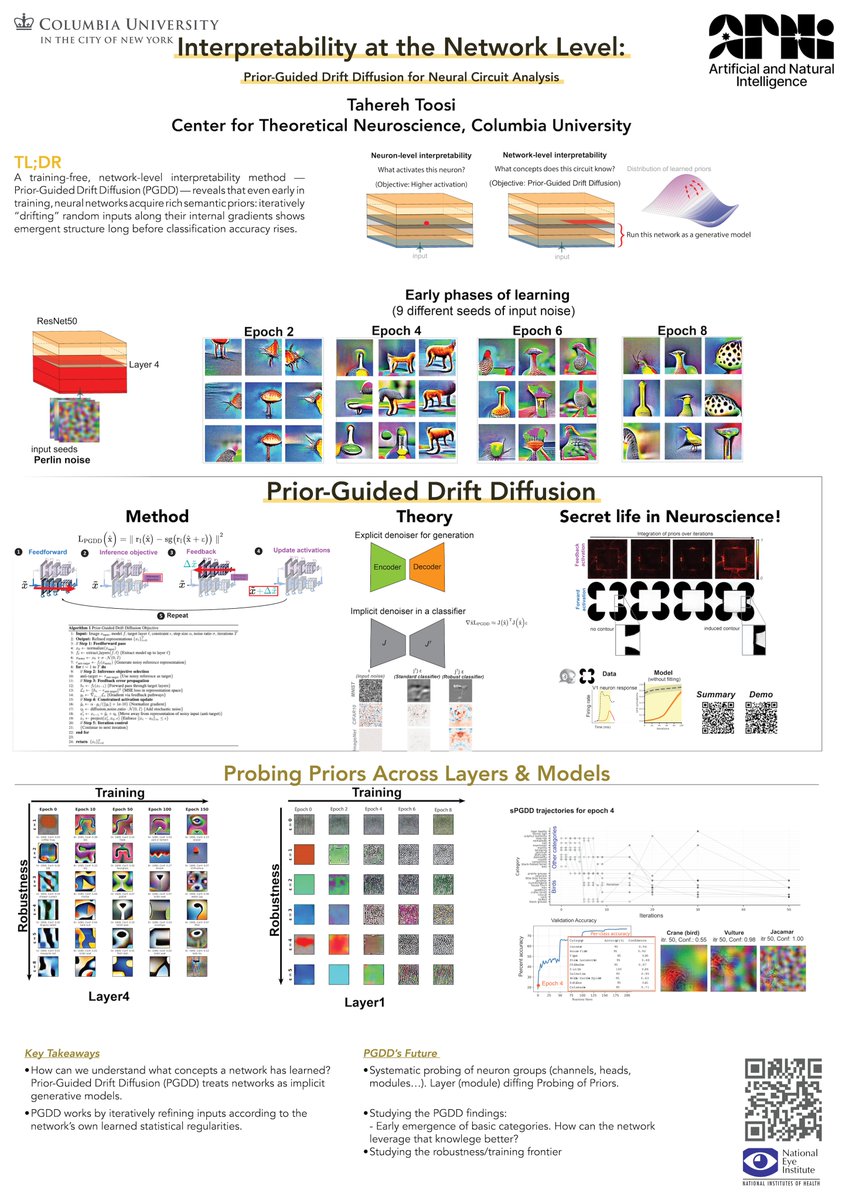
If you are around at #NeurIPS2025, come check out this amazing workshop where I am presenting: Interpretability at the Network Level: Prior-Guided Drift Diffusion for Neural Circuit Analysis Models at early epochs know much more than we thought! shorturl.at/WZ2zG
Tahereh Toosi tweet media
Neel Nanda@NeelNanda5

I'm excited that we've secured a 800+ person room for the NeurIPS mech interp workshop on Sunday! Last year was so crowded that they tried to stop me getting into the room. I'll be pretty surprised if that happens again! (And if it does, well, something else went very right)

English
3
24
111
12.3K