Tamas

6.1K posts

Tamas

Tamas

@TamasKalman71

Katılım Kasım 2021
1.3K Takip Edilen524 Takipçiler
Tamas retweetledi
Kevin Maro
Kevin Maro@KevInvestingYT·
After too many hours of research/DD to count, these are my Top 5 AI Stocks in the Top 5 AI Sectors to Invest in: 1. Neoclouds: The GPU & Compute landlords. Whoever owns the compute owns what every AI company on the earth needs to grow & succeed. $NBIS - Nebius. Spun out of Yandex, rebuilt as a pure-play AI cloud. Microsoft and Meta committed billions in contracted backlog. The fastest growing neocloud on the board. My favorite pick as a long-term investment. $CRWV - CoreWeave. The American-founded neocloud. SemiAnalysis rated this Neocloud in a class of it's own, which can not be understated. Deals with Anthropic, OpenAI, Meta, Perplexity, Google, Microsoft... the list goes on forever. $HUT - Hut 8. Started as a bitcoin miner, pivoted hard into AI hosting and power infrastructure. Owns the power, not just the GPUs. They're landing deals left and right, definitely an underappreciated sleeper pick. $APLD - Applied Digital. Same playbook. Former crypto miner now building purpose-designed AI data center campuses with long-term hyperscaler leases. $CIFR - data center host for Anthropic's directly, purchased Google TPU v7 Ironwoods (400K units, ~$10B), backed by a 10-year, $3B+ Fluidstack hosting deal where Google guarantees $1.4B of lease obligations for a 5.4% equity stake. One of the only neocloud-adjacent names with real exposure to Google's silicon instead of pure Nvidia GPU rental. 2. Optical / Photonics: Because every GPU is useless if it can't talk to the GPU next to it. $CRDO - Credo. The connectivity layer inside every AI cluster. Active electrical cables and DSPs that scale with every rack hyperscalers deploy. $LITE - Lumentum. Legacy telecom optics company that's become a core 800G/1.6T transceiver supplier for the AI buildout. $ALAB - Astera Labs. Connectivity chips that solve the bottleneck between GPUs, memory, and storage. Pure-play AI infrastructure with almost no legacy drag. $COHR - Coherent. Lasers, optical components, and transceivers spanning the entire photonics stack from datacom to industrial. $MRVL - Marvell. Custom silicon and photonic fabric for hyperscalers. The company quietly inside more AI racks than people realize. 3. Memory: The most cyclical, most violently mispriced sector in semis. HBM demand changed the entire setup. $DRAM - DRAM ETF. One ticker, every important memory company on the planet, including South Korean companies like SK Hynix and Samsung Electronic, companies you CAN'T INVEST IN with most brokerages. $SNDK - SanDisk. Spun off from Western Digital, now a pure-play NAND flash story riding the same supply tightness as everyone else in this sector. $MU - Micron. One of three companies on Earth that makes HBM. The clearest direct line from AI buildout to memory revenue. $WDC - Western Digital. Hard drive and enterprise storage demand riding the same data center capex wave as everything else on this list. $STX - Seagate. The other half of the storage duopoly. Enterprise nearline drives are seeing the same supply crunch dynamics as memory. 4. Analog / Power Semis: Unsexy. Necessary. Every data center, every EV, every robot needs power management silicon that doesn't get the AI premium yet: $MXL - MaxLinear. Smaller-cap analog and mixed-signal play with infrastructure and data center exposure that's still flying under the radar. $STM - STMicroelectronics. European chip giant spanning auto, industrial, and power semis. Way out of favor relative to its diversification. $ON - ON Semiconductor. Power semis for EVs and industrial, now leaning harder into data center power delivery as a growth vector. $VSH - Vishay. Passive components: resistors, capacitors, diodes. Boring until you realize literally everything electronic needs them. $POWI - Power Integrations. High-voltage power conversion chips. Small cap, niche, and positioned for the power efficiency problem AI data centers haven't solved yet. 5. Physical AI / Robotics: It's coming, soon, and the market is beginning to realize it. $OUST - Ouster. Lidar for robotics, industrial, and autonomy. Consolidated the space after merging with Velodyne, now the survivor. $VICR - Vicor. High-density power modules for robotics, AI servers, and defense. Power delivery at the component level, not the rack level. $VPG - Vishay Precision Group. Precision sensors and strain gauges. The torque and force-sensing hardware that gives robots a sense of touch. $AEVA - Aeva. 4D lidar with built-in velocity sensing. Smaller and earlier stage than the rest of this list, highest risk, highest ceiling. $AMBA - Ambarella. Edge AI vision chips. Powers the cameras and perception systems inside cars, robots, and security infrastructure. I believe a portfolio with these 25 names will severely outperform the market over the next few years. I have 7 figures throughout many of these names. These are all names I'm currently invested in, or plan on investing in in the near future. None of this is financial advice.
English
44
110
661
111.7K
Shay Boloor
Shay Boloor@StockSavvyShay·
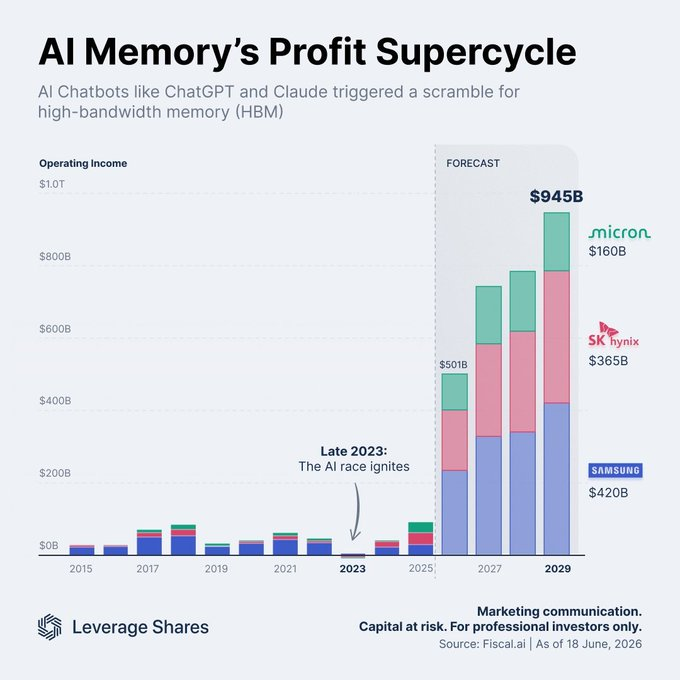
AI memory is turning into one of the biggest profit pools in the entire semiconductor stack. HBM has genuinely converted memory into qualification-gated AI infrastructure with $MU, Samsung and SK Hynix expected to generate nearly $1T of operating income by 2029.
Shay Boloor tweet media
English
42
146
888
137.1K
Tamas retweetledi
Swati Gupta
Swati Gupta@hrswatigupta·
My card was skimmed in Bangkok. $2,000 gone. My bank said "investigation takes 90 days, don't expect much." Visa's global rules say I owe $0 from day one. The bank was using my money to fund their fraud investigation. One email. Reversed in 48 hours. Here is the sentence that ends the delay:
English
109
646
4.3K
1.9M
The Value Engineer
The Value Engineer@TheValuEngineer·
$NFLX is down 40% from its 52-week high. Trading just above its 52-week low at $77. The business grew revenue 16% last quarter. Beat EPS by 56%. Guides $12.5B in free cash flow this year. Something broke between the business and the story the market is telling about it. Here's what actually happened and why I'm adding to my existing position at these levels.
The Value Engineer tweet media
English
3
0
6
827
Tamas retweetledi
The Value Engineer
The Value Engineer@TheValuEngineer·
I said when I started this account I would share every position, every thesis, and every mistake. $ADBE is down 34% from my cost basis. It might be the setup of the year at 8x earnings. It might be a melting ice cube dressed up as a strategic pivot. I genuinely don’t know which yet. What I do know is that selling before September means selling before the one data point that actually resolves the debate. I’m holding until then. September will tell me everything I need to know. Follow @TheValueEngineer — every position, every thesis, every mistake.
English
0
1
2
216
Tamas retweetledi
CHARLES
CHARLES@Ikcharles90·
Only 3 ingredients. No cream cheese, No crust, Pure cheesecake.
English
129
632
3.6K
435K
Car Grails
Car Grails@GrailArchive·
Imagine a BMW that looks like this Rate the design out of 10
Car Grails tweet mediaCar Grails tweet mediaCar Grails tweet mediaCar Grails tweet media
English
806
269
4.5K
494.3K
Tamas retweetledi
Alessandro Palombo
Alessandro Palombo@thealepalombo·
Last weekend I mapped 12 rural areas of Italy where you can buy a house with land and still be an hour from a real city. One reply kept coming back: what about the coast? This is part two. Same method, pointed at the sea. My wife still sends me a single photo of a house in Italy, no caption. Same question every time: why don't we own one of these yet? 14 rural coastal towns where you can still buy near the water, still be 30 minutes from a real city, and still pay a price set by locals, not the second-home market. Some you know. Some you don't. And seven now come with a tax rate so low it sounds made up. 🧵
Alessandro Palombo tweet mediaAlessandro Palombo tweet mediaAlessandro Palombo tweet media
English
7
11
185
33.6K
Tamas
Tamas@TamasKalman71·
@badcharts1 Do you see anything bullish right now? All you posts are bearish. Which i know, not your fault.
English

1
0
0
684
Tamas retweetledi
Patrick Karim
Patrick Karim@badcharts1·
I know, I'm not making any friends in the gold & silver mining industry right now... But I have to be objective and truthful. Here is the unbiased analysis if you are interested 👇
Patrick Karim tweet media
English
50
40
424
49.4K
Tamas retweetledi
Ricky Ho
Ricky Ho@rickyho_1989·
This chart is one of the strongest pieces of evidence supporting a prolonged memory upcycle, and it helps explain why investors continue to underestimate the earnings power of the DRAM industry. The key takeaway is simple: demand growth is running materially ahead of supply growth for the next several years. According to the forecast, total DRAM demand rises from 1,921k WSPM in 2025 to 3,775k WSPM by 2030, implying roughly 14% annual growth. Supply, however, is expected to grow only around 12% annually. That 2% gap may sound small, but in a capital-intensive industry operating near full utilization, it creates significant shortages. The projected shortfall becomes increasingly severe, reaching roughly 507k wafers per month in 2027 and peaking near 795k wafers per month in 2028. Demand-to-supply ratios of 120-130% are historically associated with aggressive pricing power for memory producers. What is driving this imbalance is not traditional DRAM demand. It is HBM. HBM wafer requirements are projected to increase from 350k WSPM in 2025 to 1.3 million WSPM by 2029-2030. In other words, virtually all incremental wafer demand over the next five years comes from AI memory. HBM’s share of total DRAM wafer starts rises from just 18% today to roughly 35% by the end of the decade. This matters because HBM consumes disproportionately more wafer capacity, more packaging capacity, and more manufacturing complexity than conventional DRAM. Every wafer allocated to HBM is effectively a wafer unavailable for commodity DRAM production. The result is a structural tightening across the entire memory ecosystem. Even customers that do not directly buy HBM may experience higher DRAM pricing because industry capacity is increasingly diverted toward AI applications. The market still tends to think about memory through the lens of previous boom-bust cycles where suppliers aggressively added capacity and eventually destroyed pricing. This cycle looks different. Samsung, SK Hynix, and Micron appear far more disciplined, while HBM manufacturing complexity makes rapid capacity additions significantly harder than in prior generations. If these forecasts prove directionally correct, the industry may be entering a multi-year period where memory becomes one of the largest beneficiaries of AI infrastructure spending. That is why our preferred positioning remains unchanged: long SK Hynix, Micron, and Samsung, in that order. SK Hynix remains the clear HBM technology leader and should capture the largest share of AI-driven profit growth. Micron continues to close the technology gap and offers significant earnings leverage as HBM volumes scale. Samsung remains the largest long-term strategic player, but execution challenges have delayed its participation relative to peers. The broader implication is that AI is no longer just a GPU story. Memory is rapidly becoming one of the most important bottlenecks in the entire AI stack. When bottlenecks emerge, pricing power follows. And when pricing power meets constrained supply, earnings revisions tend to move sharply higher.
Ricky Ho tweet media
English
4
21
139
11K
Tamas retweetledi
Hamid
Hamid@hamids·
I feel like we are getting punked with $META in the same way that we got punked with $MU in late March when the stock hit $320 before it shot up above $1,000! Meta is the strongest it has ever been! It's about to have a $60+ Billion quarter ($240 Billion+ annual run-rate), growing at a whopping 36%! That's faster than $AMZN, $GOOGL, $MSFT, $TSLA, $SPCX, $AAPL, etc. Plus, it's incredibly profitable. It's using its AI tech & investments to grow its revenues faster, and it has the 2nd or 3rd largest AI infrastructure after $GOOGL and $AMZN. It might even be the 1st largest infrastructure for their own use, if you don't count the AI cloud "rentals" of the cloud providers to others. Yet, the stock is down ~20% in the past year with a PE of just 18! Fascinating. Needless to say, I've been buying. It's now my 2nd largest position after $MU.
Hamid tweet media
English
73
12
330
51.5K
Tamas retweetledi
Jason Luongo
Jason Luongo@JasonL_Capital·
Elon Musk just said "if we harness just 1 millionth of the Sun's power for AI, that will be much more than a million times the intelligence of all of humanity." He's literally telling you what to invest in. Here are 10 solar stocks building that future: 1. $TE - T1 Energy Produced 2.79 GW of solar panels and generated $755M in net sales in 2025 from the G1 Dallas factory alone. The G2 Austin cell factory is on track for Q4 2026 production start, backed by a $440M+ capital raise and a 900 MW offtake deal starting 2027. Domestic solar manufacturing at scale.
Jason Luongo tweet media
English
31
155
1.4K
287K
Chase
Chase@Crypto_Chase·
$BTC Bulls need to reclaim 66.8K with high time frame closes. Until then it looks like shit. Equal lows at 58.9K as potential draw. And of course, Saylor. $STRC has been unable to repeg, negative feedback loop. Crypto should come together and agree not to buy. Let him bleed out
Chase tweet media
English
30
29
252
17.1K
Tamas retweetledi
Aeron
Aeron@aeronxbt·
She's 19. She says she makes $15,000 a month from her dorm room. Her dashboard shows $51,026 The year on the screen says 2026. The pitch is simple. Go to YouTube. Find a kids video with millions of views. Copy the description. Paste it into a tool called Creao AI. Download whatever it spits out. Upload 5 to 10 times a day. She demos it on camera. The input is a sweet 2D sensory video from a channel called Hey Bear. The output is a 3D baby with a pineapple for a head, and a strawberry baby eating itself with a spoon. iPad kids watch it anyway. 6.2 million views on one. 1.1 million on another. Then she pauses on the Creao dashboard for one second too long. Top left corner of the interface. Small grey text. Claude Sonnet 4.6. The "secret AI tool" she wants you to comment VIDEO for is a chat wrapper. A sidebar, a text box, and an API key. Her recent chats are still in the panel. "create a fireplace video on lapse." "Build a dark, premium, simple..." The whole stack costs cents per video to run yourself. Claude writes the prompt. Luma animates it. A Python script posts it through the YouTube API while you sleep. She's not selling a side hustle. She's selling a referral link to someone else's wrapper around someone else's model. The cannibal fruit babies are real. The $51,026.65 is a screenshot. The iPad kids are the only ones actually paying.
Frogify@0xFrogify

x.com/i/article/2057…

English
264
666
5.2K
1.8M
investing
investing@DollarCostAvg·
@PodcastAlphaX @AravSrinivas @twentyminutevc $MU is heading way much higher. They have so much cash, and printing daily, means they can fund any new product line without raising a single dollar or capex.
investing@DollarCostAvg

$MU: The Textbook Definition of Margin Expansion. Micron is the best example. Micron ($MU) is what it looks like in real life. As AI demand accelerates, Micron isn’t just growing revenue—> it’s growing higher-margin revenue. HBM, high-performance DRAM, and AI infrastructure memory are becoming a larger percentage of the business, creating a powerful earnings $flywheel. Revenue Growth + Margin Expansion + Operating Leverage = Explosive Earnings Growth. Every new AI server requires dramatically more memory than traditional computing infrastructure. As demand accelerates, Micron benefits from: 🔹 Higher DRAM pricing 🔹 Massive HBM demand growth 🔹 Increasing data center mix 🔹 Stronger product pricing power 🔹 Expanding gross margins 🔹 Operating leverage at scale As revenue grows, manufacturing and operating costs are spread across a much larger revenue base. The result is that profits grow substantially faster than sales. When revenue rises and margins expand simultaneously, profits can grow dramatically faster than sales. That’s exactly what this chart is showing. By 2027, Micron is projected to generate $133 billion in profit. Let that sink in. According to these projections, Micron would generate: ✅ More profit than Meta ($103B) ✅ More profit than Amazon ($122B) ✅ Nearly the same profit as Alphabet ($135B) ✅ Within $5B of Microsoft ($138B) I can see $MU Reaching levels as high as $3000 + this yr, potentially 4,000 in 2027. They have so much cash now, they can literally Fund any new semis lines without raising capex. ✅

English
1
0
4
796
Podcast Alpha
Podcast Alpha@PodcastAlphaX·
$MU at $1 trillion market cap. Meta at $1.3-1.4 trillion. @AravSrinivas says Micron closes that gap in 6-12 months if HBM stays the binding constraint. On @twentyminutevc: every inference run needs HBM memory. That has pushed HBM costs up 5x in cost of goods. The entity that makes HBM gets the same structural advantage as the entity that makes the GPU - but without the GPU narrative already priced in. Srinivas's bottleneck framework: whatever is the hardest-to-replace constraint in the AI stack commands the price premium. Today that is HBM. CPUs are also getting scarce again because agent orchestration loops run on CPU, not GPU. The trade is the bottleneck, not the chip. Full infrastructure bottleneck breakdown: podcastalpha.substack.com/p/aravind-srin… Source: 20VC with Harry Stebbings - youtube.com/watch?v=OxFyVc…
YouTube video
YouTube
English
8
19
224
53.4K