@tamboduc.bsky.social

27.9K posts

@tamboduc.bsky.social banner
@tamboduc.bsky.social

@tamboduc.bsky.social

@TamboDUC

Former Postman / Economic Historian. Andia Research Fellow @UNavarra & Researcher @LuEconHist. https://t.co/WZtlxkilNW #JackLondon and #Tolkien Fan
Lund, Sverige Katılım Aralık 2009
2.4K Takip Edilen2.1K Takipçiler
@tamboduc.bsky.social
@tamboduc.bsky.social@TamboDUC·
Deadline approaching! Send you proposals to cristianarturo.ducoing@unavarra.es until the next 28th February
@tamboduc.bsky.social tweet media
English
0
3
5
312
@tamboduc.bsky.social retweetledi
Andrew Akbashev
Andrew Akbashev@Andrew_Akbashev·
A really dangerous situation. Too many submissions. Too many generated papers. Little responsibility. 1. In 2026, more than 24,000 submissions were made to the International Conference on Machine Learning (ICML). It’s TWO times more than in 2025. To fight it, the organizers now require researchers to pay $100 for every subsequent paper. 2. LLM adoption has increased researcher productivity by 90% (there’s a recent paper in Science). 3. The number of papers is becoming far too high. Submissions to arXiv have risen by 50% since 2022. 4. There are simply not enough reviewers. Plus, many scientists no longer want to invest precious time in it for free. 5. We can’t easily identify AI-made papers from the genuine ones. __ Important words from Paul Ginsparg, a co-founder of arXiv: “AI slop frequently can’t be discriminated just by looking at abstract, or even by just skimming full text. This makes it an “existential threat” to the system.” Basically, we’re getting closer to the tipping point. 📍 Many professors blame the AI. But the problem is likely elsewhere: 1. Without a sufficient number of papers, many PIs can’t get funded. They have to prove their credibility to reviewers. Their proposals have to rely on prior publications. In many countries, there are some informal (or even formal) expectations for how many papers a group with a certain size has to publish to survive (funding-wise). 2. Our students / postdocs need papers if they want to be hired in faculty roles. Yes, some departments hire people with few publications. But the majority still want to ensure their faculty can get funded. If funding is partly a function of papers, this is used in decision-making. 3. The number of papers is important if you want to get high-level awards. Many of them are not given because you published one paper (even if it’s great). They are given because you made a meaningful CONTRIBUTION to the field. How do you make it? Publish more papers. 4. Tenure promotions in many places take the number of your papers into account (often indirectly). Your tenure may get delayed if you don’t publish enough. Not everywhere, but for many mid- to low-ranked universities this story is more or less the same. + There are many more to mention. 📍My opinion: Much of this is rooted in how funding is distributed. There is a strong correlation between the requirements at a university and the funding acquisition criteria. If funding were based ONLY on the quality of published papers, universities would hire people for the quality of their science. If funding agencies strongly discouraged publishing too many papers, universities wouldn’t expect numbers from faculty during promotions. And some supervisors wouldn’t pressure students and postdocs to publish unfinished studies and low-quality data. Yes, we need good detectors of fake papers. But we also need the right policies and better funding allocation criteria.
Andrew Akbashev tweet media
English
94
378
1.4K
193.1K
@tamboduc.bsky.social retweetledi
John B. Holbein
John B. Holbein@JohnHolbein1·
Some journals are now requesting reviewers affirm that they did not upload manuscripts into AI platforms.
John B. Holbein tweet media
English
50
107
791
155.3K
@tamboduc.bsky.social retweetledi
Julius Koschnick
Julius Koschnick@JuliusKoschnick·
Call for papers
Julius Koschnick tweet media
English
0
1
2
591
@tamboduc.bsky.social retweetledi
Julius Koschnick
Julius Koschnick@JuliusKoschnick·
On the 18th and 19th of June 2026, the Public University of Navarre (Spain) will host a #FRESH meeting on "Energy, Sustainability, and Economic History" Keynote lecture by Henry Willebald (@HWillebald ) Local organizer: Cristián Ducoing More details below:
Julius Koschnick tweet media
English
1
4
5
321
@tamboduc.bsky.social retweetledi
Industrial History Review
The program for the "New perspectives on Middle Eastern Economic History workshop" on 9th of January is already available! revistes.ub.edu/index.php/Hist…. Registration for the online event is open on the link!
Industrial History Review tweet media
English
1
11
26
7.9K
@tamboduc.bsky.social retweetledi
AEHE
AEHE@_AEHE·
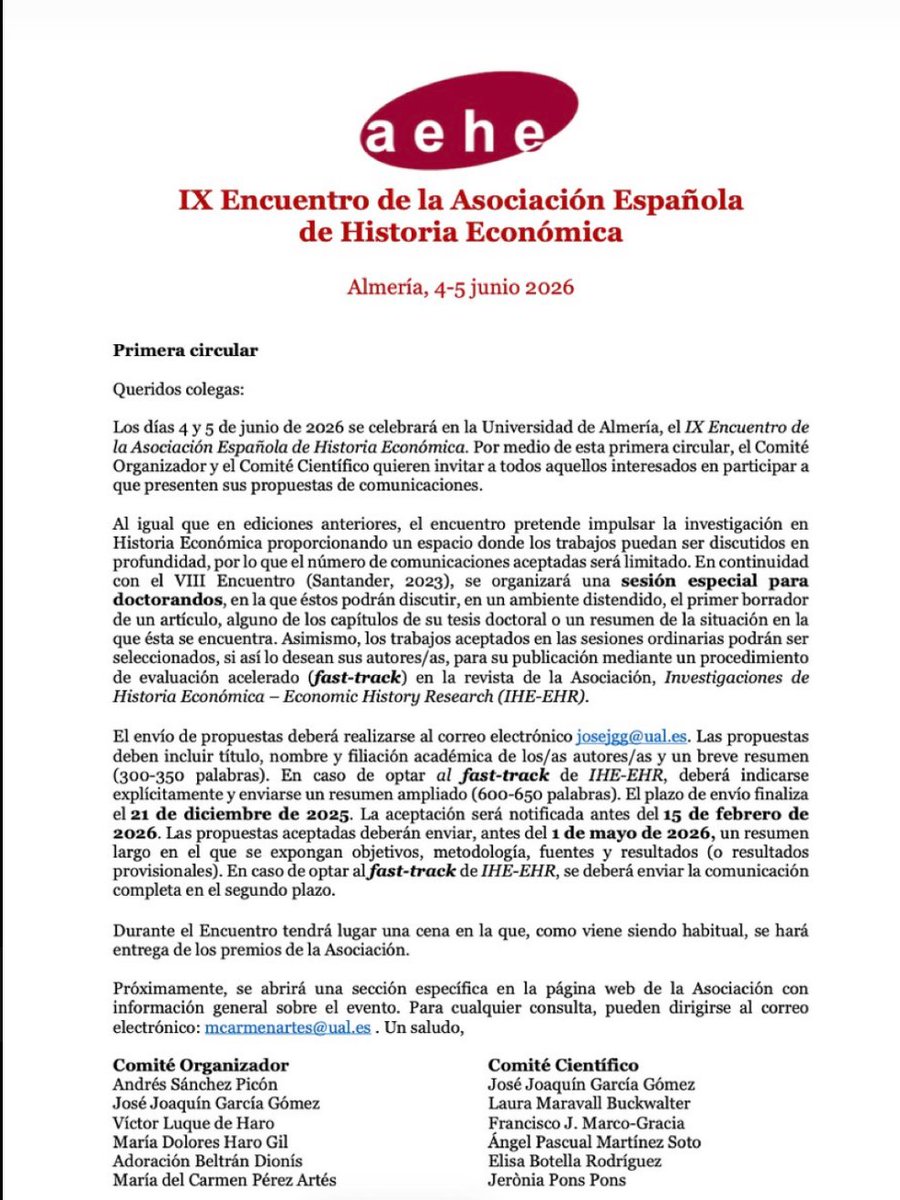
¡RECORDATORIO! Los días 4 y 5 de junio de 2026 se celebrará en la @ualmeria el IX Encuentro de la @_AEHE, organizado por @hedes_ual. 📷 El plazo de envío de propuestas finaliza el 21 de diciembre.
AEHE tweet media
Español
0
7
6
393
@tamboduc.bsky.social retweetledi
AEHE
AEHE@_AEHE·
Hoy protagoniza nuestro podcast en la sesión dedicada a tesis doctorales Guillermo Antuña quien en este episodio explica el sector metalmecanico de Asturias tras la Guerra Civil y analiza sus posibilidades presentes y futuras.
AEHE tweet media
Español
0
3
3
506
@tamboduc.bsky.social retweetledi
Elena Llaudet
Elena Llaudet@ellaudet·
Acabo de recibir la traducción al castellano de nuestro libro de análisis de datos para principiantes. ¡Con muchas ganas de revisarla y de verla publicada! Envíame un DM si quieres que te avise cuando esté disponible (incluye tu email y si eres instructor o estudiante) #rstats
Elena Llaudet@ellaudet

My textbook with Kosuke Imai (@Harvard) is finally out! Assuming no prior knowledge of statistics or coding and only minimal knowledge of math, DSS teaches the fundamentals of survey research, predictive models, and causal inference + how to analyze real-world data with R. 🧵..

Español
68
79
921
60.8K
@tamboduc.bsky.social retweetledi
AEHE
AEHE@_AEHE·
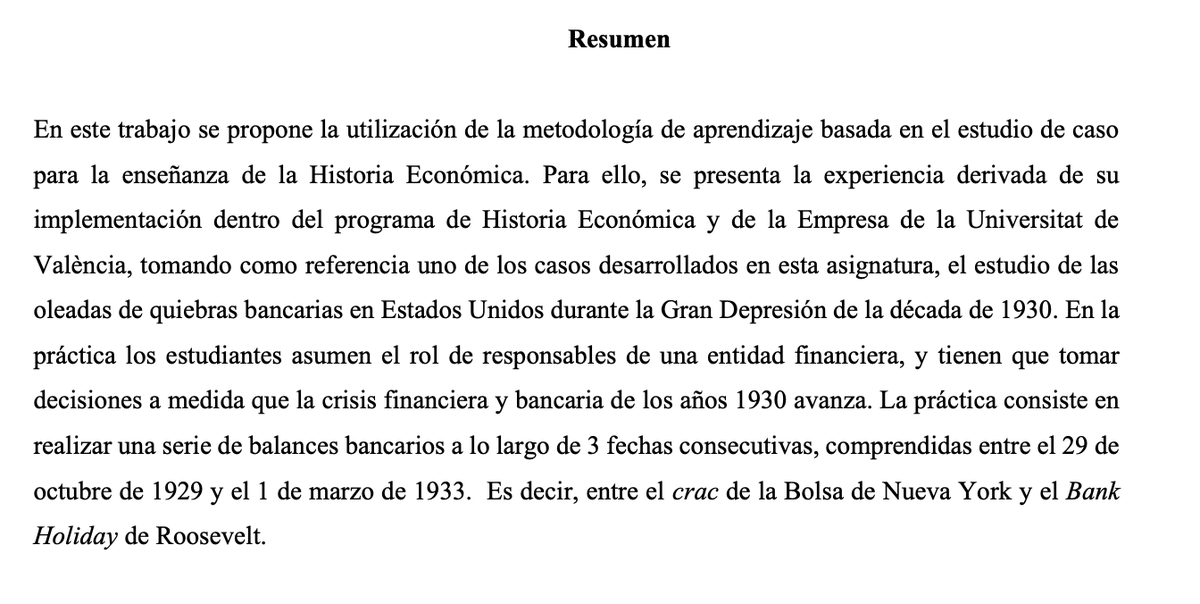
¡ALERTA DE PUBLICACIÓN! La @_AEHE se complace en publicar el nuevo Prácticum AEHE-PHE nº54. "¿Dónde están mis ahorros? Las quiebras bancarias en los Estados Unidos, 1930-1933: Un estudio de caso.". aehe.es/noticias/nuevo…
AEHE tweet mediaAEHE tweet media
Español
0
6
5
383
@tamboduc.bsky.social retweetledi
H
H@hernan_sr·
NOTABLE Balbi el chamako, regetonero con 1 millón de seguidores en Instagram y ex votante de Parisi, se suma al comando de Jeannette Jara.
H tweet mediaH tweet media
Español
976
453
3.4K
320.5K
@tamboduc.bsky.social retweetledi
AEHE
AEHE@_AEHE·
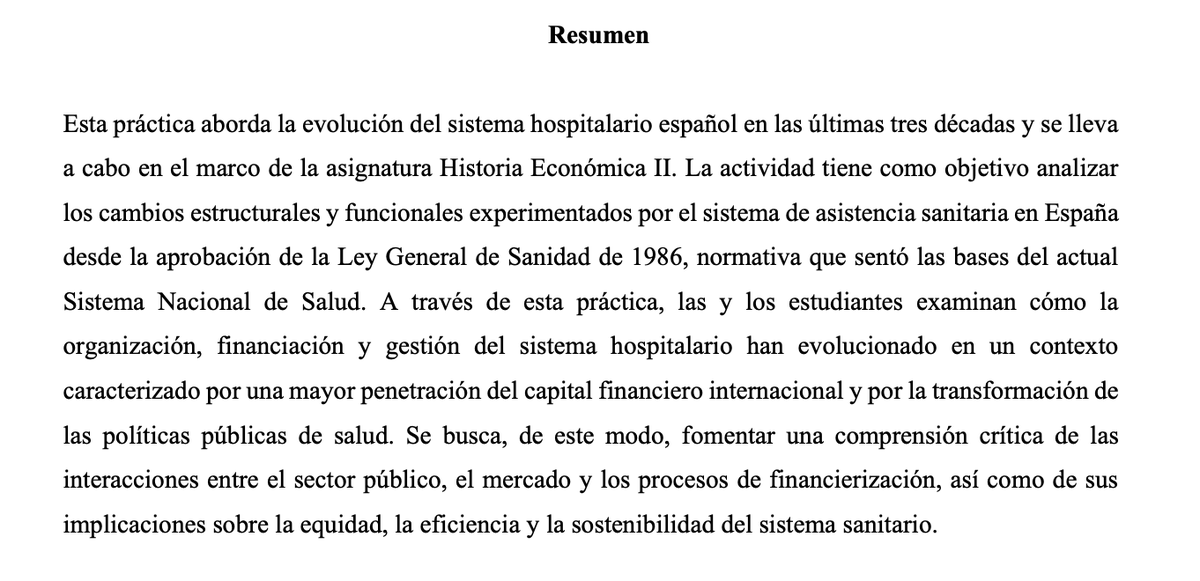
¡ALERTA DE PUBLICACIÓN! La @_AEHE se complace en publicar el nuevo Prácticum AEHE-PHE nº53. "El avance de los grupos hospitalarios privados frente a la cobertura pública en perspectiva de historia económica (1989-2019)". aehe.es/noticias/nuevo…
AEHE tweet mediaAEHE tweet media
Español
0
2
2
161
@tamboduc.bsky.social retweetledi
Diego Castañeda
Diego Castañeda@DiegoCastaneda·
Esos datos económicos están mal. La economía mexicana si se cayó mucho sobre todo entre 1913 y 1915 pero para principios de los 1920 ya se había recuperado casi por completo. La destrucción de capital no fue tan grande eso es un mito.
ArmandoHerrera 🇲🇽@armandoextremo

#RevolucionMexicana En números absolutos y relativos, la Revolución Mexicana es el evento más costoso (en vidas y riqueza perdida) de la historia moderna de América Latina. - 1.5 millones de muertos directos e indirectos -Caída de 40% del PIB per cápita, en término relativos de 80% para 1940. -Destrucción de infraestructura, 70% del sistema ferroviario dañado -Pérdida del 70% del hato bovino nacional -Entre 1910 y 1940 aumentó la brecha salarial frente a EEUU y pares de América Latina de hasta 50%

Español
4
18
57
5.3K