Tan Minh Nguyen

303 posts

Tan Minh Nguyen banner
Tan Minh Nguyen

Tan Minh Nguyen

@TanNguyen689

Assistant Professor of Mathematics (Presidential Young Professor) at the National University of Singapore (@NUSingapore). #DeepLearning, #RobustAI, #ScalableAI

Singapore Katılım Mart 2016
766 Takip Edilen1.5K Takipçiler
Tan Minh Nguyen
Tan Minh Nguyen@TanNguyen689·
Congratulations to Nguyễn Thế An (@sg__nta), Phạm Duy Tùng (@pdt931604), and Hiếu Vũ on their PhD admissions! 🎉🎉 An will join the PhD program in the Computer Sciences department at the University of Wisconsin–Madison, Tùng will join the PhD program at the Khoury College of Computer Sciences, Northeastern University, and Hiếu will join the PhD program in the Department of Mathematics at NUS. It has been a real pleasure working with these talented and passionate students over the past two years. Along the way, we’ve had a lot of fun: great food trips, many late-night League of Legends sessions (I stayed safely as an observer), and, of course, exciting research projects together. 🫰🫰 My sincere thanks to Prof. Thieu Vo Ngoc (@thieunvo) and my PhD student, Trần Việt Hoàng, whose mentorship has truly guided Tùng and An. I am also deeply grateful to my close friend, T.K. Nguyen, Hiếu’s former mentor and manager; to Prof. Tong T. Xin; and to the AI Residency at the FSOFT AI Center for their support and dedication in nurturing these young students at the early stages of their research journeys. 🙏🙏 Wishing all of you the very best as you begin this next chapter. May you continue to grow, explore boldly, and make impactful contributions to your fields. I’m excited to see all that you will achieve! ☺️
Tiếng Việt
0
0
11
1.1K
Tan Minh Nguyen
Tan Minh Nguyen@TanNguyen689·
Richb at an #ICLR2026 workshop this time (together with his oral presentation in the main conference). If you are at the conference, check it out folks. Scientific Methods for Understanding Deep Learning (Sci4DL) Workshop Room 101B 1:30 pm - 2 pm (Rio time) Excited about the 1st time attending the same conference with my PhD advisor 😃
Tan Minh Nguyen tweet mediaTan Minh Nguyen tweet media
English
0
1
5
505
Tan Minh Nguyen
Tan Minh Nguyen@TanNguyen689·
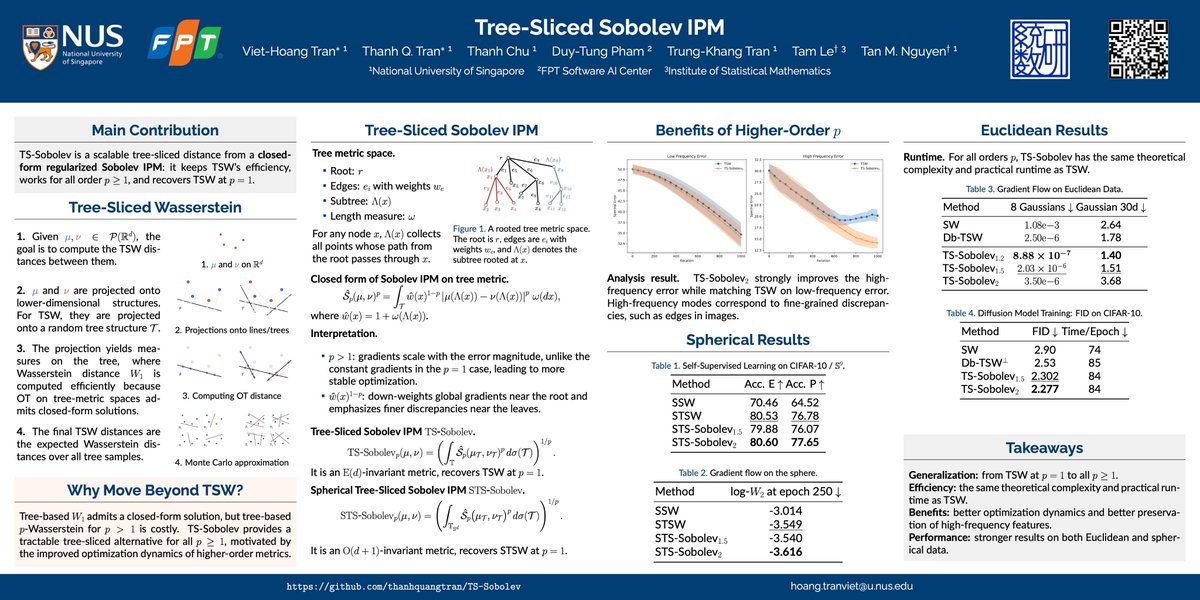
🚨 How can we compare probability distributions efficiently while still capturing rich geometry? Spoiler: lines are fast, but trees are richer — and higher-order tree-Wasserstein distances are usually expensive. 😬 Thrilled to present Tree-Sliced Sobolev IPM at #ICLR2026! 🎉 (Sat, Apr 25, 2026 • 10:30 AM – 1:00 PM. Pavilion 3 P3-#1911) We introduce TS-Sobolev, a scalable tree-sliced distance derived from a closed-form regularized Sobolev IPM on tree metric spaces. The key idea: 🌳 Keep the efficiency of Tree-Sliced Wasserstein 📈 Extend it from p = 1 to all p ≥ 1 ⚡ Preserve the same theoretical complexity and practical runtime This work was co-led by Viet-Hoang Tran and Thanh Q. Tran, in collaboration with Thanh Chu, Duy-Tung Pham, Trung-Khang Tran, and Prof. Tam Le. 📜 Paper: openreview.net/pdf?id=HHNQSXa… 📄 Code: github.com/thanhquangtran… 📍 Poster: iclr.cc/virtual/2026/p… 👇 Key ideas: 🌳 The Problem: Tree-Sliced Wasserstein is efficient because tree-based W₁ has a closed form. But for p > 1, tree-based Wasserstein becomes costly — limiting practical tree-sliced methods mostly to p = 1. 💡 The Solution: We replace tree-based p-Wasserstein with a regularized Sobolev IPM on trees, which has a closed form for every p ≥ 1. At p = 1, TS-Sobolev exactly recovers TSW. 📊 Results: TS-Sobolev improves performance across: ✅ Euclidean gradient flows ✅ CIFAR-10 diffusion model training ✅ Spherical self-supervised learning ✅ Spherical gradient flows ✅ Topic modeling 🔥 Takeaway: TS-Sobolev gives us the best of both worlds: ⚡ TSW-level efficiency 📐 Higher-order optimization benefits 🌍 Strong results on both Euclidean and spherical data Come by our poster at #ICLR2026 — happy to discuss sliced OT, Sobolev IPMs, and scalable geometric learning! 🌳🚀
Tan Minh Nguyen tweet media
English
0
3
12
1K
Tan Minh Nguyen
Tan Minh Nguyen@TanNguyen689·
🚨 Can we control an LLM’s behavior without retraining it? Spoiler: yes — but most current activation steering methods are only using a very simple controller. 😬 Thrilled to present Activation Steering with a Feedback Controller at #ICLR2026! 🎉 (Sat, Apr 25, 2026 • 10:30 AM – 1:00 PM. Pavilion 3 P3-#1710) In this work, we show that popular activation steering methods can be understood through the lens of control theory. More precisely, many existing methods behave like Proportional (P) controllers — effective, but prone to steady-state error. So we ask: why stop at P control? We introduce PID Steering, a principled framework that uses a full Proportional–Integral–Derivative controller to compute steering vectors for activation steering. 🎛️ This work was co-led by Dung V. Nguyen (@DungNv1714), Yen Nhi Pham, and ieu M. Vu (@lone17_), in collaboration with Prof. Lei Zhang. 📄 Paper: arxiv.org/pdf/2510.04309 💻 Github: github.com/dungnvnus/pid-… 📍 Poster: iclr.cc/virtual/2026/p… See the key ideas below 👇 📉 The Problem: Activation steering is a lightweight way to control LLM behavior at inference time. Instead of retraining the model, we directly modify internal activations along meaningful feature directions. We show that many popular steering methods are essentially P controllers: ❌ They react to the current activation error ❌ But they can leave a persistent steady-state bias ❌ Increasing the gain may reduce the error, but can also create instability or oscillations 💡 The Solution: We introduce PID Steering. Instead of using only the current error, PID Steering computes the steering vector using three terms: ✔️ P term: reacts to the current activation error ✔️ I term: accumulates past errors to remove persistent bias ✔️ D term: damps rapid changes and reduces overshoot In short: P reacts. I remembers. D stabilizes. Together, they give a more reliable feedback controller for activation steering. 🎯 🧠 The Theory: We formulate layer-wise activation steering as a dynamical system and analyze the average activation error across layers. Our results show that: 📌 P steering can be input-to-state stable, but still leaves steady-state error under disturbances. 📌 PI steering removes matched steady-state error, but may overshoot. 📌 PID steering preserves the bias-removal effect while reducing oscillations and overshoot. 🚀 Why It Matters: This work connects three areas that are usually studied separately: 🔹 LLM behavior control 🔹 Feature attribution / activation steering 🔹 Classical feedback control theory We believe this opens a new direction for building principled, interpretable, and stable control mechanisms for foundation models. Stop by our poster at #ICLR2026! I won’t make it to Rio in time for the poster session due to a late arrival, but I’ll be around for the workshops. Feel free to ping me if you’d like to connect or learn more about our work.
Tan Minh Nguyen tweet media
English
2
15
139
10.5K
Tan Minh Nguyen
Tan Minh Nguyen@TanNguyen689·
🚨 When two neural networks have different weights but compute the same function, should a metanetwork treat them as different? Spoiler: it really shouldn’t. 😬 But enforcing this properly is harder than it looks. Thrilled to present Quasi-Equivariant Metanetworks at #ICLR2026! 🎉 (Sat, Apr 25, 2026 • 3:15 PM – 5:45 PM. Pavilion 4 P4-# 4916) This work was co-led by Viet-Hoang Tran and An Nguyen The, in collaboration with Benoît Guérand, and Prof. Thieu Vo. 📄 Paper: openreview.net/pdf?id=XMiDpi2… 📍 Poster: iclr.cc/virtual/2026/p… See the main ideas below 👇 🧩 The Problem: Metanetworks take the weights of another neural network as input and predict properties of that network — for example, its accuracy. But neural network weights are not unique. Two very different parameter vectors can represent exactly the same function because of symmetries such as: 🔁 neuron permutations 📏 positive rescalings 🔄 attention-head symmetries So the real input to a metanetwork should not just be the raw parameter vector θ. It should be the function represented by θ. ⚠️ Existing equivariant metanetworks try to solve this by enforcing strict equivariance. But strict equivariance can be too rigid: ❌ It strongly constrains the architecture ❌ It can make the model sparse or less expressive ❌ It preserves more structure than we actually need 💡 The Solution: We introduce quasi-equivariant metanetworks. The key insight is simple: We do not need strict equivariance of the weights. We only need to preserve functional equivalence classes. That is, if two parameter vectors θ and θ̄ represent the same function, then the metanetwork outputs should also represent the same functional identity. In short: Strict equivariance says: ➡️ transform the output in exactly the same way. Quasi-equivariance says: ➡️ transform the output in some symmetry-consistent way that preserves the function. 🛠️ The Construction: Our framework is simple: Start with an existing equivariant metanetwork, then add a small learned group-valued transformation. In practice, we extract statistical features from network weights, pass them through a lightweight scale network, and use the learned scales to enhance the equivariant layer. The result: better expressivity with only a tiny increase in parameters. 🚀 Why It Matters: This work pushes metanetworks closer to the true object they should reason about: Not raw weights. Not arbitrary parameterizations. But the functions represented by neural networks. We believe quasi-equivariance provides a useful principle for future work on: 🔹 weight-space learning 🔹 neural network representation learning 🔹 model editing 🔹 network performance prediction 🔹 functional geometry of deep networks Come by our poster at #ICLR2026 — we would love to discuss symmetries, functional equivalence, and metanetworks! 🚀
Tan Minh Nguyen tweet media
English
1
3
12
1.1K
Tan Minh Nguyen
Tan Minh Nguyen@TanNguyen689·
A bit late due to our NUS Math Department Retreat, but I’ll be at #ICLR2026 in Rio for the workshop days (Sun, Apr 26 – Mon, Apr 27). If you’re around, let’s catch up. Looking forward to seeing everyone! Also, a late note: our group has been presenting six papers at the ICLR 2026 main conference. Activation Steering with a Feedback Controller iclr.cc/virtual/2026/p… Sat, Apr 25, 2026 • 10:30 AM – 1:00 PM -03 Pavilion 3 P3-#1710 Quasi-Equivariant Metanetworks iclr.cc/virtual/2026/p… Sat, Apr 25, 2026 • 3:15 PM – 5:45 PM -03 Pavilion 4 P4-#4916 Tree-sliced Sobolev IPM iclr.cc/virtual/2026/p… Sat, Apr 25, 2026 • 10:30 AM – 1:00 PM -03 Pavilion 3 P3-#1911 Revisiting Tree-Sliced Wasserstein Distance Through the Lens of the Fermat–Weber Problem iclr.cc/virtual/2026/p… Fri, Apr 24, 2026 • 3:15 PM – 5:45 PM -03 Pavilion 4 P4-#5118 Mixed-Curvature Tree-Sliced Wasserstein Distance iclr.cc/virtual/2026/p… Fri, Apr 24, 2026 • 3:15 PM – 5:45 PM -03 Pavilion 4 P4-#5112 Expert Merging in Sparse Mixture of Experts with Nash Bargaining iclr.cc/virtual/2026/p… Fri, Apr 24, 2026 • 3:15 PM – 5:45 PM -03 Pavilion 3 P3-#308
Tan Minh Nguyen tweet mediaTan Minh Nguyen tweet mediaTan Minh Nguyen tweet mediaTan Minh Nguyen tweet media
English
0
4
24
1.6K
Tan Minh Nguyen
Tan Minh Nguyen@TanNguyen689·
It has been a pleasure to co-organize this wonderful Hanoi-Singapore workshop in Hanoi with my colleagues at NUS Math. We look forward to building collaborations with outstanding mathematicians and students in Vietnam and across Southeast Asia. e.vnexpress.net/news/tech/tech…
Tan Minh Nguyen tweet media
English
0
2
18
777
Tan Minh Nguyen
Tan Minh Nguyen@TanNguyen689·
NUS Mathematics and Vietnam Institute for Advanced Study in Mathematics (#VIASM) are co-organizing a Workshop on Current Trends in Applied and Pure Mathematics on April 4–5, 2026, to strengthen connections and foster collaborations between our department at NUS and the mathematical community in Ha Noi, Vietnam. 🌟 The workshop will feature talks by our speakers on recent research developments across a range of areas in mathematics, applied mathematics, and machine learning. We look forward to engaging discussions with outstanding mathematicians and talented mathematics students in Ha Noi. 🍀 The program will also include presentations introducing the PhD and Master’s programs at NUS Mathematics--ranked 9th worldwide among graduate mathematics programs according to the QS rankings--as opportunities for further academic engagement. We warmly invite you to register and join us for this exciting two-day workshop. 🗓️ Time: April 4-5, 2026 📍Venue: Vietnam Institute for Advanced Study in Mathematics (VIASM), 161 Huynh Thuc Khang Street, Hanoi. ⏰ Deadline for general registration: March 31, 2026 Registration: lnkd.in/g6KZMyv6 Website: lnkd.in/gnTdwW2a
Tan Minh Nguyen tweet media
English
0
0
2
322
Tan Minh Nguyen
Tan Minh Nguyen@TanNguyen689·
Save the date: Asilomar ’26 | Oct 25–28 | 60th Anniversary Edition 🎉 This year marks the 60th anniversary of Asilomar, chaired by the super-cool duo, Prof. Salman Asif and Prof. Chinmay Hegde. My Ph.D. advisor, Prof. Rich Baraniuk (the guru himself), will deliver the plenary talk. It’s going to be a fantastic celebration! There are many ways to participate: *Submit and present a contributed paper (deadline: May 1). *or just attend, relax on the beautiful Asilomar grounds, catch up with old friends, and make new ones. asilomarsscconf.org
English
0
2
5
417
Tan Minh Nguyen
Tan Minh Nguyen@TanNguyen689·
Proud advisor moment 😊 My PhD student Viet-Hoang Tran will be presenting his PhD work at the Graduation Day of #ITA2026 tomorrow (Wednesday). 🕚 11:00 AM | 📍 Gemini Room If you’re at ITA and curious about hidden symmetries in modern deep learning models and their applications, please drop by; we’d love to chat and exchange ideas!
Tan Minh Nguyen tweet media
English
0
0
9
589