Gaetano@crux_capital_
Why you should care about scale-across 📓
$CIEN $NOK $NVDA
We recently dove into two types of communication
Scale-up is what happens inside the rack.
Scale-out is what happens across racks inside the cluster.
But there is a third layer starting to get a lot more important:
Scale-across.
This is what happens when AI infrastructure can no longer stay contained inside one building.
Now you are linking multiple data centers together so they can behave like one larger AI system.
That is the jist of it and it is showing up more often in company commentary for a reason.
Why is this becoming a thing?
Because the real world does not give you infinite power, land, or time.
The biggest AI clusters want more power than many sites can easily support. Permitting takes time. Grid access takes time. Buildouts take time. So instead of assuming all of the compute lives in one place, the industry is increasingly thinking about how to connect distributed AI capacity together.
That is where the optics angle gets more interesting.
Scale-across pulls in coherent pluggables, transport, routing, DCI, optical line systems, and long-haul / metro optical connectivity. This is not the same conversation as short-reach pluggables inside the cluster that we spend alot of time talking about. This is the next layer out, where the network has to stretch between facilities without breaking the economics or the latency budget.
This is why I keep coming back to $CIEN.
Ciena looks like one of the clearest names tied to this shift. Gary Smith said AI is forcing a “global rebuild of network infrastructure,” and Ciena has been leaning directly into AI networking, optical transport, Hyper-Rail, and tailored solutions for scale-across AI applications.
And then there is $NOK.
This is the more surprising one.
Yes Nokia, like that phone you had as a kid.
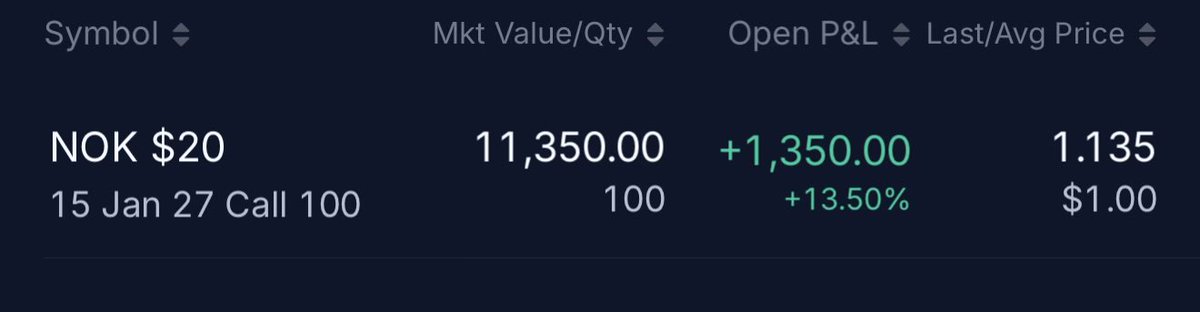
Nokia is trying to position itself across switching, routing, automation, and optical DCI for distributed AI infrastructure.
The market still tends to bucket $NOK as legacy telecom.
That may end up missing where the architecture is going.
More on $NOK later.