Taylor Jackson

330 posts

Taylor Jackson

Taylor Jackson

@TaylorJJacks

PhD Candidate @UofT_PolSci | Graduate @SAISHopkins @SFU_polisci | Interested in all things IOs, IPE, and foreign policy.

Katılım Ağustos 2014
851 Takip Edilen234 Takipçiler
Taylor Jackson retweetledi

Sean Speer
Sean Speer@Sean_Speer·
"If Carney’s speech becomes the intellectual foundation for a new wave of indiscriminate economic nationalism—or for a naïve re-embrace of Chinese trade under a different vocabulary—it will age poorly. But if it’s taken for what it appears to be—a clear-eyed description of a world Canada did not choose but must now navigate—it may prove to be one of the most consequential foreign-policy speeches delivered by a Canadian prime minister in some time."
The Hub@TheHubCanada

.@Sean_Speer and @TaylorJJacks: Carney defines his doctrine thehub.ca/2026/01/21/car…

English
39
26
228
31.8K
Taylor Jackson retweetledi
Renze Nauta
Renze Nauta@renzenauta·
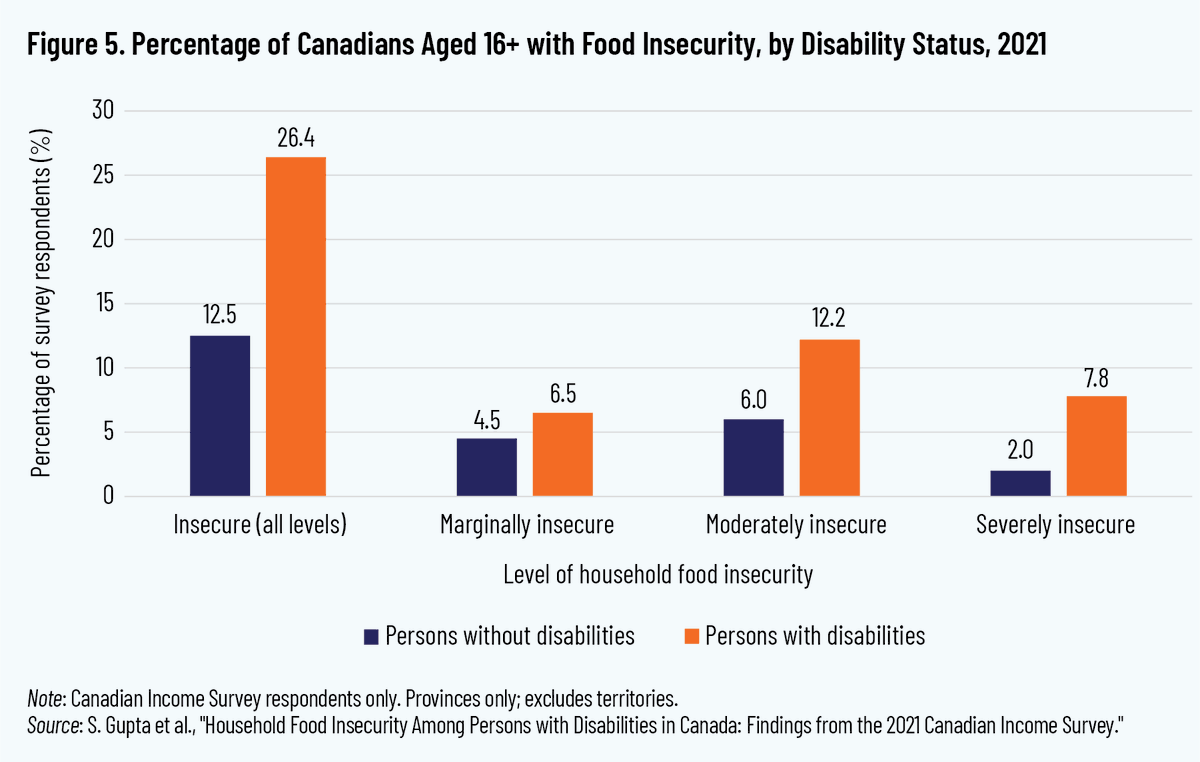
Canadians with disabilities are 4x more likely to experience severe food insecurity. Few measures so clearly highlight how having a disability impacts the ability to lead a life in dignity. See @TaylorJJacks and my policy options for @cardusca here: cardus.ca/research/work-….
Renze Nauta tweet media
English
0
3
3
208
Taylor Jackson retweetledi
Renze Nauta
Renze Nauta@renzenauta·
This new @cardusca report from @TaylorJJacks and me proposes three ways forward on the Canada Disability Benefit: (1) Increase it. (2) Or transfer it. (3) And supplement it with support for civil society.
Cardus@cardusca

Our new report proposes a New Year's resolution for the federal government: fixing the Canada Disability Benefit. At just $200 per month, it doesn't do enough to help persons with severe disabilities, who tend to live in poverty much more than other Canadians. ❌ Their median after-tax income is $30,950, about one-third less than those without a disability. ❌ Their poverty rate is 2.5 times higher than others. ❌ They are four times more likely to experience severe food insecurity. We can and should be doing better for these Canadians, most especially given that many persons with severe disabilities cannot work. The Parliamentary Budget Officer estimated that the Canada Disability Benefit would need to be about six times as much as the current $200 a month to close the gap with the poverty line. Our report proposes three ways forward for government: ✔️ Reform the benefit by boosting the monthly amount. ✔️ Transfer funds to the provinces, who could reduce administrative costs and target the money more effectively. ✔️ Support charitable organizations. Government income support isn’t going to solve everything. To round out the support, it will need help from charitable organizations that can tailor their services to the needs of individuals. Read the full report here ➡️ bit.ly/45k69if


English
1
4
2
346
Taylor Jackson retweetledi
Yuan Yi Zhu
Yuan Yi Zhu@yuanyi_z·
A return to spheres of influence could make sense if you are a great power. If you aren't one, cheering it seems foolhardy. Once again, too many people are living mentally like Americans, not realising they are citizens of the periphery.
English
123
1.3K
6.6K
423.4K
Taylor Jackson retweetledi
The Hub
The Hub@TheHubCanada·
We asked The Hub’s contributors what Canadians should expect in 2026. Here are some of their predictions for the new year: Welcome to the age of great power capitulation: The Hub predicts 2026, by @TaylorJJacks. thehub.ca/2025/12/26/wel…
English
1
4
1
2.8K
Taylor Jackson retweetledi
Sean Speer
Sean Speer@Sean_Speer·
There's suddenly a lot of talk about tax increases and spending cuts in Ottawa. This has to be understood as an unfortunate yet predictable consequence of Trudeau-era fiscal policy. Increasing program spending by 110% over a decade through large-scale borrowing has necessarily led to a structural deficit that has to be solved by higher taxes and/or lower spending. This trade-off is particularly challenging because the massive growth in spending in the Trudeau era didn't even get us to our NATO target on defence. It was spent on other stuff mostly in provincial and local jurisdictions. So now the Carney government is in fiscal box built by its predecessor. It needs to figure out how to (1) increase defence spending, (2) keep taxes low and competitive, (3) preserve core programs, and (4) reduce the deficit. One wonders if this outcome was actually intentional by the Trudeau government. By not litigating Harper-era tax policy and its lower revenue baseline and then increasing spending against it through large-scale borrowing, the government laid the fiscal groundwork for the eventual arguments in favour of tax hikes to offset new, higher, and permanent levels of federal spending. If Conservatives are accused of “starving the beast”, one way to think about the Trudeau government’s fiscal policy as a strategy to “inflate the state.”
English
3
5
16
1.9K
Taylor Jackson retweetledi
Sean Speer
Sean Speer@Sean_Speer·
The Digital Services Tax is bad on its own terms   In light of Donald Trump’s social media announcement that he’s ending trade negotiations with Canada over the federal government’s stubborn insistence on its Digital Services Tax (DST), we must remember that the DST isn’t just bad because it has provoked the president and threatened our trading relationship with the United States. It’s bad policy on its own terms.   Before the prime ministership of Justin Trudeau, successive Canadian governments had a hands-off internet policy. The results have been extraordinary. It has led to an explosion of content, democratized whose stories and what stories are told, lowered the barrier to entry for Canadian entrepreneurs and small business holders, and generated tremendous innovation that’s improved education, health care, and other parts of Canadian society.   This four-decades long experiment with an open internet has been a major policy success—in fact, I’d argue that Chretien government’s initial decision in favour of a de-regulated internet may be the most enlightened in more than 30 years.   Yet the Trudeau and now Carney governments have adopted the completely opposite view. They assume that these technology companies are exploitative and harm. That the internet is anarchistic and dangerous. That state must coordinate, manage, and shape what Canadians buy, make, see, and sell online.   They’re not satisfied, in other words, with micromanaging the physical economy. They insist on now doing the same to the online economy.   The DST must therefore be understood as part of a broader suite of policies—including the Online Streaming Act and the Online News Act—designed to re-regulate the internet. These laws and policies represent an unprecedented expansion of state power to a hitherto unregulated part of the economy.   The consequences are predictable. Although the DST is slated to generate less than $1 billion in annual revenues, the costs will be far greater. The government’s internet policies will mean less freedom and choice on the internet. Entrepreneurs and content creators will find it harder to sell their products online. Consumers preferences will be subordinated to the diktats of the government. And the tax burden will invariably be passed on to all of us.   Now we know that DST may even undermine our ability to secure a trade agreement with the U.S. It’s one thing to give up tariff free access to the American market in the name of protecting our interests or principles. It’s another to throw it away for manifestly bad policy.   The Carney government should abandon its internet regulation agenda, including the DST, because, first and foremost, it is bad for Canadians. That it is bad for Canada-U.S. relations and the future of abilateral trade agreement is only a secondary reason.
English
62
188
613
45K
Taylor Jackson retweetledi
Sean Speer
Sean Speer@Sean_Speer·
Canada’s last serious bout of economic nationalism in the 1960s and 1970s was mostly a left-wing movement. It took a quarter century or longer to unwind the inefficiencies and distortions that it caused. As I wrote for @CityJournal this week, there’s a big risk that the next expression of economic nationalism is coming from the Right. The rhetoric is different—conservatives frame it in terms of resilience and security rather than equality and fairness—but the substance is the same: subsidies, capital controls, protectionism, and state intervention wrapped in patriotic language. This would be an awful development. It would leave us with no mainstream political voice in favour of open markets and economic freedom. What would remain is two rival versions of post-liberalism—both promising protection, both distrustful of markets, and both bound to disappoint. Read more here: city-journal.org/article/neolib…
Lianne Rood, M.P. Middlesex-London@Lianne_Rood

Did you know your CPP used to invest mainly in Canada? 🇨🇦 That changed when Liberals removed limits on foreign investments. Now billions leave the country while Canadian industries struggle. It’s time to bring that money home and invest in Canada’s future. #cdnpoli #BringItHome

English
10
16
82
19.8K
Taylor Jackson retweetledi
Sean Speer
Sean Speer@Sean_Speer·
“The problem is that many of the remedies proposed by neoliberalism’s critics—industrial policy, protectionism, widespread subsidies, stringent capital controls, and other forms of economic nationalism—risk making things worse. Some may reduce inequality at the margins, but they’re also likely to dampen dynamism, lower productivity, and introduce new inefficiencies into already strained economies. More fundamentally, these approaches assume that what the public wants is greater equality—when in fact, many disaffected voters, especially in communities left behind by globalization, are asking for something different: renewed economic vitality, local investment, and the dignity of meaningful work.” — @CityJournal
City Journal@CityJournal

A Neoliberalism 2.0 would uphold the core benefits of markets and trade while rethinking how those benefits get distributed, how they align with national interests, and how they can be made politically sustainable, writes @Sean_Speer.

English
3
6
13
2.8K
Taylor Jackson retweetledi
Jason Kenney 🇨🇦🇺🇦🇮🇱
I commend the boldness of this announcement. Both Liberal and Conservative governments have underfunded national defence for far too long. (Yes, that includes the government in which I served as Minister of National Defence.) The challenge is implementation. As we saw during the Trudeau years, announcements and good intentions are no match for the hard work of getting the job done. This is particularly true in Defence, a department which has lapsed a large portion of its approved budget every year, for well over a decade. While I agree that we should gradually reduce our levels of dependence on US defence systems, I hope this isn’t done by prioritizing domestic procurement over speed and lethality. One of the central reasons for our notoriously dysfunctional procurement system is the focus on domestic preferences / regional economic benefits. Too often these political considerations have trumped speed and efficiency in acquisition. Let’s get our soldiers, sailors and aviators the kit they need as quickly as possible without wasting another decade with endless process bogged down by domestic procurement mandates.
Prime Minister of Canada@CanadianPM

In an increasingly dangerous and divided world, Canada must be prepared. With today’s investment, the government will strengthen @CanadianForces, secure our sovereignty, and meet NATO’s target, so that our defence never becomes dependent on others again. ow.ly/JMtS50W6nna

English
103
89
694
71.4K
Taylor Jackson retweetledi
Harrison Lowman
Harrison Lowman@harrisonlowman·
Today my colleagues and I came across a woman lying in a pool of her own blood at the front door of a clothing shop on Toronto’s Queen Street. As we assisted and I wished I had remembered more of the first aid class I’d taken years ago, her colleague told me she had tried to stop a man from stealing an article of clothing only to have him smash her head into the door frame. Multiple people walked by the scene. Some gawked. Myself, her colleague and a passerby all tried called 911 only to receive a busy signal. We waited 10 mins. Nothing. At the 15 min mark a retired doctor, thank God, stopped to assist. By that time the pants the piece of shit thief had tried to steal were used to try to stop the bleeding. We finally got emergency services on the line but still no one came. This poor woman continued to bleed, was in shock and unable to communicate. This was in downtown Toronto at 6pm on a Friday, blocks away from the largest centre of hospitals in Canada. We were then able to flag what appeared to be an (off duty) fire truck. Firefighters assisted and contacted an ambulance themselves. Still nothing. By the 20 min mark (? I can’t be exact wasn’t timing it) an ambulance finally, at last, arrived. How can we call Toronto a world class city? How can we tolerate this? What the hell is going on?
Harrison Lowman tweet media
English
888
2.6K
8.6K
393.8K