Tech China Trek

42 posts

Tech China Trek banner
Tech China Trek

Tech China Trek

@TechChinaTrek

Immersive program for global youth exploring China’s tech innovations.

Singapore Katılım Nisan 2026
53 Takip Edilen39 Takipçiler
Tech China Trek
Tech China Trek@TechChinaTrek·
Day 1 of our first Tech China Trek cohort 🚀 Nearly 40 students and parents joined us in Beijing! ✅Exoskeletons on the Great Wall. ✅Real-world robots at Zhongguancun. ✅Haidilao and a birthday celebration to end the day. What a start :-) #ChinaTech #STEM
Tech China Trek tweet media
English
0
0
1
47
Tech China Trek
Tech China Trek@TechChinaTrek·
One day to go. After weeks of route checks, site visits, planning, calls, messages, and countless tiny logistics puzzles, our first Tech China Trek cohort is almost here. Today: team kick-off lunch. Tomorrow: the trek begins. :-) #ChinaTech #STEM
Tech China Trek tweet media
English
0
0
4
114
Tech China Trek
Tech China Trek@TechChinaTrek·
Neolix is totally different. It builds autonomous logistics vehicles — self-driving tools for moving goods through cities. The name seems to echo “Neolithic,” when humans began using tools in new ways. So: NOETIX = mind. Neolix = tools. Same vibe? Not even close.
English
0
0
0
82
Tech China Trek
Tech China Trek@TechChinaTrek·
NOETIX is about humanoid robots, companionship, and human-machine interaction. Think “noetics”: mind, consciousness, inner experience. Very sci-fi. Very “what if robots could understand us better?”
English
1
0
1
118
Tech China Trek
Tech China Trek@TechChinaTrek·
5️⃣days to our first cohort! Sharing a fun story: Tiny naming mystery from our Beijing itinerary - We’re visiting two companies called NOETIX and Neolix. Yes, we also had to read that twice.
Tech China Trek tweet media
English
1
0
1
128
Tech China Trek
Tech China Trek@TechChinaTrek·
@sz_mediagroup Bambu Lab is a great example of why Shenzhen’s hardware ecosystem is so interesting for students. A 3D printer is not just a machine. It brings together mechanical design, software, materials, manufacturing, supply chains, and global consumer products.
English
0
0
0
19
Shenzhen Channel
Shenzhen Channel@sz_mediagroup·
A subsidiary of Shenzhen-based 3D printing startup Bambu Lab (拓竹科技) has won a land bid in Shenzhen’s Guangming District for 141.2 million yuan (≈ 20.8 million USD), with plans to build one of the world’s largest 3D printer manufacturing centers. Founded in 2020, Bambu Lab has become a global leader in consumer 3D printing, with annual revenue exceeding 10 billion yuan (≈ 1.5 billion USD) in just five years. The new project covers about 83,700 square meters and is expected to reach an annual capacity of over 3 million 3D printers. @tphuang @ViralRushX @Kanthan2030 @TaylorOgan @XH_Lee23 @ShangguanJiewen
English
4
17
74
3.9K
Tech China Trek
Tech China Trek@TechChinaTrek·
China’s AI race is moving beyond model launches. The next battles are inference cost, domestic compute, developer productivity, and how companies reorganize work around AI. For students, this is a reminder: AI is not just technology. It reshapes how organizations operate.
Tech Buzz China@TechBuzzChina

This week’s signals show China’s AI sector splitting into parallel battles: one on developer inference cost, the other on rescaling the workforce. DeepSeek deployed a Peking University open-sourced accelerator, DSpark, in V4-Flash and V4-Pro preview engines, cutting single-user generation time 60 to 85 percent at same throughput. The formal V4 launch is now set for mid-July via Tencent Cloud’s ‘original factory direct supply’ channel, with peak-hour API prices doubling. Meituan trained its LongCat-2.0 entirely on 50,000 domestic GPUs, a 1.6-trillion-parameter MoE model, while Baidu hired Sun Tianxiang, previously of MOSS, to lead its basic model unit. Behind the hardware and pricing moves, the labor consequences are sharpening: AI writes up to 90 percent of new code at Alibaba, Tencent, ByteDance, Meituan, and Bilibili, and firms are quietly letting contracts lapse rather than announcing layoffs, according to interviews with over ten engineers. Our take: the inference acceleration and domestic-chip scaling push are rewriting what counts as a cost advantage, while the coding saturation inside big tech suggests the first-order productivity gain is already baked in, leaving headcount reduction, not revenue growth, as the clearest near-term P&L effect.

English
0
0
0
82
Tech China Trek
Tech China Trek@TechChinaTrek·
@TechBuzzChina This is a useful lens for students trying to understand what happens after “better models.” The real-world impact is already organizational, not just technical.
English
0
0
0
10
Tech Buzz China
Tech Buzz China@TechBuzzChina·
This week’s signals show China’s AI sector splitting into parallel battles: one on developer inference cost, the other on rescaling the workforce. DeepSeek deployed a Peking University open-sourced accelerator, DSpark, in V4-Flash and V4-Pro preview engines, cutting single-user generation time 60 to 85 percent at same throughput. The formal V4 launch is now set for mid-July via Tencent Cloud’s ‘original factory direct supply’ channel, with peak-hour API prices doubling. Meituan trained its LongCat-2.0 entirely on 50,000 domestic GPUs, a 1.6-trillion-parameter MoE model, while Baidu hired Sun Tianxiang, previously of MOSS, to lead its basic model unit. Behind the hardware and pricing moves, the labor consequences are sharpening: AI writes up to 90 percent of new code at Alibaba, Tencent, ByteDance, Meituan, and Bilibili, and firms are quietly letting contracts lapse rather than announcing layoffs, according to interviews with over ten engineers. Our take: the inference acceleration and domestic-chip scaling push are rewriting what counts as a cost advantage, while the coding saturation inside big tech suggests the first-order productivity gain is already baked in, leaving headcount reduction, not revenue growth, as the clearest near-term P&L effect.
Tech Buzz China tweet mediaTech Buzz China tweet mediaTech Buzz China tweet media
English
4
4
34
6K
Tech China Trek
Tech China Trek@TechChinaTrek·
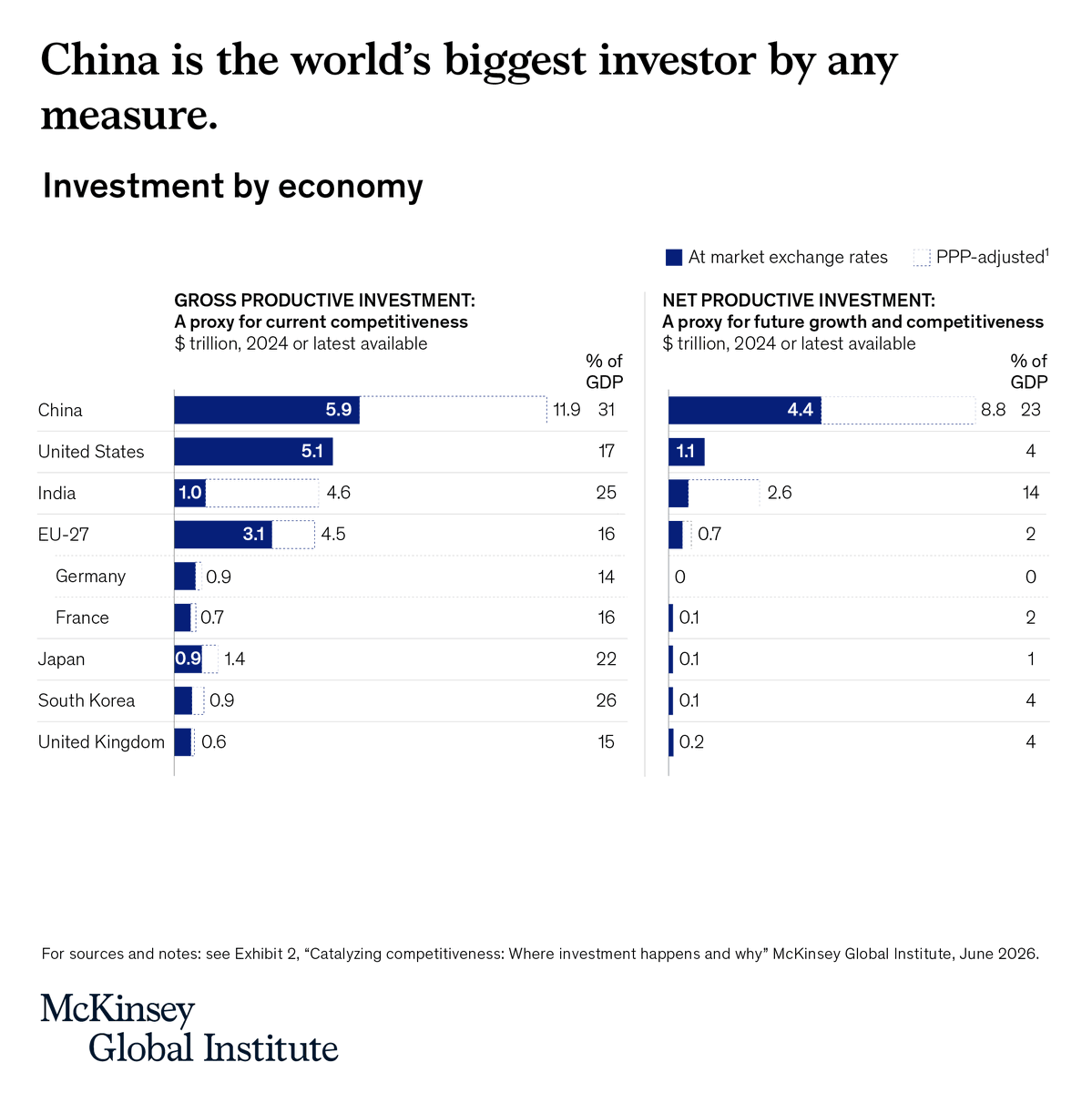
China’s tech ecosystem is not just a story of apps, AI models, or individual companies. It is also a story of productive investment: infrastructure, manufacturing capacity, supply chains, and real-world deployment. #ChinaTech #STEM
McKinsey Global Institute@McKinsey_MGI

China’s gross investments total $5.9T annually – ~30% of its GDP. The US invests $5.1T. The EU invests $3.1T. In net terms, China attracts 3x–5x more productive capital each year than the US and Europe combined. Where productive investment is happening: mck.co/competitiveness

English
0
0
1
66
Tech China Trek
Tech China Trek@TechChinaTrek·
@McKinsey_MGI Important context for understanding China’s tech ecosystem. Innovation is not only about startups or models. It is also shaped by productive capital, infrastructure, manufacturing capacity, and the speed at which investment turns into real-world deployment.
English
0
0
0
60
McKinsey Global Institute
McKinsey Global Institute@McKinsey_MGI·
China’s gross investments total $5.9T annually – ~30% of its GDP. The US invests $5.1T. The EU invests $3.1T. In net terms, China attracts 3x–5x more productive capital each year than the US and Europe combined. Where productive investment is happening: mck.co/competitiveness
McKinsey Global Institute tweet media
English
9
64
154
20.1K
Tech China Trek
Tech China Trek@TechChinaTrek·
For students studying AI, this is a great case study. The AI race is not only about better models. It is also about compute costs, user scale, pricing, workflow integration, and whether people will actually pay for productivity gains. #AI #ChinaTech
Tech Buzz China@TechBuzzChina

Doubao, ByteDance's AI assistant with 345 million monthly active users, started beta testing charging for its service in May. The pricing: standard tier at 68 yuan (~$10) per month, enhanced at 200 yuan (~$28), and premium at 500 yuan (~$70). Basic functions remain free. Doubao's move tests whether a large Chinese consumer AI app can monetize at scale. ByteDance's 2026 capital expenditure is expected to exceed 200 billion yuan (~$28 billion), up 25% from earlier plans, mostly for AI infrastructure. Yet according to LatePost, Doubao's daily revenue was under 1 million yuan (~$137.9K) while computing and operating costs ran tens of millions per day. A China Minzu Securities estimate put the cost of one day of free Doubao service at 132 million to 240 million yuan (~$33.1M). Doubao is testing the waters for WeChat. Tencent's AI strategy depends on WeChat's 1.4 billion users, but consumer willingness to pay for AI in China remains unproven. If Doubao converts even a fraction of its user base, it would show that WeChat's larger ecosystem can monetize AI. Doubao's paid features target productivity: PPT generation, data analysis, video production, and document editing. The author tested the 68 yuan (~$9) tier and found the output structurally sound but requiring manual correction for accuracy and hallucination issues. Globally, Anthropic is pivoting toward consumers after focusing on enterprise. Since late 2025, it has asked employees to improve Claude for everyday queries like health and travel. OpenAI runs a dual B2B/B2C model. Companies that win will build stronger models, scale user reach, and embed AI directly into core user workflows and scenarios. Doubao's pricing experiment checks the market temperature for consumer AI in China. If it works, WeChat is the real prize. h/t @TMTPostGlobal

English
0
0
0
46
Tech China Trek
Tech China Trek@TechChinaTrek·
@TechBuzzChina This is a useful lens for students to understand China’s AI ecosystem. AI adoption is not only about model capability or user scale. The harder question is whether AI can become valuable enough to sit inside real workflows — and get paid for.
English
0
0
0
10
Tech Buzz China
Tech Buzz China@TechBuzzChina·
Doubao, ByteDance's AI assistant with 345 million monthly active users, started beta testing charging for its service in May. The pricing: standard tier at 68 yuan (~$10) per month, enhanced at 200 yuan (~$28), and premium at 500 yuan (~$70). Basic functions remain free. Doubao's move tests whether a large Chinese consumer AI app can monetize at scale. ByteDance's 2026 capital expenditure is expected to exceed 200 billion yuan (~$28 billion), up 25% from earlier plans, mostly for AI infrastructure. Yet according to LatePost, Doubao's daily revenue was under 1 million yuan (~$137.9K) while computing and operating costs ran tens of millions per day. A China Minzu Securities estimate put the cost of one day of free Doubao service at 132 million to 240 million yuan (~$33.1M). Doubao is testing the waters for WeChat. Tencent's AI strategy depends on WeChat's 1.4 billion users, but consumer willingness to pay for AI in China remains unproven. If Doubao converts even a fraction of its user base, it would show that WeChat's larger ecosystem can monetize AI. Doubao's paid features target productivity: PPT generation, data analysis, video production, and document editing. The author tested the 68 yuan (~$9) tier and found the output structurally sound but requiring manual correction for accuracy and hallucination issues. Globally, Anthropic is pivoting toward consumers after focusing on enterprise. Since late 2025, it has asked employees to improve Claude for everyday queries like health and travel. OpenAI runs a dual B2B/B2C model. Companies that win will build stronger models, scale user reach, and embed AI directly into core user workflows and scenarios. Doubao's pricing experiment checks the market temperature for consumer AI in China. If it works, WeChat is the real prize. h/t @TMTPostGlobal
Tech Buzz China tweet media
English
2
1
14
1.6K
Tech China Trek
Tech China Trek@TechChinaTrek·
Sneak peek #7 👀 Did you know humanoid robots need massive training before real-world deployment? Our July cohort will visit one of China’s largest humanoid robot training centers, where robots learn precise tasks like pharmacy drug picking. Applied AI, trained for real world.
English
0
0
2
78
Tech China Trek
Tech China Trek@TechChinaTrek·
@sz_mediagroup Great example of how humanoid robots are moving from lab demos to public product launches. For students, a dancing robot is more than a stage moment: it brings together motion control, balance, perception, design, and productization.
English
1
0
2
248
Tech China Trek
Tech China Trek@TechChinaTrek·
This is exactly why Neolix is such a valuable stop for our students! Autonomous driving isn’t only about moving people. It’s also about moving goods: parcels, retail, cold chain, and city services. A real-world case study in how AI scales through urban logistics.
Freeman Ding@FreemanDing

In the field of autonomous delivery and self-driving logistics, Neolix is the global leader. Whether in China or anywhere else in the world, they are number one in terms of commercial scale.

English
0
0
1
48
Tech China Trek
Tech China Trek@TechChinaTrek·
Sneak peek #6 from Beijing 👀 Wanna see a global leader in L4 autonomous delivery RoboVans? Autonomous driving isn’t just about robotaxis! Our July cohort will visit Neolix, where AI moves real goods through real cities. Parcels. Cold chain. Retail. Urban logistics #ChinaTech
English
1
3
8
759
Tech China Trek
Tech China Trek@TechChinaTrek·
Sneak peek #5 from our July route check👀 Wanna try a “Bullet Time” shot like in The Matrix? Our students will visit a China-based AR/VR and film post-production studio, using multi-camera synchronized shooting + real-time processing to create their own 3D action video. #ARVR
English
0
0
2
173