TechInnovation

7.2K posts

TechInnovation banner
TechInnovation

TechInnovation

@TechInnovationz

Tech enthusiast | Diving into quantum, AI, & space $IONQ ….| Insights on future-shaping companies🚀 | Follow me!

Etats-Unis Katılım Mart 2024
796 Takip Edilen6.7K Takipçiler
Sabitlenmiş Tweet
TechInnovation
TechInnovation@TechInnovationz·
I’m 23. I’m from France. I own 400 shares of IonQ . I’m writing that upfront because it matters for what comes next. I’m not a fund manager. I’m not paid to post. Whether the stock goes up or down tomorrow, my life doesn’t change. I’m a master’s student in international business who got pulled into the quantum world a year ago and hasn’t been able to look away since. What started as curiosity turned into something else. A year of reading, asking questions, getting things wrong, being corrected by people who knew more, and trying again. The physics didn’t come naturally. Neither did the financial side. But piece by piece, conversation by conversation, it started to connect. And I’ve been wrong along the way. More than once. The community has corrected me, caught names I misspelled, flagged claims I couldn’t fully source. That’s not a weakness of doing this publicly it’s the point. Working in the open means your mistakes are visible, and that’s exactly what keeps the work honest. The real craft was never about one acquisition. It was about connecting them. Oxford Ionics. SkyWater. Capella Space. Vector Atomic. Lightsynq. Qubitekk. ID Quantique. Skyloom. Seed Innovations. Nine deals in roughly twelve months, and each one reshapes a different layer computing, manufacturing, networking, sensing, space, security, software. That’s before you count the hires behind them, the integration team under Petrina Zaraszczak, the European expansion through Lorenzo Roversi in the Nordics, Marco Pistoia in Rome with the €1B Italian commitment, Darren Strange in Oxford. Before the university partnerships Cambridge and the Cavendish Lab, the OxCam corridor, the AstraZeneca BioVentureHub in Gothenburg, MTSU’s QRISE Center in Tennessee. Before the government layer SHIELD IDIQ, Golden Dome, Katie Arrington as CIO, the GDIT partnership, Robert Cardillo at IonQ Federal. Each piece is a story. Together they tell something bigger. And somewhere along the way, a community formed. The IonQers. Multilingual, scattered across time zones, reading the same filings, catching each other’s mistakes, crediting each other’s findings. Some of my closest conversations this past year have been with people whose real names I don’t know. Content in English, Japanese.. because the quantum ecosystem isn’t a single-language story, and the people trying to follow it deserve to read it in their own language. I want to be transparent about why I do this. It’s not for money. 400 shares wouldn’t change that calculation either way. I do it to help the community understand what’s actually happening to make the information accessible. Quantum is hard. The filings are dense. The physics is intimidating. Most people who could benefit from following this story give up after two paragraphs of jargon. That’s the gap I try to close. That’s why I write the deep dives. That’s why I make short videos breaking down the technology in simple terms. Not for followers. For readers who want to actually understand. Because this ecosystem shouldn’t require a PhD to follow. And when people message me asking why the stock is up or down on a given day I don’t have that answer, and more importantly, that’s not what I’m here for. Price action is noise. The ecosystem is the signal. I’d rather explain why an acquisition matters than guess where the candle closes. I also write this from a European seat, watching a mostly American story with European fingerprints all over it Oxford in the UK, Pistoia in Italy, QuantumBasel in Switzerland, Roversi and the Nordic corridor, Cambridge’s Cavendish Lab. France is not yet a node on this map. Maybe that changes. Either way, writing from here means I see the European side of the ecosystem with a different kind of attention than someone based in Maryland or California would. Two things keep me going. First, the medical side. 1/2 $IONQ
TechInnovation@TechInnovationz

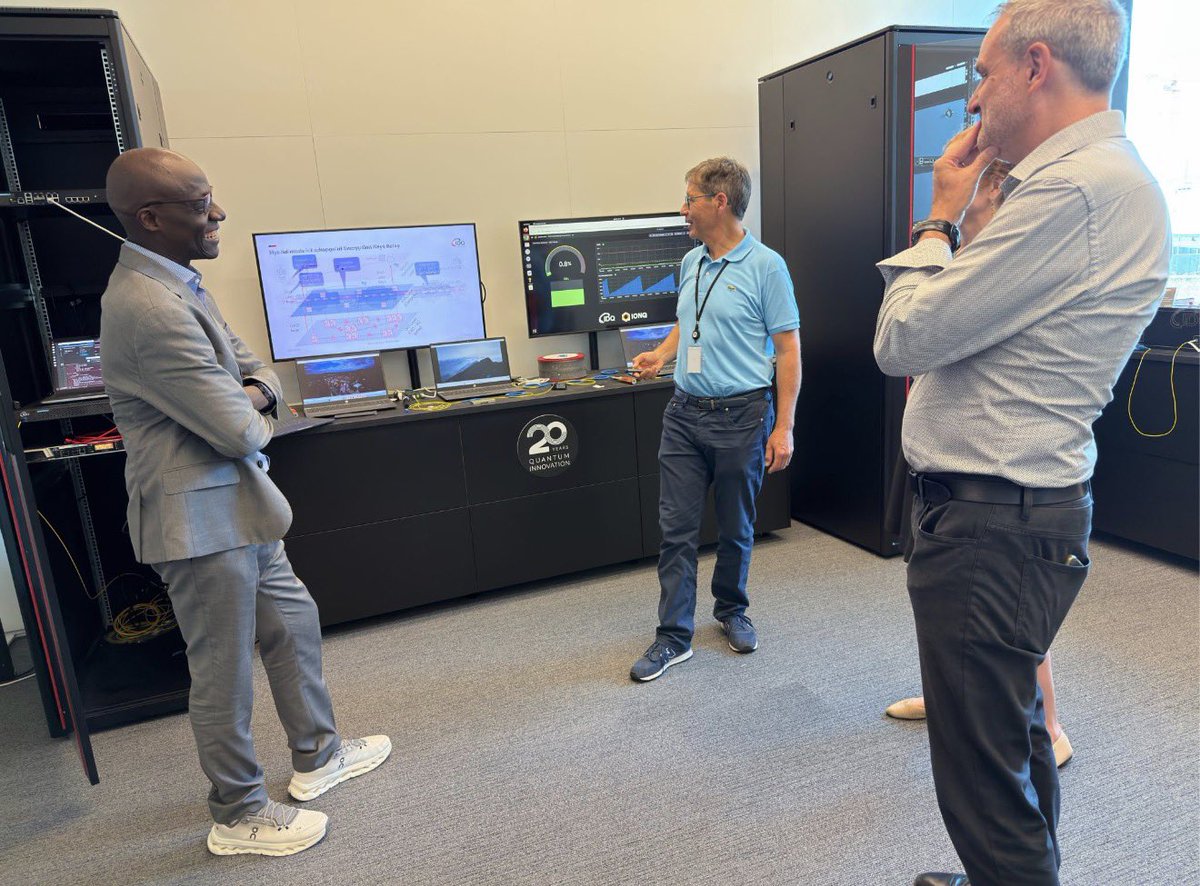
In town. See you Tuesday. $IonQ

English
39
18
206
41.9K
TechInnovation
TechInnovation@TechInnovationz·
TechInnovation@TechInnovationz

$IONQ isn't a quantum compute pure-play anymore. In 18 months, it became THE platform - singular - on which US national security quantum capability gets built. The acquisition spree wasn't diversification. It was the deliberate assembly of an end-to-end stack - operational across every domain DoD recognizes. The institutions are now naming it out loud. And the timing matters. The Trump administration owns 9.9% of Intel ($8.9B, August 2025, CHIPS Act funds converted to equity). It holds an equity stake in MP Materials (critical minerals). Commerce Secretary Lutnick: "there'll be more transactions." The Council on Foreign Relations tracks it as a "strategic portfolio of national security-related companies." That policy logic doesn't predict anything specific for $IONQ. It makes clear what kind of company becomes structurally hard to ignore: the only US-listed pure-play with an end-to-end NatSec quantum stack already deployed. Concrete real-time signal: yesterday, the President of the United States told America from the White House to "go and buy a Dell." Meanwhile, the senior Dell federal commercial bench has - over the past six months - walked into $IONQ's commercial organization. Six C-suite and VP-level operators. Combined Dell tenures north of 100 years. When a sitting President publicly endorses a company, you take note. When that same company's entire federal go-to-market machine quietly migrates into a US-listed quantum platform, you reread the chart. Now look at what's been assembled: THE ROSTER - every chair that matters for federal access: → Katie Arrington (CIO) - ex-Department of War CIO (acting), CMMC architect → Leslie Kershaw (CISO) - ex-USSF Space DELTA 6 Cyber Technical Director → Robert Cardillo (Exec Chair, IonQ Federal) - ex-NGA Director → Gen. Jay Raymond (Special Advisor) - first-ever Chief of Space Operations USSF → Bill Dunlap (SVP Architecture) - ex-Principal Deputy CIO, Department of War (acting) → Dean Acosta (Government Affairs) - briefed quantum at the White House, January 2026 → Rick Muller (SVP Federal Engagement) - ex-IARPA, ex-Sandia National Laboratories → Martin Roetteler (VP Quantum Software) - co-authored the 2020 Microsoft paper that proved Elliptic Curve Cryptography falls to quantum before RSA → Thomas Häner (Principal Scientist) - same paper co-author, joined April 2026 (ex-AWS Quantum Zurich, ex-Microsoft Azure Quantum) → The Dell federal bench, by name: • Scott Millard - Chief Business Officer • Chad Sakac - SVP Field Engineering (Dell EMC veteran) • Steve Harris - SVP Federal GTM (23y Dell federal) • Cameron Chehreh - VP Federal Field Engineering (ex-Dell Federal CTO) • Mike Lawson - VP Federal GTM (15y Dell USAF/COCOMs) • Scott Sherman - Sales Enablement (23y Dell, $16B program ops) The team that wrote the playbook for breaking ECC encryption is now inside the company. So is the team that built Dell's federal sales engine. Both, simultaneously. THE SCIENTIFIC BENCH - the people actually building the technology: → Chris Ballance (President, Quantum Computing) - co-founder Oxford Ionics, world record holder on two-qubit gate fidelity. His framing: "Physics is a sunk cost. What matters is engineering." → Chris Monroe (Co-founder, IonQ) - pioneer of trapped-ion quantum computing, recent keynote "From Startup to Success - The IonQ Story" at Southeast Venture Showcase Nashville (April 2026) → Marco Pistoia (CEO IonQ Italia) - quantum algorithms researcher, ex-JPMorgan Quantum, co-author of flagship IonQ papers including BF-DCQO portfolio optimization (arXiv 2602.23976) → Mihir Bhaskar, Bart Machielse, David Levonian (Lightsynq) - Harvard Lukin lab veterans, authored the March 2026 Nature paper on silicon-vacancy diamond interferometry across 1.55 km → Martin Suchara (Director, Quantum Applications) - ex-Microsoft Azure Quantum, ex-AWS, ex-Argonne National Lab (co-founded DOE Q-NEXT) → Daniela Becker - ex-AWS Braket, chose IonQ after evaluating every quantum vendor → Mickey McDonald - ex-Atom Computing employee #8, 15-year neutral-atom veteran who chose trapped ions 1,500+ employees globally. 300+ PhDs. 1,100+ patents. Scaling to 3,000+ post-SkyWater integration. THE PLATFORM - every entity below is owned by $IONQ: → Oxford Ionics - 99.99% two-qubit gate fidelity, trapped-ion hardware → Vector Atomic - quantum inertial sensor on the X-37B, in orbit → Capella Space - SAR imaging, sub-24h tasking → ID Quantique - QKD live in Switzerland, Slovakia, Romania, Korea (4 sovereign networks); September 2025 AFRL breakthrough - 92.3% conversion efficiency, trapped-ion to telecom C-band, highest ever recorded → Skyloom - optical comms LEO, 42 terminals already in orbit on SDA Tranche 1, 88 delivered total → Seed Innovations - Colorado-based, ~$97M DoD portfolio → Lightsynq - diamond photonic interconnects (Harvard Lukin spin-out), Nature paper March 2026 on silicon-vacancy diamond interferometry across 1.55 km → Qubitekk - quantum networking, powers EPB Chattanooga → SkyWater (pending close, shareholder vote today) - DMEA Cat 1A Trusted Foundry, 100% US supply chain THE SOFTWARE ECOSYSTEM - a platform isn't only hardware: → Q-CTRL Fire Opal - natively integrated on IonQ Forte processors (10x deeper circuits, 1000x reduced compute cost, 1000x improved accuracy per Q-CTRL's published numbers) → Kipu Quantum - algorithmic partner. BF-DCQO algorithm running on IonQ Forte / Forte Enterprise / 64-qubit Barium dev system. Joint papers: S&P 500 portfolio optimization (arXiv 2602.23976, 250 real assets), protein folding (arXiv 2604.26861). Co-authors: Martin Roetteler (IonQ), Marco Pistoia (CEO IonQ Italia), Enrique Solano (Co-CEO Kipu) → Classiq Technologies - $IONQ direct investor in Classiq's $110M Series C (largest quantum software round on record, alongside SoftBank, AMD, Qualcomm, HSBC). Hardware-agnostic compiler. Clients already on platform: BMW, Citi, Rolls-Royce, Mitsubishi Chemical, Intesa Sanpaolo, Comcast. Just launched expert-level Quantum AI Agents → Horizon Quantum - $IONQ holds 13.3% stake (post-PIPE December 2025), anchor strategic investor. Singapore-based, building Triple Alpha hardware-agnostic platform. Public via SPAC merger with dMY Squared, chaired by Harry You - ex-IonQ lead independent director, ex-dMY Technology (which brought IonQ public). Founded by Joe Fitzsimons Inder Singh (COO/CFO IonQ) framed it directly: "It's nice to have the iPhone. It's better to have the App Store with it." THE GLOBAL DEPLOYMENT - 8 sovereign jurisdictions, already in production or signed: → 🇺🇸 USA - Tennessee EPB Quantum Center (first US site for BOTH computing AND networking); Florida statewide quantum-safe initiative signed April 27 at eMerge Miami (~100-mi corridor Palm Beach → Miami-Dade, FLR's 1,540-mi backbone, 13 universities, 58 affiliates) → 🇨🇭 Switzerland - Geneva network (IDQ HQ, world's first commercial QKD); QuantumBasel $60M+ deal, 256-qubit roadmap (first IonQ system delivered outside the US) → 🇮🇹 Italy - IonQ Italia (€1B / 300 jobs, Minister Urso met De Masi in Washington); Niscemi Sicily landslide monitoring with US Consulate Naples + NAS Sigonella; Marco Pistoia (CEO IonQ Italia) at the Wilson Center DC alongside Italy Economy Minister Giorgetti - quantum framed as critical technology in the Italy-US economic security agenda → 🇰🇷 Korea - KISTI Tempo 100-qubit + HANGANG supercomputer (largest quantum-classical cluster in the world); Samsung/LG MOU; 800-km national network connecting 48 government agencies (since 2022) → 🇬🇧 UK - ProQure £2B sovereign engagement (Phase 1 deadline May 29, 2026) → 🇷🇴 Romania - RoNaQCI national network: 1,500+ km, 36 QKD-secured links, 6 cities (largest operational QKD network in Europe) → 🇸🇬 Singapore - NQSN+ with Singtel (Southeast Asia's first commercial Quantum-Safe-as-a-Service) → 🇸🇰 Slovakia - Bratislava production QKD network THE COVERAGE - every operational domain DoD recognizes: → SPACE - Skyloom (42 terminals SDA Tranche 1), Capella (SAR LEO), Vector Atomic (X-37B in orbit) → SEA - Vector Atomic (US Navy RIMPAC 2022 deployment, $200M+ federal portfolio), Capella (Devonport Naval Base Auckland captured at 25cm resolution) → LAND - Qubitekk (EPB Chattanooga commercial network), all national QKD networks above → AIR - AFRL contract vehicles, USSF leadership inside the org (Raymond, Kershaw) → CYBER - ID Quantique (QKD/PQC live), Arrington (CMMC architect), DoW CTA #2: "Quantum and Battlefield Information Dominance" IonQ at the Texas Quantum Economy Conference (Feb 28, 2026): "the world's first vertically integrated quantum technology platform - applications across land, sea, air, and space." De Masi on Florida (April 27, 2026): "Creating a statewide quantum network in Florida will mark another major milestone in the deployment of IonQ's global quantum platform." Not marketing lines. Descriptions of what's already deployed. THE INSTITUTIONAL VALIDATION - already happened, in 2026, not 2030: → MDA SHIELD IDIQ ($151B ceiling, 2,400+ eligible companies): $IONQ holds 5 independent CAGE codes - IonQ core, Capella, Vector Atomic, Skyloom, Seed Innovations. → DARPA - engaged across 4 simultaneous program tracks (no other quantum company has this position): QBI Phase B (via UMD ARLIS) with Phase C selection imminent, HARQ (sole commercial winner - first two-system trapped-ion interconnect demo, AFRL-validated April 14 2026), ROCkN (via Vector Atomic), QBI Phase C direct candidacy → Department of War Critical Technology Area #2: "Quantum and Battlefield Information Dominance" → Year of Quantum Security 2026 launched in Washington DC (January 12, 2026): IonQ's Craig Miller on stage with FBI, CISA, NIST → White House National Cyber Strategy (March): "secure quantum computing" + PQC adoption → State Dept Bureau of Emerging Threats: quantum named explicitly → DNI Tulsi Gabbard before Congress: quantum encryption as strategic threat → De Masi named commissioner on SCSP Commission on US Quantum Primacy → National Quantum Initiative Reauthorization Act ($2.7B over 5 years, bipartisan Young/Cantwell, cleared both committees) → McKinsey QTM 2026: $IONQ named the only company present across all three quantum pillars - Computing, Sensing, Communication → King Charles III state visit, Blair House reception (April 28, 2026): $IONQ on the official UK Government attendee list - alongside Apple, NVIDIA, Meta, AMD, Google, Salesforce, Amazon (only pure-play quantum invited) → GDIT (Defense IT prime, $52B revenue) named $IONQ strategic partner in its VIA emerging-tech strategy, March 2026 - alongside AWS, Google Public Sector, ServiceNow, GitLab "There is no quantum industry. There is just IonQ." - De Masi, January 2026. He wasn't bragging. He was describing assembly already in motion. You don't assemble this for press releases. You don't assemble this if your thesis is "quantum compute will eventually be a real market." You assemble this if you intend to BE the platform. Land, sea, air, space, cyber. Eight countries. Four DARPA program tracks. Five SHIELD CAGE codes. Hardware, software, algorithms, networking, foundry - owned, integrated or anchored. Two of the world's top quantum cryptanalysts on payroll. 1,500+ employees, 300+ PhDs, 1,100+ patents. One platform. That's the call $IONQ leadership made. And here's where it lands: the question is no longer whether $IONQ becomes the US national security quantum platform. The platform IS becoming $IONQ. At some point, the institutions stop having a choice about whether to recognize it. In 2026, the receipts started showing - including the federal sales bench the President just publicly told America to buy from. $IONQ #IonQ #Quantum #NationalSecurity

QME
0
0
0
35
Rand Group
Rand Group@randgroup·
The Quantum Sector Map: Every Public Company You Need to Know I've been mapping this space quietly for months and I think quantum is where AI was in early 2023. Most people can't name more than two or three tickers. By the time they figure out the landscape, the early positioning window is gone. 2026 is the year quantum became a real investable sector. Three new IPOs already landed. Quantinuum filed its S1 targeting a $20B valuation. The $QTUM ETF ripped 73% in a year. And McKinsey projects the total market hitting $100B within a decade. People see $IONQ pump 72% in seven sessions and think that's the whole story. It's not even close. Here's the full map, broken down by sector. Bookmark this one. 🔬 PURE PLAY QUANTUM HARDWARE These companies are building actual quantum computers. Different architectures, different bets on which physics wins. All racing toward fault tolerant systems. $IONQ : Trapped ion tech. First public quantum company to cross $100M in revenue ($130M in 2025). Guiding $225M to $245M for 2026. ~$19B market cap. Cloud distribution through AWS, Azure, and government contracts. Also acquiring SkyWater Technology to vertically integrate manufacturing. This is the closest thing to a "blue chip" in quantum right now, if that term even applies to a sector this early. $RGTI : Rigetti. Superconducting qubits. Modular chip architecture built for scalability. Down ~10% YTD after missing Q4 revenue by 22%. Still one of the OG pure plays. I think the architecture has merit but execution has been inconsistent. $QBTS : D-Wave. The original quantum company. Uses quantum annealing, which is a specialized technique for optimization problems. 83% gross margin. Not gate based like the others. Completely different bet. Interesting if annealing finds its niche before gate based catches up. $QUBT : Quantum Computing Inc. Photonic approach. Room temperature, low power. Acquired Luminar Semiconductor in Feb 2026 for photonic manufacturing, then NuCrypt in March to add quantum communications. Building a vertically integrated photonics platform. The acquisition pace tells you management sees a window closing. $INFQ : Infleqtion. First neutral atom quantum company to go public (Feb 2026, raised $550M). Uses cold atom arrays. Atoms as found in nature rather than manufactured qubits. The tech is efficient and reliable but slower. Trading around $11. This one is interesting to me because neutral atom is the approach that could surprise everyone. $XNDU : Xanadu. IPO'd March 2026. First pure play photonic quantum computing company on public markets. Photons transmit quantum data over long distances, which is critical for networking quantum machines together. If quantum networking becomes the bottleneck (and I think it will), photonic architectures have a natural advantage. $HQ : Horizon Quantum. IPO'd March 2026. Raised ~$120M. Pre revenue. Very early. Quantinuum (not yet public) : Honeywell's quantum subsidiary. Filed S1 targeting ~$20B. Trapped ion architecture like $IONQ but claims higher quantum volume and lower error rates. H2 processor hit a quantum volume of 2^25. Only $31M revenue in 2025 with $192M net loss. The biggest quantum IPO in history if it prices. My honest take: the $20B valuation feels aggressive when $IONQ just crossed $20B with 4x the revenue. But the tech credentials are elite. Watch this one very closely. ⚡ POST QUANTUM SECURITY This is the part of quantum most investors completely miss. And personally I think it might be the smartest near term play. While quantum computers are still being built, the security world is already racing to defend against them. The "harvest now, decrypt later" threat means adversaries are collecting encrypted data TODAY to crack it once quantum machines are powerful enough. That makes post quantum cryptography (PQC) an immediate spending priority, not a future one. The PQC market is projected to grow from $420M to $2.84B by 2030 at a 46% CAGR. Unlike quantum hardware, this revenue is compliance driven and happening now. $SEALSQ : Quantum resistant semiconductors with post quantum algorithms embedded at the chip level. Targeting IoT, automotive, identity management. ~$220M cash. One of the best capitalized names in this subsector. $ARQQ : Arqit Quantum. UK based. Software only quantum safe encryption. Products include NetworkSecure and Encryption Intelligence. Intel partnership. Revenue growing from $67K in H1 2025 to $623K in H1 2026. Tiny numbers but the contract pipeline is accelerating across telecom and defense. The kind of company that either 50x or goes to zero. No middle ground. $QNC : Quantum eMotion. Listed on NYSE American in Feb 2026. Patented Quantum Random Number Generator. Just acquired SKV Technology for its SecureKey platform. Targeting financial services, healthcare, blockchain, and government. The crypto/blockchain angle here makes this particularly relevant for our space. $BTQ : BTQ Technologies. Building blockchain infrastructure hardened with PQC. Early stage, low revenue. But the PQC x blockchain intersection is a narrative I expect to hear a lot more about as quantum threats to cryptographic standards become mainstream talking points. 🏭 TECH GIANTS WITH QUANTUM DIVISIONS The biggest quantum budgets on the planet don't belong to the pure plays. They belong to the usual suspects. And honestly, for risk adjusted exposure, these might be the smartest entries. $GOOG : Google Quantum AI. The Willow chip (105 qubits) achieved "below threshold" quantum error correction. This is the single most important quantum milestone in recent history. Adding more qubits now reduces errors instead of amplifying them. That changes the entire scaling equation. $IBM : Most mature quantum program in the industry. Superconducting qubits, open source tools, cloud access. They've shipped more quantum systems than anyone. Also deeply involved in post quantum cryptography standardization with NIST. $MSFT : Microsoft's topological qubit approach is the ultimate moonshot. Completely different physics from everyone else. Also partnered with Quantinuum to achieve "Level 2 Resilient" logical qubits. If topological works, it leapfrogs the field. Big if. $AMZN : AWS Braket provides cloud access to multiple quantum hardware platforms. The marketplace play. Whoever wins hardware, Amazon collects the toll. Classic Bezos energy. $HON : Honeywell. Majority owner (~54%) of Quantinuum. If the IPO lands at $20B, Honeywell's stake alone is worth over $10B. They're also splitting into three companies in 2026. The quantum spinoff optionality here is underpriced in my opinion. $NVDA : Not a quantum company per se, but quantum simulations run on GPUs. As quantum/classical hybrid workflows scale, NVIDIA sits right at the intersection. You get stability, earnings growth, and quantum optionality all in one. 🔧 COMPONENTS, MATERIALS & EQUIPMENT The picks and shovels layer. Companies making what goes inside quantum systems or enabling the PQC hardware refresh. $LSCC : Lattice Semiconductor. First to ship post quantum compliant FPGAs (CNSA 2.0). Their MachXO5 NX family integrates NIST standardized algorithms. Revenue estimate $631M for 2026 (+21%). The compliance driven PQC hardware refresh cycle is their tailwind. This one doesn't get enough attention. $MCHP : Microchip Technology. Crypto agile MCUs and FPGAs for the post quantum transition. Embedded security solutions. Not pure play but deep in the quantum security supply chain. $NXPI : NXP Semiconductors. Quantum safe hardware at chip level. Secure key storage, encryption accelerators, cryptographic modules across automotive, financial services, and IoT. 📡 QUANTUM NETWORKING The earliest and potentially most important subsector. Networking quantum machines together is what unlocks the real compute power. QUBT is expanding here via its NuCrypt acquisition. $XNDU's photonic approach has natural networking advantages. Several security names ( ARQQ, $SEALSQ) also overlap into this space. This category barely exists as a tradable theme yet. But I think two years from now people will look back and wish they'd paid attention to quantum networking the way they wish they'd mapped the AI inference buildout earlier. 📊 THE ETF PLAY $QTUM : Defiance Quantum ETF. ~84 companies. Modified equal weight. Up 73% in one year, 176% over five. ~$3.7B AUM. 5 star Morningstar rating. If you want broad exposure without single stock blowup risk, this is the cleanest vehicle available. 🧠 FINAL THOUGHTS The global quantum computing market goes from $3.5B (2025) to an estimated $20B by 2030. McKinsey sees $850B by 2040. Quantum equity funding in the first nine months of 2025 hit $3.77B. Nearly 3x all of 2024. We went from 6 pure play public quantum companies to potentially 12 by year end 2026. That's the kind of expansion that creates the early mover setups most people only recognize in hindsight. I'm not saying buy everything on this list. I'm saying map it. Understand the layers. Know where the architectures differ. Know where the revenue is real versus aspirational. This sector is where AI stocks were before ChatGPT made everyone a believer. The difference is the quantum crowd hasn't had its "ChatGPT moment" yet. When it comes, the people who already mapped the landscape will move first.
Rand Group tweet media
English
50
83
333
28.4K
TechInnovation
TechInnovation@TechInnovationz·
$IONQ Hanna, my friend, just dropped her new report quantum software this time. The pillar that gets the least coverage and decides the most. Her opening line: “Hardware without production-ready, enterprise-accessible software is just expensive lab equipment.” 10 vendors. 8 dimensions. Reproducible scoring, due-diligence grids, a Day-90 POC playbook. The names she puts on the map: Q-Ctrl, Horizon Quantum, Classiq, Riverlane and several others. The layer most retail conversations skip the one enterprise actually buys. Go read @HannaSuds in full ↓ quantumtechintegration.blogspot.com/2026/05/strate… $IONQ $HQ $IBM $MSFT $XNDU $QBTS $INFQ $RGTI $AMZN $HON #IonQ #QuantumSoftware
Hanna353@HannaSuds

$IONQ $HQ $IBM $MSFT $XNDU $QBTS $INFQ $RGTI $AMZN $HON The most thorough and independent quantum software report ever published is now available. While the quantum hardware race has captured nearly all the headlines and investment attention, this report makes one thing unmistakably clear: the software layer will ultimately determine which hardware companies succeed commercially and which remain laboratory curiosities. Hardware without production-ready, enterprise-accessible software is just expensive lab equipment. Yet the quantum software sector remains dramatically under-discussed and likely under-valued relative to its decisive importance for enterprise adoption and government programs. Every serious quantum investor and enterprise decision-maker needs to understand this space right now as software companies such as Q-Ctrl, Horizon Quantum, Classiq, Riverlane, and several others are critical conductors of just how far and far the quantum ecosystem will mature. Make no mistake, though the market has generally discussed hardware companies, understanding the integrated relationships between hardware and software provides a true understanding of the market, where it’s going, and who’s taking us there. To read the full report visit: quantumtechintegration.blogspot.com/2026/05/strate… This is the only complete, conflict-free framework evaluating ten leading quantum software vendors across eight dimensions — with reproducible scoring, due-diligence grids, sector guidance, and a full day 90 POC playbook. No other report comes close to this level of depth and independence. Read the report at: quantumtechintegration.blogspot.com/2026/05/strate…

English
0
2
20
2K
TechInnovation
TechInnovation@TechInnovationz·
TechInnovation@TechInnovationz

$IonQ Mohammad Usaid Abdullah just joined Oxford Ionics ( @IonQ_Inc Company) as IC Lead, bringing impressive credentials: • 7 years at Intel on Analog/Mixed-Signal IPs for IoT & Wearables • Experience at Universal Quantum on analog circuits for quantum computers • Deep expertise in cryogenic analog circuit design & Phase-Locked Loops This signals Oxford Ionics' serious push in integrated circuit development for quantum systems. The race to build scalable, production-ready quantum computers is heating up! ⚛️ The quantum hardware space is attracting top semiconductor talent - a sign the technology is maturing. #QuantumHardware #SemiconductorTalent #NewBeginnings

QME
0
0
1
419
TechInnovation
TechInnovation@TechInnovationz·
TechInnovation@TechInnovationz

$IONQ What opened in Boulder today isn’t a lab. It’s a return. Chris Monroe - IonQ’s co-founder - spent 8 years as a Staff Physicist at NIST Boulder, from 1992 to 2000. In 1995, working with Nobel laureate David Wineland, he demonstrated the world’s first quantum logic gate. Ion traps. The building where modern quantum computing was born. The man who cut the ribbon yesterday spent six years at that same NIST facility. Dr. David Allcock - now IonQ’s VP Science for Compute - was a Postdoctoral Research Fellow at NIST Boulder from 2013 to 2019. He simultaneously served as a PREP Researcher at the University of Colorado Boulder. He’d been part of the original Oxford University research on EQC-based ion traps, alongside Dr. Chris Ballance and Dr. Tom Harty (h/t @netcreat). When he joined Oxford Ionics as Director of Science for North America in June 2024, he was already living in Boulder. When IonQ acquired Oxford Ionics in September 2025 for $1.075B, Allcock didn’t need to move. He was already there. A week ago, Allcock posted his own announcement on LinkedIn: VP Science for Compute, leading the Science team alongside CTO Tom Harty and Director Ken Wright across four time zones - College Park, Oxford, Boulder, Seattle. And he ended the post with the story. The ion traps now going into production at SkyWater, Allcock wrote, are based on designs he sketched on napkins in grad school, in 2011 - “if only someone could actually build these.” Fifteen years later, IonQ is the company actually building them. Dr. Chris Ballance - now IonQ’s President of Quantum Computing - said at the ceremony that Boulder was chosen over several other cities precisely because of the density of NIST, CU Boulder, and the talent pool that has been compounding there for three decades. That talent isn’t theoretical. It’s walking in. Dr. Mickey McDonald - the eighth employee ever at Atom Computing, the man who personally led the technical design of their first commercial machine - just joined Oxford Ionics in Boulder. After six and a half years in neutral atoms, he chose to learn trapped ions. Dr. Steven Moses spent seven years at Honeywell and Quantinuum scaling QCCD trapped-ion architectures, then a stint at the AWS Center for Quantum Computing at Caltech. In September 2025 - the same month IonQ closed the Oxford Ionics acquisition - he joined Oxford Ionics’ Boulder office. Before all of that, he was a postdoc in Chris Monroe’ own group at JQI and the University of Maryland. His PhD was at JILA in Boulder. (h/t @netcreat) Eight years after Monroe trained him in Maryland, Moses walked back into Boulder, into the lab Monroe’s company just opened, in the city where Monroe demonstrated the first quantum logic gate thirty years ago. The pattern is becoming visible: IonQ is concentrating the best ion-trap, neutral atom, and EQC architects on a single floor. And this lab doesn’t sit in isolation. On the Q1 2026 earnings call (May 6), the picture got sharper: → 256-qubit chip (6th gen) going into production at the SkyWater fab right now → 7th gen 10,000-qubit chip development just started, same fab partner → 200,000-qubit chip expected back from SkyWater in 2028 Three consecutive generations of IonQ hardware are already locked into one US foundry. The SkyWater acquisition (expected legal close Q2/Q3 2026) is paperwork on something that’s already shipping. What’s coming online in Boulder: $100M of investment. 100+ jobs at full operations. Construction completes this summer. The first quantum computer arrives end of 2026, from IonQ’s UK manufacturing chain (Oxford Ionics). In Boulder, “quantum platform” isn’t a slide deck. It’s a 30-year homecoming, a competitor brain drain, a napkin sketch from 2011 going into production, and a hardware roadmap that runs from 256 qubits today to 200,000 qubits by 2028. Nothing about this is random. Every move was placed. Honestly. What a story. Bravo, and bravo again, to the entire @IonQ_Inc👏 #IonQ

QME
1
0
1
426
TechInnovation
TechInnovation@TechInnovationz·
$IONQ 🎯 "Scaling quantum is now primarily an engineering challenge." Mohammad Usaid, IC Lead at Oxford Ionics, on LinkedIn this morning. He's hiring. I told you about Mohammad on February 2 - 7 years at Intel, Universal Quantum, cryogenic analog PLLs. 4 months in, he's speaking publicly for the first time. The words sound familiar because the entire IonQ leadership has been saying them for 5 months. Chris Ballance, co-founder Oxford Ionics, now President Quantum Computing world record holder on two-qubit gate fidelity: "Physics is a sunk cost. What matters is engineering." Inder Singh at J.P. Morgan, seven days ago: "A lot of the science breakthroughs that were needed are behind us at this point. Now it's about engineering and manufacturability." Mohammad isn't echoing. He's the proof. The Oxford Ionics trio Ballance, Tom Harty (CTO), David Allcock (VP Science Compute) sketched these ion traps on napkins in 2011, in grad school. "If only someone could actually build these." Fifteen years they waited for the IC team and the fab to catch up. Mohammad is the IC team. SkyWater is the fab. The waiting is over. Why Mohammad is hiring NOW: → Singh at JPM: "There are only 5,000 quantum engineers in the world. A lot of quantum physicists, not many quantum engineers." → Mohammad is one of those 5,000. → A LinkedIn hiring post from that pool is not noise. It's a war signal. Why this is the moment, not next year: → Q1 2026: $64.7M revenue · +755% YoY · beat midpoint by 30% → FY26 guidance RAISED to $260-270M - 100% organic, pre-SkyWater → RPO $470M, +554% YoY. Record backlog. → $12M of SkyWater commercial spend already booked in Q1 before the merger even closed → Tape-outs A, B, C, D all complete → First ion trap samples from SkyWater "beyond critical quality metrics" for 256-qubit → Singh at JPM: "Already pre-selling" the 256. "What we thought would take 9 months has been done in just a few." → Chip "about the size of your thumbnail" Why SkyWater is non-negotiable: → "We're starting our chip road map entirely in the SkyWater foundry." Singh, JPM → A Stockholm foundry once asked for revenue share. Singh's reply: "Over my dead body." → CMOS multiplexing on mature 128nm nodes. Fully depreciated plant. 30 years of proven scaling Mohammad's playground. → "It will be very hard to change foundries 2 years from now versus today." → "Wouldn't want to promise someone a 256 and not be able to sell them a 10,000 next." And the part nobody else is saying out loud: → "We are a merchant supplier. We sell components to the other quantum computing companies. Some of their machines wouldn't work with our components." Singh, JPM The team is now complete: → Ballance + Harty - the co-founders who set the thesis → Allcock - the scientist who sketched the trap geometries in 2011 → Mohammad - the IC Lead who finally builds them at scale → SkyWater - the US Trusted Foundry that fabricates them → Singh - the CFO who lined up $3.1B cash to back it → De Masi on CNBC, May 7: "Quantum is coming sooner than people think." "If we're building more and more powerful iPhones, we're building the App Store that goes with it at the same time." -Inder Singh, JPM. Four months ago, a hire. Seven days ago, a thesis. Today, a LinkedIn post. "There is no quantum industry. There is just IonQ." That's not a slogan anymore. It's a Q1 print, a tape-out, a 2011 napkin, a chip the size of your thumbnail, a US foundry, and a war for 5,000 engineers worldwide. Mohammad is hiring. #IonQ #OxfordIonics #SkyWater #Quantum #ChipDesign
TechInnovation tweet media
English
2
3
36
1.7K
Lun
Lun@1unh2g·
@TechInnovationz Bro. I just noticed that you are following the $QS too! Do you want to talk about that?
English
1
0
0
253
TechInnovation
TechInnovation@TechInnovationz·
$IONQ 🔐 The document Katie Arrington signed before crossing over to IonQ. Nov 18, 2025. Three years to the day after OMB Memorandum 23-02 first mandated federal PQC migration. Pentagon memo: "Preparing for Migration to Post Quantum Cryptography." Signed by Arrington as Performing the Duties of the Chief Information Officer of the Department of War. Cleared for open publication Nov 20, 2025. What it does: → Mandates PQC migration across EVERY DoW system. National security systems, non-NSS, weapons systems, cloud, mobile devices, physical access control, internet of things, unmanned systems, operational technology. "Regardless of classification, location, connection, type, purpose, or use." → Requires inventory of ALL cryptography currently in use across the Department, with mandatory reporting. → Sets hard phase-out deadlines: PSK-based solutions and symmetric key establishment protocols out by December 31, 2030. NSA CSfC-registered solutions by December 31, 2031. → Bans procurement of commercial PSK-based and symmetric key solutions for quantum resistance, effective immediately. → Replaces them with NIST-approved asymmetric PQC algorithms. CNSA 2.0-listed for National Security Systems. → Creates a new gatekeeper office: the DoW CIO PQC Directorate. Every Component must obtain intake approval AND deployment approval from this office before testing, piloting, using, or acquiring any PQC-related technology. → Names Dr. Britta Hale as DoW lead for PQC. The legal stack it sits on: OMB Memorandum 23-02 (Nov 2022). CNSS Policy #15 (Dec 2024). Chairman of Joint Chiefs of Staff Instruction 6510.02 (Aug 2022). Eight weeks after signing this memo, on January 14, 2026, IonQ announced Arrington as Chief Information Officer. She started January 19. She wasn't alone. Bill Dunlap was Acting Principal Deputy CIO at the Department of War during the same Oct 2025 to Mar 2026 window. The number two of the office that issued this memo. On April 1, 2026, he joined IonQ as SVP Global Architecture, reporting to Arrington. The official who signed the federal PQC migration mandate, and her deputy from the same office, are now both inside IonQ. Thanks to @InvestifyDaily flagging the memo. @InvestifyDaily 🔗dowcio.war.gov/Portals/0/Docu… $IONQ @IonQ_Inc #IonQ #PQC #QuantumComputing
TechInnovation tweet media
English
5
11
81
5.7K
TechInnovation
TechInnovation@TechInnovationz·
$IONQ 🇺🇸 The statutory Sector Risk Management Agency for U.S. energy just published its first-ever five-year playbook. Multiple flagship programs map onto deployments IonQ already operates. THE INFORMATION This week, CESER - the DOE's Office of Cybersecurity, Energy Security & Emergency Response - pushed its first-ever Strategic Plan on LinkedIn. Plan covers FY2026-2030. Published February 2026; blog drop March 18. Director: Alexander Fitzsimmons, appointed by President Trump. Secretary of Energy: Christopher Wright. CESER holds the Department's statutory role as the Sector Risk Management Agency for the energy sector. The plan aligns with and implements President Trump's Cyber Strategy for America through Pillars 4, 5, and 6, verbatim: "to secure critical infrastructure, sustain superiority in critical and emerging technologies, and build talent and capacity." The LinkedIn post itself, verbatim: "Our guiding principle at CESER is to provide timely, actionable information to the energy sector… We are committed to strengthening energy resilience for American communities and national security. Capabilities like Project ARMOR and the Rural and Municipal Utility Cybersecurity (RMUC) program highlight our efforts to secure critical energy infrastructure." Two programs named in a single sentence. Both target categories where IonQ already has operational deployments in Tennessee. Fitzsimmons, in the March 18, 2026 blog post announcing the plan, verbatim: "The CESER Strategic Plan reflects the Department's commitment to provide timely and actionable information to the energy sector, develop world-class security technologies, harden U.S. energy infrastructure, and respond and recover from incidents. Together with our industry partners, we can protect critical energy infrastructure from emerging threats and usher in a Golden Era of American Energy Dominance." THE PLAN - PROGRAMS NAMED UNDER EACH GOAL → Goal 1 - Develop World-Class Security Technologies Flagship: AI-FORTS (Artificial Intelligence for Operationally Resilient Technologies and Systems). → Goal 2 - Harden U.S. Energy Infrastructure Flagship: Project ARMOR. 2-year objective, verbatim: "rank and harden defense critical energy infrastructure for national security." Flagship: RMUC - Rural and Municipal Utility Advanced Cybersecurity Program. Cooperative agreements to municipal and locally-owned utilities for advanced cybersecurity technologies, training, and assistance. → Goal 3 - Respond and Recover from Incidents Aligned with Executive Order 14239. Plus Genesis Mission - DOE-wide initiative mobilizing all 17 national laboratories for AI applications across energy, national security, and scientific discovery. The plan also names Objective 2 under its guiding principle, verbatim: "Increase CESER monitoring for hardware and software vulnerabilities in energy supply chains to improve cybersecurity, operational planning, and energy resilience." Supply chain monitoring is now an explicit federal mandate. EXECUTION LAYER 1 - IONQ IS ALREADY OPTIMIZING THE GRID → GRID-Q (Grid Research, Integration and Deployment for Quantum). Multi-year DOE project led by Oak Ridge National Laboratory. IonQ is one of only two quantum industry partners selected to develop scalable quantum algorithms for grid operations. → July 31, 2025 - IonQ + ORNL + DOE demonstrated a hybrid quantum-classical approach applied to the Unit Commitment problem (the core optimization that determines which generators run when, to meet demand at minimum cost). 36-qubit Forte Enterprise. 24 time periods. 26 generators. → Per U.S. Energy Information Administration: over 60% of energy used in U.S. electricity generation is lost before it reaches end users. The optimization headroom is significant. → De Masi, July 2025 : "This demonstration marks a significant milestone in applying quantum computing to real-world energy challenges… As our systems scale to thousands and millions of qubits, we expect to solve grid optimization challenges at a scale that classic computing methods cannot match." → Dr. Suman Debnath, ORNL senior R&D staff who led ORNL's contributions, verbatim: "the feasibility of using an ion-trapped quantum computing device to solve the Unit Commitment problem in the power grid." → December 2025 - Darío Gil, DOE Under Secretary for Science, visited ORNL discussing the Genesis Mission. IonQ's partnership with ORNL on grid optimization is one workstream within the broader Genesis Mission scope. → NSF, December 2025: $1.3M QuantumGrid Innovation Hub. EPB + IonQ. Mandate: use quantum to secure and optimize the U.S. power grid. → DOE Office of Technology Commercialization, March 2026: 2026 Global Industry Challenge sponsors an energy infrastructure planning challenge - microgrid siting, energy storage deployment, grid resilience - with IonQ Aria and Forte among the available hardware platforms. Four separate federal funding rails. One company across the four named here. EXECUTION LAYER 2 - IONQ IS ALREADY SECURING THE GRID → October 26, 2017 - Dr. Duncan Earl, then CTO of Qubitekk, testifies before the U.S. Senate Energy & Natural Resources Committee. On C-SPAN. Verbatim: "The grid has never faced a threat of the type and severity as it is experiencing today." His proposed counter-measure on Senate record: overlay quantum key distribution on the DOE's grid communication system. → 2016-2019 - DOE Cybersecurity for Energy Delivery Systems award. $4.6M. Prime: Qubitekk. Partners: Oak Ridge National Laboratory (AQCESS nodes), Los Alamos National Laboratory, EPB, Schweitzer Engineering Labs. 20+ km of fiber. 7 substations. SSP-21 protocol. Real-time eavesdropping detection. Team won an R&D 100 Award for the demonstration. → DOE peer-review goal in 2018, verbatim: "The demonstration at EPB will serve as a reference implementation for other utilities interested in a quantum solution." → November 30, 2022 - EPB Quantum Network goes commercial. → January 6, 2025 - IonQ closes the Qubitekk acquisition for $22M. 118 patents transferred. Four founders join, including Earl. → April 25, 2025 - IonQ + EPB sign a second $22M deal. IonQ Forte Enterprise on site. Chattanooga becomes the first U.S. hub combining commercial quantum computing and commercial quantum networking on the same fiber. → RMUC profile = municipal and locally-owned utilities. EPB Chattanooga = municipal utility. Operational. Middle Tennessee Electric = 2nd largest U.S. electric co-op, 750K Tennesseans, 11 counties. MOU signed with MTSU on May 19, 2026. Co-created the MT-QuTech Hub. Flagship academic partner: Oak Ridge National Laboratory - same ORNL on GRID-Q and on the AQCESS nodes. → January 12, 2026 - Year of Quantum Security 2026 launched in Washington, D.C. Craig Miller (IonQ) on stage alongside FBI, CISA, NIST, D-Wave, Qunnect. The same agencies signing federal advisories on energy infrastructure threats are co-sponsoring the year with IonQ on stage. THE CHATTANOOGA STACK - WHERE THE PLAN HAS A TESTBED → Fiber backbone. EPB's 600-square-mile fiber footprint, built in 2010 as the backbone of America's first community-wide gigabit internet. The quantum network sits on top of that existing infrastructure. → Compute + network stack. EPB Quantum Center co-located: IonQ trapped-ion quantum computer (Forte Enterprise), local photonics-based quantum network (built on the Qubitekk-deployed fiber), NVIDIA DGX supercomputer, on live grid infrastructure. The hybrid stack runs on the same fiber as the operational grid. → Physical IonQ presence on the ground. IonQ opened three offices at the Edney Innovation Center (suites 901, 904, 905) on Market Street in early 2026 - a permanent operational hub in Chattanooga's Innovation District, in the same building as CO.LAB (the city's tech entrepreneur center, anchor tenant since 2015) and UTC's Center for Urban Informatics and Progress. Cheryl Krauss (IonQ Global Head of Marketing and Communications) visited Chattanooga in 2026 to coordinate with EPB leadership (J. Ed Marston, Sandra Tilley, Sophie Moore) ahead of public-facing events later in 2026. Not a regional sales footprint. A permanent operational team. → Academic and research nodes. University of Tennessee at Chattanooga - first university node on a commercial quantum network in the United States. Vanderbilt University - Institute for Quantum Innovation, campus planned in Chattanooga (confirmed at LaunchTN, March 2026). Oak Ridge National Laboratory - lead on GRID-Q, AQCESS, and the ORNL workstream of the Genesis Mission. → Utility ecosystem participants. EPB (municipal), Tennessee Valley Authority (federal corporation utility serving 7 Southeastern states), Middle Tennessee Electric (rural co-op). All three converge on the same ORNL and MTSU footprint. → State funding. Tennessee Quantum Initiative - $20M proposed in Governor Bill Lee's 2026-2027 budget on February 2, 2026. Allocation pending legislative approval. → Federal workforce funding. NIST disclosed $4M on February 2, 2026 for quantum workforce development in Chattanooga, backing a new Quantum Computing Fellowship program. → Economic projections. UTC Center for Regional Economic Research, Dr. Bento Lobo, March 2026 white paper "From Gig City to Quantum City": up to $1.1B in regional economic output, income, and taxes by 2035, plus 2,000 quantum-sector jobs. Sits on an earlier peer-reviewed baseline: approximately $5.3B in community benefit from EPB's existing fiber and automated grid since 2010, supporting over 10,400 jobs. → Public validation. Janet Rehberg, EPB President & CEO-elect, on stage at LaunchTN in March 2026, verbatim: "Chattanooga is now the first U.S. quantum technology center offering commercial access to both quantum computing and quantum networking." → Mainstream press. The IonQ Chattanooga office opening was covered by the Chattanooga Times Free Press on March 18, 2026 (Daniel Dassow). Regional press confirmation, not a social-media-only signal. → Regional corridor. March 31, 2026 - EPB joins the Southeastern Quantum Collaborative (led by University of Alabama in Huntsville). Chattanooga sits as the most mature node of an emerging regional network across the Southeast. EXECUTION LAYER 3 - STANDARDS, MANUFACTURING, INTERNATIONAL → Standards. Katie Arrington joined IonQ as CIO in January 2026. Previously DoD Chief Information Officer. Architect of the federal cybersecurity maturity standards (CMMC) that DoD contractors must meet. The person who wrote that federal cyber framework now runs IonQ's enterprise security posture. → Manufacturing. SkyWater Technology - pending IonQ acquisition (~$1.8B, F-4 effective May 14, shareholder vote completed, close expected Q2-Q3 2026). DMEA Category 1A Trusted Foundry. Capable of fabricating onshore the photonic ICs and detectors that quantum networking systems use. Aligned with the plan's Objective 2 verbatim on supply chain monitoring, and with the "American Energy Dominance" framing. → International. ID Quantique - IonQ super-majority holding. Geneva-based. 24-year track record of commercial QKD. ~300 patents. Ships to banking, telco, government customers across Europe. Combined with Qubitekk's U.S. critical-infrastructure credentials, IonQ becomes the only public company combining U.S. critical-infrastructure credentials with two decades of European commercial QKD deployments. Niccolo De Masi frames it in one line: "Be the Nvidia AND Cisco of quantum." Computing AND networking. The plan CESER just published needs both - and IonQ is the only public quantum company with both already deployed on American critical infrastructure. THE TENNESSEE ANCHOR Ryan Harring runs the day-to-day operational layer for IonQ across Tennessee. Director of Partnerships & Alliances. Based in Murfreesboro. Operates out of IonQ's Chattanooga offices at the Edney Innovation Center. Twenty years of enterprise hardware sales at HPE, Zones, and Dell EMC before quantum. Six stages in six weeks across the state in early 2026: CO.LAB, SXSW, LaunchTN, Vanderbilt Quantum Forum, MTSU Tech Vision Day, GNPCA. His verbatim line from MTSU in April: "Quantum is no longer theoretical. It's becoming regional infrastructure." Four days later, IonQ co-founder Chris Monroe delivered the Southeast Venture Showcase II keynote in the same city - "From Startup to Success: The IonQ Story." Ground game followed by headliner. Same city. Same week. OPERATIONAL IMPLICATIONS - ENERGY IS NOW METERED IN TOKENS This is where the plan stops being only a cybersecurity document and becomes also an industrial policy document. For engineers building AI in 2026, the unit of demand on the grid has changed. It is no longer "compute." It is "tokens per joule." → A single GPT-4o query: 0.34-0.43 Wh. A GPT-5.5 standard chat: 0.84 Wh. A Gemini 3 Deep Think reasoning trace: 6.2 Wh. A long-context Claude Opus 4.7 call: 14.1 Wh. (ML.Energy + Stanford AI Index 2026.) → John Snow Labs, February 2026: 700 million GPT-4o queries per day equals annual electricity of approximately 35,000 U.S. households, or approximately 50 inpatient hospitals. → Inference flipped past training in mid-2025. 63%+ of frontier-model energy. Up to 90% in continuous deployment. → Gartner: by 2028, more than 80% of data center workload accelerators will be dedicated to inference. → Microsoft 2025 sustainability report, verbatim: "electricity expenditure is the single largest component of ongoing operating cost." Internal phrasing: "Every Watt Counts as Cost." → AI inference market: $106B (2025) → $250B+ (2030), 19.2% CAGR (MarketsandMarkets). → Global AI energy demand could reach approximately 1,000 TWh by 2026 - roughly 4% of world electricity. The macro grid impact: → Morgan Stanley: U.S. data center demand reaches 74 GW by 2028. Projected shortfall: 49 GW. → Grid Strategies: 5-year peak demand forecasts went from 38 GW (2023) to 128 GW (2024). 3.4x in twelve months. → EPRI: data centers could consume up to 9% of U.S. electricity by 2030. → Chris Wright, Secretary of Energy: compute-driven electricity growth is a strategic competitiveness issue. The structural reality on the ground: → 330M Americans served. 7,300 power plants. 600,000 miles of transmission. 55,000+ substations on automated communication. 75% of transmission lines over 25 years old. Half of oil and gas pipelines over 50 years old. (CSIS, April 2026.) Every token a user sends is a watt-hour an engineer has to source. Every watt-hour comes from a substation. Every substation is on fiber. And those fibers are, by adversary design, being increasingly probed. The FBI + CISA + NSA + EPA + DOE + CNMF joint advisory of April 7, 2026 (AA26-097A) confirmed Iran-aligned IRGC CyberAv3ngers actively compromising internet-exposed PLCs across U.S. Energy, Water, and Government Facilities - a new campaign since at least March 2026. CSIS framed it the same day, verbatim: a "multidomain punishment campaign… systematically putting energy facilities, ports, water systems, and digital infrastructure at risk." CESER published its plan in February. The advisory landed in April. Both landed inside a four-month window. THE SEQUENCE 2017: Earl tells the Senate the threat is real and near-term. On C-SPAN. 2019: the DOE reference implementation goes live on EPB substations. 2022: it goes commercial. July 2025: IonQ + ORNL + DOE apply the Forte Enterprise to Unit Commitment. January 2025: IonQ buys the entire networking stack for $22M. April 2025: IonQ Forte Enterprise lands on the EPB fiber. January 2026: Year of Quantum Security launches. IonQ on stage. February 2026: CESER turns the playbook into national five-year strategy. April 2026: FBI confirms adversaries are inside U.S. PLCs. May 2026: MTE signs the next chapter. The playbook was already written. The optimization runs are already published. The hardware is already on substation fiber. The standards layer is in-house. The manufacturing layer is closing. AI made it strategic. The threat made it urgent. 🔗energy.gov/ceser/articles… $IONQ #IonQ #GridSecurity #EnergyDominance #Quantum #CriticalInfrastructure #AI
TechInnovation tweet media
English
0
5
27
1.5K
TechInnovation
TechInnovation@TechInnovationz·
@NoahKingJr @NoahKingJr 🚨👇👇🚨
TechInnovation@TechInnovationz

$IONQ isn't a quantum compute pure-play anymore. In 18 months, it became THE platform - singular - on which US national security quantum capability gets built. The acquisition spree wasn't diversification. It was the deliberate assembly of an end-to-end stack - operational across every domain DoD recognizes. The institutions are now naming it out loud. And the timing matters. The Trump administration owns 9.9% of Intel ($8.9B, August 2025, CHIPS Act funds converted to equity). It holds an equity stake in MP Materials (critical minerals). Commerce Secretary Lutnick: "there'll be more transactions." The Council on Foreign Relations tracks it as a "strategic portfolio of national security-related companies." That policy logic doesn't predict anything specific for $IONQ. It makes clear what kind of company becomes structurally hard to ignore: the only US-listed pure-play with an end-to-end NatSec quantum stack already deployed. Concrete real-time signal: yesterday, the President of the United States told America from the White House to "go and buy a Dell." Meanwhile, the senior Dell federal commercial bench has - over the past six months - walked into $IONQ's commercial organization. Six C-suite and VP-level operators. Combined Dell tenures north of 100 years. When a sitting President publicly endorses a company, you take note. When that same company's entire federal go-to-market machine quietly migrates into a US-listed quantum platform, you reread the chart. Now look at what's been assembled: THE ROSTER - every chair that matters for federal access: → Katie Arrington (CIO) - ex-Department of War CIO (acting), CMMC architect → Leslie Kershaw (CISO) - ex-USSF Space DELTA 6 Cyber Technical Director → Robert Cardillo (Exec Chair, IonQ Federal) - ex-NGA Director → Gen. Jay Raymond (Special Advisor) - first-ever Chief of Space Operations USSF → Bill Dunlap (SVP Architecture) - ex-Principal Deputy CIO, Department of War (acting) → Dean Acosta (Government Affairs) - briefed quantum at the White House, January 2026 → Rick Muller (SVP Federal Engagement) - ex-IARPA, ex-Sandia National Laboratories → Martin Roetteler (VP Quantum Software) - co-authored the 2020 Microsoft paper that proved Elliptic Curve Cryptography falls to quantum before RSA → Thomas Häner (Principal Scientist) - same paper co-author, joined April 2026 (ex-AWS Quantum Zurich, ex-Microsoft Azure Quantum) → The Dell federal bench, by name: • Scott Millard - Chief Business Officer • Chad Sakac - SVP Field Engineering (Dell EMC veteran) • Steve Harris - SVP Federal GTM (23y Dell federal) • Cameron Chehreh - VP Federal Field Engineering (ex-Dell Federal CTO) • Mike Lawson - VP Federal GTM (15y Dell USAF/COCOMs) • Scott Sherman - Sales Enablement (23y Dell, $16B program ops) The team that wrote the playbook for breaking ECC encryption is now inside the company. So is the team that built Dell's federal sales engine. Both, simultaneously. THE SCIENTIFIC BENCH - the people actually building the technology: → Chris Ballance (President, Quantum Computing) - co-founder Oxford Ionics, world record holder on two-qubit gate fidelity. His framing: "Physics is a sunk cost. What matters is engineering." → Chris Monroe (Co-founder, IonQ) - pioneer of trapped-ion quantum computing, recent keynote "From Startup to Success - The IonQ Story" at Southeast Venture Showcase Nashville (April 2026) → Marco Pistoia (CEO IonQ Italia) - quantum algorithms researcher, ex-JPMorgan Quantum, co-author of flagship IonQ papers including BF-DCQO portfolio optimization (arXiv 2602.23976) → Mihir Bhaskar, Bart Machielse, David Levonian (Lightsynq) - Harvard Lukin lab veterans, authored the March 2026 Nature paper on silicon-vacancy diamond interferometry across 1.55 km → Martin Suchara (Director, Quantum Applications) - ex-Microsoft Azure Quantum, ex-AWS, ex-Argonne National Lab (co-founded DOE Q-NEXT) → Daniela Becker - ex-AWS Braket, chose IonQ after evaluating every quantum vendor → Mickey McDonald - ex-Atom Computing employee #8, 15-year neutral-atom veteran who chose trapped ions 1,500+ employees globally. 300+ PhDs. 1,100+ patents. Scaling to 3,000+ post-SkyWater integration. THE PLATFORM - every entity below is owned by $IONQ: → Oxford Ionics - 99.99% two-qubit gate fidelity, trapped-ion hardware → Vector Atomic - quantum inertial sensor on the X-37B, in orbit → Capella Space - SAR imaging, sub-24h tasking → ID Quantique - QKD live in Switzerland, Slovakia, Romania, Korea (4 sovereign networks); September 2025 AFRL breakthrough - 92.3% conversion efficiency, trapped-ion to telecom C-band, highest ever recorded → Skyloom - optical comms LEO, 42 terminals already in orbit on SDA Tranche 1, 88 delivered total → Seed Innovations - Colorado-based, ~$97M DoD portfolio → Lightsynq - diamond photonic interconnects (Harvard Lukin spin-out), Nature paper March 2026 on silicon-vacancy diamond interferometry across 1.55 km → Qubitekk - quantum networking, powers EPB Chattanooga → SkyWater (pending close, shareholder vote today) - DMEA Cat 1A Trusted Foundry, 100% US supply chain THE SOFTWARE ECOSYSTEM - a platform isn't only hardware: → Q-CTRL Fire Opal - natively integrated on IonQ Forte processors (10x deeper circuits, 1000x reduced compute cost, 1000x improved accuracy per Q-CTRL's published numbers) → Kipu Quantum - algorithmic partner. BF-DCQO algorithm running on IonQ Forte / Forte Enterprise / 64-qubit Barium dev system. Joint papers: S&P 500 portfolio optimization (arXiv 2602.23976, 250 real assets), protein folding (arXiv 2604.26861). Co-authors: Martin Roetteler (IonQ), Marco Pistoia (CEO IonQ Italia), Enrique Solano (Co-CEO Kipu) → Classiq Technologies - $IONQ direct investor in Classiq's $110M Series C (largest quantum software round on record, alongside SoftBank, AMD, Qualcomm, HSBC). Hardware-agnostic compiler. Clients already on platform: BMW, Citi, Rolls-Royce, Mitsubishi Chemical, Intesa Sanpaolo, Comcast. Just launched expert-level Quantum AI Agents → Horizon Quantum - $IONQ holds 13.3% stake (post-PIPE December 2025), anchor strategic investor. Singapore-based, building Triple Alpha hardware-agnostic platform. Public via SPAC merger with dMY Squared, chaired by Harry You - ex-IonQ lead independent director, ex-dMY Technology (which brought IonQ public). Founded by Joe Fitzsimons Inder Singh (COO/CFO IonQ) framed it directly: "It's nice to have the iPhone. It's better to have the App Store with it." THE GLOBAL DEPLOYMENT - 8 sovereign jurisdictions, already in production or signed: → 🇺🇸 USA - Tennessee EPB Quantum Center (first US site for BOTH computing AND networking); Florida statewide quantum-safe initiative signed April 27 at eMerge Miami (~100-mi corridor Palm Beach → Miami-Dade, FLR's 1,540-mi backbone, 13 universities, 58 affiliates) → 🇨🇭 Switzerland - Geneva network (IDQ HQ, world's first commercial QKD); QuantumBasel $60M+ deal, 256-qubit roadmap (first IonQ system delivered outside the US) → 🇮🇹 Italy - IonQ Italia (€1B / 300 jobs, Minister Urso met De Masi in Washington); Niscemi Sicily landslide monitoring with US Consulate Naples + NAS Sigonella; Marco Pistoia (CEO IonQ Italia) at the Wilson Center DC alongside Italy Economy Minister Giorgetti - quantum framed as critical technology in the Italy-US economic security agenda → 🇰🇷 Korea - KISTI Tempo 100-qubit + HANGANG supercomputer (largest quantum-classical cluster in the world); Samsung/LG MOU; 800-km national network connecting 48 government agencies (since 2022) → 🇬🇧 UK - ProQure £2B sovereign engagement (Phase 1 deadline May 29, 2026) → 🇷🇴 Romania - RoNaQCI national network: 1,500+ km, 36 QKD-secured links, 6 cities (largest operational QKD network in Europe) → 🇸🇬 Singapore - NQSN+ with Singtel (Southeast Asia's first commercial Quantum-Safe-as-a-Service) → 🇸🇰 Slovakia - Bratislava production QKD network THE COVERAGE - every operational domain DoD recognizes: → SPACE - Skyloom (42 terminals SDA Tranche 1), Capella (SAR LEO), Vector Atomic (X-37B in orbit) → SEA - Vector Atomic (US Navy RIMPAC 2022 deployment, $200M+ federal portfolio), Capella (Devonport Naval Base Auckland captured at 25cm resolution) → LAND - Qubitekk (EPB Chattanooga commercial network), all national QKD networks above → AIR - AFRL contract vehicles, USSF leadership inside the org (Raymond, Kershaw) → CYBER - ID Quantique (QKD/PQC live), Arrington (CMMC architect), DoW CTA #2: "Quantum and Battlefield Information Dominance" IonQ at the Texas Quantum Economy Conference (Feb 28, 2026): "the world's first vertically integrated quantum technology platform - applications across land, sea, air, and space." De Masi on Florida (April 27, 2026): "Creating a statewide quantum network in Florida will mark another major milestone in the deployment of IonQ's global quantum platform." Not marketing lines. Descriptions of what's already deployed. THE INSTITUTIONAL VALIDATION - already happened, in 2026, not 2030: → MDA SHIELD IDIQ ($151B ceiling, 2,400+ eligible companies): $IONQ holds 5 independent CAGE codes - IonQ core, Capella, Vector Atomic, Skyloom, Seed Innovations. → DARPA - engaged across 4 simultaneous program tracks (no other quantum company has this position): QBI Phase B (via UMD ARLIS) with Phase C selection imminent, HARQ (sole commercial winner - first two-system trapped-ion interconnect demo, AFRL-validated April 14 2026), ROCkN (via Vector Atomic), QBI Phase C direct candidacy → Department of War Critical Technology Area #2: "Quantum and Battlefield Information Dominance" → Year of Quantum Security 2026 launched in Washington DC (January 12, 2026): IonQ's Craig Miller on stage with FBI, CISA, NIST → White House National Cyber Strategy (March): "secure quantum computing" + PQC adoption → State Dept Bureau of Emerging Threats: quantum named explicitly → DNI Tulsi Gabbard before Congress: quantum encryption as strategic threat → De Masi named commissioner on SCSP Commission on US Quantum Primacy → National Quantum Initiative Reauthorization Act ($2.7B over 5 years, bipartisan Young/Cantwell, cleared both committees) → McKinsey QTM 2026: $IONQ named the only company present across all three quantum pillars - Computing, Sensing, Communication → King Charles III state visit, Blair House reception (April 28, 2026): $IONQ on the official UK Government attendee list - alongside Apple, NVIDIA, Meta, AMD, Google, Salesforce, Amazon (only pure-play quantum invited) → GDIT (Defense IT prime, $52B revenue) named $IONQ strategic partner in its VIA emerging-tech strategy, March 2026 - alongside AWS, Google Public Sector, ServiceNow, GitLab "There is no quantum industry. There is just IonQ." - De Masi, January 2026. He wasn't bragging. He was describing assembly already in motion. You don't assemble this for press releases. You don't assemble this if your thesis is "quantum compute will eventually be a real market." You assemble this if you intend to BE the platform. Land, sea, air, space, cyber. Eight countries. Four DARPA program tracks. Five SHIELD CAGE codes. Hardware, software, algorithms, networking, foundry - owned, integrated or anchored. Two of the world's top quantum cryptanalysts on payroll. 1,500+ employees, 300+ PhDs, 1,100+ patents. One platform. That's the call $IONQ leadership made. And here's where it lands: the question is no longer whether $IONQ becomes the US national security quantum platform. The platform IS becoming $IONQ. At some point, the institutions stop having a choice about whether to recognize it. In 2026, the receipts started showing - including the federal sales bench the President just publicly told America to buy from. $IONQ #IonQ #Quantum #NationalSecurity

QME
0
0
0
6
Noah
Noah@NoahKingJr·
What’s coming after Artificial intelligence?
English
6.9K
698
8.3K
3.6M
TechInnovation
TechInnovation@TechInnovationz·
$IONQ 🇺🇸 Memorial Day. NYSE & NASDAQ closed. A look at how much the federal layer at IonQ_Inc has shifted in 12 months. May 2025 - federal-facing stack: Vector Atomic. ID Quantique. Capella pre-integration. May 2026 - federal-facing stack: LEADERSHIP → Katie Arrington (ex-DoD CIO, CMMC architect) - CIO → Bill Dunlap (ex-DoW Acting Principal Deputy CIO, ex-DARPA) - SVP Global Architecture → Leslie Kershaw (ex-Space Force) - CISO → Robert Cardillo (ex-NGA Director) - Exec Chair IonQ Federal → Rick Muller (ex-IARPA, ex-Sandia) - SVP Federal Technical → Gary Dunow (14 yrs NGA) - Chief of Staff Federal → Dell federal team migrating in (Harris, Chehreh, Lawson) CONTRACTS & PROGRAMS → SHIELD IDIQ - $151B ceiling, 5 IonQ entities with their own CAGE codes (IonQ, Capella, Vector Atomic, Skyloom, Seed Innovations) → Capella SDA HALO Track 1 - $48.9M (April 2026) → DARPA - 4 programs simultaneously (QBI, ROCkN, HARQ, candidate Phase C) → GDIT named IonQ a strategic partner (March 2026) → SkyWater merger closing - DMEA Cat1A trusted foundry, 100% U.S. supply chain DEPLOYED CAPABILITIES → X-37B in orbit with Vector Atomic strategic-grade quantum inertial sensor (Aviation Week Laureate) → Skyloom - 88 SDA Tranche 1 optical terminals → AFRL entanglement demo (April 14, 2026) Same ticker. Different company. #IonQ #MemorialDay
English
3
7
62
4.2K
4FIRE
4FIRE@netcreat·
@TechInnovationz "Sharing is caring"🤣👌 blog.naver.com/4-fire/2242962… IonQ’s Emerging Quantum Security Strategy: From QKD to a “Quantum Trust Operating System” Anyone who has followed the quantum computing industry for years may have sensed something unusual in IonQ’s recent moves. For a long time, IonQ focused heavily on: trapped-ion quantum computers quantum networking photonic interconnects QKD QRNG The acquisition of ID Quantique (IDQ) was especially symbolic, because IDQ is not just a QRNG company — it is one of the world’s best-known QKD providers. Yet something felt strange. The broader industry has increasingly shifted toward PQC (Post-Quantum Cryptography), not QKD. Google accelerated its PQC migration timeline. Samsung and SealSQ began competing in PQC security chipsets. Major players like Cisco, IBM, Cloudflare, and QuSecure already moved aggressively into the space. So why was IonQ relatively quiet about PQC until recently? That question became much more interesting during Quantum Day, when Niccolo de Masi introduced a three-layer structure: QKD PQC Cloud Virtual Quantum Key Management At first glance, this looked like a simple security expansion. But the more pieces started connecting, the more it appeared that IonQ might be aiming at something far larger than just quantum computing. One key realization is this: The future value of PQC may not come from the algorithms themselves. Kyber, Dilithium, and other PQC standards are already moving toward: NIST standardization open-source ecosystems OpenSSL integration large vendor adoption Over time, PQC itself could become commoditized, much like TLS or AES. And in cybersecurity, commoditized cryptography usually shifts the real value upward: toward orchestration, lifecycle management, policy control, and trust architecture. That is where the concept of “Cloud Virtual Quantum Key Management” suddenly becomes extremely important. This is likely not just another KMS product. Instead, it resembles a quantum-era orchestration layer capable of managing: PQC QKD hybrid cryptographic environments satellite optical links AI agent identities government-grade infrastructure across large-scale distributed networks. Interestingly, this mirrors how today’s cloud KMS market already works. AWS KMS, Azure Key Vault, and Google Cloud KMS are no longer simply “key storage” products. Their real strength lies in: identity management policy enforcement orchestration lifecycle management audit and compliance integration The competition has already shifted from: “What encryption algorithm do you use?” to: “How do you orchestrate trust across infrastructure?” IonQ’s partnership ecosystem also starts making more sense under this lens. IDQ and Cisco recently demonstrated a hybrid PQC/QKD quantum-safe network using: Cisco SKIP IDQ Solteris Q-KMS hybrid key orchestration integrated directly into MACsec/IPsec infrastructure. Meanwhile, IonQ’s collaboration with ARLIS on Zero Trust quantum security research suggests the company may be thinking beyond encryption itself — toward how future quantum infrastructure should be governed, authenticated, and continuously verified. The arrival of AI Agents makes this even more important. In the future, security systems may need to manage not only humans, but also: AI agents autonomous systems quantum networks distributed cloud infrastructure inside a unified trust architecture. This is why the NVIDIA analogy becomes interesting. When ChatGPT popularized generative AI, the real explosion happened not only in AI models, but in the infrastructure required to operate them: GPUs orchestration layers hyperscale datacenters acceleration platforms Similarly, the quantum era may not be won simply by whoever creates PQC algorithms. Instead, the real strategic layer could become: key orchestration trust management policy-based security quantum-safe infrastructure control And that may explain why IonQ suddenly began talking about qKMS. Because perhaps the company is not merely trying to become a “quantum computer company.” Perhaps it is trying to become something much larger: A trust operating system for the quantum era. Toward Quantum Security Lock-In Good work Team @IonQ_Inc and @NiccoloDeMasi
4FIRE tweet media4FIRE tweet media
English
1
3
32
4.8K
TechInnovation
TechInnovation@TechInnovationz·
$IONQ Why IonQ suddenly started talking about PQC. The frame that finally makes every move of the last six months click. @netcreat picked up this morning's Arrington PQC memo and built the read around it. The Pivot: → FROM a quantum computer and QKD hardware vendor. → TO an infrastructure trust architecture for the post-quantum era. The core argument: PQC algorithms become commodity infrastructure - the way TCP/IP, TLS, AES did. The moat is not the algorithm. The moat is orchestrating trust above it. The NVIDIA analogy lands. When ChatGPT popularized AI, the explosion was not in the models. It was in the infrastructure required to run them. PQC follows the same shape. The line to keep, from @netcreat: "The PQC algorithm itself will not create a strategic moat or vendor lock-in." Full piece on his Naver blog below. Bravo @netcreat. Brilliant work. 🔗 m.blog.naver.com/PostView.naver… 👇🧵 #IonQ #PQC #QuantumSecurity
4FIRE@netcreat

@TechInnovationz "Sharing is caring"🤣👌 blog.naver.com/4-fire/2242962… IonQ’s Emerging Quantum Security Strategy: From QKD to a “Quantum Trust Operating System” Anyone who has followed the quantum computing industry for years may have sensed something unusual in IonQ’s recent moves. For a long time, IonQ focused heavily on: trapped-ion quantum computers quantum networking photonic interconnects QKD QRNG The acquisition of ID Quantique (IDQ) was especially symbolic, because IDQ is not just a QRNG company — it is one of the world’s best-known QKD providers. Yet something felt strange. The broader industry has increasingly shifted toward PQC (Post-Quantum Cryptography), not QKD. Google accelerated its PQC migration timeline. Samsung and SealSQ began competing in PQC security chipsets. Major players like Cisco, IBM, Cloudflare, and QuSecure already moved aggressively into the space. So why was IonQ relatively quiet about PQC until recently? That question became much more interesting during Quantum Day, when Niccolo de Masi introduced a three-layer structure: QKD PQC Cloud Virtual Quantum Key Management At first glance, this looked like a simple security expansion. But the more pieces started connecting, the more it appeared that IonQ might be aiming at something far larger than just quantum computing. One key realization is this: The future value of PQC may not come from the algorithms themselves. Kyber, Dilithium, and other PQC standards are already moving toward: NIST standardization open-source ecosystems OpenSSL integration large vendor adoption Over time, PQC itself could become commoditized, much like TLS or AES. And in cybersecurity, commoditized cryptography usually shifts the real value upward: toward orchestration, lifecycle management, policy control, and trust architecture. That is where the concept of “Cloud Virtual Quantum Key Management” suddenly becomes extremely important. This is likely not just another KMS product. Instead, it resembles a quantum-era orchestration layer capable of managing: PQC QKD hybrid cryptographic environments satellite optical links AI agent identities government-grade infrastructure across large-scale distributed networks. Interestingly, this mirrors how today’s cloud KMS market already works. AWS KMS, Azure Key Vault, and Google Cloud KMS are no longer simply “key storage” products. Their real strength lies in: identity management policy enforcement orchestration lifecycle management audit and compliance integration The competition has already shifted from: “What encryption algorithm do you use?” to: “How do you orchestrate trust across infrastructure?” IonQ’s partnership ecosystem also starts making more sense under this lens. IDQ and Cisco recently demonstrated a hybrid PQC/QKD quantum-safe network using: Cisco SKIP IDQ Solteris Q-KMS hybrid key orchestration integrated directly into MACsec/IPsec infrastructure. Meanwhile, IonQ’s collaboration with ARLIS on Zero Trust quantum security research suggests the company may be thinking beyond encryption itself — toward how future quantum infrastructure should be governed, authenticated, and continuously verified. The arrival of AI Agents makes this even more important. In the future, security systems may need to manage not only humans, but also: AI agents autonomous systems quantum networks distributed cloud infrastructure inside a unified trust architecture. This is why the NVIDIA analogy becomes interesting. When ChatGPT popularized generative AI, the real explosion happened not only in AI models, but in the infrastructure required to operate them: GPUs orchestration layers hyperscale datacenters acceleration platforms Similarly, the quantum era may not be won simply by whoever creates PQC algorithms. Instead, the real strategic layer could become: key orchestration trust management policy-based security quantum-safe infrastructure control And that may explain why IonQ suddenly began talking about qKMS. Because perhaps the company is not merely trying to become a “quantum computer company.” Perhaps it is trying to become something much larger: A trust operating system for the quantum era. Toward Quantum Security Lock-In Good work Team @IonQ_Inc and @NiccoloDeMasi

English
2
2
25
4.2K
TechInnovation
TechInnovation@TechInnovationz·
@elpistollero_ 100 % ! D'ailleurs, je vois tes posts tous les jours sur mon feed et je voulais prendre le temps de te dire que j'apprécie énormément ce que tu fais. 👏👏
Français
0
0
0
15
elpistollero invest
elpistollero invest@elpistollero_·
🚨⚠️Je vais revenir sur ce sujet parce que je pense qu’il est important. On en a déjà parlé sur d’autres thématiques, comme le nucléaire et les réacteurs à sels fondus par exemple, mais il y a beaucoup de secteurs qui fonctionnent de cette manière. Le quantique en fait partie. Tout le monde en parle aujourd’hui, mais tout le monde en parlait déjà il y a deux ou trois ans voir plus! . Ce n’est pas nouveau. Peut-être que le sujet est davantage mis en lumière avec les réseaux aujourd’hui, mais ça faisait déjà longtemps que c’était une thématique forte. Selon moi, les investisseurs ne paient pas réellement les revenus ou les applications actuelles ; ils paient une histoire. Ils paient une vision, une promesse. C’est un peu comme la fusion nucléaire, le spatial ou d’autres grandes thématiques : ça fait rêver, ça raconte quelque chose, les gens ont envie d’avoir un pied dans cette aventure, et c’est souvent ce qui fait exploser certains titres. C’est d’ailleurs ce que j’ai toujours reproché au secteur. C’est aussi ce qui m’avait poussé à sortir de $IONQ après un x5 ou x6. J’aimais l’idée, mais moins le management. J’avais le sentiment qu’il y avait énormément de bruit pour pas forcément assez de concret, même si l’entreprise a évolué depuis. C’est aussi ce qui m’a fait revenir récemment vers le quantique avec $INFQ @infleqtion . Ce qui m’a parlé, c’était justement une approche différente : moins de buzz, plus d’applications concrètes dans le monde réel. On a déjà parlé des horloges atomiques et d’autres technologies du même type. Ça me parle davantage. Un secteur, c’est très bien. Mais à mes yeux, s’il n’y a pas d’application concrète derrière, il manque quelque chose. Les ordinateurs quantiques seront probablement utiles et généreront peut-être des milliards demain, mais aujourd’hui ce n’est pas forcément ce que je recherche. Donc encore une fois : aucun problème avec le secteur. Mais sachez où vous mettez les pieds. Vous achetez souvent une histoire avant d’acheter des résultats concrets, et il faut en avoir conscience. Et si vous voulez jouer ce jeu-là, à mon sens, le meilleur terrain reste malgré tout les États-Unis. Même si mon cœur est en France et que je suis fan des technologies qu’on est capables de développer, les moyens financiers et les écosystèmes ne sont pas comparables. Ne vous laissez pas emporter par le bruit. Il y a quelques années déjà, le quantique était une thématique très médiatisée ; aujourd’hui, ça risque d’être encore plus fort avec un flot d’informations qui va arriver de toutes parts. Agissez avec prudence.
elpistollero invest tweet media
Français
3
0
16
5.6K
TechInnovation
TechInnovation@TechInnovationz·
@elpistollero_ Je savais bien que tu suivais le dossier depuis longtemps. Pour les petits détails ou autre, n’hésite pas à passer sur mon compte.😉🤝
Français
1
0
1
19
TechInnovation
TechInnovation@TechInnovationz·
Your intuition is exactly right and it’s precisely the Qubitekk (IonQ subsidiary) vision from 2020. You’re not just talking about protecting substations. You’re proposing to use them as nodes in a broader quantum network. That’s exactly what Qubitekk presented at the Pentagon in November 2020 (MOSAICS program, U.S. Navy critical infrastructure cybersecurity). In the same presentation, 5 target markets: utility networks, satellites, 5G, DoD internet, precision time distribution. All capable of running through the same physical nodes. Why substations are ideal: already distributed (~20 km between them, exactly the optimal distance), already linked by fiber, physical security in place, control buildings that can be isolated. The U.S. DOE funded Chattanooga as a “reference implementation” precisely for this. 5 substations operational since 2019. IonQ integrated Qubitekk in January 2025 and is executing what comes next: Florida LambdaRail… So you’re describing the backbone of the quantum internet as Qubitekk envisioned it. And IonQ is building it. 🔗 rdp21.org/wp-content/upl…
TechInnovation tweet media
English
1
0
5
179
$IONQ全ツッパおじさん
@TechInnovationz @KouziTsuru そう、それは送電網を量子的に守る話。 その延長線で考えると、 変電所は、量子ネットワークの中継地点にかなり向いている気がするんだけど、 どう思う?
日本語
2
0
1
226
$IONQ全ツッパおじさん
量子ネットワークの主役は、 電力会社だ💡💡⚡️👹👹 量子は遠くまで飛ばせない。 だから将来は、 QPU ⇄ 光 ⇄ 中継地点 ⇄ 光 ⇄ QPU になる。 問題は、中継拠点をどこに置くか。 ここで、電力会社の変電所をみると、、、 ・広域光ファイバー ・大電力 ・高セキュリティ ・数km〜数十km間隔で全国展開済み 量子ネットワークに必要な条件が、 最初からすべて揃っている。 つまり、 既存の「送電網」   ↓ 次世代の「量子網」 へのインフラ転用。 ここに、 $IONQ の今の動きの答えがある。 ネットワーク 通信 光 セキュリティ 量子時代の覇権が、 計算能力ではなく接続能力で決まるなら、 電力網の上に量子レイヤーを敷く $IONQ が、 すでにその覇権を握りつつある。 米国屈指の光インフラを持つテネシー州の電力会社(EPB)との数千万ドル規模の展開は、その最初の設計図。 1つ目のドミノは、既に倒されている。 次は州、そして、国家インフラへ。 見えるぞ❗️全ツッパだ❣️
TechInnovation@TechInnovationz

🌐 IDQuantique (an IonQ company) published a new application note May 19. Title: "Simplifying polarization control for SNSPDs operating in Quantum Data Centers using PMF coupling." The cover photo, front and center: EPB Quantum Network in Chattanooga, Tennessee. A year ago, this would have been an IDQ product page out of Geneva. Today it puts EPB on its cover, names three applications that map directly onto the IonQ portfolio, references entanglement-based networks Lightsynq just demonstrated for the Air Force, and includes a medical imaging application adjacent to IonQ's healthcare push. The Geneva product page became the Tennessee commercial reference.

日本語
7
7
65
25K
TechInnovation
TechInnovation@TechInnovationz·
@InvestifyDaily Thank you for sharing this information it's normal to mention you and yes, it happens faster than anyone thinks. 💛⌛️
English
0
0
3
120
Investify Daily
Investify Daily@InvestifyDaily·
@TechInnovationz Appreciate the shout out brother. Govt docs can be the clearest signal of things to come. The U.S. govt 🇺🇸 obviously sees Quantum not just as speculation but as something coming fast. We are in a prime opportunity to buy rn!
English
1
0
5
214
TechInnovation
TechInnovation@TechInnovationz·
@netcreat Hello my friend, thank you for your message. I eagerly await your report. 💛
English
1
0
2
176
4FIRE
4FIRE@netcreat·
@TechInnovationz My friend, the puzzle I’d been trying to figure out for couple of months has finally come together. Thank you so much. I’ll share the details a bit later.
English
2
0
4
280
こうじ
こうじ@KouziTsuru·
@IONQ_Zentsuppa 自分は量子リピータを普通に光ファイバーケーブルの基地局に置くんだとばかり思ってました。電力会社かもしれないのですね。
日本語
2
0
6
703