

Ted Merz
3.9K posts
Ted Merz
@TedMerz
Ghostwriting for CEOs at Principals Media. Former Global Head of News Product at Bloomberg.
New York City Katılım Ekim 2008
6.3K Takip Edilen3.8K Takipçiler

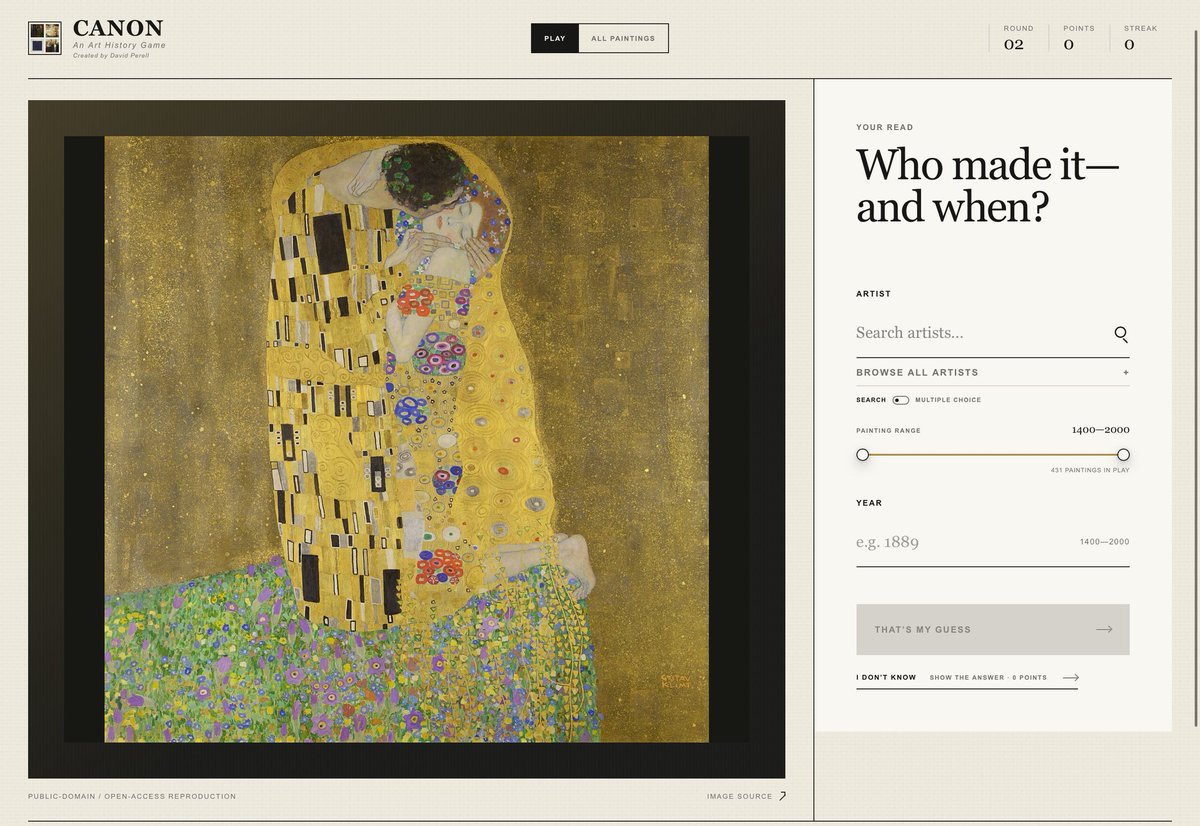
I made a game to teach myself art history.
And now I’m sharing it here, for free. It’s a trivia game that shows a painting, then asks you to guess when it was made and who painted it.
You can play with friends or by yourself.
I designed it to highlight the relationship between the spirit of an era and its paintings. Playing the game, for example, will give you a visceral sense for how different the energy was in Europe when Impressionism was popular in the 1880s vs. when Cubism was coming into fashion in the 1910s. The shift in style is a reflection of how the tectonic plates in society were shifting in the years before World War I.
Similar themes show up throughout human history. That’s why the answer page is filled with so many rabbit holes, such as Wikipedia pages about:
- The painting itself
- The year it was painted
- The artist
- The people who inspired the artist
- Popular works of art created at the time
And also a timeline of the artist’s life and a guide to looking at the painting.
Here’s the site: canon.perell.com
English


They may not care about the Treasury market. But the Treasury market cares about them.
Ben Carlson@awealthofcs
Walked by a bunch of restaurants and bars tonight that were slammed w/ppl They were smiling, drinking, eating, spending money on $19 cocktails Do they not realize the 30 year treasury yield is now 5.3%???
English

Explain to me like I’m 5 or a golden retriever how Citadel’s rate hike call 1 day before the Fed meeting, market had a 38% prob of a hike, impacted Situational Awareness positioning.
It barely moved Treasury yields.
Those making this insinuation hurt their own credibility.
Enrique Abeyta@enriqueabeyta
There is a lot of hyperventilating right now about Situational Awareness and Leopold Aschenbrenner @leopoldasch. 95% of it is BULLSHIT. First, @Citadel (and Ken Griffin) did nothing to manipulate this into happening. The kid took HUGE risks and they went the wrong way. Citadel had liquidity and he didn't. This is the way the markets are SUPPOSED to work. End of story. Second, it is doubtful this had much of an impact on the overall market. The $30 billion involved (even levered) is a tiny portion of the market. We may well have seen the "bottom" in technology stocks but this would be just a part of it not a cause of it. Remember, both tops and bottoms in the market are a PROCESS - not a moment in time.
English

Ten million people have watched an MIT professor accidentally destroy the executive coaching industry.
He filmed the lecture once in January 2018 and died eighteen months later.
Executive coaches charge fifteen thousand dollars a session to teach a third of what he covered in one hour for free.
His name was Patrick Winston. He ran the MIT Artificial Intelligence Laboratory from 1972 to 1997 and wrote the AI textbook every computer science major in the world read for thirty years.
Every January for four decades, he gave a lecture called "How to Speak."
His entire framework fits on a napkin.
Do not read. Be in the image. Keep images simple. Eliminate clutter. Start with an empathetic connection. End with a punch line the audience can repeat over dinner. Never open with a joke. Never end with "thank you."
That last rule alone has probably cost the executive coaching industry a hundred million dollars.
"Your success in life will be determined largely by your ability to speak, your ability to write, and the quality of your ideas. In that order."
That is the actual opening line of the lecture. Winston believed it strongly enough to spend fifty years teaching computer scientists how to talk.
Founders spend $80,000 on an MBA and then hire a communications coach to teach them the same material Winston filmed once for free. Engineers write brilliant code and lose promotions to teammates who watched this lecture on the train.
The lecture is free on MIT OpenCourseWare. The textbook is free on his page.
Winston died in 2019. Almost none of the ten million viewers have actually implemented the four rules on the napkin.
The napkin is free. The willingness to actually use it in your next meeting is the entire edge.
Lumen@lumenxbt
English
@GergelyOrosz do you see this out of touchness generally in the tech scene or specifically OpenAI
English

I cannot explain how terrible it is to see OpenAI’s CEO advocating to use their own AI product to have LESS personal connection with those closest to you: family and kids.
No, don’t use AI to create a podcast about your kids based on their calendars. Talk to your kids, not to AI
Sam Altman@sama
cool use case of chatgpt work i heard last night: connect your family calendars and explain your kids' interests. every morning for the drive to school, have it make a podcast that talks about one kid's soccer game that afternoon, one kid's upcoming birthday, some news, etc.
English
@itscoachgoodman i commend the philosophical attitude. do you plan to buy more Bitcoin? it's a lot to lose and there doesn't seem to be a solution
English

$1.6 million dollars in Bitcoin was drained from my account on July 29th in the Cold Card wallet hack.
My Bitcoin was in cold storage. My keys were on a ColdCard device kept in a safety deposit box that had never been connected to the internet.
This part's nerdy, but here's what happened:
Hackers discovered a vulnerability in the part of the hardware wallet code used to create seed phrases.
This allowed them to use AI to brute force guessing seed phrases.
I was at our cottage and heard about the hack today.
"No way this affects me." I thought.
I logged into Wasabi––software that lets me view my bitcoin wallets online.
Right away I saw lines of red transaction–withdrawals–and I knew.
From 9:36pm - 9:43pm on July 29th, every wallet I had had been emptied.
18.25245043 btc gone. That's just over $1.6 million dollars CAD.
Perhaps the hardest part about this is that I did everything right.
I never shared my seed phrase with anybody. My devices never touched the internet. Everything was kept in multiple safes and safety deposit boxes.
None of it mattered. All because the hardware that created the seed phrase originally had one line in their code from 2021 that had a vulnerability.
I'm filing a police report and a report with the Ontario Securities Commission. But I don't expect to recoup anything.
A part of me is trying to make sense of what just happened. Or try to figure out a lesson in it. I'm struggling. $1.6 million is a staggering amount of money to have stolen.
I guess all that I can think about right now is that I'm so damn happy that I'm an entrepreneur and that my earning potential is under my control. Mark my damn words. I'll recover.

English
curious how Bitcoin bulls explain these kinds of stories. it's weird that 15 years in this is still not uncommon. imagine $1.6 mln being stolen from a JPM account... it seems less than optimal.
Jonathan Goodman 🇨🇦@itscoachgoodman
$1.6 million dollars in Bitcoin was drained from my account on July 29th in the Cold Card wallet hack. My Bitcoin was in cold storage. My keys were on a ColdCard device kept in a safety deposit box that had never been connected to the internet. This part's nerdy, but here's what happened: Hackers discovered a vulnerability in the part of the hardware wallet code used to create seed phrases. This allowed them to use AI to brute force guessing seed phrases. I was at our cottage and heard about the hack today. "No way this affects me." I thought. I logged into Wasabi––software that lets me view my bitcoin wallets online. Right away I saw lines of red transaction–withdrawals–and I knew. From 9:36pm - 9:43pm on July 29th, every wallet I had had been emptied. 18.25245043 btc gone. That's just over $1.6 million dollars CAD. Perhaps the hardest part about this is that I did everything right. I never shared my seed phrase with anybody. My devices never touched the internet. Everything was kept in multiple safes and safety deposit boxes. None of it mattered. All because the hardware that created the seed phrase originally had one line in their code from 2021 that had a vulnerability. I'm filing a police report and a report with the Ontario Securities Commission. But I don't expect to recoup anything. A part of me is trying to make sense of what just happened. Or try to figure out a lesson in it. I'm struggling. $1.6 million is a staggering amount of money to have stolen. I guess all that I can think about right now is that I'm so damn happy that I'm an entrepreneur and that my earning potential is under my control. Mark my damn words. I'll recover.
English
imagine the Romans were the dominant global power today instead of the Americans. What architecture and art would we see being made today? How incredible would it be?
Gareth Harney@OptimoPrincipi
The spectacular Palatine Colossi from the actual throne room of the Roman emperor. Carved in rare green basanite, the colossal statues depicting Bacchus and Hercules once stood in the magnificent Aula Regia audience chamber of the Roman imperial palace, where they were unearthed in 1724. Upon their discovery the statues were brought to Parma to decorate the gardens of the Ducal Palace, before being transferred to the city's National Gallery in 1822. Flavian era, late 1st century AD.
English
agree. but its sort of funny to say this right after Anthropic - arguably the most responsible LLM - was discovered to have allowed shared results to be indexed and visible in Google searches... i mean ... it seems like the more you know about all the corner cutting by LLMs the less you should trust them
English

This is the number one question I get asked by my non-AI pilled friends.
Most people haven't unlocked all the amazing things that agents can do because they simply don't understand or trust how AI will use their personal info.
There should be more in-product education and re-assurances to overcome this hurdle.

Peter Yang@petergyang
Here’s my new tutorial that covers the six steps I follow to design and build products with AI, including how to: → Define the problem and create a design md → Prototype in Claude Design → Draft an interactive HTML spec → Design the core flows and build I share a real example of how I built Tastemaker - an app for sharing your favorite movies, TV shows, and games - end to end with Claude Design and Claude Code. One thing I’ve learned is that good upfront planning with AI is the difference between getting the product you want vs. getting slop. Flesh out the requirements and designs first, and resist AI’s urge to start coding too soon. 📌 Watch my 25-minute tutorial now: youtu.be/G9o8eoHzpxc
English

Financial advisors should increasingly consider posting on YouTube.
Ritholtz Wealth CEO Joshua Brown argues FAs should be posting on sites like YouTube that contribute to LLM content. @Downtown @RitholtzWealth
English
@tbpn @lulumeservey obviously this makes good time allocation sense. the only caveat I would say is that podcast performances can be amazingly idiyosncratic based on the host and particular moment and you don't know which interview generates fantastic clips.
English

Rostra Founder @lulumeservey says CEOs should treat media appearances like capital allocation and maximize impact with the fewest commitments.
"I think CEOs need to be thinking, 'What is minimum viable effort where I can get my vision and persona and build trust with the people that I need to without actually going on a press tour."
"If you have five publicity opportunities, and they're all different, think about who do you actually need to reach? What is the best use of your time?"
"If you don't need to reach the general population, and if you don't need to show some fun side of your personality, then instead of doing five podcasts that are all different, just cut the other three that are either duplicative or reaching people you don't need. Literally just don't do them."
English
@HedgieMarkets I do think we are seeing something fundamentally different in the unwritten contract with labor because it no longer matters if you are doing well and the company is doing well. it still doesn't matter in terms or protection
English

🦔ServiceNow laid off hundreds of employees this week. One worker stayed late on a customer problem and woke up at 6:53am to a separation notice. Others got invited to a meeting with cameras and microphones disabled. The company's Q2 revenue grew 24.5%, it beat estimates, raised guidance, and its AI business crossed $1 billion. ServiceNow is the 247th company to cut tech jobs in 2026. 124,380 people so far.
My Take
$3.88 billion in quarterly revenue and the company couldn't pick up the phone. Cameras off, mics muted, no chance to hear a human voice or ask a question. CEO McDermott promised flat headcount for the year, which means every new AI role erases an existing one. These aren't cuts from a company in trouble. These are cuts from a company that just raised guidance.
124,380 tech workers across 247 companies this year, most of them profitable. AI gave every CEO a reason to restructure and record earnings gave them the cover. If you work in tech right now, how hard you worked last night has no connection to whether you have a job tomorrow morning.
Hedgie🤗

English

Sometimes I feel like I am taking crazy pills. I log on here (and LinkedIn) and see:
> People who have never done marketing claiming to have replaced the entire function with an AI agent.
> GTM agency founders claiming to be booking inhuman amounts of meetings on autopilot (and then claiming to ‘share’ that workflow publicly).
> Clearly Claude-slopped visual assets that have the entire engagement pod going crazy in the comments section.
Meanwhile, I am over here writing each post by hand like a Luddite.
It makes me think: “Am I a bad marketer? Am I—at the age of 26—washed up?”
Sometimes I start to believe it.
Yet, every week, I talk to Heads of Marketing at Series A-C tech companies desperate for content talent.
They’ve tried a ghostwriting agency and got burned. Founders (wait for it) DON’T want their content automated by Claude, because everyone can tell. Whatever alpha there is to be found in short-term tactics that GTM bros espouse is exactly that: short-term.
Real marketing takes work.
Paul Mit@pmitu
Bad news: Marketing on autopilot will never be possible
English
@HedgieMarkets i feel like 90% of everything you write is a banger, including this one
English
🦔For somewhere between $1 and $4, an AI can now figure out who you are from your anonymous internet posts. Researchers at ETH Zurich tested this on Hacker News users and matched 67% of them to their LinkedIn profiles at 90% accuracy. The AI read their posts, pulled out small details they'd dropped over months and years, and searched for the person who fit. Classical pre-AI methods scored near 0% on the same task. One of the paper's co-authors works at Anthropic. The full paper is free to read and I'd encourage everyone to look at it.
My Take
Most people assume that if they don't put their name on something, nobody can trace it back to them. That assumption is done. The AI doesn't need you to slip up in one big way. It collects the small stuff you've scattered across years of posts, your city, your job field, a pet's name, a repeated opinion, a favorite subreddit, and assembles a profile that narrows you down from millions of candidates to one. The researchers estimated it still works against a pool of a million people, at about 45% accuracy. Anyone with API access and a few dollars can run it. A government, a corporation, an ex, a stranger. The barrier is gone.
Every anonymous account you've ever posted from, Reddit throwaways, forum accounts, anonymous reviews, is now potentially traceable to your name and employer by someone with a credit card and a few hours. If you've talked about your health, your workplace, your politics, or your personal life under a pseudonym, the protection you thought you had is much thinner than you assumed. The paper's authors put it simply: the practical obscurity that protected anonymous users online no longer holds. We should all take that seriously.
Hedgie🤗
Link to research: arxiv.org/pdf/2602.16800

English
@itsolelehmann good post. btw love the semantic use of "one shorted" in the context of nomading
English

i know several people in their mid 30s that got one-shotted by nomading and are starting to be really depressed about it
here's the problems they are facing:
> a lot of them would actually love to start a family
> EVERYONE Is single though, often for years or even decades of situationships
> optionality both human wise (relationships etc) and location wise has made it impossible to commit to anything
> there's a constant feeling of the grass might be greener (leading to no grass at all!)
> all of them moved around multiple times a year for 10-20 years
> all of the nomad places (bali, KPG etc) are dominated by people who are there only for a couple of week/months a year
> a lot of my friends have a lot of people they "know" but almost 0 true friends (because friendships actually need a lot of time spent together)
> and because all of their friends are also nomads, everyone is always on the go so it's incredibly hard to build depth in any relationship
> most of these "friendships" feel very intense in the moment but amount to 0 over a couple of years because you simply never see most people
> if you want to start a family, when you're hitting mid 30s it suddenly gets real that you might miss that traind entirely (some of them are starting to be really depressed about this)
> this is more true for women, but let's face it most 30-35 yo woman also don't want someone in their 50s or 60s so the window is also closing rapidly for the men
> most of the nomad lifestyle is also antioptimized to be family friendly
> you could say that being a nomad longterm really is anti-optimizing to make starting a family more likely
> most nomad places are also predominantly inhabited by people in their 20 or early 30, once you outgrow these cohorts a mismatch starts to happen (people either become manchilds or start feeling totally disconnected)
> btw, it's TOTALLY fine not wanting to start a family or have roots at one place. all i'm saying is many of these peopel thought so too in their mid 20s but then missed to adjust their lifestyle to what they really wanted: deep friendships, roots and eventually a family
> let's be realistic, a lot of relationships go to waste so even if you're "only" 30, that's basically just 1-2 relationships go wrong before your become infertile (as we women). it happens fast as fuck! also you don't want to start a family with someone you just met, so you also need to include at least 1-2 years of living together before you make such a decision
> friendships & relationships are assets that compound over time and it's very very hard for most nomad to actually get to that point. i'm not saying it's impossible but it's just what i'm seeing with people I know
> I think a great solution is to take some of your nomad friends and actually start a co-living project like @levelsio does.
> it's totally anecdotal, but I just wanted to remind everyone to rethink if you're lifestyle is actually aligned with your long term goals. and no, you don't have all the time in the world. things take time. use it wisely.
btw. I also traveled a lot (and still do by most people's standards)! i totally get why people love this lifestyle. but it's so important to understand the downside too

English

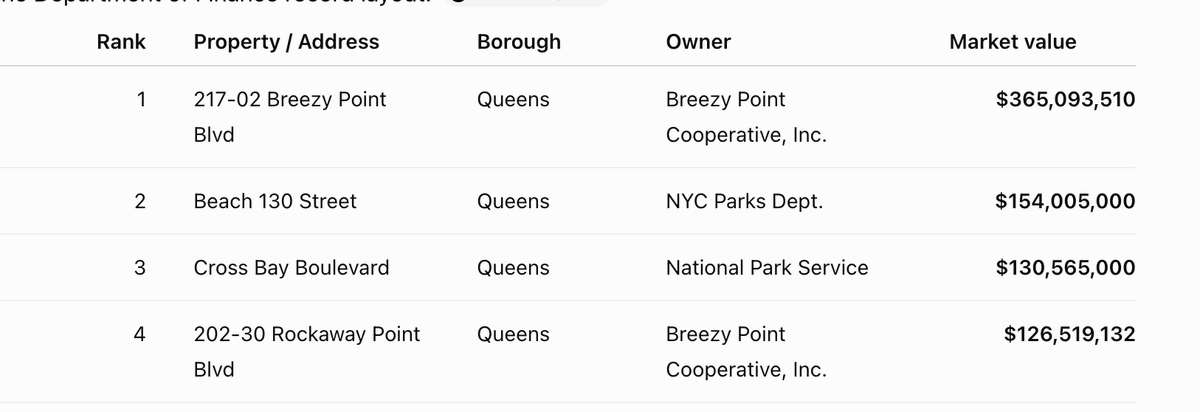
Holy crap NYC really did release every building, owner and value... can someone use Ai to clean this up!?
nyc.gov/site/finance/p…
English

Anthropic's decline continues.
Following the release of Kimi K3 on July 16, Anthropic’s implied pre-IPO valuation is estimated to have shrunk by approximately 13.1%, representing a decline of about $126.42 billion from its last confirmed valuation and about $531.20 billion from its implied peak of $1,369.78 billion.
Dario is probably worried that if he doesn't get the Trump administration to regulate his open-weight competition now, nothing will be left by the time the company goes public.

English