Deep Dive

15 posts

Deep Dive banner
Deep Dive

Deep Dive

@TheDispatch01

Deep Dive

Katılım Nisan 2026
0 Takip Edilen1.1K Takipçiler
Sabitlenmiş Tweet
Deep Dive
Deep Dive@TheDispatch01·
Dhruv, this isn’t about distance - it’s about control. Great Nicobar lies ~160 km from the Malacca Strait, one of the world’s busiest chokepoints. ▶️ Facts you skipped: • 94,000 ships pass annually • 30% of global trade flows through it • 75% of China’s energy imports depend on it This is what makes it a chokepoint, dense global traffic through a narrow corridor, exactly why the Hormuz comparison exists. And China knows it well - hence the “Malacca Dilemma.”
Dhruv Rathee@dhruv_rathee

Anyone who calls Great Nicobar as India's Strait of Hormuz is the biggest clown 🤡

English
13
191
973
42.3K
Deep Dive
Deep Dive@TheDispatch01·
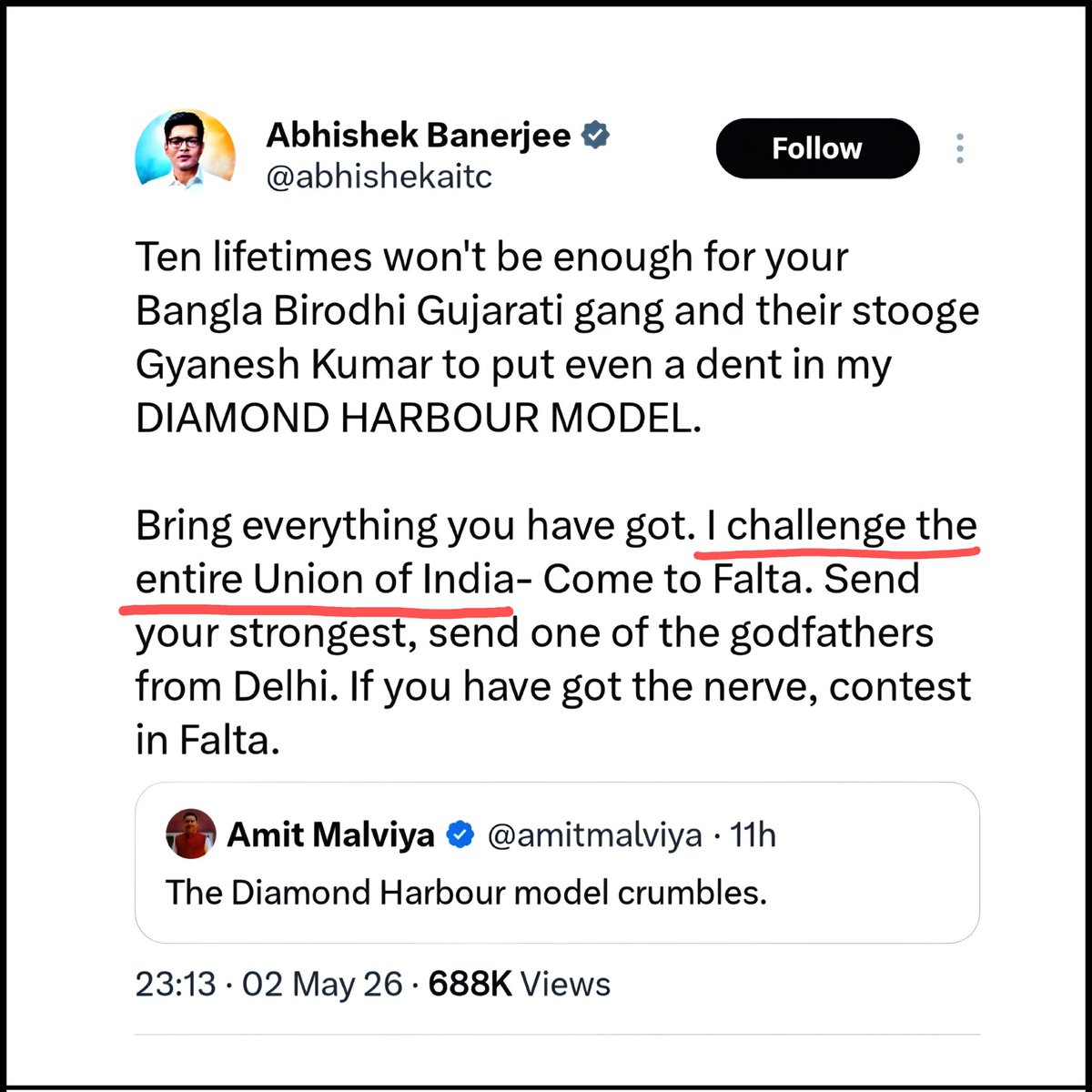
🚨 THE ANATOMY OF A DEFEAT BEING MANAGED Mamata Banerjee and Abhishek Banerjee Scripting Bengal’s Post-Result Chaos. May 4 is counting day in West Bengal. Across India, elections follow a settled democratic rhythm, polling concludes, EVMs are secured, and political actors step back as institutions deliver the verdict. From Tamil Nadu to Kerala to Assam, this norm broadly holds. Bengal stands apart. In the final stretch before counting, what is unfolding is not routine vigilance, it is a calibrated attempt to pre-shape the narrative around the result itself. And the clearest window into that mindset comes from Abhishek Banerjee’s own words. ↪️ THE TRIGGER: FROM DEFENCE TO DEFIANCE In response to criticism by Amit Malviya, Abhishek Banerjee publicly declared: > “I challenge the entire Union of India… Come to Falta… Send your strongest.” This is not defensive communication. It is confrontational escalation. More importantly, it signals something deeper: Not denial of the so-called “Diamond Harbour Model” -but ownership of it. In political messaging, false allegations are rejected. Here, they are being dared. 📌 1. THE STRONGROOM SPECTACLE: DISTRACTION AS STRATEGY Parallel to this rhetoric, high-visibility political theatre has unfolded. Mamata Banerjee’s visit to a strongroom in Bhabanipur triggered wall-to-wall coverage, amplifying suspicion around EVM security. At the same time, disturbances and allegations surfaced at other locations, away from the media spotlight. This dual-track approach fits a familiar pattern: Create noise in one place, shift focus from another. The Election Commission has maintained that strong rooms remain secure. But the objective here isn’t verification, it’s perception. 📌 2. THE ‘DIAMOND HARBOUR MODEL’: ASSERTION OVER DENIAL The controversy peaks in Falta, within Diamond Harbour. Serious irregularities were flagged: • Obstruction of voting choices • Unauthorized presence inside booths • Proxy voting patterns • Voter intimidation The institutional response was decisive: Repolling across all 285 booths. That scale alone signals systemic disruption, not isolated error. Yet, instead of distancing himself, Abhishek Banerjee doubled down, publicly defending the model and daring opponents to challenge it on ground. That shift - from allegation to assertion..is critical. 📌 3. FROM BOOTH CONTROL TO NARRATIVE CONTROL What emerges is not just an electoral issue, but a layered strategy: • Control perception before results • Cast doubt on institutional processes • Build a pre-emptive explanation for defeat The tweet isn’t just political bravado. It is a signal: The battlefield is no longer just electoral - it is psychological. 📌 4. AFTER THE VOTE: PRESSURE DOESN’T END AT THE BOOTH Ground reports suggest a familiar Bengal pattern - post-poll pressure moving from polling stations to local communities. Allegations of intimidation, warnings, and reprisals reinforce a key idea: Even if the vote is secret, the environment around it may not feel secure. This is why central forces remain extended beyond polling. This is why the contest doesn’t end with voting day. 📌 5. BUILDING THE FALLBACK BEFORE THE FALL Taken together: • Strongroom theatrics • Institutional questioning • Public confrontation • Open defence of contested methods These are not random events. They form a coherent sequence. If victory comes - narrative fades. If defeat comes - narrative activates. And that narrative is already being written. 📌 THE REAL CONTEST IS AFTER COUNTING On May 4, the numbers will be declared. But Bengal’s real battle may begin after that. Because what we are witnessing right now is not anxiety & it is preparation. A preparation to ensure that if the arithmetic doesn’t align, the narrative already does. And when a leader says, “I challenge the entire Union of India,” it’s no longer just about winning an election. It’s about controlling what the result is made to mean.
Deep Dive tweet media
English
2
21
56
12.1K
Deep Dive
Deep Dive@TheDispatch01·
History has already tested this kind of “challenge” and it didn’t end well for those who tried. • Hyderabad: wanted to stay separate, integrated in days. • Junagadh Accession: went against people’s will, brought into India. • Goa Liberation: foreign rule resisted, India took control. The Union of India isn’t challenged by rhetoric. It answers with action and history proves it every time.
Abhishek Banerjee@abhishekaitc

Ten lifetimes won't be enough for your Bangla Birodhi Gujarati gang and their stooge Gyanesh Kumar to put even a dent in my DIAMOND HARBOUR MODEL. Bring everything you have got. I challenge the entire Union of India- Come to Falta. Send your strongest, send one of the godfathers from Delhi. If you have got the nerve, contest in Falta.

English
1
9
48
3.3K
Deep Dive
Deep Dive@TheDispatch01·
Gyanesh Kumar Just Did What No Election Commissioner Has Done in West Bengal's Modern History. Here Is What the Data Tells You. 📊 Bengal’s Electoral - Past 15 Years •2016 Assembly: 8–12 killed •2018 Panchayat: 10+ killed (poll day) •2019 Lok Sabha: 12–15 killed •2021 Assembly: ~24 killed •2023 Panchayat: 11–15 killed •2024 Lok Sabha: 3 killed, 761 injured ➡️ Violence, bombs, booth capture = consistent pattern 📊 2026 Assembly Election: 294 seats | 68M+ voters | 2 phases 🟢 0 murders 🟢 0 bomb incidents 🟢 Only minor, controlled disruptions This is why the ecosystem is rattled.
Deep Dive tweet media
English
20
263
1.4K
89K
Deep Dive
Deep Dive@TheDispatch01·
Exit Poll: 4 मई दीदी गई!
0
0
6
316
Deep Dive
Deep Dive@TheDispatch01·
SIR & DELIMITATION – THE HIDDEN ARCHITECTURE OF PHASE II, BENGAL 2026 While public attention stays on rallies, the real contest in Phase II Bengal is being shaped quietly through voter rolls and constituency geometry. This is not routine politics. This is structural election engineering. 📌 THE INVISIBLE GAME: SIR + DELIMITATION Phase II is where two silent forces converge: ➡️ SIR (Special Intensive Revision of voter rolls) ➡️ Delimitation-driven constituency reshaping effects Together, they are reshaping: • voter density • booth composition • margin vulnerabilities • and “safe seats” arithmetic In tight elections, lists decide leaders before votes do. 📌 WHY PHASE II IS MOST IMPACTED ▶️ Phase II Strength: 142 Seats Phase II comprises 142 Assembly seats, with South Bengal alone accounting for 126 seats - the core decisive electoral belt. ➡️ Kolkata (11 seats): TMC 11 | BJP 0 ➡️ Howrah (16 seats): TMC 16 | BJP 0 ➡️ North 24 Parganas (33 seats): TMC 28 | BJP 5 ➡️ South 24 Parganas (31 seats): TMC 30 | BJP 1 ➡️ Nadia (17 seats): BJP 9 | TMC 8 ➡️ Hooghly (18 seats): TMC 14 | BJP 4 ▶️ In 2021, the Presidency block played a crucial role in strengthening the TMC’s performance. • TMC: 96 • BJP: 14 This is the most urban + most electorally dense region in Bengal, the highest exposure zone for voter roll corrections and demographic reshuffling impact 📌 SIR EFFECT: MARGINS UNDER PRESSURE Across multiple Phase II constituencies: • voter additions/removals recalibrate booth strength • micro-majorities shrink into razor-thin contests • “safe seats” turn into swing seats overnight In several belts, even 2,000–5,000 vote margins are now structurally vulnerable ➡️ The real shift is not vote share ➡️ It is vote stability 📌 SIR RECALIBRATION: MARGINS ARE TIGHTER NOW Massive voter deletions are concentrated in Phase II districts: • North 24 Parganas: 12.6 lakh+ • South 24 Parganas: 10.9 lakh+ • Kolkata: 7 lakh+ • Howrah: 6 lakh+ • Hooghly: 4.6 lakh+ • Nadia: 4.8 lakh+ ➡️ The scale of revision is heavily Phase II-centric, directly impacting urban-dense constituencies 📌 CONSTITUENCY IMPACT: ARITHMETIC SHIFT In 25+ constituencies, deletions exceed past victory margins: • Bongaon South: ~2,000 win margin | ~7,000 deletions • Kalyani: ~2,000 win margin | ~9,000 deletions ➡️ Earlier “safe” seats are now structurally tighter contests 📌 DELIMITATION IMPACT: REDRAWN POLITICAL GEOGRAPHY Even without dramatic seat changes, adjustments have created: • uneven voter distribution • altered urban-rural composition within seats • shifted community clustering patterns • new competitive micro-zones ➡️ Old electoral assumptions no longer hold 📌 THE STRATEGIC LAYER: BJP’S BENGAL DESIGN Over recent months, BJP’s Bengal strategy has focused on: • booth-level restructuring • voter list scrutiny • Matua belt consolidation • urban penetration planning • high-command micro-strategy inputs ➡️ Objective: convert structural weakness into battleground contests 📌 PHASE II REALITY South Bengal remains: • TMC stronghold geography • urban welfare-driven ecosystem • booth-dense organizational belt But now it is no longer static. ➡️ It is fluid, compressed, and unpredictable. This election is not only fought on ground rallies. It is fought on: • voter databases • constituency geometry • booth arithmetic • micro-level consolidation The side that controls structure… controls outcome.
Deep Dive tweet media
English
1
31
91
7.9K
Deep Dive
Deep Dive@TheDispatch01·
🚨 WHY PHASE II OF WEST BENGAL 2026 IS THE REAL BATTLE FOR BJP ➡️ 142 seats ➡️ One single polling day ➡️ The entire road to Nabanna runs through it On April 29, 2026, Bengal votes in Phase II - the decisive day. Of the 142 seats going to polls in Phase II, the TMC won 123 in 2021. The BJP won just 18. The ISF won one. 📌 THE ARITHMETIC: WHY PHASE I IS NOT ENOUGH WEST BENGAL – SIMPLE MATH Total seats: 294 Phase I: 152 | Phase II: 142 ➡️ PHASE I: BJP STRONGHOLD BELT: North Bengal + Jangal Mahal + core districts •Cooch Behar •Darjeeling •Jalpaiguri •Alipurduar •Bankura •Purulia •Paschim Medinipur. Even with a near sweep in Phase I, BJP would reach only ~80-90 seats. ⏩ Majority Mark: 148 Shortfall after Phase I: 58–68 seats ➡️.Phase II (142 seats | South Bengal): BJP must go from 18 to 58+ seats in Phase II - a 3x surge in its weakest belt. Phase I builds momentum. Phase II decides power. 📌 PHASE II GEOGRAPHY: THE NUMBERS THAT MATTER Phase II shifts the battle to south Bengal - the decisive belt. ➡️ Kolkata (11 seats): TMC 11 | BJP 0 ➡️Howrah (16 seats): TMC 16 | BJP 0 ⏩ BJP starts from zero in 27 key urban seats ➡️ North 24 Parganas (33 seats): TMC 28 | BJP 5 ➡️South 24 Parganas (31 seats): TMC 30 | BJP 1 ⏩ TMC dominance: 58 of 64 seats ➡️ Nadia (17 seats): BJP 9 | TMC 8 ➡️ Hooghly (18 seats): TMC 14 | BJP 4 ⏩ BJP’s only strong openings within Phase II Big Picture: The Presidency belt (Kolkata, Howrah, North & South 24 Parganas, Nadia) sends 111 MLAs. •TMC: 96 •BJP: 14 •ISF: 1 Phase II is BJP’s weakest zone, but also its only path to power. 📌 THE 2021 LESSON: WHERE BJP LOST THE ELECTION In 2021, BJP surged in the north, then south Bengal voted: •Presidency Division: TMC 111 | BJP 16 •Burdwan Division: TMC 79 | BJP 31 •Jalpaiguri Division: BJP 30 | TMC 23 BJP’s strength was real but limited; the decisive blow came in south Bengal’s urban belts. •Howrah (16): BJP 0 •Kolkata (11): BJP 0 •South 24 Parganas (30): BJP 0 ➡️ 57 seats. BJP: Zero 📌 THE THREE VARIABLES THAT COULD CHANGE PHASE II If Phase II repeats 2021, BJP loses. The difference? ⏩ 1. SIR Recalibration: Massive voter deletions in Phase II: •North 24 Parganas: 12.6 lakh+ •South 24 Parganas: 10.9 lakh+ •Kolkata: 7 lakh •Howrah: 6 lakh •Hooghly: 4.6 lakh+ •Nadia: 4.8 lakh+ In 25+ constituencies, deletions exceed past victory margins. •Bongaon South: ~2,000 win margin | ~7,000 deletions •Kalyani: ~2,000 win margin | ~9,000 deletions ➡️ No Safe Seat ⏩ 2. Matua Consolidation The Matua belt (North 24 Parganas + Nadia) influences 50+ seats BJP has gone all-in: •Direct outreach •Citizenship (CAA) narrative •High-symbolism campaign push ➡️ Matua consolidation can flip multiple marginal seats in one sweep. ⏩ 3. Bhabanipur Bhabanipur is more than a constituency, it’s a symbolic battleground. •CM’s home turf •High-stakes prestige fight ➡️ If TMC holds: narrative stability ➡️ If BJP breaks it: psychological shock across Bengal In tight elections, narrative drives momentum, and momentum drives votes. ➡️ Bottom Line Phase II in 2026 is not the same battlefield as 2021 now. 📌 THE 91-SEAT FORTRESS Kolkata, Howrah, North & South 24 Parganas hold 91 of 294 seats (~1/3rd) - mostly in Phase II. This belt votes now. 📌 THE MINIMUM MATH FOR BJP •Majority: 148 •Phase I best-case: 85–90 • Req from Phase II: 58–63 seats In 2021: BJP: 18/142 ➡️ BJP must 3x its tally Target Breakup: • Nadia: 5+/17 • North 24 Parganas: 10+/33 • Howrah: 3–4/16 (from 0) • Kolkata: 2–3 /11 (from 0) • Hooghly: 5+/18 • South 24 Parganas: 4–5/31 ➡️ This is not growth, it is structural realignment. •SIR impact •Matua consolidation •Urban anti-incumbency ↪️ THE MOMENT OF TRUTH Phase I kept BJP in the fight, but the gap can only close in Phase II. This isn’t just voting, it’s the verdict. Break this belt → BJP reaches Nabanna Hold this belt → TMC retains power On April 29, Bengal decides its direction.
Deep Dive tweet media
English
21
89
471
87.6K
Deep Dive
Deep Dive@TheDispatch01·
📌 THE HINDU EXODUS: WHEN A COMMUNITY VOTES WITH ITS FEET The most damning metric of any government's failure toward a community is whether its members choose to leave rather than endure. By that measure, the record is devastating. In Murshidabad, the Hindu share of the population has fallen from approximately 44% in 1951 to 33.73% in 2011. In Malda, from 65% to 48.73%. In Uttar Dinajpur, from 70%+ to approximately 50%. These are not merely demographic statistics. They are the measurable signature of a community under sustained pressure, economic displacement, physical insecurity, festival restrictions, unregistered FIRs - choosing, incrementally and reluctantly, to leave the land their families have lived on for generations. After the 2021 post-poll violence, hundreds of BJP-supporting Hindu families crossed the Bengal-Assam border to seek shelter in another state. Assam CM Himanta Biswa Sarma described it as "an ugly dance of Democracy." After the 2025 Murshidabad Waqf violence, over 500 Hindus fled specific areas. After the Dhuliyan attack, families crossed the Ganga river itself to find safety in another district. Field reporting from Murshidabad in 2025 captured the truth of this exodus in one sentence, from a displaced family: "We are not leaving because of any single incident. We are leaving because of the accumulation, the festivals we couldn't hold, the temples desecrated without consequence, the FIRs the police wouldn't register." A community that flees its homes, crosses state borders, and crosses rivers to escape violence, in a constitutional democracy, in its own state, governed by a woman who calls herself their Maa, has been failed by its government in the most fundamental way possible. 📌 THE VERDICT: GOVERNANCE BY APPEASEMENT. JUSTICE BY OMISSION. Fifteen years. One Chief Minister. One community. Let the record speak. ▶️ What Mamata Banerjee gave Bengal's Hindus: → Festivals that require court orders → Temples desecrated without prosecution → Post-poll rape and murder described as "small-small incidents" → Tax money used to fund rival religious institutions → Police that protect attackers and jail victims → A Chief Minister who appeared at the Calcutta Khilafat Committee's platform to make electoral appeals, an organisation historically associated with anti-Hindu violence in colonial India, while never once addressing a comparable Hindu organisation in the same electoral spirit → Zero unambiguous public condemnation of any documented anti-Hindu attack across 15 years ▶️ What Bengal's Hindus - 70% of the state - deserved: → Equal festival rights, applied without judicial intervention → Temple protection with the same institutional energy as mosque protection → Budget allocation proportional to their demographic weight → Police that serve citizens, not party bosses → A Chief Minister who condemns violence against them as loudly as she condemns violence against anyone else → A government that sees them as a constituency deserving equal governance, not as a fragmented vote bank that can be taken for granted, minimised, and sacrificed to maintain the coalition that matters The Hindu community of West Bengal - the builders of its temples, the practitioners of its Durga Puja, the keepers of its Rabindra-Nazrul syncretic inheritance, 70% of its people, has been governed not as the majority it constitutionally is, but as a political afterthought whose grievances can be managed, whose violence can be minimised, and whose exodus can be ignored. West Bengal decides on May 4. The evidence is on the table. The verdict belongs to the people. The End.
Deep Dive tweet media
English
0
1
5
176
Deep Dive
Deep Dive@TheDispatch01·
📌 YOUR TAX MONEY. THEIR MOSQUES. THE BUDGET THAT TELLS THE REAL STORY. Numbers don't lie. Politicians do. So let us look at the numbers. • ₹5,713 crore - West Bengal government's allocation for Minority Affairs and Madrasah Education in the 2026–27 budget. • ₹0 - Budget for an equivalent Hindu welfare board, Hindu religious education support, or Hindu development corporation. • ₹2,500 per month - State stipend paid to approximately 30,000+ imams across West Bengal since 2012. • ₹0 - Equivalent state stipend for Hindu priests, temple pujaris, or religious workers. • ₹2,500+ crore - Cumulative estimated total of imam stipend payments across 12 years, funded by Bengal's general exchequer - the overwhelming majority of whose taxpayers are Hindu. In 2012, Mamata Banerjee introduced the imam stipend scheme. It was political. It was calculated. And it established a principle that has governed 15 years of TMC budgets: minority religious infrastructure receives state investment; majority religious infrastructure does not. If any government had introduced a ₹2,500 monthly stipend for Hindu priests funded by Muslim taxpayers' money, the response would, rightly - be described as communal and unconstitutional. But when the reverse happens, it is called "secularism." That is not secularism. That is selective governance. And Bengal's Hindus have paid for it, literally - for 15 years. 📌 THE IMPUNITY MACHINE: HOW IT WORKS, STEP BY STEP The most important thing to understand about anti-Hindu violence in West Bengal is not the violence. It is the system that protects the violators. Here is the four-stage impunity machine, documented across dozens of incidents: • Stage 1 - Victim Blamed: When Ram Navami processions are attacked with petrol bombs and acid bottles, Mamata Banerjee holds a press conference and says Hindu devotees "went from area to area to create communal violence." The victims are framed as provocateurs. This is documented, on video, across multiple years. • Stage 2 - Scale Minimised: When deaths, rapes, and refugee crises result from TMC-affiliated violence, the Chief Minister describes them as "small-small incidents." She frames federal investigation as political persecution. She calls the perpetrators "our boys and girls." The scale of the crime is officially reduced before it can enter the institutional record. • Stage 3 - Police Become the Tool:** In the Jalpaiguri Ram Navami incidents, police locked the Hindu victims in jails, not the attackers. In temple desecration cases, police heard the complaint and then contacted the TMC leaders named as perpetrators to inform them "a complaint has come against you." In the 2021 post-poll violence, police were documented as complicit in facilitating attacks on BJP-supporting households. This is not institutional failure. This is institutional design. • Stage 4 - Instant Exoneration: West Bengal Police issues social media statements declaring "no communal angle" within hours of Hindu temple attacks, before any investigation has begun. In documented cases, perpetrators are described as having "mental health issues." The fastest, most conclusive investigations in Bengal's history are those that clear attacks on Hindu religious sites of communal motive. The result: West Bengal's conviction rate for communal violence cases is among the lowest in India. Cases drag for years. Witnesses are intimidated. Families withdraw complaints under pressure. And every TMC-affiliated perpetrator receives the same signal from the state machinery: attack a Hindu, burn a temple, rape a wife - and we will protect you. Part: 5 below 👇
Deep Dive tweet media
English
1
1
6
222
Deep Dive
Deep Dive@TheDispatch01·
🚨 Mamata Banerjee Foundational Betrayal: A Majority Made Into a Minority in Its Own State A Deep Dive - 15 Years of Documented Failure Based on Court Records, Budget Data, NCRB Figures, and Documented Incidents. Seventy percent of West Bengal's population is Hindu. Seventy percent. In their own state, the land that built the Durga Puja, that gave the world Vivekananda and Tagore, that produced some of India's greatest temples and philosophical traditions, Bengal's Hindu majority has spent 15 years under a government that requires them to approach the Calcutta High Court to hold their own festivals. That locks them in jails when they are attacked. That releases their attackers before the investigation is even complete. That pays their Chief Minister's political allies a monthly stipend from their own tax money, while providing nothing equivalent for their own priests and pandits. What follows is not a political pamphlet. It is a documented, data-driven record of fifteen years of governance failure, drawn from Wikipedia, NCRB reports, Calcutta High Court orders, the Census of India, Union Ministry of Home Affairs communications, and field journalism across multiple districts. Read every word. Then decide. 📌 THE FOUNDATIONAL BETRAYAL: HOW THE MAJORITY BECAME THE AFTERTHOUGHT When Mamata Banerjee assumed office in 2011, Bengal's Hindu community, 70.54% of the population, had one basic expectation from their new government: impartiality. Not special treatment. Impartiality. Equal application of law. Equal protection of constitutional rights. Equal recognition of cultural identity. What they got instead was the precise opposite. What developed under TMC rule is a political economy built on one foundational calculation that Mamata has never publicly stated but has consistently operationalised: Hindu votes are fragmented and replaceable. Muslim votes are consolidated and essential. That calculation - cold, rational, and electorally logical from her perspective, has produced every governance failure documented in this report. Fifteen years of that calculation have produced: ↪️ A state where Hindu festivals routinely need Calcutta High Court orders to proceed - while Eid celebrations face zero administrative objection anywhere in Bengal. ↪️ A state where the government allocates ₹5,713 crore for Minority Affairs and Madrasah Education in a single budget year - with zero equivalent for Hindu religious or welfare institutions. ↪️ A state where 30,000+ imams receive ₹2,500 monthly stipends from the state exchequer - paid by Hindu taxpayers, while Hindu priests and temple pujaris receive nothing. ↪️ A state where communal attackers of Hindu processions receive a public "clean chit" from the Chief Minister before any investigation is complete. ↪️ A state where, after the worst anti-Hindu violence since Partition, the Chief Minister described it as "small-small incidents that happen everywhere after elections." This is not a governance failure by omission. It is governance failure by deliberate political architecture. 📌 THE VIOLENCE CHRONICLE: NINE YEARS OF ANNUAL ATTACKS - DOCUMENTED Let us go through this year by year. Because this is not a single incident. It is a pattern. And patterns have architects. ↪️ 2017 - Baduria-Basirhat, North 24 Parganas A communal riot erupted following an objectionable social media post. Hindu homes, shops, and properties were systematically targeted and destroyed. One person was killed. On-ground journalists documented the selectivity: Muslim-owned properties in the same localities were untouched. The state government's response was delayed. No TMC leader was held accountable. Part: 2 - below 👇
Deep Dive tweet media
English
1
126
252
10.9K
Deep Dive
Deep Dive@TheDispatch01·
🚨 West Bengal's Demographic Shift & Mamata Banerjee’s Open-Door Policy ➡️ Nearly 1 in 3 seats in West Bengal is now shaped by demographics. With 294 Assembly seats, nearly 100 have over 30% Muslim population, making voter concentration as decisive as political campaigns. At the center of is the open-door approach toward illegal Bangladeshi immigration under Mamata Banerjee, and its long-term electoral impact. ↪️ THE LONG-TERM DEMOGRAPHIC SHIFT Post-Partition, West Bengal’s demographic balance looked very different: • Hindus: ~78.45% • Muslims: ~12% By 2011: • Hindus: ~70.54% • Muslims: ~27.01% ➡️ Insight: This is not a short-term fluctuation, it is a multi-decade demographic shift, with clear regional concentration patterns. ↪️ WHERE THE SHIFT IS MOST VISIBLE The change is not uniform, it is sharply concentrated in border and specific districts: • Murshidabad: 67% → rising trend • Malda: 51% → increasing share • Uttar Dinajpur: 50% → upward movement • North 24 Parganas: 25% → 30% range • Nadia: 26% → 30% range ➡️ Pattern: A continuous belt of demographic consolidation is emerging along key districts. ↪️ THE 30% THRESHOLD EFFECT Why does the “30% population” mark matter? Because in first-past-the-post systems: • 30–35% cohesive voting bloc • + fragmented opposition ➡️ Can decisively swing outcomes This is how 100 constituencies become politically sensitive zones. ↪️ CONSOLIDATION: THE REAL FORCE MULTIPLIER Demographics alone don’t win elections - voting behaviour does. • High community consolidation amplifies impact • Fragmented counter-voting reduces resistance ➡️ Result: A numerically smaller but cohesive bloc can outperform a larger but divided electorate. ↪️ BORDER DISTRICT DYNAMICS Many high-impact districts share one common feature: • Proximity to the India–Bangladesh border This introduces additional layers: • Migration debates • Documentation and voter rolls • Political narratives around identity and security ➡️ Outcome: Demography becomes not just electoral - but strategic and political. ↪️ POPULATION GROWTH: THE DEBATE Population change in Bengal is influenced by multiple factors: • Fertility rate differences (now converging nationally) • Internal migration • Cross-border movement (a politically contested issue) ➡️ Key point: While illegal immigration is a major political claim, its scale and impact remain heavily debated and not conclusively quantified in public data. ↪️ SOCIAL INFRASTRUCTURE & POLITICS There has also been a rise in: • Religious and community institutions • Education networks within specific communities ➡️ Interpretation varies: • Some see cultural assertion • Others see political mobilisation But electorally, these networks often act as: • Information channels • Community coordination systems ↪️ ELECTORAL IMPLICATION What does this mean for 2026? • 41 seats: clear demographic majority impact • 47–54 seats: high decisiveness • 100 seats: swing potential due to 30%+ population ➡️ Translation: A structured electoral advantage in clustered regions ↪️ THE STRATEGIC REALITY Winning Bengal now requires: • Breaking consolidation in high-density zones OR • Overcompensating in the remaining 190+ seats ➡️ This raises the electoral threshold significantly. ↪️ THE LARGER SHIFT This is no longer just about one election cycle. West Bengal is witnessing: • Demographic clustering • Electoral consolidation • Region-specific political behaviour ➡️ Together, they form a long-term structural electoral pattern ↪️ THE VERDICT Here’s what the data supports: • 100 seats with 30%+ Muslim population • Strong regional concentration in border districts • Consolidation amplifying electoral impact • Demography increasingly shaping political strategy The 2026 West Bengal elections won’t be won by campaigns, they’ll be dictated by demography, territorial consolidation, and bloc voting power.
Deep Dive tweet media
English
11
115
338
27.8K
Deep Dive
Deep Dive@TheDispatch01·
🚨 How Mamata Banerjee Failed the Women of West Bengal A Deep Dive The narrative of “Maa” politics in West Bengal was built on protection, welfare, and empowerment. By retaining the Home portfolio throughout her 15 year tenure, Mamata Banerjee placed herself at the center of law and order accountability. Alongside this, expansive welfare schemes targeting women reinforced her image as their political protector. And yet, under her rule, West Bengal has increasingly been seen as unsafe for women among major Indian states. This is not perception. This is data-backed reality. ↪️ THE NUMBERS MAMATA CAN’T DEFEND NCRB data exposes the gap between political claims and ground reality: • 34,738 – Crimes against women (2022) • 71.8 per lakh – Above national average • 3.7% conviction rate – among the lowest in India • 57 acid attacks (2023) – highest in the country • 1,261 trafficking cases – among top states • 3.68 lakh pending cases – justice system burdened • 15.3% rise – crimes increasing, not declining ➡️ Hard truth: In Mamata Banerjee’s Bengal, the probability of punishment remains critically low. A 3.7% conviction rate signals a severe breakdown in justice delivery. ↪️ THREE CASES THAT EXPOSED THE SYSTEM ➡️ RG Kar Medical College (2024) A trainee doctor raped and murdered inside a govt hospital. • Happened within a state institution • Triggered massive public outrage • Required intervention from the Supreme Court of India ➡️ Key takeaway: Even state-controlled spaces are not insulated from crime. ➡️ Sandeshkhali (2024) Over 200 women alleged sexual violence and coercion by a ruling party leader. • Accused absconded for weeks • Police response faced serious criticism • Incident became a major political flashpoint ➡️ Key takeaway: Perception of political shielding weakens institutional credibility. ➡️ Trafficking Network • 1,261 cases officially recorded • Experts point to possible underreporting • Concerns over organised networks in vulnerable regions ➡️ Key takeaway: Organised crime expands when enforcement weakens. ↪️ THE WELFARE ILLUSION Yes, welfare schemes exist: • Lakshmir Bhandar reaches crores • Kanyashree earned global recognition But the deeper reality: ➡️ Cash transfers cannot substitute safety Financial support does not prevent violence, ensure FIR registration, or guarantee justice. Economic indicators expose deep structural gaps. • Female youth unemployment: 11.9% • Educated women unemployment: 15.4% ↪️ THE SSC SCAM: BETRAYAL OF BENGAL’S DAUGHTERS • 25,753 teaching jobs cancelled • Declared fraudulent by courts ➡️ Impact: • Qualified women lost opportunities • Corruption in hiring • Institutional trust severely eroded A systemic failure affecting an entire generation. ↪️ THE IMPUNITY MODEL • FIRs delayed or denied • Investigations weakened • Accused often evade swift action • Witness pressure • Low conviction rates ➡️ Result: High crime, low consequences. All under Mamata Didi who retained direct control of the Home Department. ↪️ SHIFTING POLITICAL GROUND Urban & semi-urban voters are responding: • Electoral shifts visible in Kolkata pockets • Reduced dominance in key areas • Growing concern among educated women Drivers include: • Safety concerns • Corruption controversies • Institutional distrust ↪️ THE CORE CONTRADICTION West Bengal reflects a dual reality: • Strong welfare delivery • Weak law enforcement ➡️ This creates a dangerous imbalance: • Financial aid without security • Messaging without accountability • Welfare optics without justice ➡️ FINAL VERDICT Mamata built her politics on women’s empowerment. But the data tells a different story: • Rising crimes • Low conviction rates • Institutional strain • Growing public concern This is not just a governance gap - it’s a credibility crisis. When a leader claims protection and controls law and order, the failure is not just systemic. It is personal and political.
Deep Dive tweet media
English
7
112
312
29.6K
Deep Dive
Deep Dive@TheDispatch01·
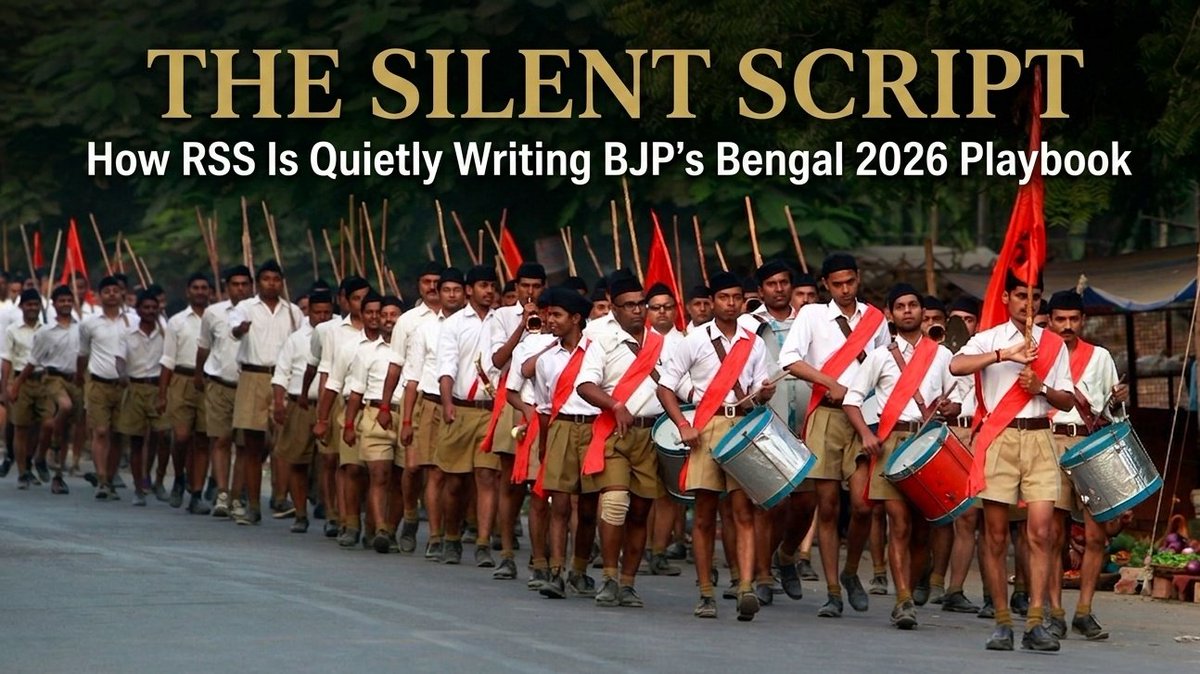
🚨 How RSS Is Quietly Writing BJP’s Bengal 2026 Playbook A Deep Dive The Historic 91.46% Phase 1 polling turnout has immediately become a critical political signal in West Bengal. In electoral analysis, such exceptionally high participation is often interpreted as a marker of strong sentiment, particularly against the ruling party. While not a direct indicator of vote direction, it suggests one clear reality: political mobilisation has intensified at the grassroots level, and voter behaviour is becoming more confrontational rather than passive. In this context, RSS’s long-term expansion in Bengal is converging with rising voter turnout driven by growing anti-incumbency, a dynamic that could reshape the 2026 contest. ↪️ WHY BENGAL HAS ALWAYS BEEN DIFFERENT Unlike the RSS strong hold states, Bengal carries a literary and intellectual tradition - Tagore, Vivekananda - that historically insulated it from the cultural nationalism associated with the RSS. Under 34 years of Left rule, the organisation was ideologically marginalised and socially contained. The shift began in 2011 with Mamata Banerjee, where identity-based welfare politics became mainstream. RSS adapted to this environment. Result: RSS units in Bengal grew to 4,540 by 2026, marking deep structural penetration. ↪️ THE 2024 TURNING POINT BJP’s drop to 12/42 Lok Sabha seats in 2024 triggered internal reassessment. The conclusion: over-reliance on personality-driven politics weakened ground expansion. ↪️ Shift initiated: • From leader-centric to organisation-centric strategy • From election bursts to continuous social embedding ↪️ SCALE OF EXPANSION • Organisational growth • 4,540 RSS units in Bengal (2026) • 583 new shakhas in one year • Target: 8,000 units covering every gram panchayat ↪️ National mobilisation support • 83,129 daily shakhas across India • 36,000+ Hindu Sammelans in centenary push • Mohan Bhagwat’s 10-day Bengal outreach (2025) ↪️ Electoral ecosystem changes • Large-scale voter roll restructuring in sensitive constituencies • Heightened electoral participation signals shifting ground sentiment ➡️ Key region focus • Madhya Banga belt: Birbhum, Bankura, Purulia, Murshidabad, Burdwan • A continuous strategic corridor combining tribal and rural Hindu zones. ↪️ SHADOW COMMAND STRUCTURE Unlike election-time party machinery, RSS operates year-round through shakhas and ideological training. Centenary programme “Har Gaon, Har Basti, Ghar Ghar” functions as: • Household mapping • Community sentiment tracking • Local ideological classification This creates a parallel grassroots intelligence system. ↪️ SIX CORE OPERATIONAL DRIVERS 1. Identity reframing Bengali culture integrated with Hindu nationalist symbols. 2. Ram Navami mobilisation Acts as structured mass mobilisation rehearsal system. 3. Urban middle-class shift (Bhadralok) Corruption, recruitment scandals, and governance fatigue create openings. 4. Matua factor Citizenship (CAA) vs voter list uncertainty becomes a key swing issue. 5. Muslim-majority seat recalibration Voter roll changes alter arithmetic in key constituencies like Jangipur. 6. Tribal belt consolidation Jangal Mahal regions show growing receptivity due to economic and identity gaps. ↪️ ELECTORAL ARITHMETIC • Total seats: 294 • Majority: 148 • BJP competitive zone: ~160 seats A 6–8% consolidation swing in Hindu vote share could translate into 30–45 seats, enough to alter state outcome dynamics under first-past-the-post. ↪️ THE LARGER REALITY Even beyond elections, a structural shift is underway. RSS expansion in Bengal is evolving into a multi-layered system: • Organisational networks • Cultural redefinition • Mobilisation pipelines • Rural and tribal embedding • Intellectual outreach This is no longer a short-term campaign model. It is long-term institutional architecture being built beneath electoral cycles. And its impact will persist regardless of the 2026 outcome.
Deep Dive tweet media
English
7
181
708
76K