How did one of the world's most advanced intelligence services fail so catastrophically on October 7th?
I've always believed Israel operates as a laboratory for the world - what happens there tends to appear elsewhere later.
Counterterrorism. Urban warfare. Targeting systems. And now, intelligence itself.
So I sat down with Dr. Itai Shapira, BG (res.) - Brigadier General, 25+ years inside Israeli intelligence - to understand what October 7th reveals about the future of strategic intelligence everywhere.
October 7th wasn't an intelligence failure because information was missing.
Hamas's operational plan existed. It was obtained. Analyzed.
Then dismissed.
Why?
Because it didn't fit the model everyone - politicians, military command, intelligence analysts - had agreed upon.
Shapira's diagnosis is brutal:
"Traditional traits of Israeli intelligence culture - moral courage, contrarian thinking - were absent."
The thing is, this isn't an Israeli problem. It's structural.
What we're witnessing is the slow death of strategic intelligence under three simultaneous pressures:
→ From above: leaders want confirmation, not friction
→ From below: AI absorbs targeting and fusion, what remains human narrows
→ From the market: everyone produces "intelligence", without doctrine or judgment
The result?
Intelligence is filtered by acceptability: what the leader WANTS TO HEAR.
🔒 Full conversation: from October 7th to the global crisis of strategic intelligence, why belief is replacing analysis, and what happens when power can't tolerate friction
Link in comments
Stay lucid,
Oriane
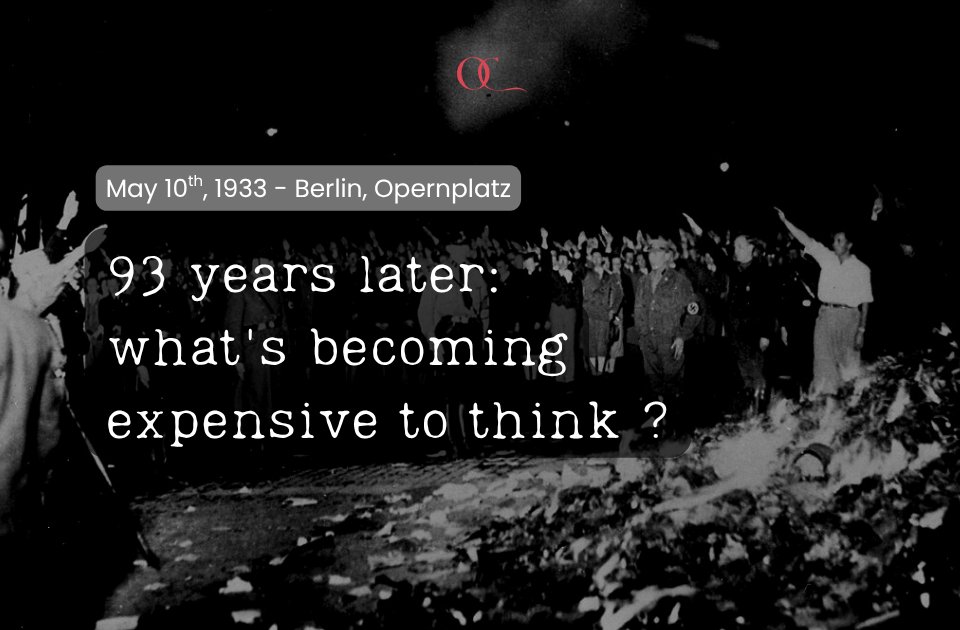
Book burnings start with cognitive exhaustion.
The most interesting thing about the Nazi book burnings of May 10, 1933 is the logic behind it.
The German students who burned Freud, Zweig, Marx, or Einstein didn't think they were destroying knowledge.
They thought they were "purifying" reality. That's the important point: a book burning is NEVER presented as destruction. Always as restoration.
Books are burned because they introduce complexity, ambiguity, multiple identities, contradictions. Fire becomes a tool for cognitive simplification.
And this is precisely where the Grey Zone begins.
Authoritarian regimes don't just control bodies or territories. They attempt to control the architectures of perception:
→ Which narratives are legitimate
→ Which words become speakable
→ Which authors become "toxic"
→ Which concepts must disappear to make the world "readable" again
But the most dangerous part is the moment when a society begins to desire the reduction of reality itself. It internalizes it.
When complexity exhausts people.
When they crave simple categories:
→ the pure / the impure
→ the loyal / the traitor
→ the people / the enemy
→ the truth / the contaminated
The book burning becomes a collective psychological act before it becomes political.
And contrary to the comfortable myth, this doesn't belong to the past...
Today, books don't necessarily burn physically. But the mechanisms still exist:
→ Algorithms that bury complexity
→ Content ranked by emotional payoff
→ Engagement metrics that select for outrage
→ Social pressure that makes ideas "expensive to defend"
→ Platforms that classify thoughts as "sensitive content"
→ Reputational destruction through coordinated reporting
→ Automatic filtering that removes what doesn't perform
Every era has its own book burnings, just with different tools.
This is the topic of today's Grey Zone piece, link in comments
Stay lucid,
Oriane
I judge people when they're drunk, yes.
It's the only time I trust what I see.
Because alcohol creates disinhibition. It lowers impulse control. And when control drops, you stop seeing what people wants you to see.
You see what... leaks.
In normal conditions, everyone manages:
→ What they say
→ How they come across
→ How much they expose
Under alcohol, that regulation weakens.
What I look for isn't whether they drink. I couldn't care less.
It's what surfaces when they stop managing perception:
The person who becomes aggressive after two drinks? That's not the alcohol talking. That's what they're suppressing during the day.
The one who overshares? That's their baseline need for connection without the executive function to manage it.
The one who stays measured? That tells me their self-control runs deeper than social performance.
--
Having people drunk on purpose is a classic HUMINT technique.
Alcohol is one of the oldest tools for reading someone's dominant traits and extracting information they wouldn't normally share.
Is it manipulative? Hell yeah.
The constraint, however, that you must not forget: if you get your target to drink, you're usually expected to drink too. Which means... the effect mirrors.
They lose control, and so do you. If you're not careful, you start leaking as much as they do...
There are ways to do it well, but that's not for this post :)
--
Don't listen to how people describe themselves.
Watch how they behave when they lose control.
💥 This week I share one HUMINT signal per day to identify manipulation, opportunism, and weak integrity early.
Stay lucid,
Oriane
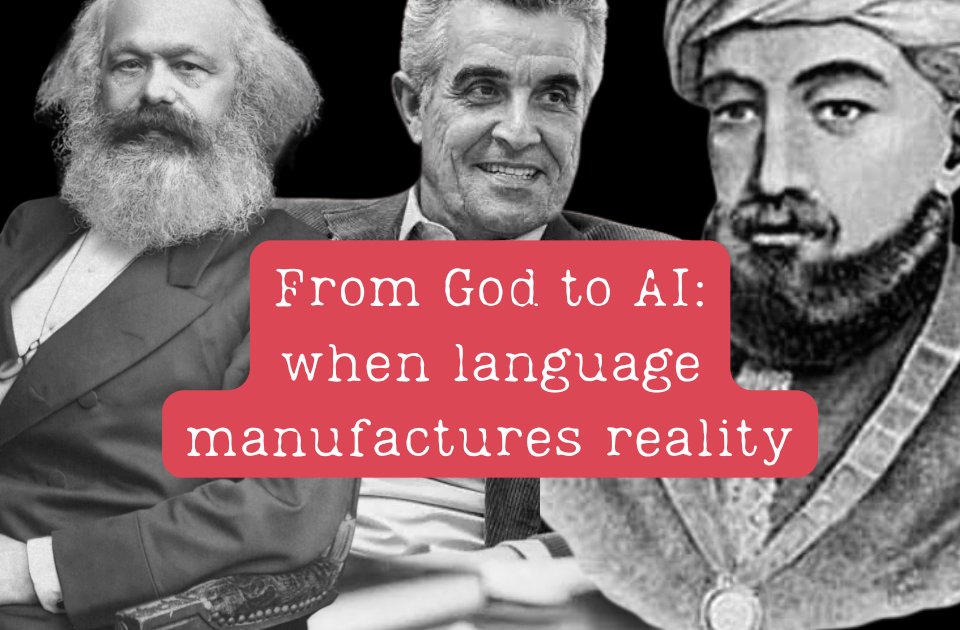
We're making the same error with AI that we made with God. And this time, it speaks back to us!
In the 12th century, Maimonides spent years addressing a problem: why does Scripture describe God with human attributes - hands, eyes, anger, movement?
His answer (in very short): because man cannot think outside the categories available to him.
When faced with something incomprehensible, we project what we can grasp. And guess what... We're doing it again.
Not with God this time. But with machines.
When we say AI "understands," "thinks," "hallucinates," even that it might "want".
We give it human language because it's the only framework we have to interpret what appears before us.
But there's a huge difference now:
When humans projected onto God, God didn't respond through a chat interface. The anthropomorphic error remained interpretive.
Today, the system produces the medium through which projection happens: language itself.
--
This is the topic of today's (very special) Grey Zone brief.
Some readers will stop at the surface of the analogy: God, AI and language.
Others will understand that this about a structure of thought that keeps returning under different names.
This brief asks for more effort than usual. If you follow it carefully, it will take you much further than theology or technology alone: into cognition, mimetic contagion, value, capital, and the strange way an error in language can become a structure of reality... and economy!
🔗 To read the full analysis: orianecohen.com/from-god-to-ai…
Stay lucid,
Oriane
Why do narratives about Jews, power, and influence keep resurfacing across different countries, systems, and periods?
And why do they intensify precisely when the world becomes unstable?
We are in one of those moments now. A grey, uncertain environment where:
- complexity and uncertainty increase
- trust erodes
- explanations collapse
And in that space, certain narratives come back... Stronger. Amplified. Now they're also monetized !
I'm not interested in debating these ideas. I've always been interested in understanding how they form.
So I’m running a fully ANONYMOUS study on how people perceive Jews today - especially in relation to power, influence, and current events.
It takes 5 to 7 minutes.
I don't gather any data: no name, no email, no tracking, nothing. What I want is raw perspectives in order to write an analysis based on actual perception.
The more responses I gather, the sharper the analysis will be. Feel free to share. I will publish the piece in the coming weeks.
🔗 Share your perspective: form.orianecohen.com/jewsperception
The most valuable companies in the world depend on the dirtiest, most fragmented industry nobody wants to talk about.
I published a Grey Zone conversation with @AmandaVandyke13, founder of the Critical Minerals Hub, that breaks every clean narrative about technology.
In the S&P 500, nearly half the market value sits in tech companies: Apple, Microsoft, Nvidia, Google, Amazon.
None of them produce minerals...
Yet, ALL of them depend on them, structurally.
One number tells you everything:
To get 1 ton of copper, you move 200 tons of rock.
An AI data center uses up to 50,000 tonnes of copper.
Now remove the minerals.
The entire system we're building on collapses.
Amanda doesn't mince words about what mining actually is.
In this conversation, we break down:
→ Why mining is the most fragmented, opaque system in the global economy
→ How China positioned itself (and why the "evil China" narrative misses the point)
→ What 40 million artisanal miners have to do with your supply chain
→ Why recycling can't save us
→ What investors miss when they price technology without pricing physical constraints
Mining is the quintessential Grey Zone industry.
It is the hidden engine behind the global technological revolution, financial stability, and energy transition. Crucial, yet dangerously overlooked.
Nobody controls it.
And you should beware of anyone who pretends they can.
🔗 Full piece in the comments
Are you investing in the future without understanding what it's actually built on?
Stay lucid,
Oriane
Elicitation is the art of creating conditions where truth wants to reveal itself. You don't extract information, you create the environment where they give it freely.