
Infravision Foundation

1.2K posts

Infravision Foundation banner
Infravision Foundation

Infravision Foundation

@TheInfravision

We are an independent think-tank working to evaluate and shape India’s public policy in infrastructure development.

Gurugram Katılım Mayıs 2023
784 Takip Edilen384 Takipçiler
Infravision Foundation
Infravision Foundation@TheInfravision·
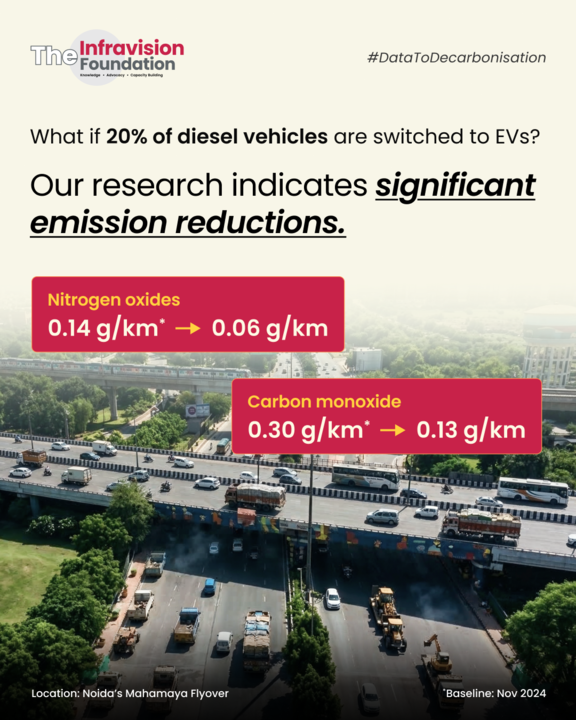
In our previous posts under hashtag#DataToDecarbonisation, we decoded how spatial insights from traffic intelligence can help curb urban emissions and congestion. Through examples of Bhubaneswar, Hyderabad and Singapore, we also understood how tools such as AI-based adaptive signal optimisation can improve traffic flow. But that is just one layer of our decarbonisation research. The evidence from our Noida study points to another crucial insight. ➡️ Urban transport emissions are not driven by vehicle volume alone. The fuel type of vehicles matters a lot as well. Using traffic data from the city’s Intelligent Traffic Management System (ITMS), the report modelled emission scenarios for one of Noida’s key corridors, the 𝐁𝐞𝐥𝐨𝐰 𝐌𝐚𝐡𝐚𝐦𝐚𝐲𝐚 𝐟𝐥𝐲𝐨𝐯𝐞𝐫 area. The results revealed how even modest fleet electrification can generate outsized gains. In the scenario analysis, we found that converting just 𝟐𝟎% 𝐨𝐟 𝐭𝐡𝐞 𝐝𝐢𝐞𝐬𝐞𝐥 𝐯𝐞𝐡𝐢𝐜𝐥𝐞𝐬 operating in the area to EVs could significantly reduce key pollutants. 🔷 NOx emissions could fall from 0.14 g/km to 𝟎.𝟎𝟔 𝐠/𝐤𝐦. 🔷 CO emissions could fall from 0.30 g/km to 𝟎.𝟏𝟑 𝐠/𝐤𝐦. The base of this insight lies in the disproportionately high emission potential of diesel vehicles. With a mere 𝟐𝟐% share in the fleet (compared to 55% petrol and 23% CNG), diesel vehicles emitted𝟕𝐱 𝐦𝐨𝐫𝐞 𝐍𝐎𝐱 than other vehicles. Even partial electrification, therefore, can deliver a significant impact. 🔶 𝐏𝐨𝐥𝐢𝐜𝐲 𝐭𝐚𝐤𝐞𝐚𝐰𝐚𝐲 The findings highlight a critical policy takeaway. The urban transport decarbonisation framework must be broader. It must address both 𝐭𝐫𝐚𝐟𝐟𝐢𝐜 𝐞𝐟𝐟𝐢𝐜𝐢𝐞𝐧𝐜𝐲 and 𝐟𝐥𝐞𝐞𝐭 𝐜𝐨𝐦𝐩𝐨𝐬𝐢𝐭𝐢𝐨𝐧. When combined with data-driven traffic management systems, cities gain the ability to design targeted interventions. From incentives to congestion pricing, from 𝐋𝐨𝐰-𝐄𝐦𝐢𝐬𝐬𝐢𝐨𝐧 𝐙𝐨𝐧𝐞𝐬 (𝐋𝐄𝐙𝐬) to clean freight corridors, multiple pathways can support urban transport decarbonisation. 𝐒𝐦𝐚𝐫𝐭 𝐭𝐫𝐚𝐟𝐟𝐢𝐜 𝐦𝐚𝐧𝐚𝐠𝐞𝐦𝐞𝐧𝐭 and strategic 𝐟𝐥𝐞𝐞𝐭 𝐞𝐥𝐞𝐜𝐭𝐫𝐢𝐟𝐢𝐜𝐚𝐭𝐢𝐨𝐧 must work together at the core of the decarbonisation framework. Policy implementation and behavioural changes can follow their lead. For a deeper look at the modelling framework, emission analysis and policy recommendations, read our report “𝐃𝐞𝐜𝐚𝐫𝐛𝐨𝐧𝐢𝐬𝐢𝐧𝐠 𝐮𝐫𝐛𝐚𝐧 𝐭𝐫𝐚𝐧𝐬𝐩𝐨𝐫𝐭 𝐮𝐬𝐢𝐧𝐠 𝐭𝐫𝐚𝐟𝐟𝐢𝐜 𝐚𝐧𝐝 𝐭𝐫𝐚𝐧𝐬𝐩𝐨𝐫𝐭 𝐝𝐚𝐭𝐚 𝐟𝐫𝐨𝐦 𝐈𝐂𝐂𝐂: 𝐀 𝐏𝐢𝐥𝐨𝐭 𝐒𝐭𝐮𝐝𝐲 𝐢𝐧 𝐍𝐨𝐢𝐝𝐚.” Link: theinfravisionfoundation.org/assets/pdf/dec… #Decarbonisation #CleanMobility #SustainableTransport #ClimateAction #DataToDecarbonisation #TheInfravisionFoundation
Infravision Foundation tweet media
English
0
0
0
39
Infravision Foundation
Infravision Foundation@TheInfravision·
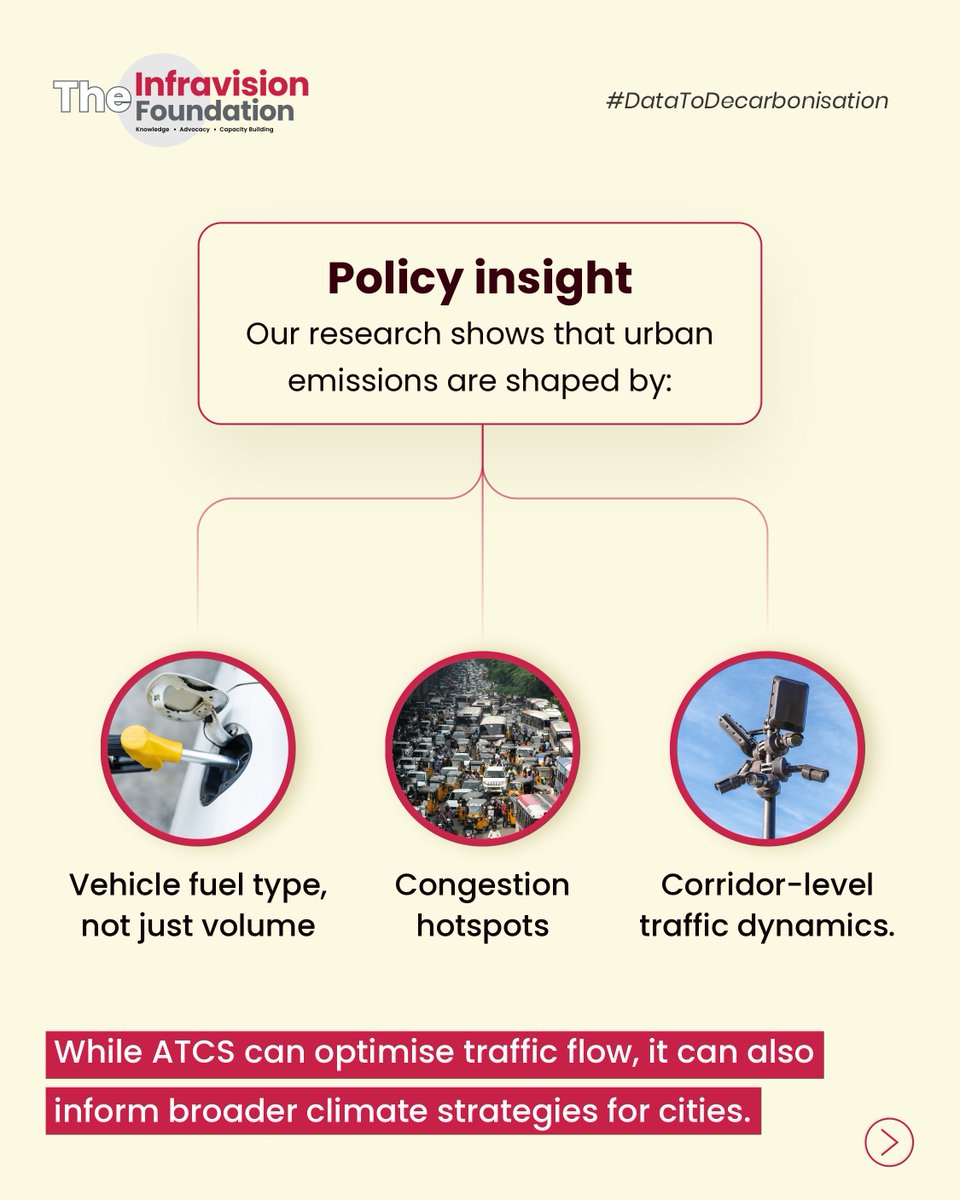
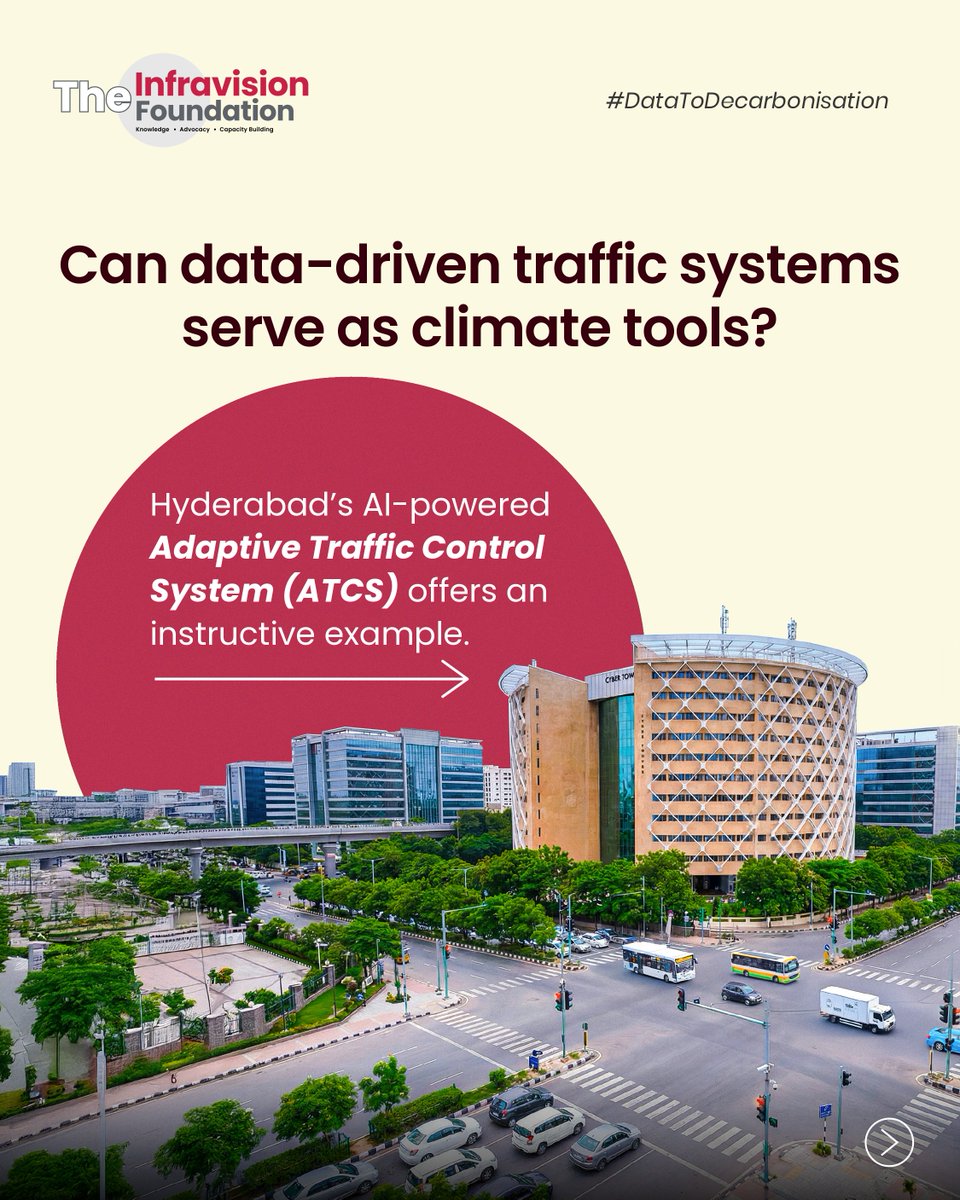
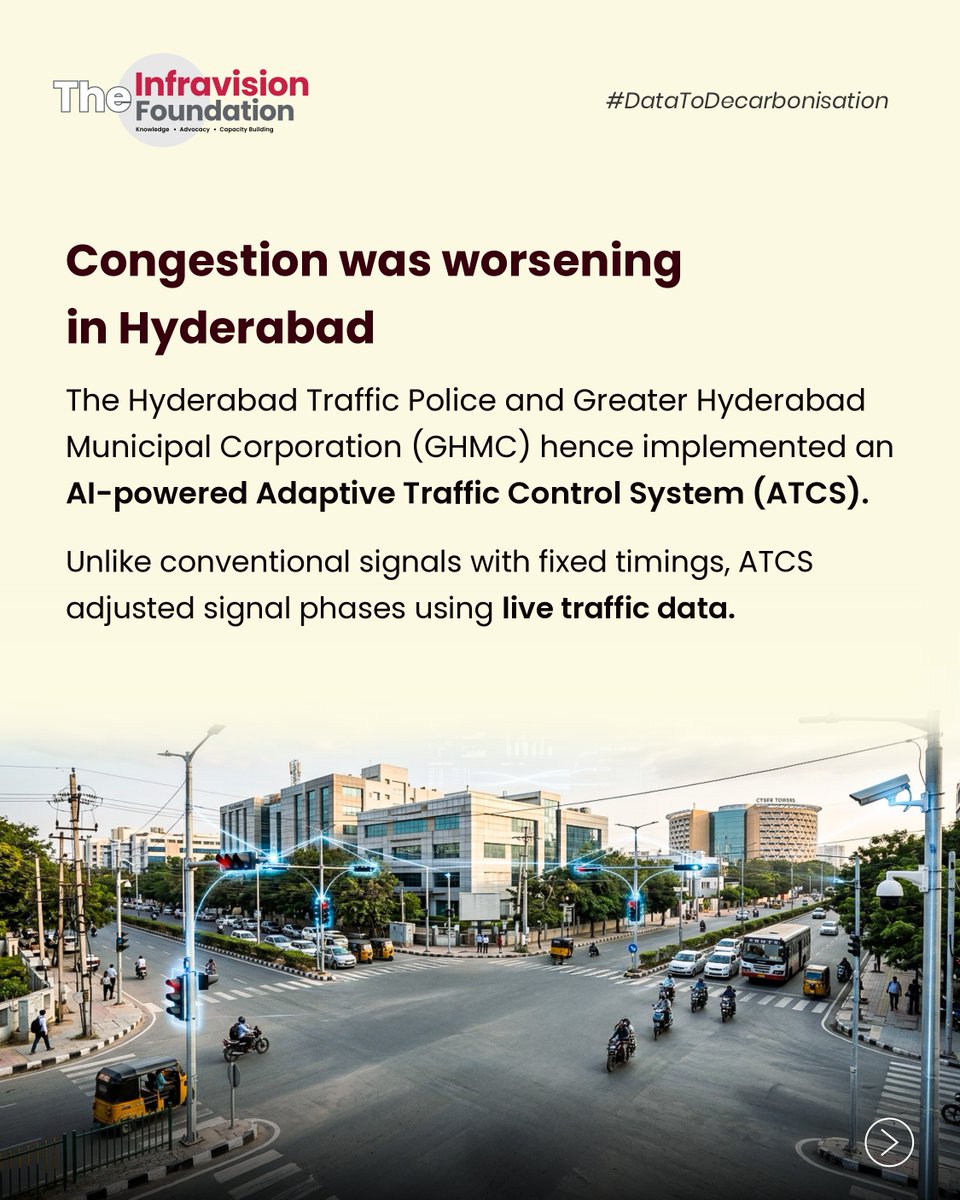
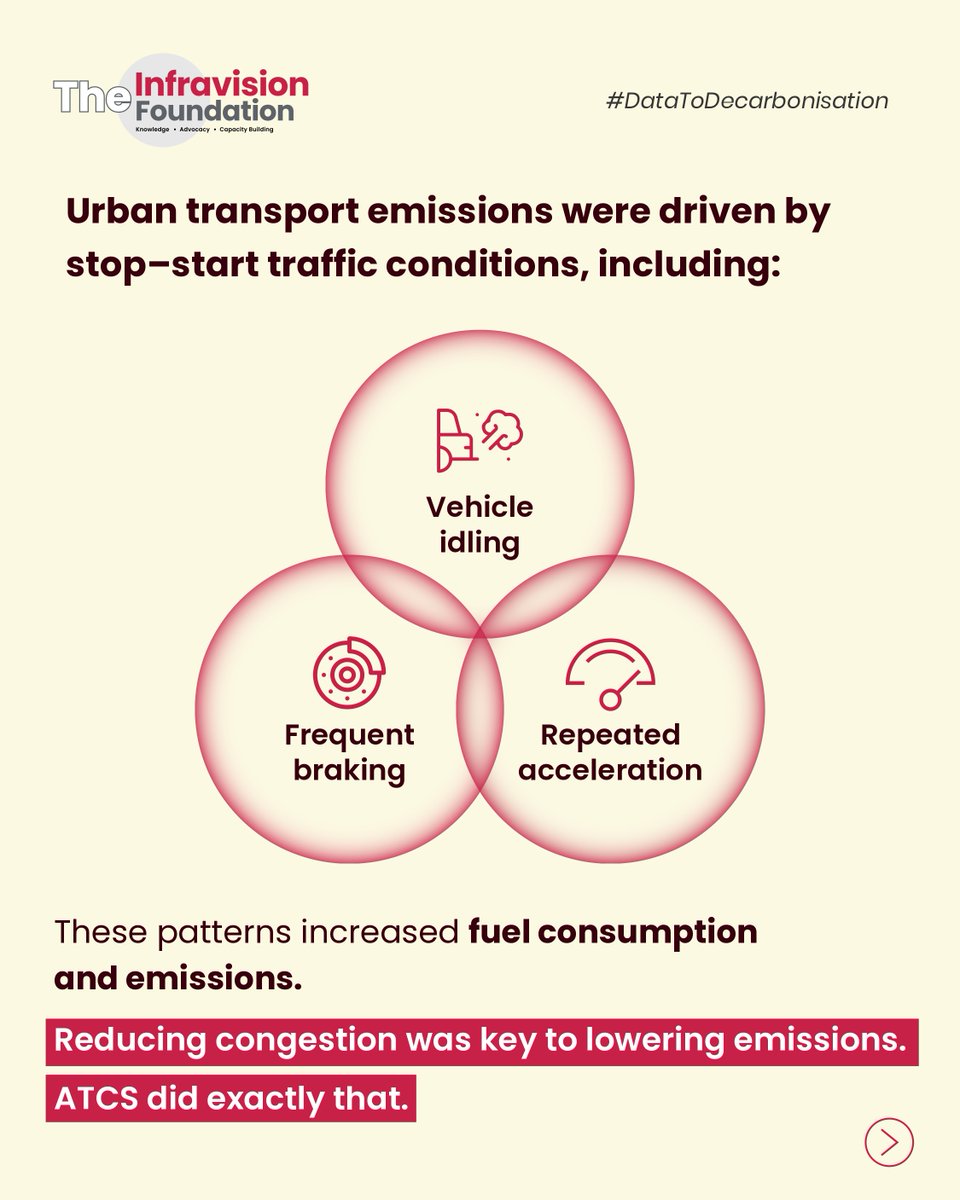
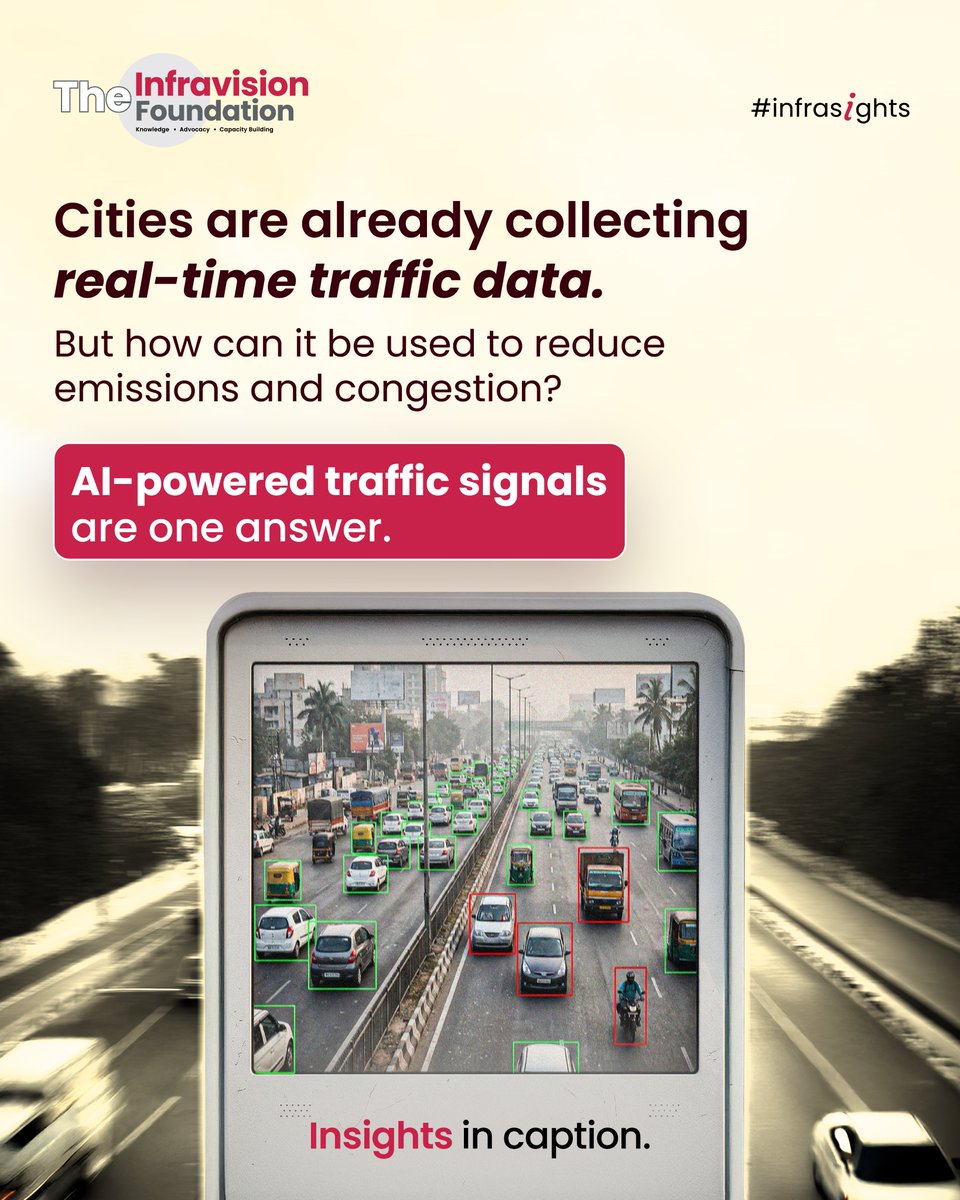
By 2030, more than 40% of India’s population will dwell in urban areas. In a rapidly urbanising India, congestion and emissions can no longer be treated as mobility problems. They are increasingly becoming a 𝐜𝐥𝐢𝐦𝐚𝐭𝐞 𝐜𝐡𝐚𝐥𝐥𝐞𝐧𝐠𝐞. This means traffic systems can’t remain just city-level mobility tools. They must also be viewed as climate tools. Hyderabad’s 𝐀𝐈-𝐩𝐨𝐰𝐞𝐫𝐞𝐝 𝐀𝐝𝐚𝐩𝐭𝐢𝐯𝐞 𝐓𝐫𝐚𝐟𝐟𝐢𝐜 𝐂𝐨𝐧𝐭𝐫𝐨𝐥 𝐒𝐲𝐬𝐭𝐞𝐦 (𝐀𝐓𝐂𝐒) offers a commanding example. It shows how traffic data can do more than just optimise traffic flow. By reducing vehicle idling and optimising signal cycles through AI/ML-driven predictive analysis, ATCS hints at a larger possibility: traffic systems as 𝐞𝐦𝐢𝐬𝐬𝐢𝐨𝐧 𝐠𝐨𝐯𝐞𝐫𝐧𝐚𝐧𝐜𝐞 𝐭𝐨𝐨𝐥𝐬. More in the carousel. Interested in learning more about Hyderabad’s ATCS? Read our report “𝐃𝐞𝐜𝐚𝐫𝐛𝐨𝐧𝐢𝐬𝐢𝐧𝐠 𝐮𝐫𝐛𝐚𝐧 𝐭𝐫𝐚𝐧𝐬𝐩𝐨𝐫𝐭 𝐮𝐬𝐢𝐧𝐠 𝐭𝐫𝐚𝐟𝐟𝐢𝐜 𝐚𝐧𝐝 𝐭𝐫𝐚𝐧𝐬𝐩𝐨𝐫𝐭 𝐝𝐚𝐭𝐚 𝐟𝐫𝐨𝐦 𝐈𝐂𝐂𝐂: 𝐀 𝐏𝐢𝐥𝐨𝐭 𝐒𝐭𝐮𝐝𝐲 𝐢𝐧 𝐍𝐨𝐢𝐝𝐚.” Report link: theinfravisionfoundation.org/assets/pdf/dec… #DataToDecarbonisation #ClimateAction #SustainableCities #ThoughtLeadership #TheInfravisionFoundation
Infravision Foundation tweet mediaInfravision Foundation tweet mediaInfravision Foundation tweet mediaInfravision Foundation tweet media
English
1
0
0
43
Infravision Foundation
Infravision Foundation@TheInfravision·
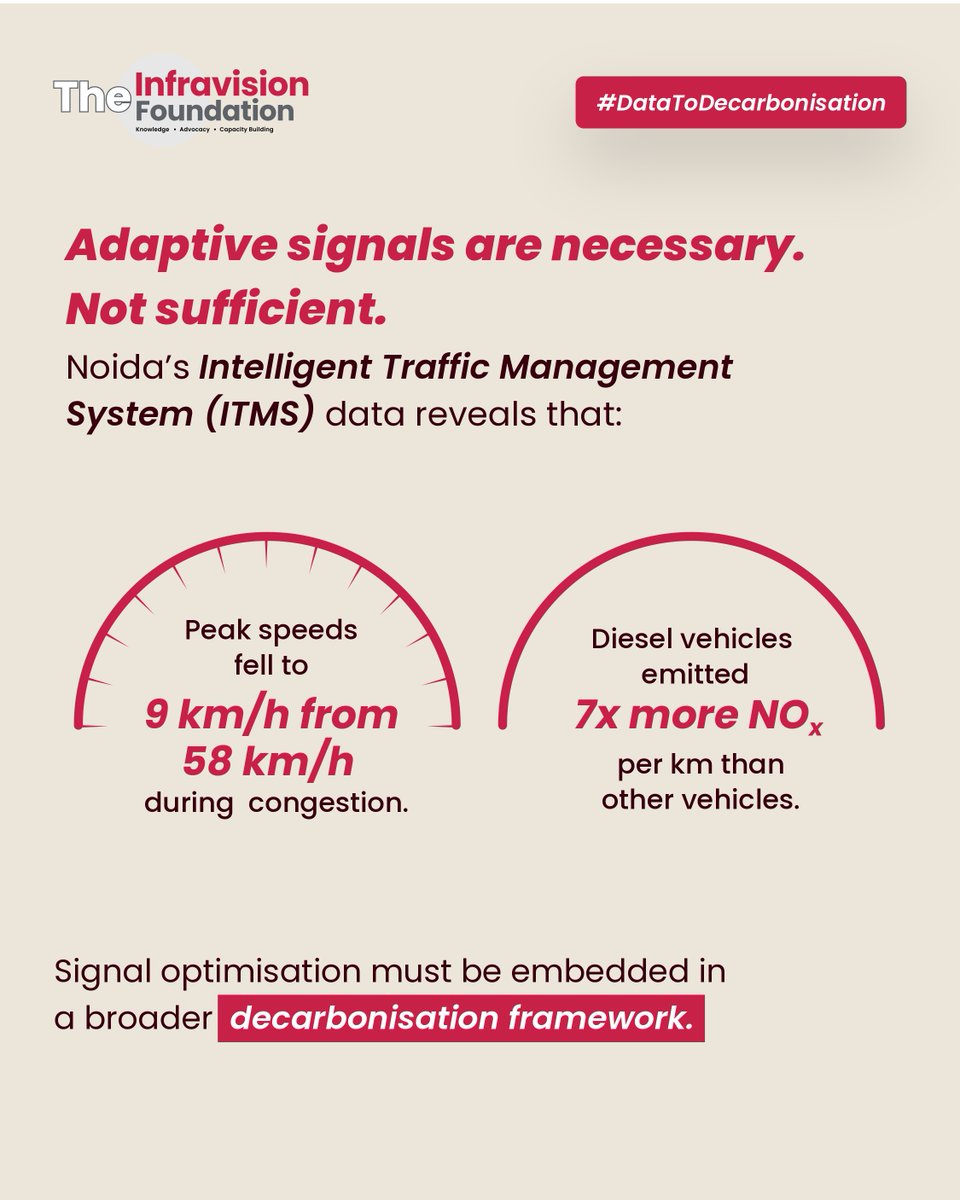
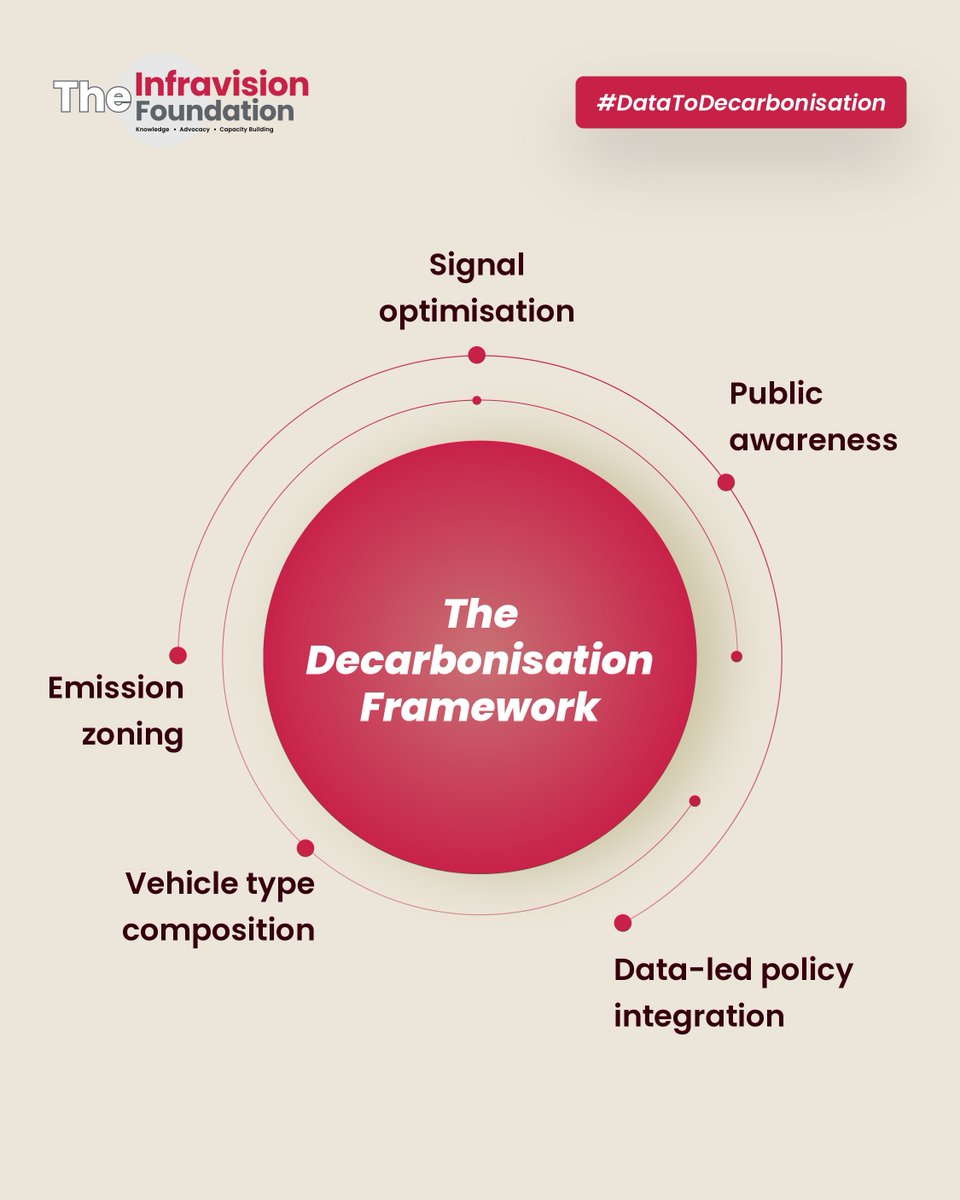
In our previous post, we examined how AI-driven adaptive signal optimisation can improve traffic flow with Bhubaneswar’s case in point. But congestion management alone cannot address the urban emission challenge. It must be embedded within a broader regulatory framework. Data from Noida’s Intelligent Traffic Management System (ITMS), spanning 677 devices across 112 locations, gave us a spatial analysis of speed and pollutant trends. The results were not citywide. They were 𝐜𝐨𝐫𝐫𝐢𝐝𝐨𝐫-𝐬𝐩𝐞𝐜𝐢𝐟𝐢𝐜. 🔷 At 𝐛𝐞𝐥𝐨𝐰 𝐌𝐚𝐡𝐚𝐦𝐚𝐲𝐚, PM₂.₅ levels reached 𝟐𝟓𝟏.𝟕 μ𝐠/𝐦³. (The CPCB standard is 60 μg/m³.) 🔷 Sector 93 recorded PM₂.₅ concentrations of 𝟑𝟎𝟐.𝟐 μ𝐠/𝐦³, alongside low vehicle speeds and elevated NO₂ levels. It indicated congestion-amplified emissions. 🔷 𝐌𝐨𝐝𝐞𝐥 𝐓𝐨𝐰𝐧 and 𝐒𝐞𝐜𝐭𝐨𝐫 𝟗𝟑 also emerged as PM2.5 and PM₁₀ hotspots. 𝐓𝐡𝐞 𝐞𝐯𝐢𝐝𝐞𝐧𝐜𝐞 𝐢𝐬 𝐬𝐩𝐚𝐭𝐢𝐚𝐥. When emissions concentrate in specific corridors and intersections, regulations must follow that geography. Our research report proposes the formalisation of 𝐋𝐨𝐰-𝐄𝐦𝐢𝐬𝐬𝐢𝐨𝐧 𝐙𝐨𝐧𝐞𝐬 (𝐋𝐄𝐙𝐬) to leverage targeted enforcement for precise outcomes. LEZs are geographically demarcated areas where vehicle entry is highly regulated by emission class (Bharat Stage norms). Within these identified hotspots, entry of high-emission vehicles is either restricted or priced, while cleaner fleets such as EVs and hybrids are prioritised. Enabled by GIS mapping, traffic analytics and Integrated Command and Control Centres (ICCC), LEZs become a precise regulatory layer within a broader decarbonisation toolkit. By regulating high-emission vehicles, LEZs can also create enabling conditions for cleaner fleets and public transport prioritisation. It marks a shift from 𝐭𝐫𝐚𝐟𝐟𝐢𝐜 𝐨𝐩𝐭𝐢𝐦𝐢𝐬𝐚𝐭𝐢𝐨𝐧 𝐭𝐨 𝐬𝐩𝐚𝐭𝐢𝐚𝐥 𝐞𝐦𝐢𝐬𝐬𝐢𝐨𝐧 𝐠𝐨𝐯𝐞𝐫𝐧𝐚𝐧𝐜𝐞. Read our full report “𝐃𝐞𝐜𝐚𝐫𝐛𝐨𝐧𝐢𝐬𝐢𝐧𝐠 𝐮𝐫𝐛𝐚𝐧 𝐭𝐫𝐚𝐧𝐬𝐩𝐨𝐫𝐭 𝐮𝐬𝐢𝐧𝐠 𝐭𝐫𝐚𝐟𝐟𝐢𝐜 𝐚𝐧𝐝 𝐭𝐫𝐚𝐧𝐬𝐩𝐨𝐫𝐭 𝐝𝐚𝐭𝐚 𝐟𝐫𝐨𝐦 𝐈𝐂𝐂𝐂: 𝐀 𝐏𝐢𝐥𝐨𝐭 𝐒𝐭𝐮𝐝𝐲 𝐢𝐧 𝐍𝐨𝐢𝐝𝐚” for deeper insights. Link : theinfravisionfoundation.org/assets/pdf/dec… #DataToDecarbonisation #AI #ICCC #TheInfravisionFoundation
Infravision Foundation tweet media
English
0
0
1
31
Infravision Foundation
Infravision Foundation@TheInfravision·
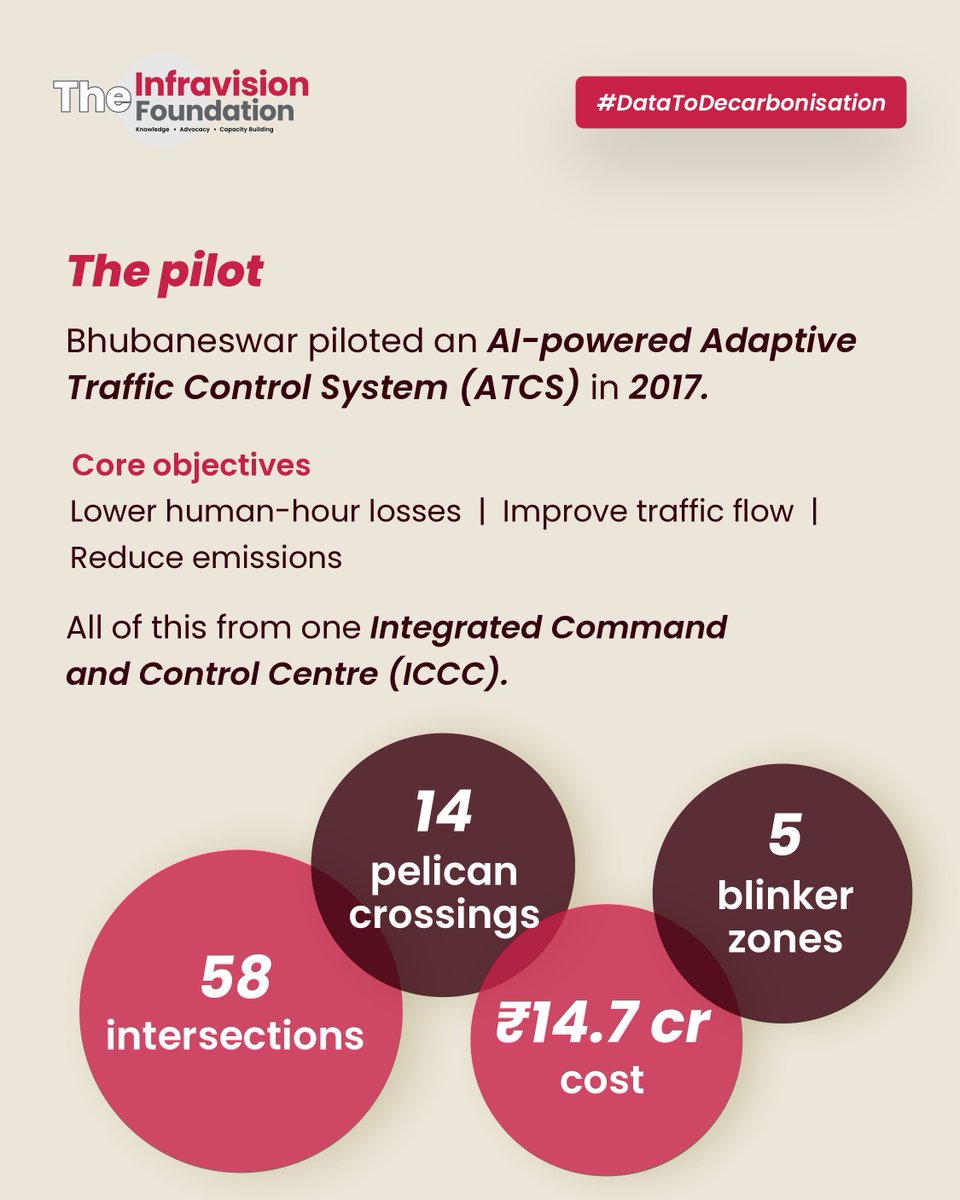
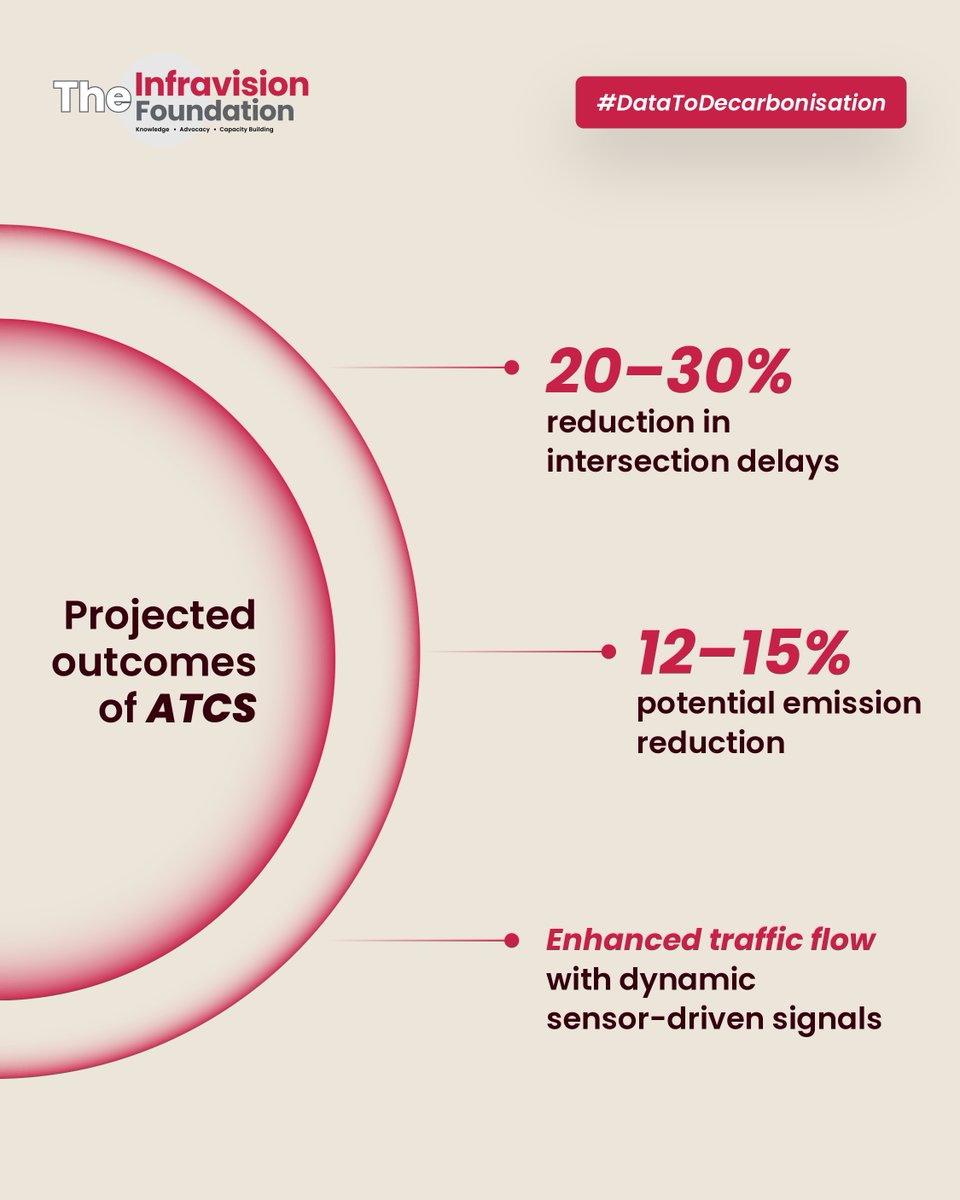
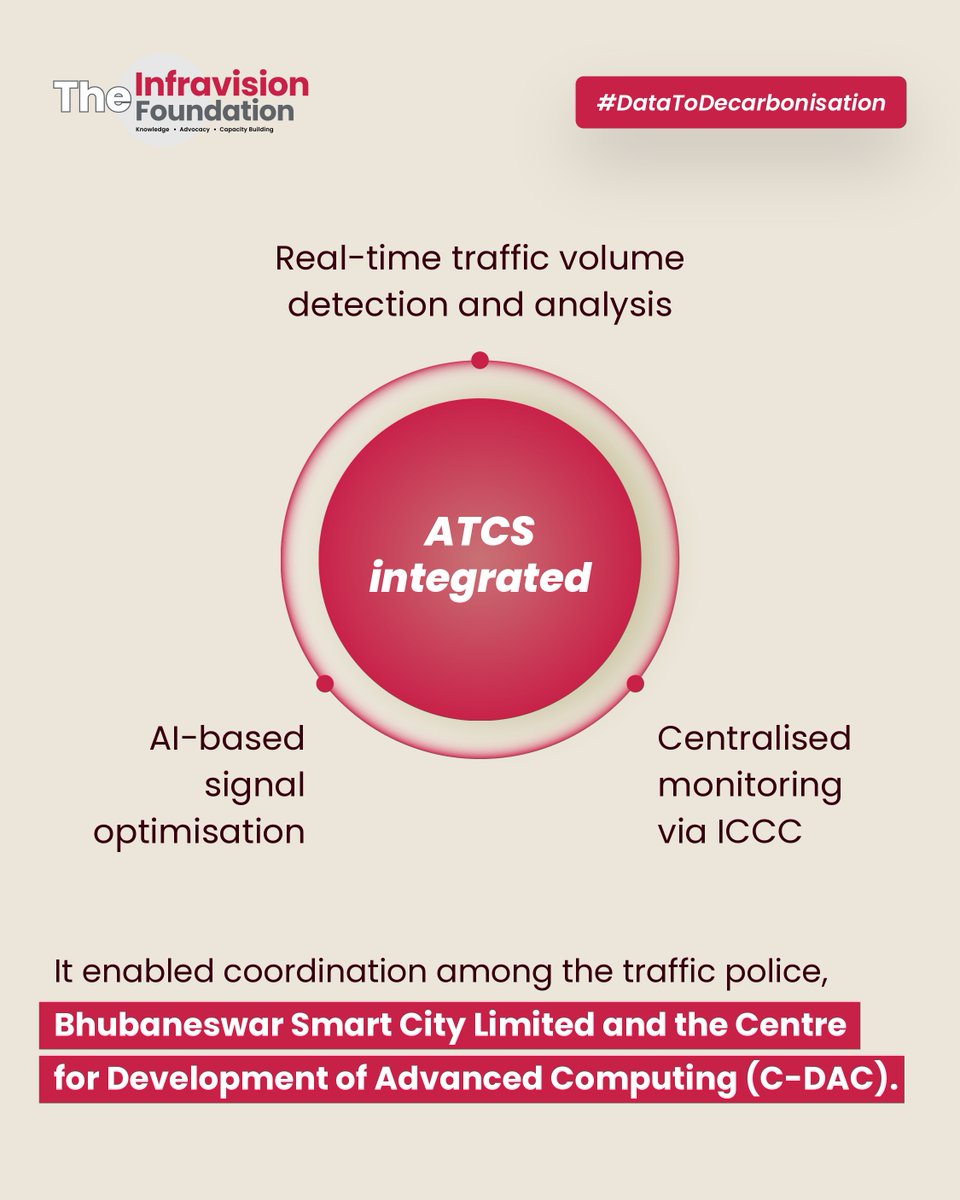
India is experiencing serious mobility pressure. From congestion to emissions, urban transport is becoming a 𝐜𝐥𝐢𝐦𝐚𝐭𝐞 and 𝐩𝐮𝐛𝐥𝐢𝐜 𝐡𝐞𝐚𝐥𝐭𝐡 𝐜𝐡𝐚𝐥𝐥𝐞𝐧𝐠𝐞. 𝐁𝐡𝐮𝐛𝐚𝐧𝐞𝐬𝐰𝐚𝐫 offers an instructive example of how traffic and transport data can help cities understand emission patterns and prioritise interventions. Using an indigenous AI-powered solution developed by the Centre for Development of Advanced Computing (C-DAC), the city is making conscious efforts to reduce congestion and associated emissions. Our #DataToDecarbonisation series explores why traffic systems must be viewed through a climate lens. This shift can not just decongest city roads but also decarbonise urban transport. More details in the carousel. Interested in exploring the findings further? Read our report “𝐃𝐞𝐜𝐚𝐫𝐛𝐨𝐧𝐢𝐬𝐢𝐧𝐠 𝐔𝐫𝐛𝐚𝐧 𝐓𝐫𝐚𝐧𝐬𝐩𝐨𝐫𝐭 𝐔𝐬𝐢𝐧𝐠 𝐓𝐫𝐚𝐟𝐟𝐢𝐜 𝐚𝐧𝐝 𝐓𝐫𝐚𝐧𝐬𝐩𝐨𝐫𝐭 𝐃𝐚𝐭𝐚 𝐟𝐫𝐨𝐦 𝐈𝐂𝐂𝐂: 𝐀 𝐏𝐢𝐥𝐨𝐭 𝐒𝐭𝐮𝐝𝐲 𝐢𝐧 𝐍𝐨𝐢𝐝𝐚.” Link theinfravisionfoundation.org/assets/pdf/dec… #DataToDecarbonisation #TheInfravisionFoundation
Infravision Foundation tweet mediaInfravision Foundation tweet mediaInfravision Foundation tweet mediaInfravision Foundation tweet media
English
1
0
0
38
Infravision Foundation
Infravision Foundation@TheInfravision·
In Noida, diesel vehicles constitute only 22% of the city’s fleet. Yet, they emit nearly 7x more nitrogen oxides (NOx) per kilometer than petrol or CNG vehicles. Precisely, 0.14 g/km versus 0.02 g/km. Road transport contributes nearly 10% to India’s GDP and is the backbone of its mobility system with: 🔷 87% passenger traffic 🔷 60% Freight movement But greenhouse gas (GHG) emissions and congestion have become the mandatory consequences of this dependence. The rapid increase in the number of private vehicles, along with inadequate public transport infrastructure, has played a major hand. Cities are not oblivious to this reality. They have introduced technological integrations to manage the crisis. For instance, under the Smart Cities Mission (2015), many cities have operationalised Integrated Command and Control Centres (ICCCs) for traffic management, solid waste management and water distribution management. For traffic management, these centralised systems collect data such as speed, vehicle flows, violations and pollution levels. The data exists. Yet, GHG emissions continue to rise. Congestion continues to worsen. The obvious question: If we already have so much data, why is decarbonisation still reactive? Over the next few weeks, we will address the challenges of emissions and congestion. We will examine how Indian cities can move from traffic management to transport decarbonisation, using the data they already collect. Stay tuned. #FromDataToDecarbonisation
English
0
1
1
45
Infravision Foundation
Infravision Foundation@TheInfravision·
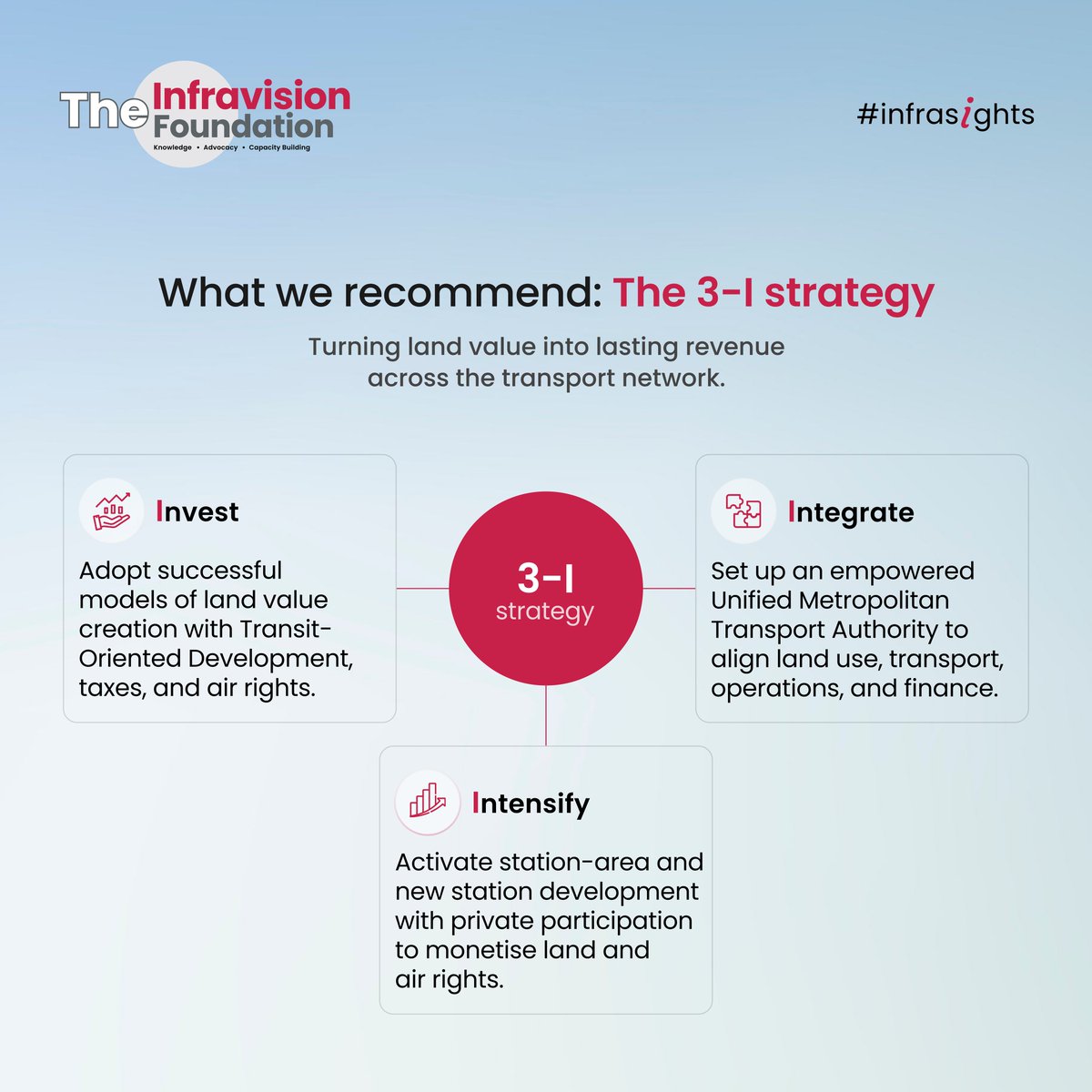
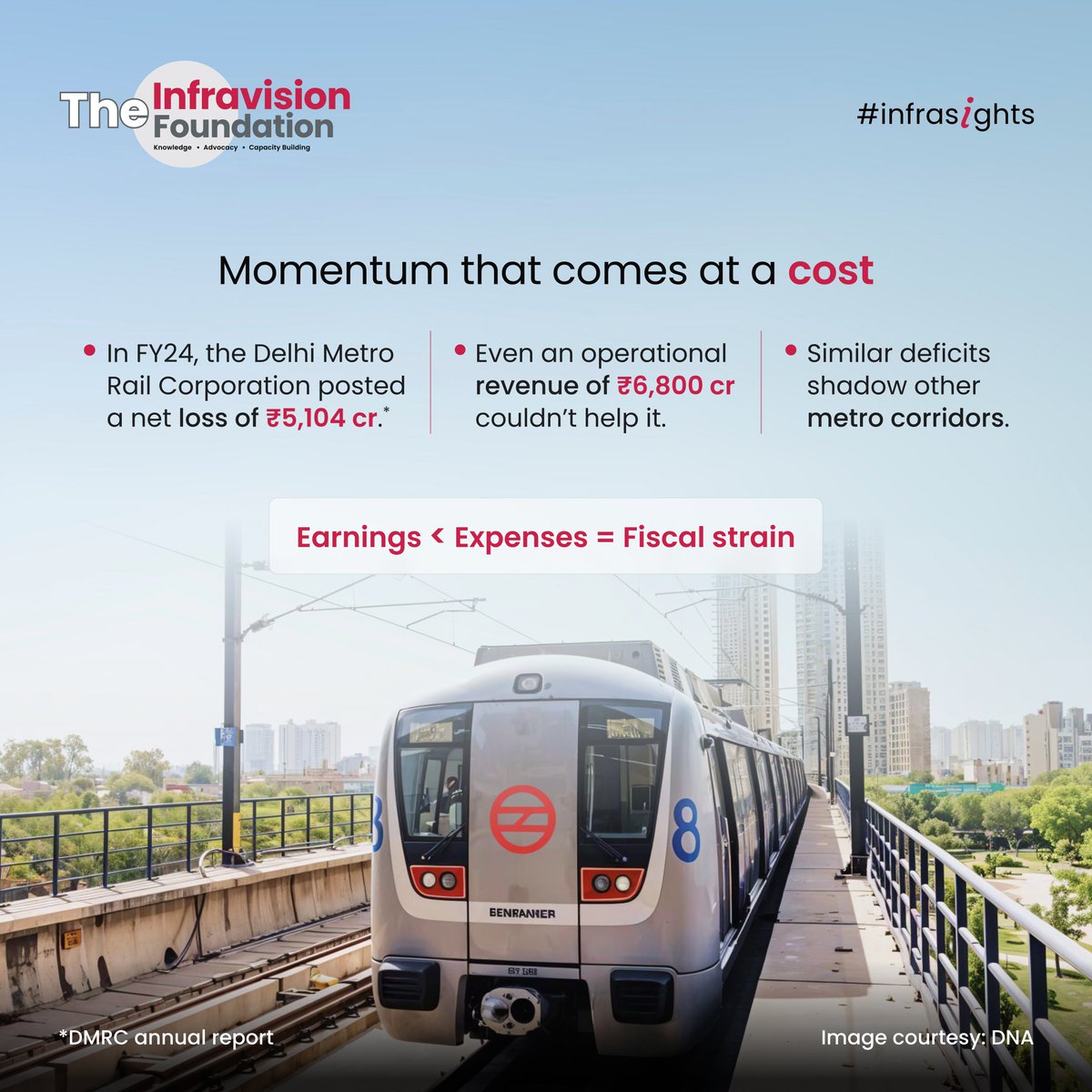
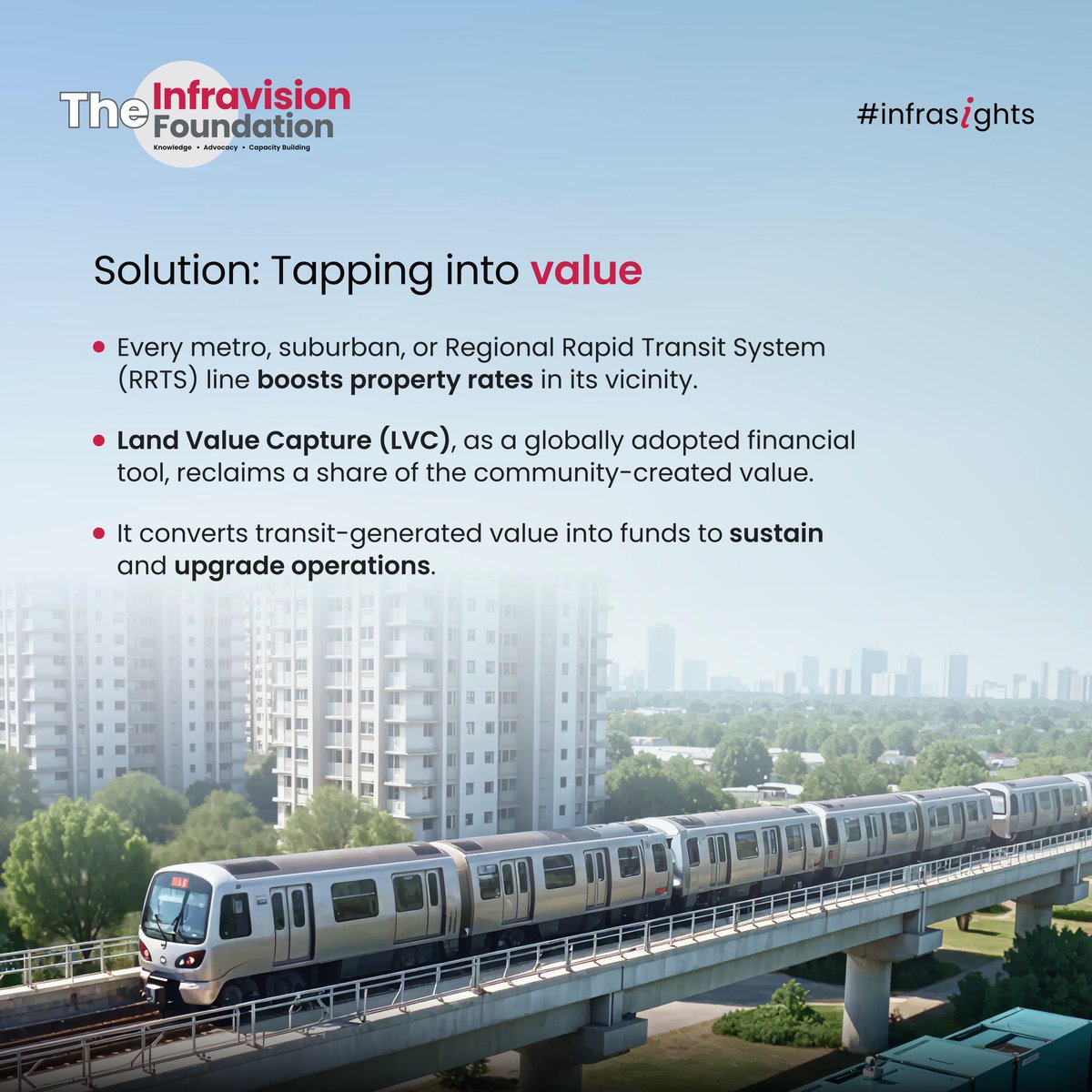
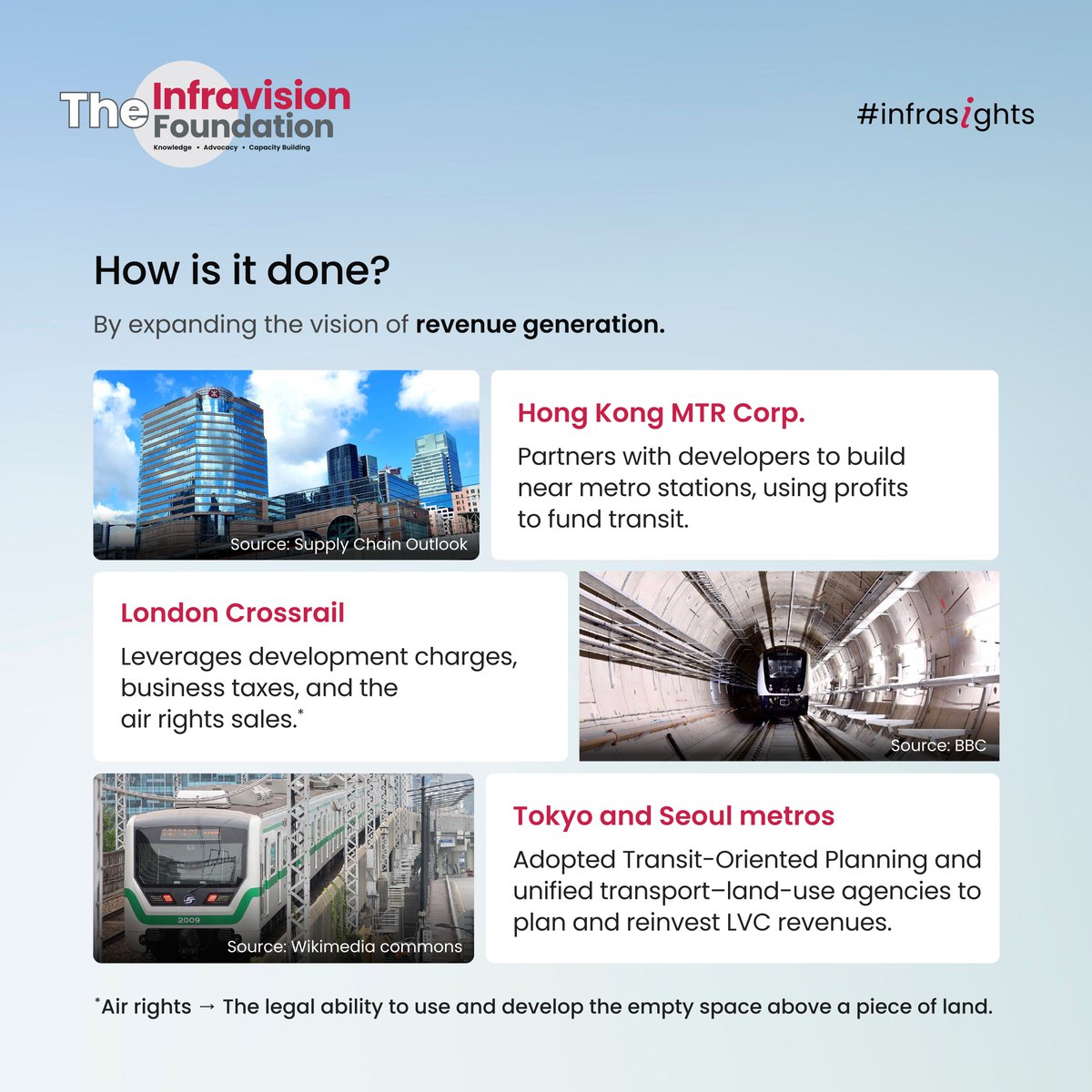
Following a ₹𝟓,𝟏𝟎𝟒 𝐜𝐫𝐨𝐫𝐞 loss in FY24, the Delhi Metro announced a fare hike earlier this year in August. Coming after eight years, the revision was driven by the financial strain arising from train refurbishments, civil asset upkeep and salary obligations, as stated by the Delhi Metro Rail Corporation (DMRC). With an average daily ridership of 5.83 million in FY24, these figures underline a clear truth – 𝐟𝐚𝐫𝐞𝐬 𝐚𝐥𝐨𝐧𝐞 𝐜𝐚𝐧𝐧𝐨𝐭 𝐬𝐮𝐬𝐭𝐚𝐢𝐧 𝐈𝐧𝐝𝐢𝐚’𝐬 𝐠𝐫𝐨𝐰𝐢𝐧𝐠 𝐦𝐞𝐭𝐫𝐨 𝐧𝐞𝐭𝐰𝐨𝐫𝐤𝐬. Similar financial pressures are visible across several metro systems in the country. The need is to look beyond. 𝐋𝐚𝐧𝐝 𝐕𝐚𝐥𝐮𝐞 𝐂𝐚𝐩𝐭𝐮𝐫𝐞 (𝐋𝐕𝐂), a globally proven financial tool, can help metro and regional rail systems not only recover costs but also reinvest in service quality and network expansion, with stronger financial independence. Swipe through to understand how LVC works and how TIF recommends its integration with India’s urban transport systems. A detailed research report titled “𝐋𝐚𝐧𝐝 𝐕𝐚𝐥𝐮𝐞 𝐂𝐚𝐩𝐭𝐮𝐫𝐞 𝐟𝐨𝐫 𝐔𝐫𝐛𝐚𝐧 𝐚𝐧𝐝 𝐑𝐞𝐠𝐢𝐨𝐧𝐚𝐥 𝐏𝐮𝐛𝐥𝐢𝐜 𝐓𝐫𝐚𝐧𝐬𝐩𝐨𝐫𝐭 𝐈𝐧𝐟𝐫𝐚𝐬𝐭𝐫𝐮𝐜𝐭𝐮𝐫𝐞 𝐅𝐢𝐧𝐚𝐧𝐜𝐢𝐧𝐠”, authored by Dr Sandip Chakrabarti, explores the subject further. Report link: theinfravisionfoundation.org/assets/pdf/LVC… #Infrasights #TheInfravisionFoundation
Infravision Foundation tweet mediaInfravision Foundation tweet mediaInfravision Foundation tweet mediaInfravision Foundation tweet media
English
1
0
1
46
Infravision Foundation
Infravision Foundation@TheInfravision·
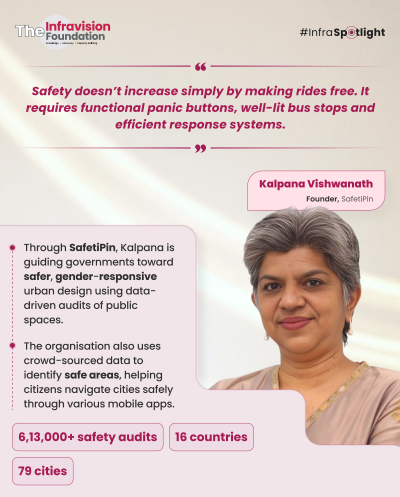
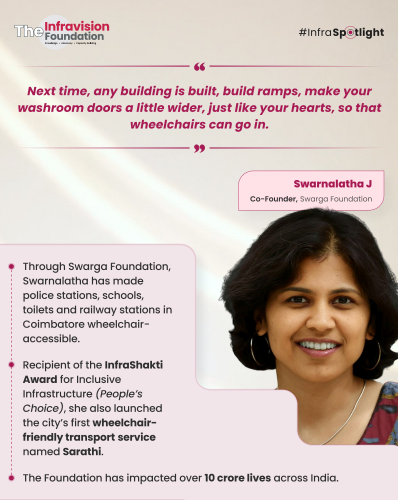
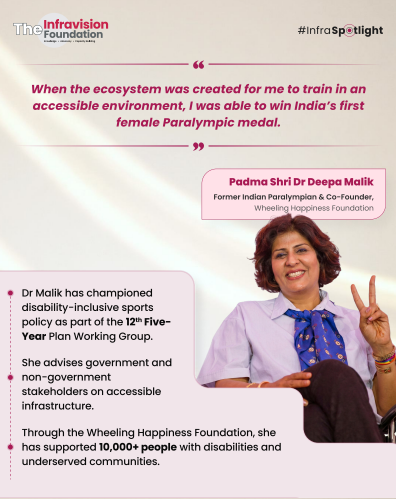
Infrastructure’s greatest imperative is inclusion. Over the years, we have engaged with leaders who are actively reshaping India‘s approach to infrastructure. And women are increasingly leading that shift. Across conversations and awards, we have had the privilege of interacting with such changemakers. From gender-responsive urban planning to accessibility for all, their work reminds us that infrastructure must ensure no one is left behind. This Women’s Day, we turn the #InfraSpotlight on three leaders who continue to push systems toward inclusivity and impact. Watch our conversations with these leaders through the links InfraKatha with Padma Shri Dr Deepa Malik: youtube.com/watch?v=5uzHmH… The Infravision Conversation with Kalpana Viswanath: youtube.com/watch?v=gg9Ntu… InfraShakti Award for Inclusive Infrastructure (People’s Choice) Swarnalatha J: youtube.com/watch?time_con…
YouTube video
YouTube
YouTube video
YouTube
YouTube video
YouTube
Infravision Foundation tweet mediaInfravision Foundation tweet mediaInfravision Foundation tweet mediaInfravision Foundation tweet media
English
1
0
0
15
Infravision Foundation
Infravision Foundation@TheInfravision·
Urban congestion is not just a mobility issue. It is one of the core drivers of the worsening climate crisis. The Observer Research Foundation (ORF) notes that transport accounts for 𝟏𝟒% of India’s energy-related CO₂ emissions. Congestion amplifies that footprint in dense corridors. Many Indian cities have modernised their traffic systems already. Noida, for instance, operates an Intelligent Traffic Management System (ITMS) integrating cameras, sensors, Emergency Call Boxes (ECBs), MET systems and an Integrated Command and Control Centre (ICCC)-backed data centre. The digital backbone exists. Yet across Indian cities, this intelligence is largely used for monitoring, not decarbonisation. 🔶 𝐖𝐡𝐲 𝐭𝐡𝐢𝐬 𝐦𝐚𝐭𝐭𝐞𝐫𝐬 → Idling at intersections increases fuel burn. → Stop–start cycles raise the intensity of emissions. → Speed instability worsens air quality. 𝐀𝐈-𝐝𝐫𝐢𝐯𝐞𝐧 𝐚𝐝𝐚𝐩𝐭𝐢𝐯𝐞 𝐬𝐢𝐠𝐧𝐚𝐥𝐥𝐢𝐧𝐠 can reduce delay and idling, stabilise speeds and lower congestion-linked emissions. 𝐒𝐢𝐧𝐠𝐚𝐩𝐨𝐫𝐞 demonstrates what this integration looks like. Through its Intelligent Transport System (ITS) and Electronic Road Pricing (ERP), it has reduced congestion-linked CO₂ emissions by 15% and increased peak-hour public transport usage to 75%. ERP uses real-time traffic data to price road usage, reducing private vehicle use during rush hours. India has the data infrastructure. It needs to link that data to its climate mitigation strategy. 🔶𝐇𝐞𝐫𝐞’𝐬 𝐰𝐡𝐚𝐭 𝐢𝐭 𝐜𝐚𝐧 𝐝𝐨 → With real-time traffic-based operations, adaptive signals can reduce vehicle idling and stop–start cycles. → Congestion pricing in high-traffic zones using traffic flow data can increase public transport usage. → Identifying high-emission vehicles and retiring them can significantly lower emissions. Our report, “𝐃𝐞𝐜𝐚𝐫𝐛𝐨𝐧𝐢𝐳𝐢𝐧𝐠 𝐮𝐫𝐛𝐚𝐧 𝐭𝐫𝐚𝐧𝐬𝐩𝐨𝐫𝐭 𝐮𝐬𝐢𝐧𝐠 𝐭𝐫𝐚𝐟𝐟𝐢𝐜 𝐚𝐧𝐝 𝐭𝐫𝐚𝐧𝐬𝐩𝐨𝐫𝐭 𝐝𝐚𝐭𝐚 𝐟𝐫𝐨𝐦 𝐈𝐂𝐂𝐂: 𝐀 𝐩𝐢𝐥𝐨𝐭 𝐬𝐭𝐮𝐝𝐲 𝐢𝐧 𝐍𝐎𝐈𝐃𝐀” elaborates these pathways. It examines how traffic data can be integrated into India’s decarbonisation policymaking. The question is no longer whether data exists. It is how we use it to our advantage and build a sustainable mobility ecosystem. 🔗 Read the full report : theinfravisionfoundation.org/assets/pdf/dec… #Infrasights #TheInfravisionFoundation
Infravision Foundation tweet media
English
0
0
1
33
Infravision Foundation
Infravision Foundation@TheInfravision·
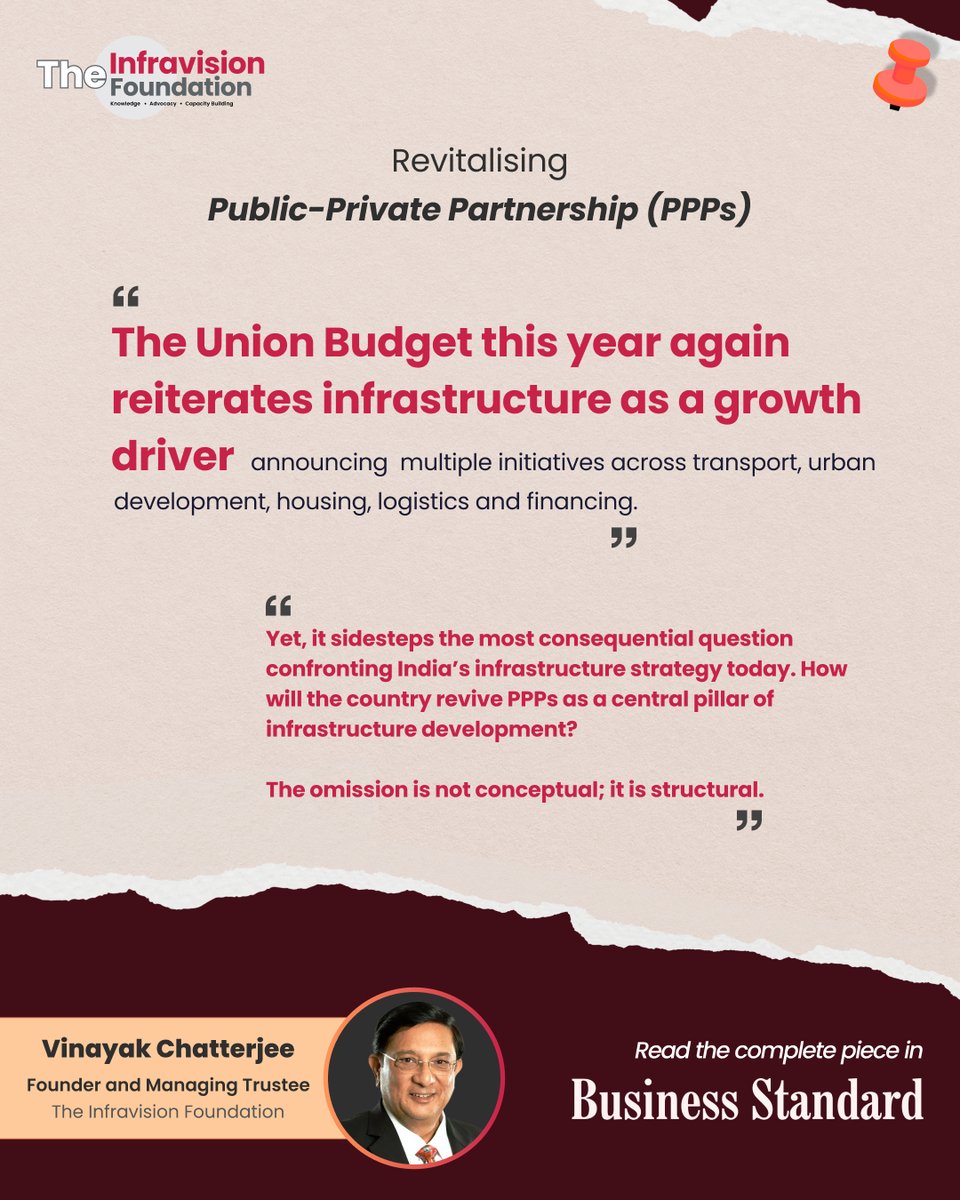
Private participation in India’s infrastructure has fallen from ~37% during the Eleventh Plan (2007–12) to 𝟐𝟎–𝟐𝟐% in recent years. Amidst India’s ever expanding infrastructure needs, this decline raises a fundamental question: 𝐜𝐚𝐧 𝐩𝐮𝐛𝐥𝐢𝐜 𝐟𝐢𝐧𝐚𝐧𝐜𝐞𝐬 𝐚𝐥𝐨𝐧𝐞 𝐜𝐚𝐫𝐫𝐲 𝐭𝐡𝐞 𝐢𝐧𝐟𝐫𝐚𝐬𝐭𝐫𝐮𝐜𝐭𝐮𝐫𝐞 𝐛𝐮𝐫𝐝𝐞𝐧? In his latest OpEd for Business Standard, our Founder and Managing Trustee, Vinayak Chatterjee argues that the earlier Public-Private Partnership (PPP) slowdown was not a failure of concept, but of design and governance. Flawed risk allocation, rigid contracts and the absence of structured renegotiation frameworks, among many other factors, undermined investor confidence. Revival of PPP is central to the newly announced ₹𝟏𝟕 𝐭𝐫𝐢𝐥𝐥𝐢𝐨𝐧 PPP pipeline. Chatterjee calls for realistic risk allocation between government and private partners, built-in renegotiation mechanisms, stable tariffs and independent oversight for regulatory certainty and stronger institutional capacity. Reviving PPPs is not privatisation, it is partnership, he argues. At TIF, we continue to advocate for reforms that can fuel India’s infrastructure transformation. Article link : business-standard.com/opinion/column… #PublicPrivatePartnership #TheInfravisionFoundation
Infravision Foundation tweet media
English
0
0
0
25
Infravision Foundation
Infravision Foundation@TheInfravision·
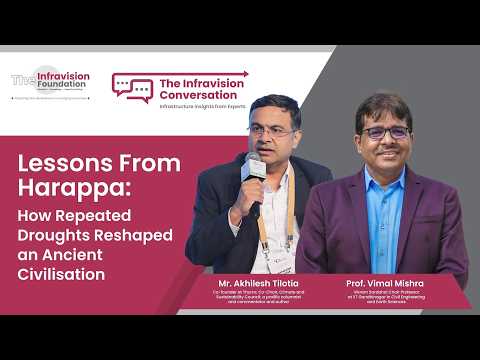
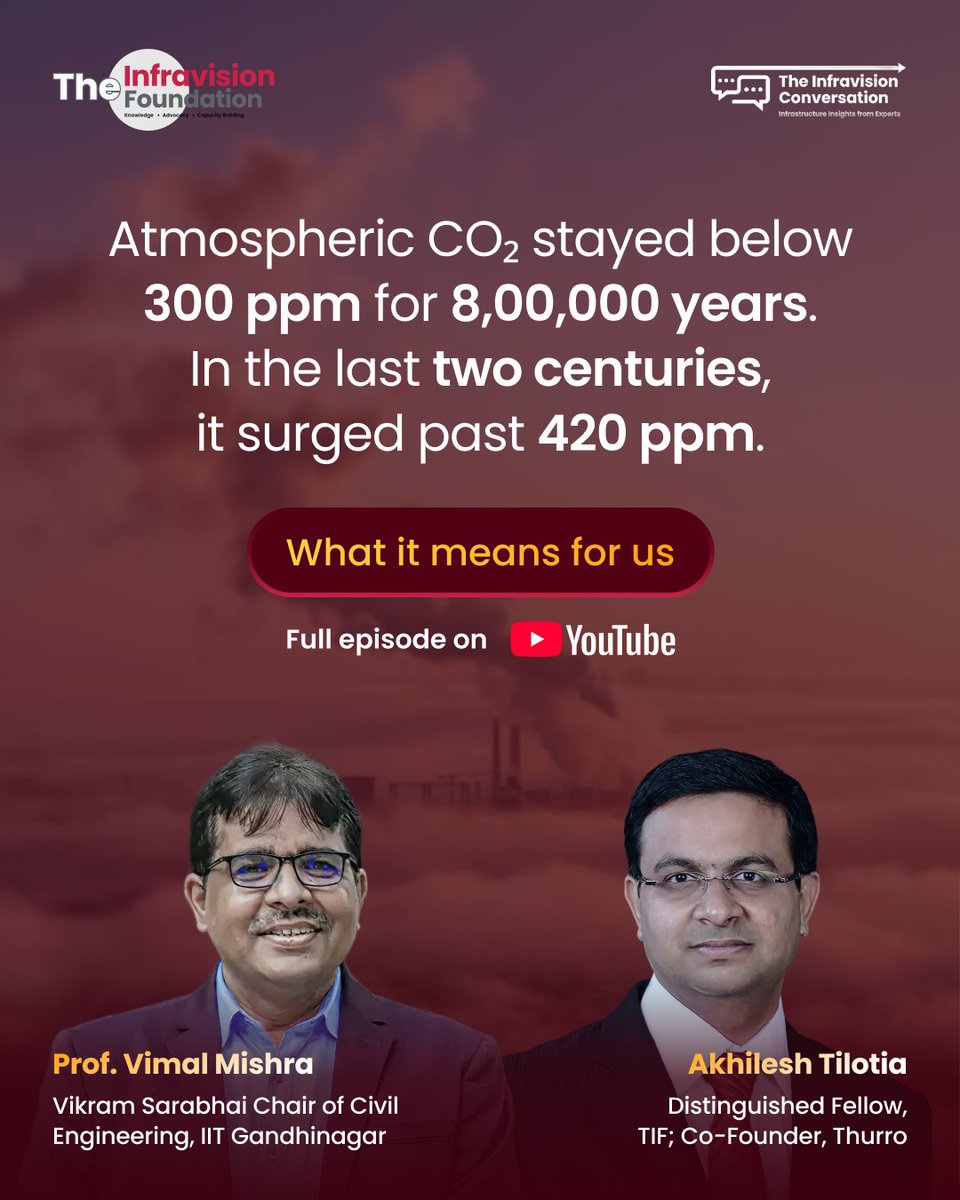
Atmospheric CO₂ is increasing at an unprecedented rate. In just the last two centuries, it has surged past 𝟒𝟐𝟎 𝐩𝐩𝐦. For nearly 𝟖,𝟎𝟎,𝟎𝟎𝟎 𝐲𝐞𝐚𝐫𝐬, concentrations remained below 𝟑𝟎𝟎 𝐩𝐩𝐦. In our latest Infravision Conversation, Distinguished Fellow at TIF, Akhilesh Tilotia, Professor Vimal Mishra of IIT Gandhinagar and Head of Advocacy at TIF, Kaveree Bamzai draw parallels between the adaptive responses of the Indus Valley Civilization and the risks we face today due to shifting climate patterns. They discuss how even a 0.5°C rise in temperature is not just an environmental challenge. It’s a socio-economic crisis. While technology may allow sections of the society to adapt to rising temperatures, the cost of adoption will push the vulnerable population further down, creating socio-economic imbalance. Professor Mishra argues with evidence that Indus Valley did not vanish overnight. Instead, communities gradually dispersed and migrated to survive prolonged droughts. Today, our challenge is different. The rate of change is unprecedented and the cost of staying put is unaffordable for most. Watch the full episode on YouTube : youtu.be/zfyIdr_YnYA?si…
YouTube video
YouTube
Infravision Foundation tweet media
English
0
0
0
44
Infravision Foundation
Infravision Foundation@TheInfravision·
When the Hon’ble Finance Minister announced INR 5,000 cr per City Economic Region (CER) over five years, it drew attention, and rightly so. CER is not a regular budget scheme. It embodies a structural shift in how India approaches urbanisation. Emphasising outcomes, it moves from entitlement-based allocations to a competitive challenge-mode, reform-cum-results financing mechanism. Built around economic agglomeration and region-specific growth drivers, CER encourages integrated planning. This augurs well for tier 2 and tier 3 cities. It could boost urban growth with concerted efforts from all stakeholders. Access to funding will depend on credibility and regional grounding of strategies, creating room for context-driven planning. CER will be more effective if Urban Local Bodies (ULBs) become a part of this transformation matrix. The 74th Constitutional Amendment (74th AC) in 1992 envisaged empowered ULBs. three decades down, the progress has been limited. If implemented in letter and spirit, CER could: 🔷 𝐁𝐫𝐞𝐚𝐤 𝐬𝐢𝐥𝐨𝐞𝐬 CERs might trigger the gradual blurring of administrative borders, leading to creation of functional regional systems. 🔷 𝐂𝐫𝐞𝐚𝐭𝐞 𝐫𝐞𝐟𝐨𝐫𝐦-𝐥𝐞𝐝 𝐦𝐨𝐝𝐞𝐥𝐬 With merit becoming key to funding, reforms are expected to follow. This could replenish India’s urbanisation landscape with replicable models for various cities. 🔷 𝐀𝐭𝐭𝐫𝐚𝐜𝐭 𝐩𝐫𝐢𝐯𝐚𝐭𝐞 𝐜𝐚𝐩𝐢𝐭𝐚𝐥 Private capital has historically been limited to transport and energy. CERs can crowd in private investment. This can fill the capacity gap (planning, technical and financial) to design and manage complex urban infrastructure for tier 2 and tier 3 cities. All in all, CER is a good idea. The real test will be whether governments and ULBs can translate this mechanism into regionally coherent growth plans, calibrated to local competitive advantages and socio-economic realities. #infrasights #CityEconomicRegions #TheInfravisionFoundation
Infravision Foundation tweet media
English
0
0
0
20