Intelpoint

4.1K posts

Intelpoint banner
Intelpoint

Intelpoint

@TheIntelpoint

Decision-making insights, infographics, and reports for everyone! (A product of @Businessfront) 🌐https://t.co/YRxnqCIpD1

Lagos, Nigeria Katılım Mayıs 2021
6 Takip Edilen5.2K Takipçiler
Sabitlenmiş Tweet
Intelpoint
Intelpoint@TheIntelpoint·
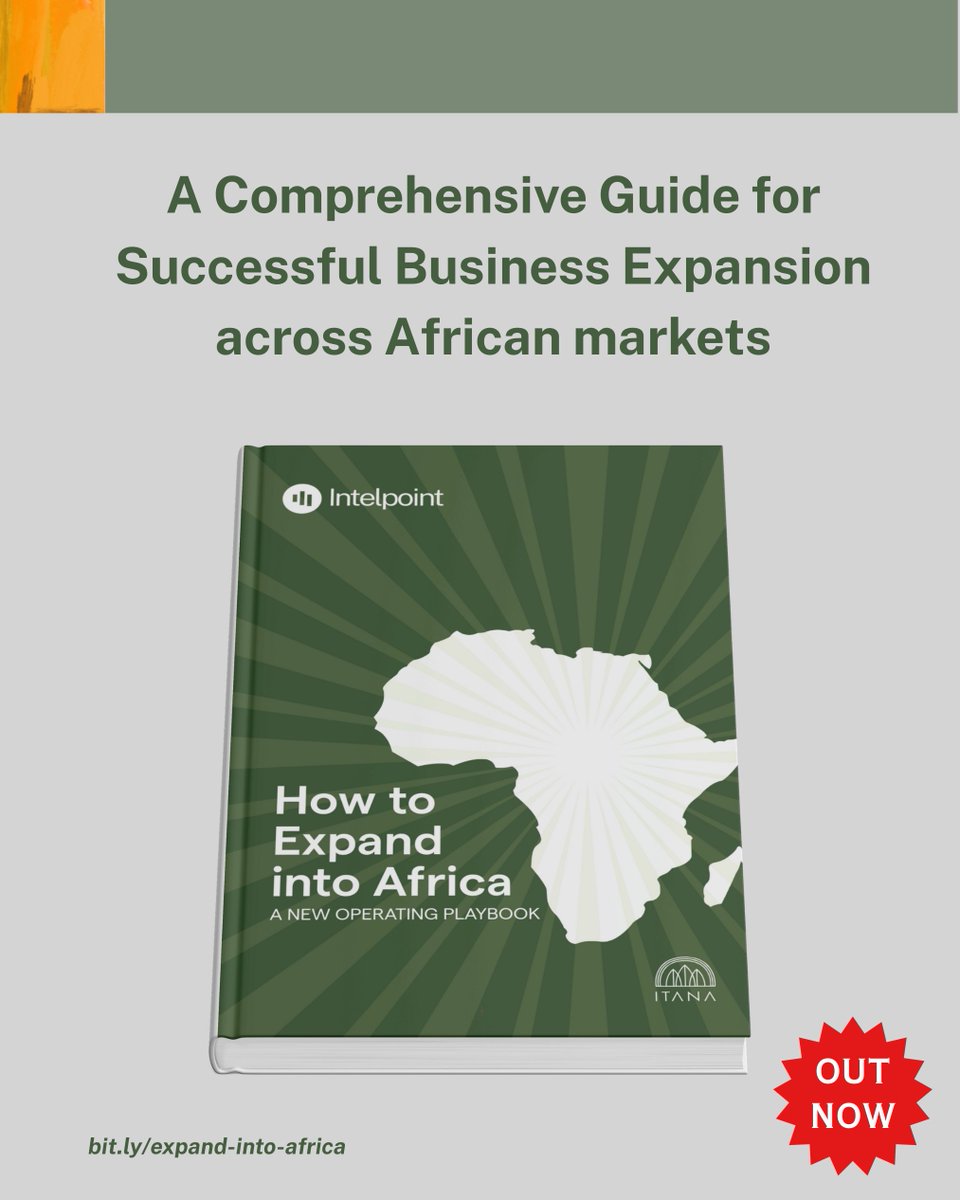
📢 New Report: How to expand into Africa Africa is a market of over 1.5 billion people, with accelerating digital adoption. In partnership with @ItanaAfrica, we've put together a practical guide for expansion in Africa. Get the guide now intelpoint.co/report/how-to-…
Intelpoint tweet media
English
0
8
14
3.2K
Intelpoint
Intelpoint@TheIntelpoint·
For 40 years, one country generated all of Africa’s commercial nuclear power. That could soon change. Since 1984, South Africa’s Koeberg has been the continent’s only commercial nuclear power station. One plant for a continent of 1.4 billion people — 600 million of whom still have no electricity at all. In 2024, Africa’s total nuclear output was 7.8 terawatt-hours. France alone produced 380 TWh. The US generated more than 823 TWh. For a continent with fast-rising electricity demand, the gap is staggering. African leaders and energy officials are meeting in Kigali this week around one major question: can nuclear ambition become reality? Egypt is already constructing the four-reactor El Dabaa plant, Kenya recently invited reactor vendors for its planned programme, and South Africa is reviving parts of its small modular reactor ambitions. For four decades, Koeberg stood alone. Africa’s nuclear story is no longer only about keeping Koeberg alive — it is increasingly about whether other countries can actually build and sustain nuclear programmes of their own. The plants at a glance: 🔵 KOEBERG — South Africa (Functioning) 📍 Melkbos, 30km north of Cape Town ⚡ Capacity: 1,934 MW 📊 Output (2024): 7.8 TWh (~46% capacity factor, below the global average due to major maintenance outages in 2023–2024) 🏭 Built by: Framatome, France 📅 Commissioned: Unit 1 — 1984 | Unit 2 — 1985 📜 Licence extended: Unit 1 to 2044 | Unit 2 to 2045 🟡 EL DABAA — Egypt (Under construction) 📍 North Coast, Mediterranean Sea ⚡ Capacity (when complete): 4,800 MW (4 × 1,200 MW) 🏭 Built by: Rosatom, Russia 📅 Construction started: 2022 🎯 Expected commission: Unit 1 — 2028 | All four units — 2030 💰 Cost: $28.75 billion (85% financed through a Russian state loan) 👷 Workers on site (2025): 25,000 ⏳ Reactor lifespan: 60 years, extendable to 100
Intelpoint tweet media
English
0
0
2
103
Intelpoint
Intelpoint@TheIntelpoint·
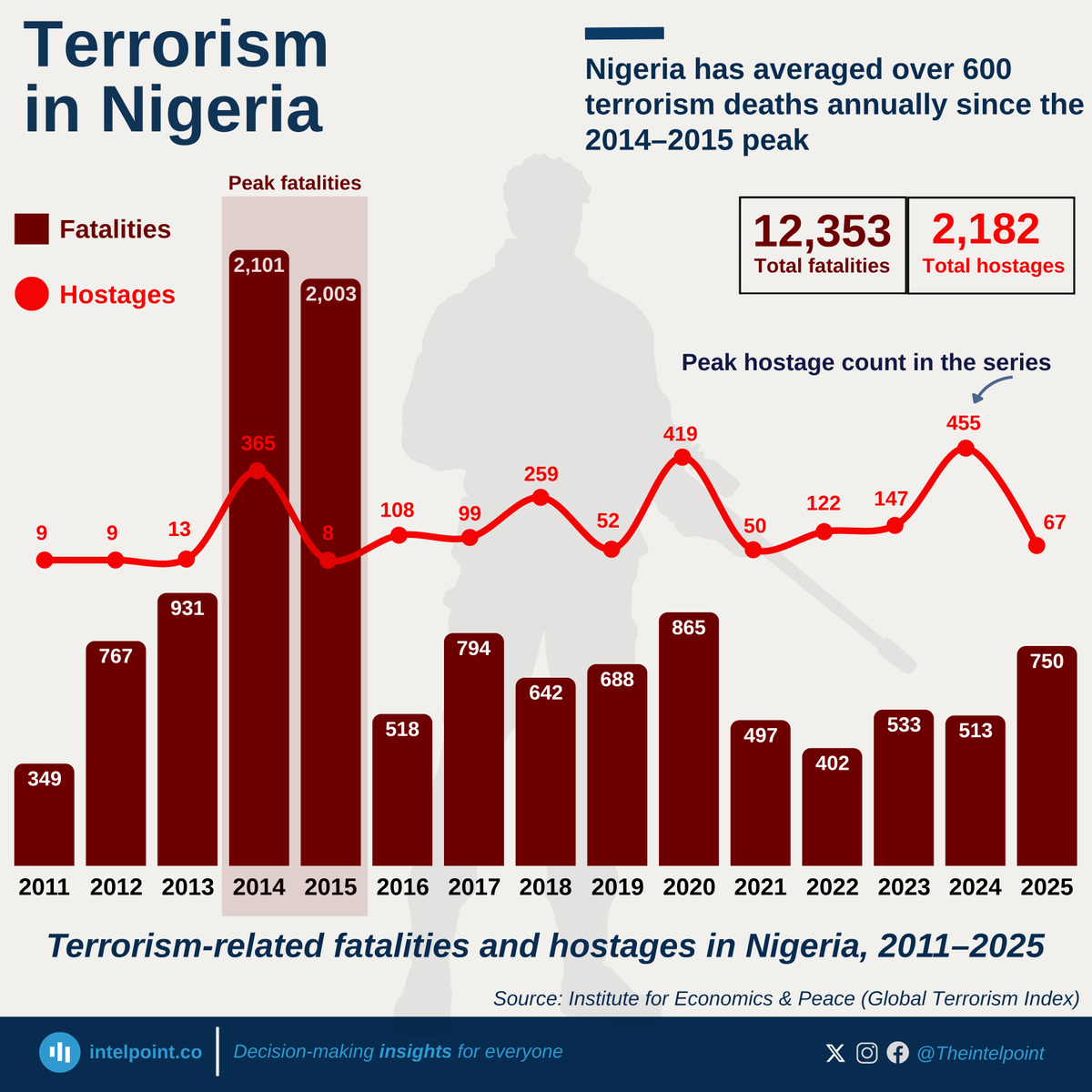
Nigeria’s deadliest insurgency years may have passed, but the country continues to face persistent insecurity in evolving forms. Counterterrorism operations helped reduce the scale of mass-casualty attacks after 2015, though kidnappings, rural raids, and other forms of armed violence continue to test security efforts across the country.
Intelpoint tweet media
English
0
3
3
166
Intelpoint
Intelpoint@TheIntelpoint·
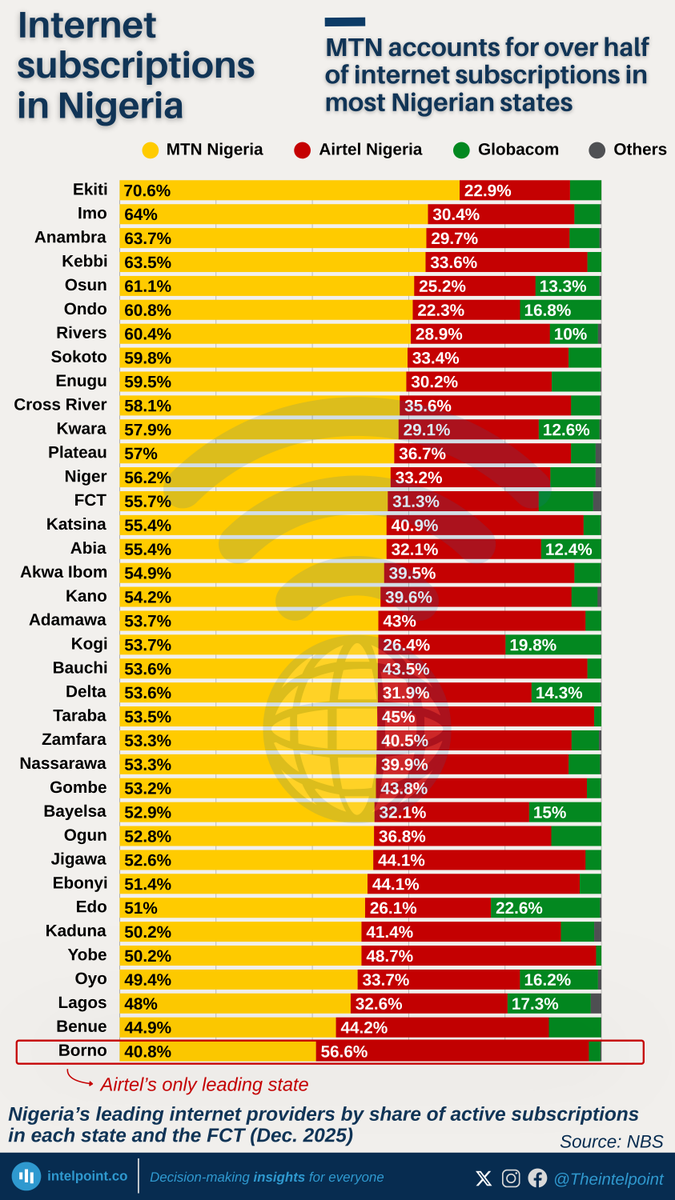
.@MTNNG accounted for more than half of active internet subscriptions in most Nigerian states as of December 2025, reinforcing its dominance across Nigeria’s telecom market. @AirtelNigeria was the only other provider to lead any state, recording a higher share than MTN in Borno. Meanwhile, Globacom did not top any state despite maintaining notable subscriber bases in parts of southern Nigeria. Lagos remained Nigeria’s largest internet market across all major providers.
Intelpoint tweet media
English
1
4
6
396
Intelpoint
Intelpoint@TheIntelpoint·
Africa's most economically powerful countries are not necessarily its most structurally capable. Nigeria and Egypt — two of the continent's five largest economies by GDP — rank 167th and 129th globally on productive capacity, well below much smaller economies like Mauritius (56th) and Seychelles (68th). According to @UNCTAD's Productive Capacities Index 2024, which measures eight foundations an economy needs to sustain and grow: human capital, natural capital, energy, transport, ICT, institutions, private sector development, and structural change, no African country ranks in the global top 50. Closing the gap will require African governments to direct more investment into the foundations that drive long-term capacity, rather than relying on natural resource revenues alone.
Intelpoint tweet media
English
0
2
4
125
Intelpoint
Intelpoint@TheIntelpoint·
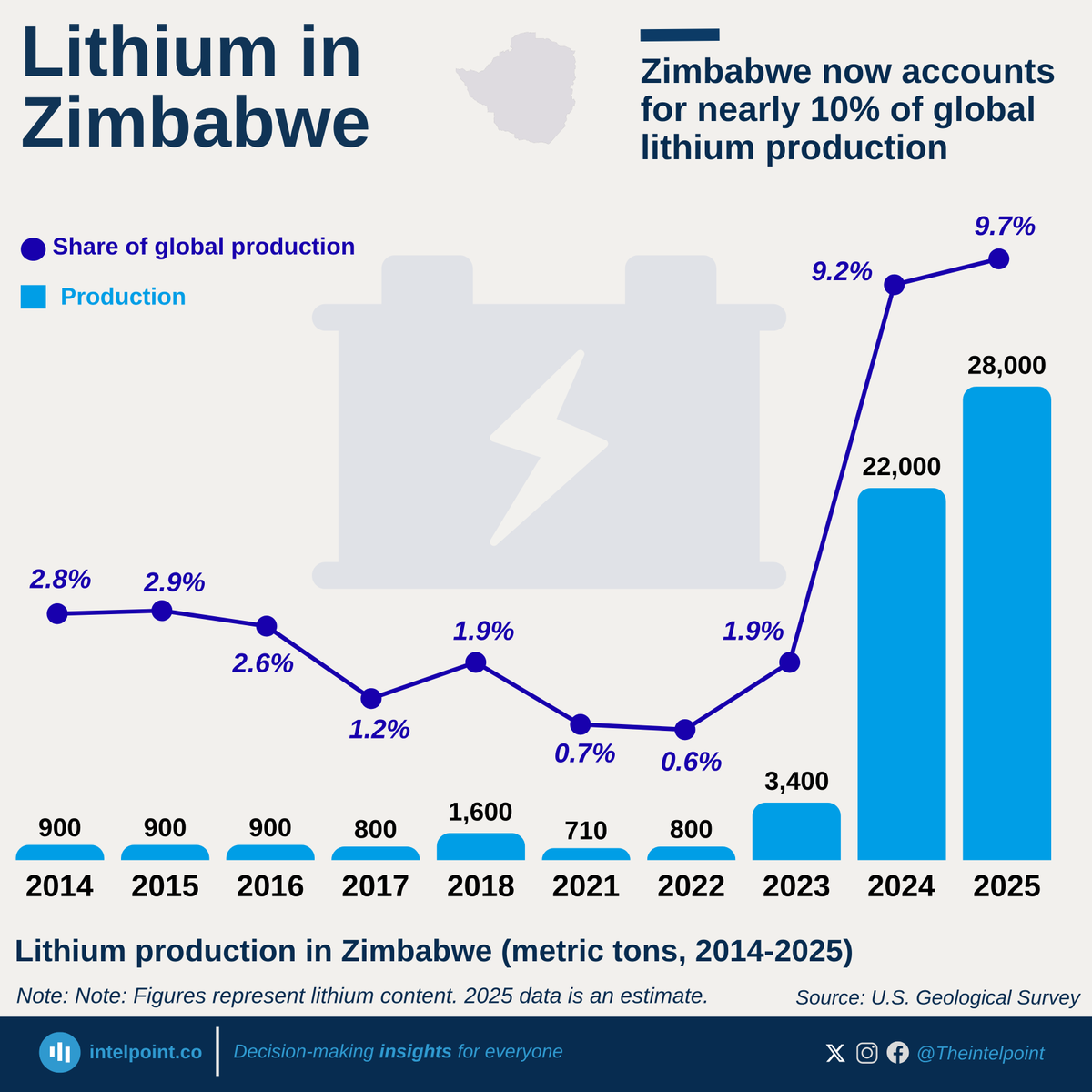
A decade ago, Zimbabwe was barely part of the global lithium industry. Today, it is increasingly connected to one of the technologies reshaping modern life: batteries powering electric vehicles and energy storage systems. As global demand for EV batteries surged, Zimbabwe emerged as one of the world’s fastest-growing lithium producers. Its lithium output rose from 900 tons in 2014 to an estimated 28,000 tons in 2025, increasing its share of global production from 2.8% to 9.7%. The shift has rapidly increased Zimbabwe’s importance in the global battery supply chain. Chinese firms have invested heavily in the country’s lithium sector, while the government is pushing to move beyond raw mineral exports into local processing.
Intelpoint tweet media
English
0
0
1
121
Intelpoint
Intelpoint@TheIntelpoint·
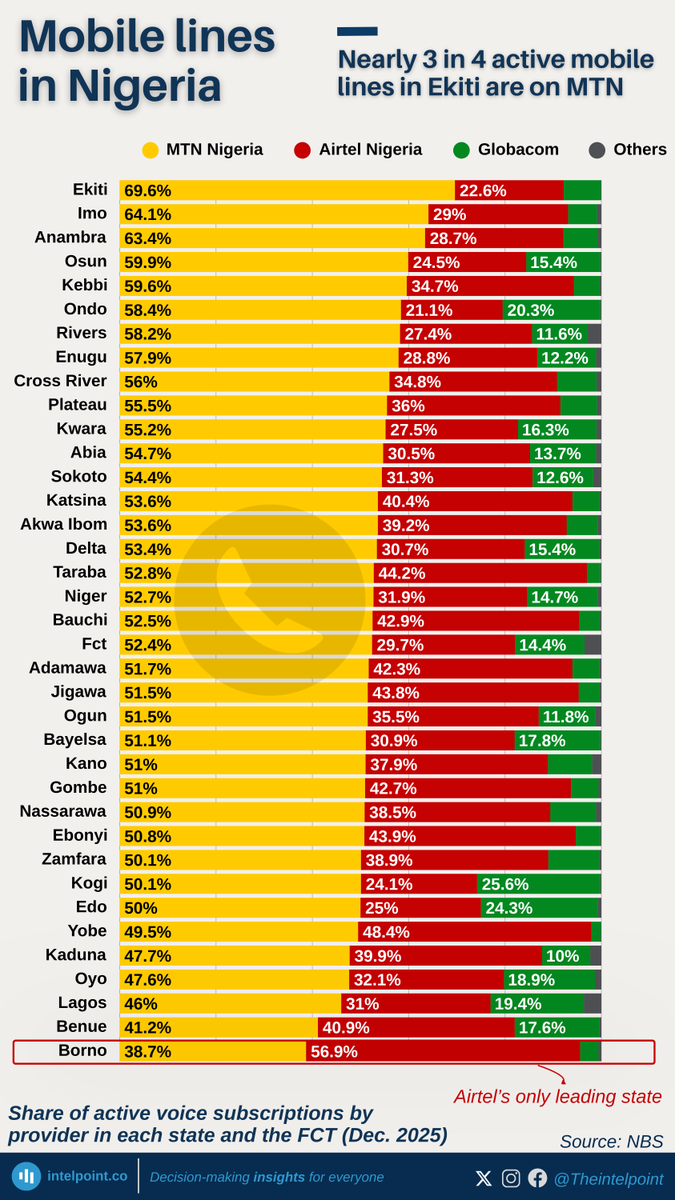
Share of active voice subscriptions by provider in each state as of December 2025. x.com/i/status/20523…
Intelpoint@TheIntelpoint

Nearly three out of every four active mobile lines in Ekiti were on MTN as of December 2025, giving the operator its highest state-level share in Nigeria. @MTNNG also maintained majority share across most Nigerian states, reinforcing its dominance in the country’s mobile market. @AirtelNigeria however, remained especially strong in parts of northern Nigeria, leading only in Borno, while Globacom maintained a more limited footprint across many states.

English
0
0
0
95
Intelpoint
Intelpoint@TheIntelpoint·
Nearly three out of every four active mobile lines in Ekiti were on MTN as of December 2025, giving the operator its highest state-level share in Nigeria. @MTNNG also maintained majority share across most Nigerian states, reinforcing its dominance in the country’s mobile market. @AirtelNigeria however, remained especially strong in parts of northern Nigeria, leading only in Borno, while Globacom maintained a more limited footprint across many states.
Intelpoint tweet media
English
0
0
7
372
Intelpoint
Intelpoint@TheIntelpoint·
In 2008, Equatorial Guinea was producing about $22,831 worth of goods and services per person — the highest level in Africa — at the peak of a historic oil boom. Just a decade earlier, that figure had been below $1,000. Oil transformed the economy rapidly, driving export revenues and pushing national output to extraordinary levels. With a population of under one million, the surge translated into one of the sharpest rises ever seen on the continent. But the boom didn’t hold. By 2016, output per person had fallen below $10,000. Today, it sits around $7,000–$8,000 — still relatively high in Africa, but far from its peak. A useful contrast is Nigeria, Africa’s largest oil producer. Despite decades of oil wealth, Nigeria has never reached those levels per person — its much larger population spreads the gains more thinly, and oil remains just one part of a broader economy. Other oil-producing countries, such as Angola and Gabon, have also experienced periods of rapid income growth during oil booms. Meanwhile, Libya has sustained relatively high output per person over time, though often with sharp swings tied to oil production and instability. Together, these cases point to the same reality: resource wealth can drive rapid gains — but sustaining them is far more complex. That context matters today. Countries like Mozambique, at the center of major gas developments, and Democratic Republic of the Congo, rich in critical minerals, are often seen as part of Africa’s next resource wave.
English
0
2
7
1.9K
Intelpoint
Intelpoint@TheIntelpoint·
Africa's GDP per capita in 2025 is sharply uneven, and East Africa leads the top. Seychelles ($18.5K) and Mauritius ($13K) sit far above the rest. Both economies have spent decades pivoting into high-value services: tourism, finance, and logistics, while maintaining relatively stable institutions and smaller populations. That combination naturally lifts output per person. Behind them, resource-backed economies like Gabon and Botswana follow, showing how hydrocarbons and minerals still shape Africa's upper tier. At the other end, the bottom 10 tells a more fragile story. Countries like the Democratic Republic of the Congo, Somalia, and South Sudan remain constrained by conflict, weak institutions, and limited industrial bases. In many cases, GDP grows but population growth outpaces it, diluting output per person.
Intelpoint tweet media
English
0
1
9
601
Intelpoint
Intelpoint@TheIntelpoint·
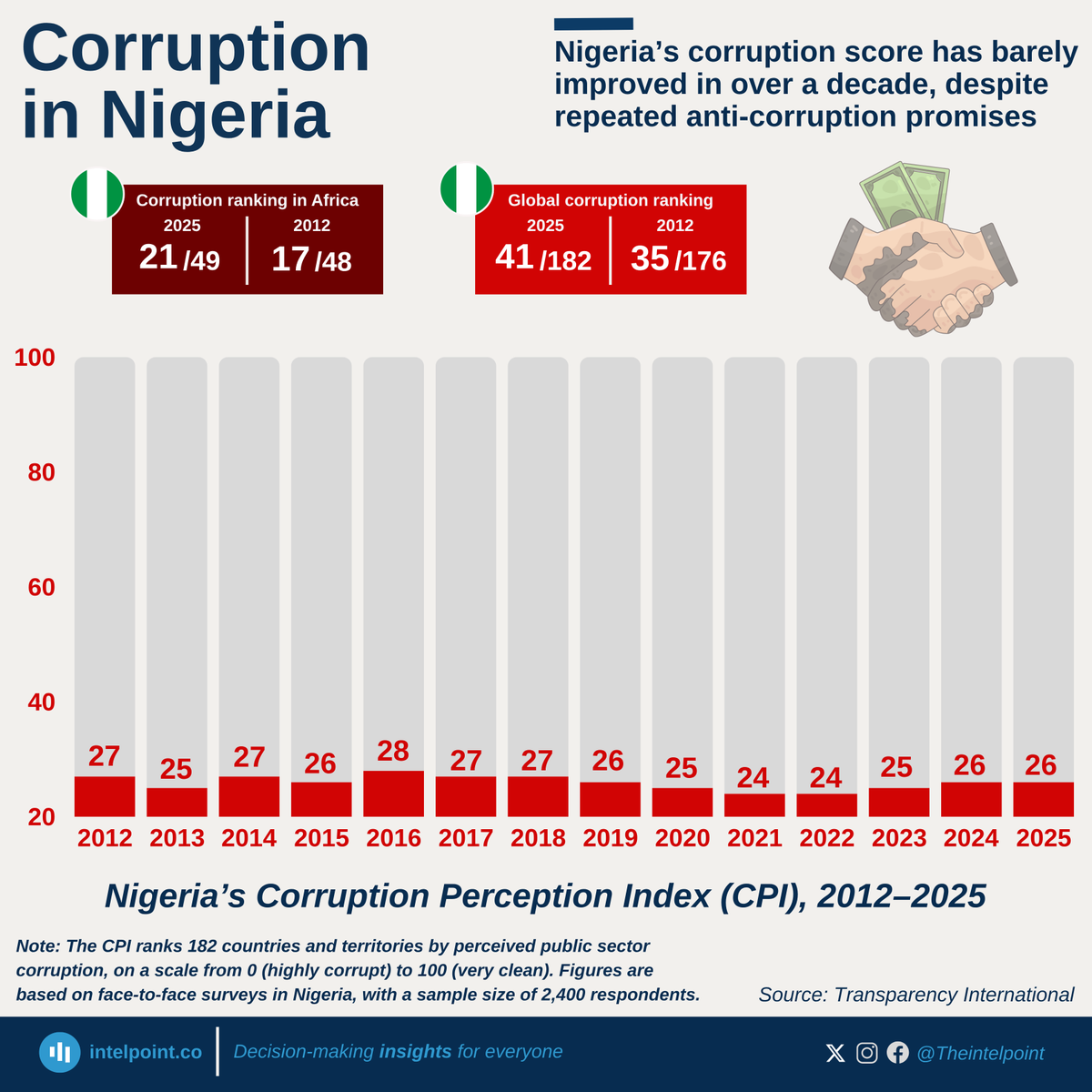
Nigeria’s CPI has stayed within a narrow 24–28 range since 2012. The latest score, 26, remains low on a 100-point scale. The highest score was 28 in 2016. The lowest scores were 24 in 2021 and 2022. The recent uptick from 24 to 26 is a mild recovery, not a shift. Nigeria’s corruption story is one of stagnation, not progress. The CPI has hovered between 24 and 28 from 2012 to 2025, with the latest score of 26 matching levels seen in 2015 and 2019. In effect, Nigeria has spent over a decade stuck at a weak level of perceived corruption, with only minor year-to-year changes. The latest data from Transparency International places Nigeria at a score of 26, ranking 142nd out of 182 countries—making it the 41st most corrupt globally.
Intelpoint tweet media
English
0
1
1
169
Intelpoint
Intelpoint@TheIntelpoint·
North Africa dominates Africa’s top 10 C-section rates, with Egypt alone at 72%—far ahead of the rest of the continent. In Egypt, Tunisia, and Libya, surgical capacity has expanded so much that C-sections are now the default in many facilities. What’s driving Egypt’s surge? The private sector. A UNFPA study shows C-section rates in private facilities reached 81% by 2021, up from 65.7% in 2014. Defensive medicine also plays a role: obstetricians, wary of malpractice risks, are more likely to avoid vaginal births after a prior C-section. The result is a rate nearly five times the WHO’s recommended level.
Intelpoint tweet media
English
0
0
3
108
Intelpoint
Intelpoint@TheIntelpoint·
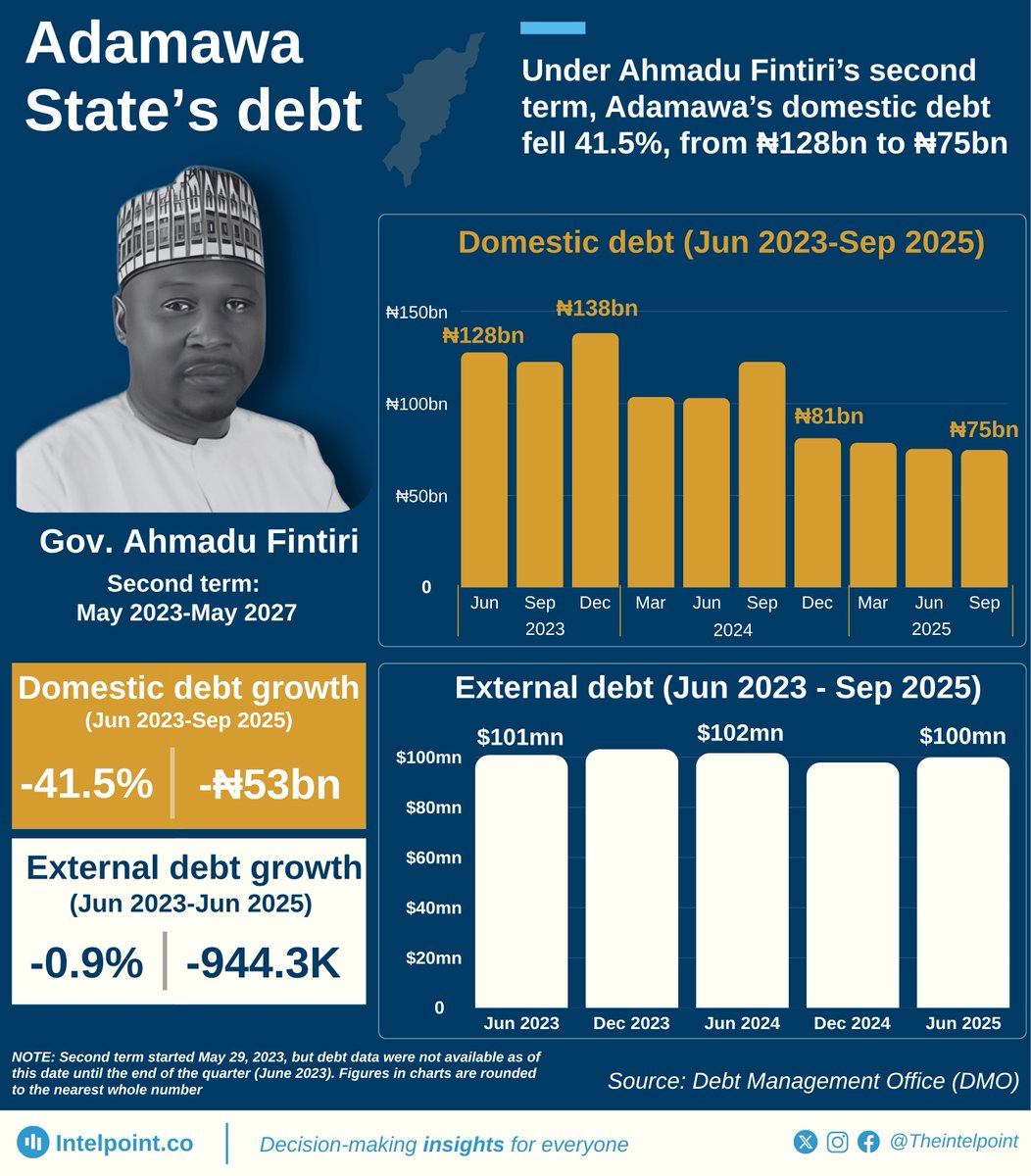
Adamawa’s domestic debt dropped from ₦128 billion in December 2023 to ₦75 billion in September 2025, a 41.5% decline. External debt, by contrast, barely moved, edging down from about $100.9 million to $100 million over the period. This shows that the state’s adjustment was driven far more by reducing naira liabilities than by materially changing its foreign-currency exposure. This pattern makes sense in the wider state-finance environment. Since the removal of subsidies and FX reforms, state revenues from the Federation Account Allocation Committee (FAAC) have risen, with much of the increase coming from stronger federation transfers. At the same time, some states have also improved internally generated revenue (IGR).
Intelpoint tweet media
English
1
2
4
324
Intelpoint
Intelpoint@TheIntelpoint·
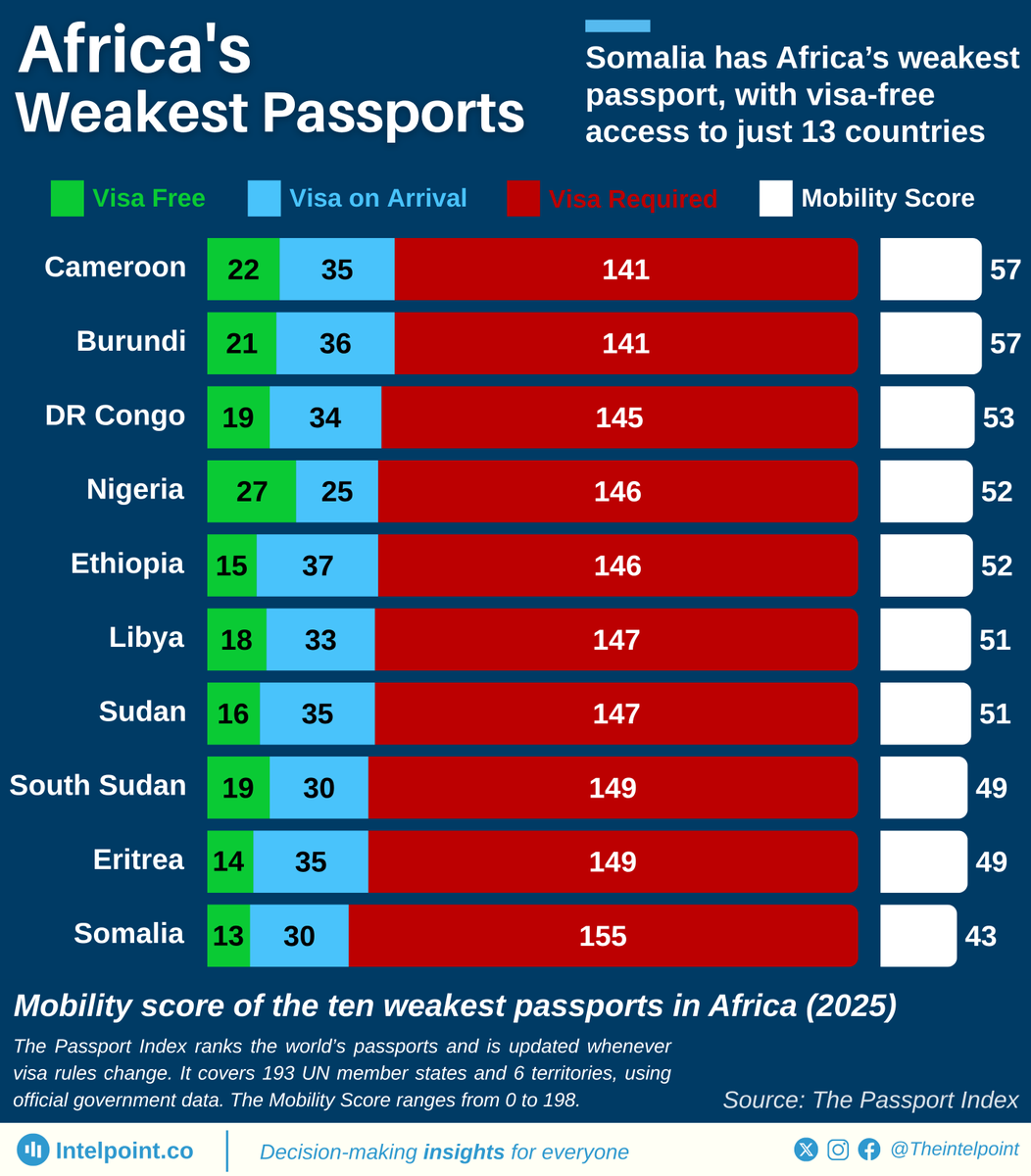
Somalia ranks last in Africa in the passport power ranking, with a mobility score of 43 and access to just 13 visa-free destinations. In many cases, weak passport mobility reflects a wider problem of conflict, fragility, and trust deficits. All the countries in the bottom ten appear on the World Bank's latest lists of fragile and conflict-affected countries. Countries facing war, institutional stress, border instability, or weak state capacity tend to struggle more with reciprocal visa waivers and broader travel confidence from other governments. Sudan’s war has displaced close to 14 million people, while the World Bank says Somalia remains caught in a cycle where climate shocks interact with fragility, conflict, and violence. That kind of background shapes how a passport is perceived. Nigeria, one of Africa’s largest economies by GDP, still appears in the bottom ten with a mobility score of 52. That suggests passport strength depends less on economic weight alone and more on a combination of diplomatic reach, security perceptions, border management, and political stability.
Intelpoint tweet media
English
0
4
7
390
Intelpoint retweetledi
Intelpoint
Intelpoint@TheIntelpoint·
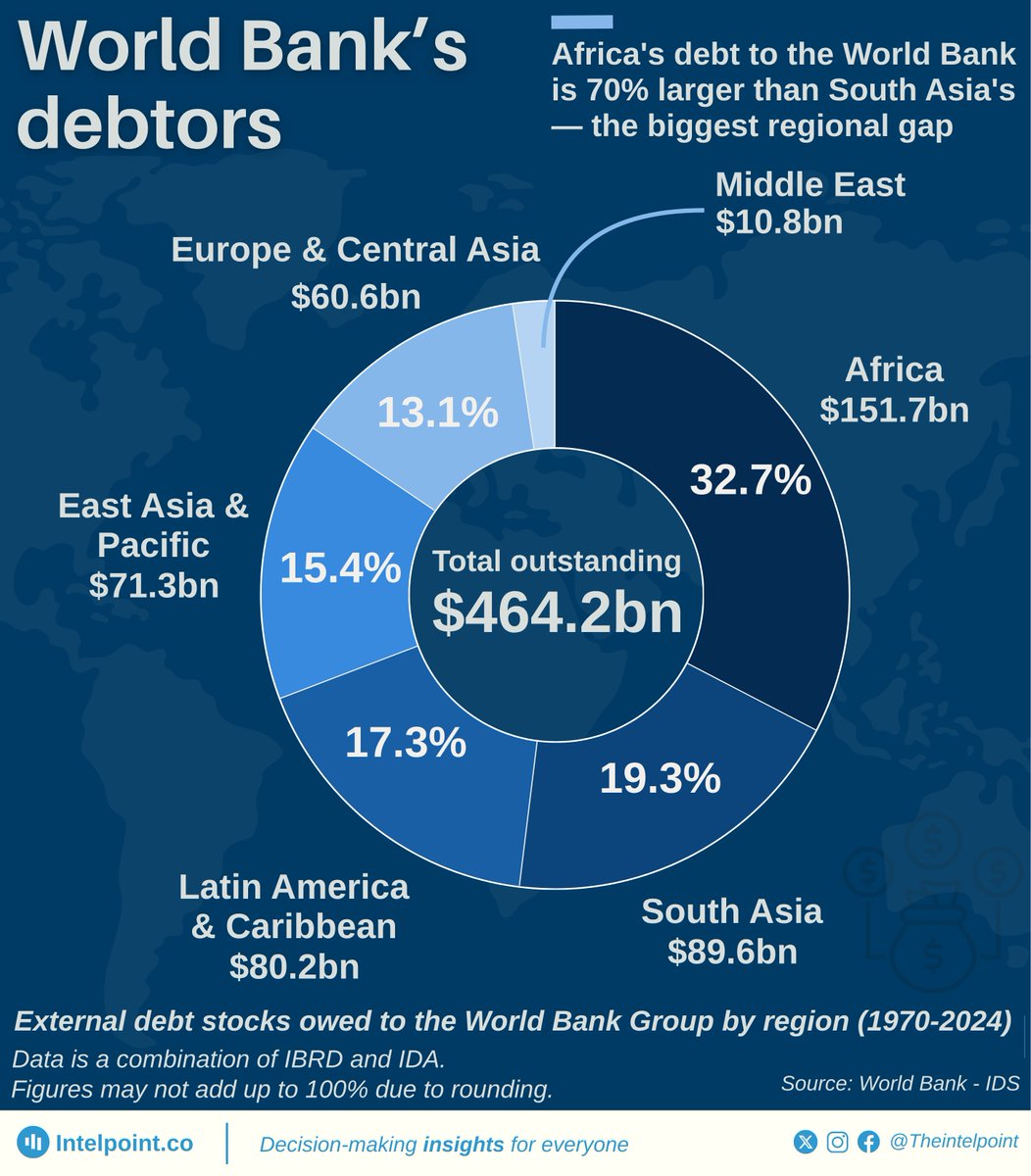
Africa holds the largest share of external debt owed to the World Bank Group, standing at $151.7 billion in 2024 — nearly 70% more than South Asia's $89.6 billion in second place. Despite this, Africa's year-on-year growth of 9.3% is not the fastest among regions. Europe & Central Asia saw its debt stock rise by 19.8%, adding $10 billion in a single year to reach $60.6 billion. At the other end of the spectrum, East Asia & Pacific recorded virtually no change, growing by just 0.21% — a $150 million increase on a $71.3 billion base. Latin America & Caribbean and the Middle East grew at moderate rates of 3.5% and 7.5%, respectively. Overall, while Africa's debt load remains by far the largest in absolute terms, the fastest accumulation of new debt in 2024 was concentrated in Europe & Central Asia.
Intelpoint tweet media
English
1
5
9
2.7K