Moulaye Tabouré

3.9K posts

Moulaye Tabouré banner
Moulaye Tabouré

Moulaye Tabouré

@TheModernKnight

"I will steer my life and thoughts as if the whole world was to witness the former and read trough the latter" -- Seneca

Abidjan & all over the place Katılım Ocak 2011
769 Takip Edilen3.7K Takipçiler
Sabitlenmiş Tweet
Moulaye Tabouré
Moulaye Tabouré@TheModernKnight·
“Pour tuer la peur [de rentrer, d’entreprendre, de réussir], il faut tuer le confort” - Philippe TAGNE #BackToAfrica est vraiment l’événement de l’année, à tout point de vue 👏🏾👏🏾👏🏾
Moulaye Tabouré tweet media
Français
4
53
254
171.8K
Moulaye Tabouré
Moulaye Tabouré@TheModernKnight·
Happi Léopold " tu es payé pour t'occuper d'eux "
Français
0
1
1
26
Moulaye Tabouré retweetledi
Ed Zitron
Ed Zitron@edzitron·
Uber’s COO has said that it’s getting “harder to justify” its AI costs because there was no way to show a link between AI spend and any meaningful increase in useful features. This is the first time I’ve seen a company say this directly. businessinsider.com/uber-coo-andre…
Ed Zitron tweet mediaEd Zitron tweet media
English
226
4K
21.7K
1.2M
Moulaye Tabouré
Moulaye Tabouré@TheModernKnight·
Développer l’Afrique ne devrait pas être le combat de quelques-uns seulement. Tu es d’accord ?
Français
0
3
3
195
Moulaye Tabouré retweetledi
Babájídé
Babájídé@Babajiide·
To have a successful career, you need three things: A coach: Someone with the tools and know-how to help you sharpen what is at play. They are usually certified. A mentor: A senior person who has walked a similar path to yours. A sponsor: A senior person who mentions your name in places you cannot access. Sponsors choose you because you are AUTHENTIC AND DEPENDABLE. You will not stain their white because their name carries weigh
Ronnie, the Founders’ Storyteller🦋✨@ronn_aa

Does anyone want to share career hacks with us?????

English
21
393
1.6K
92.8K
Moulaye Tabouré retweetledi
HustleBitch
HustleBitch@HustleBitch_·
🚨 FORMER TESLA PRESIDENT ADMITS ELON USED THE DOMINO’S PIZZA APP TO REINVENT HOW PEOPLE BUY CARS — AND THE STORY IS BLOWING PEOPLE’S MINDS Former Tesla president Jon McNeill is going viral after revealing the bizarre moment Elon Musk pulled up the Domino’s pizza app during a meeting… because Tesla customers needed 64 CLICKS just to buy a car online. Elon’s reaction? “How many taps does it take to get a pizza?” Answer: • 10 taps Buying a Tesla at the time? • 64 clicks • endless loan documents • nonstop forms • massive friction Elon became obsessed with stripping the process down after realizing most of the paperwork wasn’t even legally required. So Tesla started going bank-to-bank asking: Why does buying a car need to feel harder than ordering dinner? Most banks reportedly refused to cooperate. Then one Midwest bank CEO finally agreed to test a radically simplified system… and Tesla allegedly eliminated around 40 clicks from the process almost overnight. Now people online are saying this perfectly explains why Tesla disrupted the entire auto industry while traditional dealerships kept drowning customers in paperwork, waiting rooms, and sales tactics. Did Tesla accidentally expose how outdated the entire car dealership model really was? 📹: kencoleman
English
187
1.3K
11K
760.3K
Moulaye Tabouré retweetledi
Osaretin Victor Asemota
My first interaction with Olam was when they were in the agricultural inputs business in the early 90s, supplying Okomu Plc with chemicals. They were hustling like everyone else and perfected their business. None of the similar Nigerian-run businesses survived. They survived, pivoted, and scaled. Moving their HQ was instrumental to this growth. It is the same reason I left Nigeria in 2008/2009. I didn't learn about pivoting from services back to products until 2013. The same thing we were building in 2014 is what is making OPay go public in 2026. We have no excuses; we didn't take it as seriously as the Chinese. I keep hearing that they had a lot of funding, and that is how big business is typically built. They raise a lot of money for growth. They hired the right corporate development and finance people to make it possible. I get very upset when the predominant media narrative of African entrepreneurship is about the personalities involved instead of the business model. Nobody talks about the founder of Olam today but the $40B per annum business that they built as a company. Nobody also talks about the CEO or the founders of Opay. This is what we must learn to unlearn.
GIANT@tomiwalker_

Nigerians don’t talk about Olam enough A company that was founded in Nigeria by an Indian, expanded to 60+ countries and does over $40B in annual revenue Lots of lessons to learn for Nigerian entrepreneurs about limiting beliefs and global ambitions

English
8
63
240
19.3K
Moulaye Tabouré
Moulaye Tabouré@TheModernKnight·
Il a fallu perdre avant de vraiment comprendre comment fonctionne la bourse.
Français
0
1
5
217
Moulaye Tabouré retweetledi
MBOA PARIS
MBOA PARIS@MboaParis·
#MBOAPARIS2026 🇨🇲🇫🇷 TECHNOLOGIE, INNOVATION ET IA. « TALENTS,MARCHÉ,EXÉCUTION : CE QUI MANQUE VRAIMENT À L’ÉCOSYSTÈME TECH AFRICAIN ? » Cette table ronde a été présentée par @natachayepnga , avec @YvesSamen , HABIB IYA, @TheModernKnight et OUSSOUMANOU SEHOU.✨
MBOA PARIS tweet media
Français
1
3
4
141
Moulaye Tabouré
Moulaye Tabouré@TheModernKnight·
Et si beaucoup d’entrepreneurs abandonnaient simplement parce qu’ils découvrent trop tard que le financement est un combat constant ?
Français
0
2
2
125
Moulaye Tabouré
Moulaye Tabouré@TheModernKnight·
Réussir, c’est parfois parier sur une conviction avant tout le monde. Le fondateur de Shopify avait compris une chose : si la technologie/internet devenait simple, beaucoup plus de personnes pourraient entreprendre
Français
1
2
12
324
Moulaye Tabouré retweetledi
Gap | Suby
Gap | Suby@gaspardlezin·
France is hardcore mode for founders: • Pay an employee $5K net → costs you $13K • Make profit → 30% corporate tax • Succeed → public calls you an exploiter • Get famous → kidnapping becomes a real threat No other country stacks the difficulty this high.
The Block@TheBlockCo

Wife of Sandbox co-founder Sebastien Borget targeted in kidnapping attempt at home in France: report theblock.co/post/402146/wi…

English
198
641
6.5K
907.1K
Moulaye Tabouré retweetledi
Zeb Evans
Zeb Evans@DJ_CURFEW·
Today we reduced headcount by 22%. The business is the strongest it's ever been. So I think it's important to be direct about what I'm seeing and why. First, I made this decision and I own it. I did it because the way to operate at the highest level of productivity is changing, and to win the future, ClickUp needs to change with it. Second, this wasn't about cutting costs. Most savings from this change will flow directly back into the people who stay. We'll be introducing million-dollar salary bands. If you create outsized impact using AI, you'll be paid outside of traditional bands. Most importantly, I have the deepest gratitude for those affected. We're doing this from a position of strength specifically so we can take care of people properly. Everyone affected receives a package aimed at honoring their contributions and easing the transition. I only see two options: wait for this to play out gradually in the market or be honest about what I'm seeing and act proactively. THE 100X ORGANIZATION The primary change is that we're restructuring around what I call 100x org. The goal is 100x output. The roles required to build at the highest level are fundamentally different than they were a year ago. Incremental improvements to existing systems won't get us there. We need new ones. That means creating enough disruption to rebuild rather than iterate on what's already broken. The common narrative is that AI makes everyone more productive. It doesn't. Many of the workflows of today, if left unchanged, create bottlenecks in AI systems. These roles will evolve. But waiting for that to happen naturally means falling behind now. The 100x org is actually heavily dependent on people - infinitely more than today. This is only possible with 10x people that have embraced and adopted new ways of working. THE BUILDERS, AGENT MANAGERS, AND FRONT-LINERS — THE BUILDERS: 10X ENGINEERS I don't think most companies have internalized what's actually happening with AI in engineering. The common narrative is that AI makes all engineers more productive. That may be true in isolation, but at an organization level - that is the farthest thing from reality. Here's what we've validated recently at ClickUp: the great engineers, the ones who can orchestrate, architect, and review, are becoming 100x engineers. They're not writing code. They're directing agents that write code. The skill is judgment. AI makes the best engineers wildly more productive, and everyone else using AI slows these engineers down. Think about it - the bottlenecks are (1) orchestration - telling AI what to do, and (2) reviewing - what AI did. Everything is leapfrogged and no longer needed. So who do you want orchestrating and reviewing code? And how do you want your best engineers to spend their time? If your best engineers are spending time reviewing other people's code, then this is inherently an inefficient bottleneck. These engineers can review their agent's code much faster than reviewing human code. The new world is about enabling your 10x engineers to become 100x. The wrong strategy is to push every engineer to use infinite tokens. Companies doing this are celebrating 500% more pull requests. But customer outcomes don't match the volume of code being generated. I call this the great reckoning of AI coding, and every company will face this soon if not already. More code is just another bottleneck to the best engineers, and ultimately to your company's impact as well. — THE BUILDERS: 10X PRODUCT MANAGERS Product management and design roles are merging. Designers that have customer focus, become more like product managers. And product managers that have intuition for UX become more like designers. The bottleneck of user research is gone. It takes us just one mention of an agent to kickoff research and analyze results. The bottleneck of product <> design iteration is also gone. The product builder iterates on their own, along with agents and skills that ensure alignment with quality and strategy. Also controversial today - I believe that the wrong strategy is to have your PMs shipping code - that just introduces another bottleneck that the best engineers will waste their time on. To be clear, PMs should be coding but they should do this in a playground to iterate, validate, and scope. That code should not go to production. Everything outside of managing systems, orchestrating AI, and reviewing output becomes a bottleneck. That's why the other roles that are critical along with these are the systems managers (to reduce bottlenecks) along with a bottleneck you can't replace - customer meeting time. — THE SYSTEM MANAGERS Ironically, the people that automate their jobs with AI will always have a job. They become owners of the AI systems - agent managers. We have many examples of these people at ClickUp. The underlying systems in which we operate are absolutely critical to get right. I think most companies are delusional to think they can iterate on existing systems and compete in this new world. You must create enough disruption so that old systems are deprecated entirely. If there's any definition for 'AI native' that's what it is. — THE FRONT-LINERS In a world that will become saturated with AI communication, the human touch will matter more than anything to customers. This is a bottleneck that you shouldn't replace - even when agents are high enough quality to do video meetings. One-on-one meeting time with customers is something that shouldn't be automated. The systems around the meetings should be - so that front-liners spend nearly 100% of their time with customers. REWARDING 100X IMPACT In a world where companies are able to do so much more with less, where does that excess money go? In our case, much of the savings in this new operating model will flow directly back to those that enabled it. We must reward people that create productivity accordingly. This aligns incentives on both sides. Plus, in a world where your best people create 100x impact, you can't afford to lose them. You should aim to retain these employees for decades. The context they have and their ability to efficiently orchestrate and review will be nearly impossible to replace. Compensation bands of today should be thrown out the door. We're introducing $1 million cash/year salary bands with a path available to nearly everyone in the company if they produce 100x impact by creating or managing AI systems. THE FUTURE Nearly every company will make changes like these. The ones that do it proactively will define what comes next. The future is not fewer people. It's different work, new roles, and better rewards for those who embrace it. We're already seeing entirely new roles emerge, like Agent Managers, that didn't exist a year ago. ClickUp is positioning to lead this shift, not just internally, but for our customers too. I've never been more certain about where we're headed.
English
1.6K
3.8K
12.4K
9.1M
Moulaye Tabouré
Moulaye Tabouré@TheModernKnight·
Happi Léopold raconte un entretien d’embauche aussi particulier qu’inattendu.
Français
0
1
3
156
Moulaye Tabouré
Moulaye Tabouré@TheModernKnight·
Entre entrepreneurs, les sacrifices parlent parfois plus que les mots.
Français
0
3
10
237
Moulaye Tabouré retweetledi
Ihtesham Ali
Ihtesham Ali@ihtesham2005·
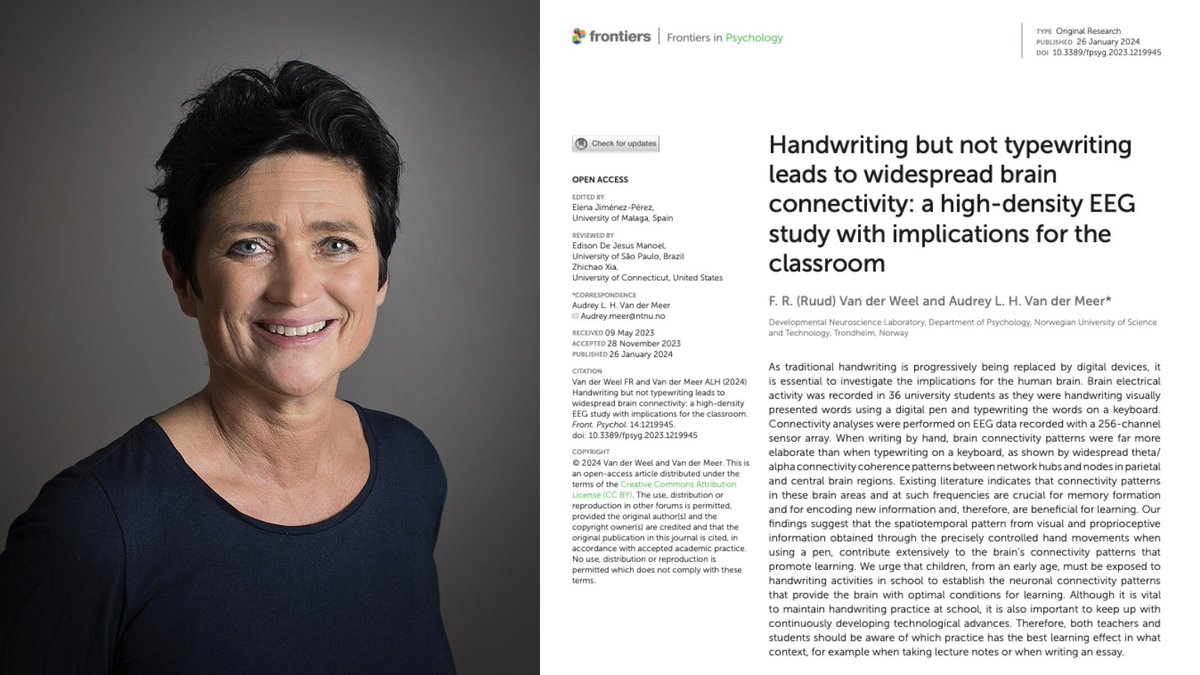
A Norwegian neuroscientist spent 20 years proving that the act of writing by hand changes the human brain in ways typing physically cannot, and almost nobody outside her field has read the paper. Her name is Audrey van der Meer. She runs a brain research lab in Trondheim, and the paper that closed the argument was published in 2024 in a journal called Frontiers in Psychology. The finding is brutal enough that it should have changed every classroom on Earth. The experiment was simple. She recruited 36 university students and put each one in a cap with 256 sensors pressed against their scalp to record brain activity. Words flashed on a screen one at a time. Sometimes the students wrote the word by hand on a touchscreen using a digital pen, and sometimes they typed the same word on a keyboard. Every neural response was recorded for the full five seconds the word stayed on screen. Then her team looked at the part of the data most researchers had ignored for years, which is how different parts of the brain were communicating with each other during the task. When the students wrote by hand, the brain lit up everywhere at once. The regions responsible for memory, sensory integration, and the encoding of new information were all firing together in a coordinated pattern that spread across the entire cortex. The whole network was awake and connected. When the same students typed the same word, that pattern collapsed almost completely. Most of the brain went quiet, and the connections between regions that had been alive seconds earlier were nowhere to be found on the EEG. Same word, same brain, same person, and two completely different neurological events. The reason turned out to be something nobody had really paid attention to before her work. Writing by hand is not one motion but a sequence of thousands of tiny micro-movements coordinated with your eyes in real time, where each letter is a different shape that requires the brain to solve a slightly different spatial problem. Your fingers, wrist, vision, and the parts of your brain that track position in space are all working together to produce one letter, then the next, then the next. Typing throws all of that away. Every key on a keyboard requires the exact same finger motion regardless of which letter you are pressing, which means the brain has almost nothing to integrate and almost no problem to solve. Van der Meer said it plainly in her interviews. Pressing the same key with the same finger over and over does not stimulate the brain in any meaningful way, and she pointed out something that should scare every parent who handed their kid an iPad. Children who learn to read and write on tablets often cannot tell letters like b and d apart, because they have never physically felt with their bodies what it takes to actually produce those letters on a page. A decade before her, two researchers at Princeton ran the same fight using a completely different method and ended up at the same answer. Pam Mueller and Daniel Oppenheimer tested 327 students across three experiments, where half took notes on laptops with the internet disabled and half took notes by hand, before testing everyone on what they actually understood from the lectures they had watched. The handwriting group won by a wide margin on every question that required real understanding rather than surface recall. The reason was hiding in the transcripts of what the two groups had actually written down. The laptop students typed almost word for word, capturing more total content but processing almost none of it as they went, while the handwriting students physically could not write fast enough to transcribe a lecture in real time, which forced them to listen carefully, decide what actually mattered, and put it in their own words on the page. That single act of choosing what to keep was the learning itself, and the keyboard had quietly skipped the choosing and skipped the learning along with it. Two studies. Two countries. Same answer. Handwriting makes the brain work. Typing lets it coast. Every note you have ever typed instead of written went into your brain through a thinner pipe. Every meeting, every book highlight, every idea you captured on your phone instead of on paper was processed at half depth. You did not forget those things because your memory is bad. You forgot them because typing never woke the part of the brain that would have made them stick. The fix is the thing your grandmother already knew. Pick up a pen. Write the thing down. The slower road is the faster one.
Ihtesham Ali tweet media
English
2.5K
44.7K
120.8K
10.1M
Moulaye Tabouré
Moulaye Tabouré@TheModernKnight·
Petit marché, forte concurrence, environnement complexe : Gueye Henri partage sa réalité entrepreneuriale au Sénégal.
Français
0
0
3
115
Moulaye Tabouré
Moulaye Tabouré@TheModernKnight·
Le but d’un pitch n’est pas de tout dire… mais de créer l’intérêt.
Français
0
1
9
153
Moulaye Tabouré
Moulaye Tabouré@TheModernKnight·
Selon Gueye Henri, le professionnalisme repose aussi sur le sens de la responsabilité… un point qui reste parfois frustrant au quotidien.
Français
1
0
2
132
Moulaye Tabouré
Moulaye Tabouré@TheModernKnight·
Et si beaucoup échouaient simplement parce qu’ils ne maîtrisaient pas encore assez leur métier ?
Français
0
1
8
343