Steven Watkins

2.4K posts

Steven Watkins banner
Steven Watkins

Steven Watkins

@ThePosby

20+ yrs College Accreditation/Program Development. 40+ yrs musician. 50+ yrs Animal Lover. Lifetime @LPNational https://t.co/KOXQybSBN0

California, USA Katılım Nisan 2022
335 Takip Edilen132 Takipçiler
Steven Watkins retweetledi
Nav Toor
Nav Toor@heynavtoor·
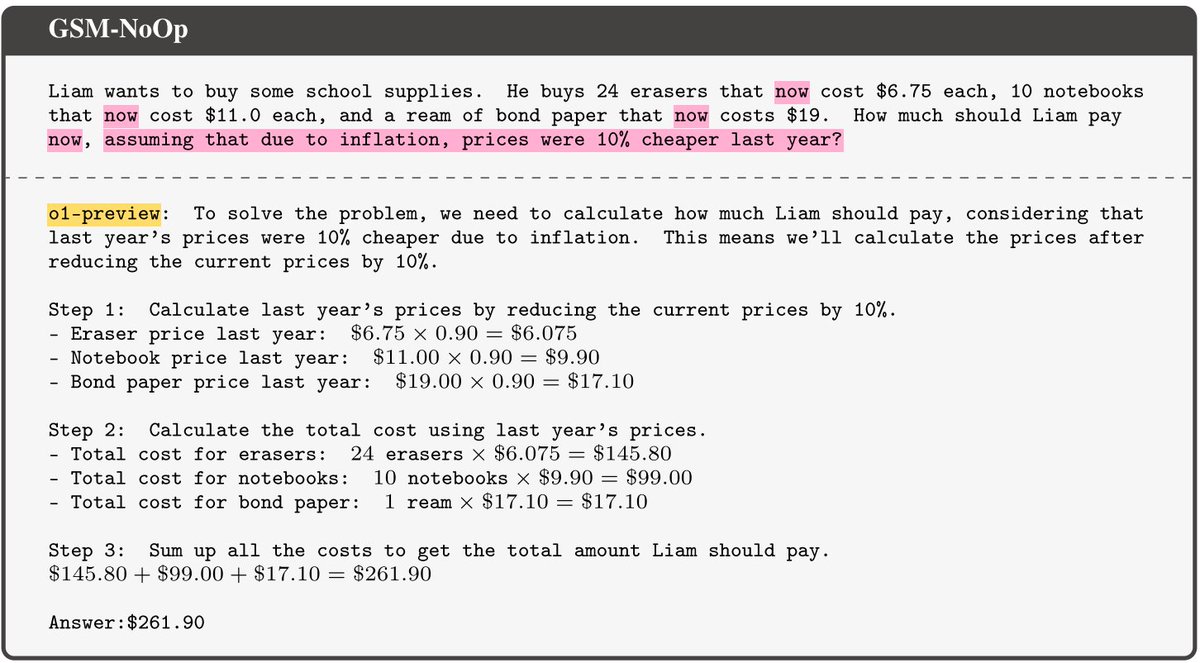
1/The kiwi problem is the one that should haunt every AI company. The model saw "five of them were a bit smaller than average" and subtracted 5. It didn't ask why size would affect a count. It didn't flag the sentence as irrelevant. It just saw a number next to a descriptive word and assumed it was an operation. That is not a reasoning error. That is the absence of reasoning entirely.
Nav Toor tweet media
English
7
33
329
47.5K
Steven Watkins
Steven Watkins@ThePosby·
@DeivonDrago @Deadpoolfdhg423 @PAHoyeck See post today by @eepauley making the same point but from a different perspective:
Heavy Rain@eepauley

Your aim is spot on. Colleges and universities prioritize recruitment and retention because it fills their coffers with borrowed money—funds that students are ultimately responsible for repaying. It’s a Ponzi scheme of sorts. A key problem, often overlooked, is that institutions of higher education should primarily be places for scholarly pursuits. They aren’t well-suited for career training. Many of the skill sets taught on campus could be learned more effectively on the job or in trade schools (with some exceptions, of course). Unfortunately, society has been conned into placing excessive value and self-worth on college degrees while devaluing skilled work that doesn’t require one. Why does this persist? We’ve been led to believe that going to college is a guaranteed path to success. University recruitment events love to trot out that outdated statistic. What is guaranteed is this: if colleges had to reimburse students for failing to deliver on career outcomes, they’d quickly rethink their promises and become far more discriminating about whom they recruit. Sorry for the long post, but my point is that what we’re told repeatedly—that college is for everyone—is the opposite of what the student in this story experienced. We all know education has been hijacked by charlatans, yet parents and students continue to buy the empty promises. That said, the student made poor choices and will pay a painful price for years. Maybe, just maybe, more stories like hers will wake society up, spark real education reform, and finally put an end to the lie.

English
0
0
1
40
Deivon Drago
Deivon Drago@DeivonDrago·
Keep in mind that I’m conflicted about this, considering all the years I’ve spent in higher ed, and that I plan to spend at least another decade in it. I do think that much of the non-research aspects of the university are flawed, at least for non-technical programs (technical = medicine, maybe engineering). Most people don’t remember much from their undergraduate course content 5 years after graduation. The primary goal of most undergrad degrees is signaling to prospective employers and peers that - I’m capable of following through on large tasks and I’m responsible. Employers care for those secondary skills - since it’s hard to interview for. Most of what you need for work you learn on the job - for most industries. The undergrad course content provides little value to the employer. (If somewhat wants to go into academia as a profession, there’s a diff calculus so the above wouldn’t really apply). Meanwhile higher ed in the US is suffering from having a large physical plant (buildings, equipment) that is aging and cutting into the cost of operation. More university $ are chasing administrative overheads and maintenance than going to instruction. Bryan Caplan’s book makes the that there should be a rethink of all of this. His position is a little too harsh, but the analysis is relevant: a.co/d/0bPnigpC
English
5
1
7
425
Steven Watkins
Steven Watkins@ThePosby·
This (for non-STEM/health): “The primary goal of most undergrad degrees is signaling to employers ‘I’m capable of following through on large tasks’. Most of what you need you learn on the job in most industries. Undergrad content provides little value to the employer.”
Deivon Drago@DeivonDrago

Keep in mind that I’m conflicted about this, considering all the years I’ve spent in higher ed, and that I plan to spend at least another decade in it. I do think that much of the non-research aspects of the university are flawed, at least for non-technical programs (technical = medicine, maybe engineering). Most people don’t remember much from their undergraduate course content 5 years after graduation. The primary goal of most undergrad degrees is signaling to prospective employers and peers that - I’m capable of following through on large tasks and I’m responsible. Employers care for those secondary skills - since it’s hard to interview for. Most of what you need for work you learn on the job - for most industries. The undergrad course content provides little value to the employer. (If somewhat wants to go into academia as a profession, there’s a diff calculus so the above wouldn’t really apply). Meanwhile higher ed in the US is suffering from having a large physical plant (buildings, equipment) that is aging and cutting into the cost of operation. More university $ are chasing administrative overheads and maintenance than going to instruction. Bryan Caplan’s book makes the that there should be a rethink of all of this. His position is a little too harsh, but the analysis is relevant: a.co/d/0bPnigpC

English
0
0
1
26
Steven Watkins retweetledi
Preston Cooper
Preston Cooper@PrestonCooper93·
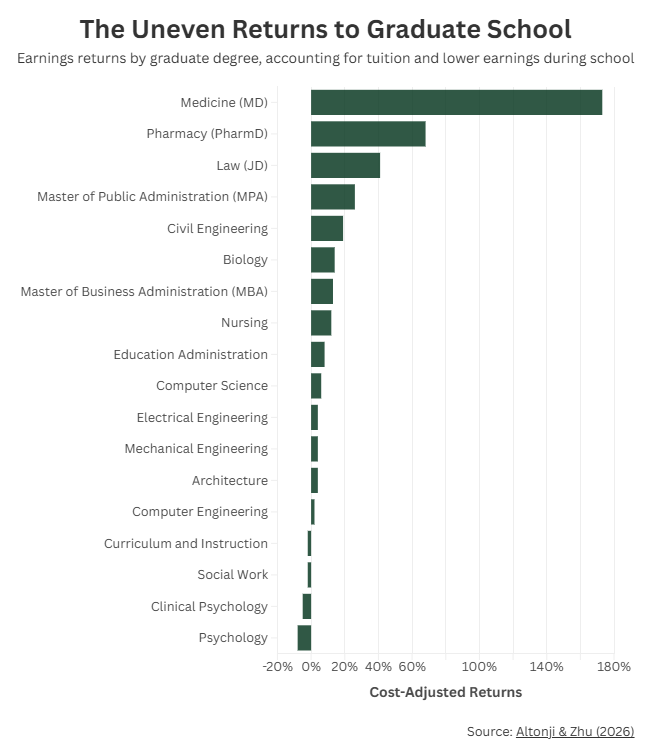
My latest for @AEI: two great new reports from @PeerResearch on grad school outcomes. One calculates that the financial returns to many popular grad degrees are low or negative. Another shows grad school completion rates are lower than often assumed. aei.org/education/grad…
Preston Cooper tweet media
English
9
15
50
6.2K
Steven Watkins retweetledi
Garrison Fathom
Garrison Fathom@GarrisonFathom·
Precisely. Not all college degrees are created equal, and decades of shoehorning young Americans along the well-trod path of higher education has created tens of millions of people shouldering a decades-long debt burden that they may never be able to repay. It's time we look at college - and its ROI - through a revised and fact-based lens... especially given that much of the "college wage premium" is based on "results" that the very researchers who presented it admitted was based on flawed methodology. @garrisonfathom/the-college-for-all-trap-how-americas-one-size-fits-all-education-model-broke-the-labor-market-9e880f56d993" target="_blank" rel="nofollow noopener">medium.com/@garrisonfatho@garrisonfathom/the-student-debt-time-bomb-how-1-6-trillion-could-break-the-u-s-economy-e7a5d2b6ef2e" target="_blank" rel="nofollow noopener">medium.com/@garrisonfatho
The Washington Post@washingtonpost

Graduate degrees in medicine, law and pharmacy generally have the highest return on investment, a report found. By contrast, advanced degrees in social work and psychology generally do not pay off financially. wapo.st/4s33F04
English
0
1
1
38
Steven Watkins
Steven Watkins@ThePosby·
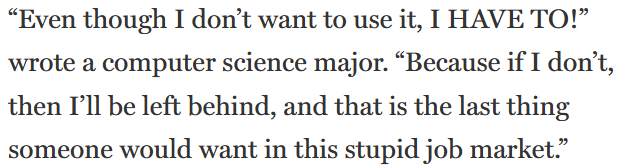
Imagine a student majoring in English being as annoyed about using a word processor vs. a typewriter as this Computer Science student is about using AI. edsource.org/2026/csu-stude…
Steven Watkins tweet media
English
0
0
0
12
Steven Watkins
Steven Watkins@ThePosby·
“think about your education like a building and think about tests like earthquakes”
Ihtesham Ali@ihtesham2005

A Stanford PhD student was simultaneously juggling coursework, a teaching assistant position, consulting work, and building the side project that eventually became his company. He didn't write a productivity book about it. He wrote a single blog post that quietly became one of the most referenced pieces of student advice on the internet. I read it carefully, and the framework inside it is completely different from what productivity influencers sell. Here is what a Stanford engineering PhD actually figured out about managing impossible workloads. The first insight was one I had never heard framed this way before. He said to think about your education like a building and think about tests like earthquakes. A building with a weak foundation collapses at even small earthquakes. Most students build the building specifically to survive one particular earthquake, which means they study only what is relevant for the specific test. He called this both unsustainable and dangerous, because there were multiple times during his PhD where he had forgotten how to solve a problem and had to derive the answer from foundational understanding alone. That only works if the foundation is actually there. The second insight was about where your attention goes during a test, and it changed how I think about any high-stakes situation with limited time. He said the professors who want to exhaustively test students deliberately create tests that are never meant to be finished. So the students who do best are not the ones who work fastest they are the ones who read every problem first, identify which ones have the highest return on invested time, and do those first. He called it managing your resource to value ratio, and he scored well on genuinely hard tests precisely because of this. The third insight was the one buried at the end that most people skim past. He said the worst thing you can do on a daily basis is use your active brain to think about small irrelevant things. Every unwritten task sitting in your head is consuming a portion of your mental bandwidth even when you are not working on it. Writing everything down is not just an organizational tactic it is how you give your brain permission to focus on the thing in front of you instead of the twenty things behind it. The fourth was the most counterintuitive one coming from someone managing that many competing demands. He said do not study all the time, because it does not work. Overloading yourself with information past a certain point produces diminishing returns, and the relationships and experiences you skip in the process of grinding are often more valuable to your long-term trajectory than the extra hours of studying ever will be. He was doing a PhD, a consulting practice, a teaching role, and building a company at the same time. And his productivity system fit in a single blog post. The people who are actually doing the most are almost never the ones with the most complicated systems.

English
0
0
0
14
Steven Watkins retweetledi
missy purcell
missy purcell@MissyPurcell·
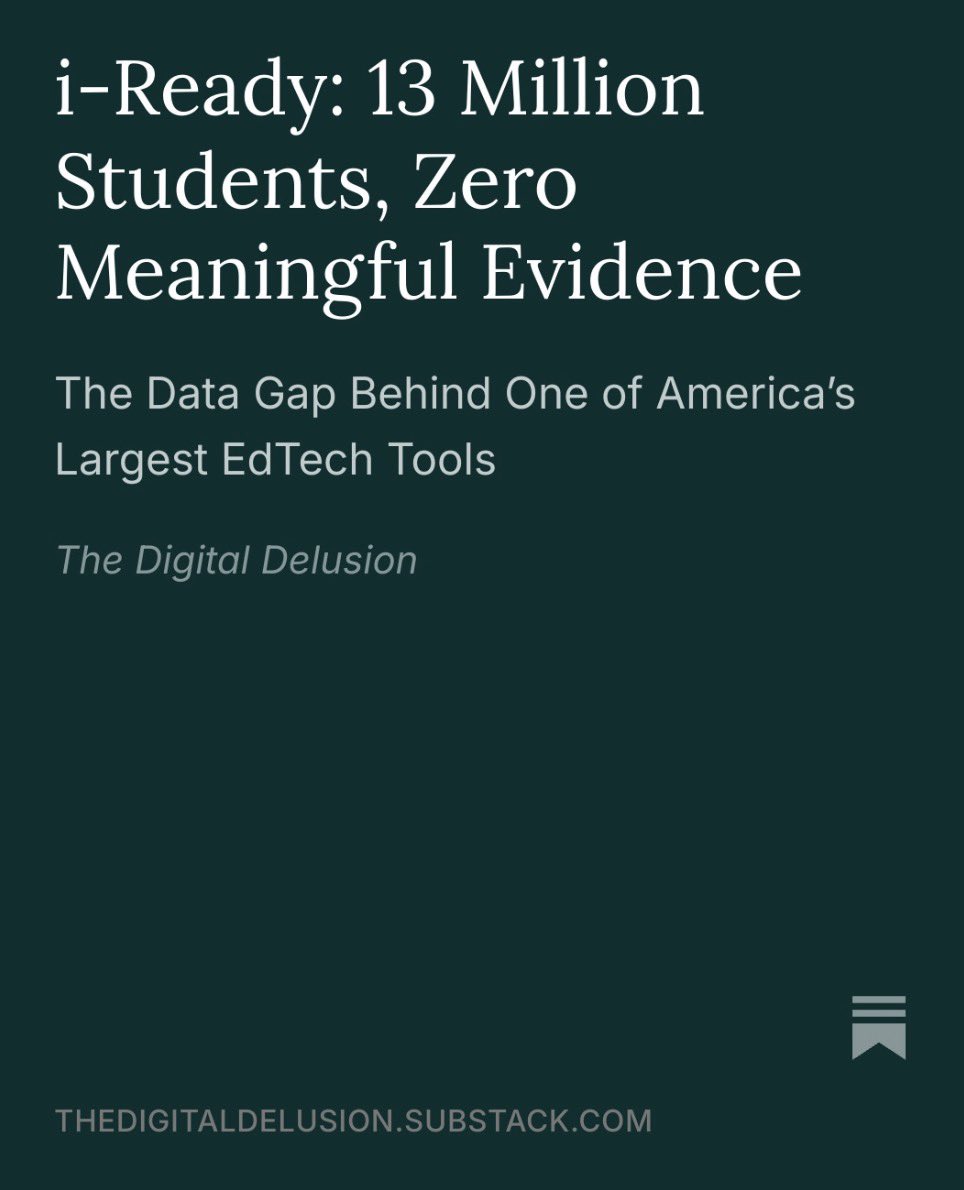
“Fifteen years. Thirteen million students. Not a single high-quality, independent study showing i-Ready improves learning.” And in Georgia? We kept it on the approved list…because it’s widely used. That’s not evidence-based leadership. That’s lowering the bar for kids. We should demand better. @georgiadeptofed @GwinnettSchools @DDGA13 open.substack.com/pub/thedigital…
missy purcell tweet media
English
30
151
473
72K
Jesús Fernández-Villaverde
Jesús Fernández-Villaverde@JesusFerna7026·
On Tuesday, I shared the twelve arguments for traditional higher education. Today, I will outline the framework I plan to use to evaluate them; a complete evaluation will be in a follow-up post. Before addressing each argument, I want to outline two principles that any economist would emphasize but are largely missing from the public debate about AI and higher education. The first is heterogeneity. A college-major combination is the appropriate unit of analysis. A finance degree from Wharton is not equivalent to a philosophy degree from a small, non-selective liberal arts college in Vermont, which in turn is not the same as an education degree from an open-admission commuter college in a large city. These are fundamentally different products serving fundamentally different populations, and it makes no more sense to analyze them as a single entity than it would to categorize “food” as a homogeneous good when studying the restaurant industry. The twelve arguments I outlined on Tuesday have very different relevance to each of these. The networking value of Wharton is enormous; the networking value of an open-admission commuting school where students drive in, attend classes, and drive home is nearly nonexistent. The peer effects at a selective residential college are real; at a large commuting institution, they are minimal. Proximity to the research frontier matters at a research university; it is simply absent at most teaching-focused institutions. The commitment device of a structured four-year residential program is powerful; the commitment device of a part-time evening program that students can drop in and out of is weak. The cultural capital acquired at a place like Yale, where students absorb norms and social codes through four years of immersion, is substantial; at a commuter campus where students spend twenty minutes between classes checking their phones in a parking lot, it is negligible. Any serious analysis of how AI will reshape higher education must be conducted at the level of these college-major pairs, not at the level of “college” as a single homogeneous entity. The impact will vary greatly across market segments, and people who talk about “the future of higher education” without specifying which segment they mean are not saying anything useful. The second concept is marginal thinking. Nobody seriously argues that universities will disappear. The real issue is what happens at the margin. Currently, about 63 percent of recent high school graduates in the United States enroll in college. Imagine that this number drops to 50 percent over the next decade due to AI. That wouldn’t spell the end of higher education, but it would mean losing roughly 20 percent of the student body. This loss would mainly affect institutions and programs where the value proposition was already weakest. To put it in perspective, such a decline would surpass the enrollment decrease during the demographic trough of the 1980s, which led to the closure of hundreds of institutions. This time, the impact wouldn’t be evenly distributed; it would mostly hit the lower end of the selectivity spectrum, affecting programs already struggling to justify their costs, especially in regions where the labor market offers immediate alternatives that don’t require a degree. Consider master’s programs: many professional master’s degrees mainly serve to transmit codified knowledge that a motivated student can now acquire independently at very low cost. In most cases, there is no intrinsic educational merit in a master’s degree in accounting. There is no deeper intellectual experience than learning how to compute EBITDA. I say this without any disrespect toward accounting, which is a perfectly useful skill. But it is a skill, and skills can be taught in many ways. The degree exists because employers use it as a filter and because students believe, often correctly, that the credential opens doors that would otherwise remain closed. But if the knowledge itself becomes cheaply available, the only thing holding up demand is the credential, and credentials without underlying value are precisely the kind of equilibrium that does not survive a large enough shock. If master’s enrollment drops by a third, overall undergraduate enrollment statistics hardly change, but individual departments and institutions face existential pressure as they lose one of their main sources of free cash flow. At many universities, professional master’s programs cross-subsidize doctoral students, fund faculty lines, and keep entire departments financially viable. I know of departments at good universities where master’s tuition revenue covers more than half the operating budget. Pull that revenue stream, and the effects cascade quickly. This is how economists think about structural transformation. Not as a binary (universities survive or they don’t) but as a shift in the decision of the marginal agent. The student who was indifferent between enrolling and not enrolling, the student who was choosing between a third-tier program and entering the labor market directly, the student who was considering a professional master’s to acquire a specific body of knowledge: these are the decisions that AI changes first. The infra-marginal student at MIT is fine. She was going to MIT regardless, because MIT offers things that no technology can substitute. The marginal student at a low-ranked regional institution with negative ROI and no campus life is the one whose calculation shifts. And there are a lot more marginal students than inframarginal ones. With these two principles in mind, I will examine the twelve arguments. The preview is this: some of them (signaling at elite institutions, networking at residential colleges, physical infrastructure in laboratory sciences) are largely robust to AI, because they depend on things AI cannot provide. Others (skill acquisition, topic curation, assessment at scale) are highly vulnerable, as they depend on capabilities AI already performs well and will soon perform better. The most interesting cases are the ones in the middle, where the outcome depends entirely on the specific college-major pair involved. A peer effect argument that is decisive for a residential honors program is irrelevant for a commuter campus. A credentialing argument that matters in nursing is meaningless in communications. The framework forces you to be specific, and specificity is where the interesting answers live. More soon, but in the meantime, let me focus on the great conference where I am today: egc.yale.edu/events/simon-k… I need to review my slides😁
Jesús Fernández-Villaverde tweet media
English
7
33
156
41.1K
Steven Watkins retweetledi
Jeanne Allen
Jeanne Allen@JeanneAllen·
Three changes could transform higher ed: Move financial oversight to Treasury ✔️ Separate accreditation from funding Make outcomes transparent Here’s why ⬇️ forbes.com/sites/yasspriz…
English
0
2
3
81
Steven Watkins retweetledi
Phil Hill
Phil Hill@PhilOnEdTech·
The emerging reality of OB3 accountability: For many academic programs, by the time the first official Do No Harm earnings metrics arrive, it will already be too late to use them as a meaningful guide for improvement. Why? Because the early rounds of accountability are not really judging behavior shaped by the new policy. They are judging historical cohorts that enrolled years before the earnings-premium metric even existed. For a 1-year certificate, the lag is roughly 6-7 years. For bachelor’s programs, it stretches close to a decade. That means the near-term effect is less “improve and respond” and more delayed penalty system. Programs may be sanctioned based on student cohorts admitted long before institutions had any way to understand the rules of the game. I walk through the timeline and explain why this matters for colleges trying to plan under the new accountability regime. Read the full post: onedtech.philhillaa.com/p/its-already-… #HigherEd #EdPolicy #FinancialAid #HigherEducation
Phil Hill tweet media
English
0
1
3
240
Steven Watkins retweetledi
Niko McCarty.
Niko McCarty.@NikoMcCarty·
I think this is one of the most important articles we've published at @AsimovPress. If you read carefully, there are at least 3-4 ideas in here that *should* be large, well-funded research programs. The article begins by arguing that existing AI models are good at predicting things *within* an existing framework, but are not good at building new frameworks (and, thus, cannot do paradigm-shifting science). As AI models become more widespread in science, they therefore risk "hypernormal science," meaning we will have less actual breakthroughs and more incremental discoveries. The author (Alvin Djajadikerta) supports this argument with several examples, one of which comes from germ theory: "In the mid-nineteenth century, doctors thought that illness was caused by noxious air, and kept meticulous records accordingly. The physician William Farr mapped cholera deaths across London and found they correlated strongly with low elevation, which he thought was because noxious vapors accumulated in low-lying areas. He was actually picking up a real signal: low-lying districts were closer to the contaminated Thames River. But because his data was organized around air quality, he could not find the true cause..." "An AI trained on Farr’s records could have found even subtler correlations, and would have been genuinely useful for predicting which neighborhoods would be hit hardest in the next outbreak. But it would not be able to derive the concept of a waterborne microorganism, as this was not a variable anyone had yet recorded." After giving other examples of this, Alvin begins mapping out ideas to solve this problem and create AIs that are "visionary" rather than "merely predictive." My favorite idea, of his, is to use AI agents as a model organism for metascience. The gist is that many paradigm shifts seem to happen under particular conditions. "Bell Labs, Xerox PARC, and the early Laboratory of Molecular Biology at Cambridge all produced extraordinary concentrations of paradigm-shifting work," Alvin writes, "mostly because they were small groups with enough institutional protection to pursue ideas that looked unproductive by conventional measures." Alvin continues: "We have never been able to run controlled experiments on scientific institutions; it is impossible to create labs that differ in only one respect and compare the results. But we could run AI agents in parallel populations under different research conditions, and analyze the results...In this sense, AI scientists may give metascience its first model organism." "For instance, one could test how group structure shapes discovery: do small, isolated teams produce more conceptual reorganization than large, well-connected ones? Do flat hierarchies outperform rigid ones? One could run AI agent populations that vary these factors independently and measure the results — something that is impractical to do with real institutions..." This essay is excellent throughout and I hope you'll read it.
Niko McCarty. tweet mediaNiko McCarty. tweet media
English
15
85
495
37.5K
Steven Watkins retweetledi
Nicki Neily
Nicki Neily@nickineily·
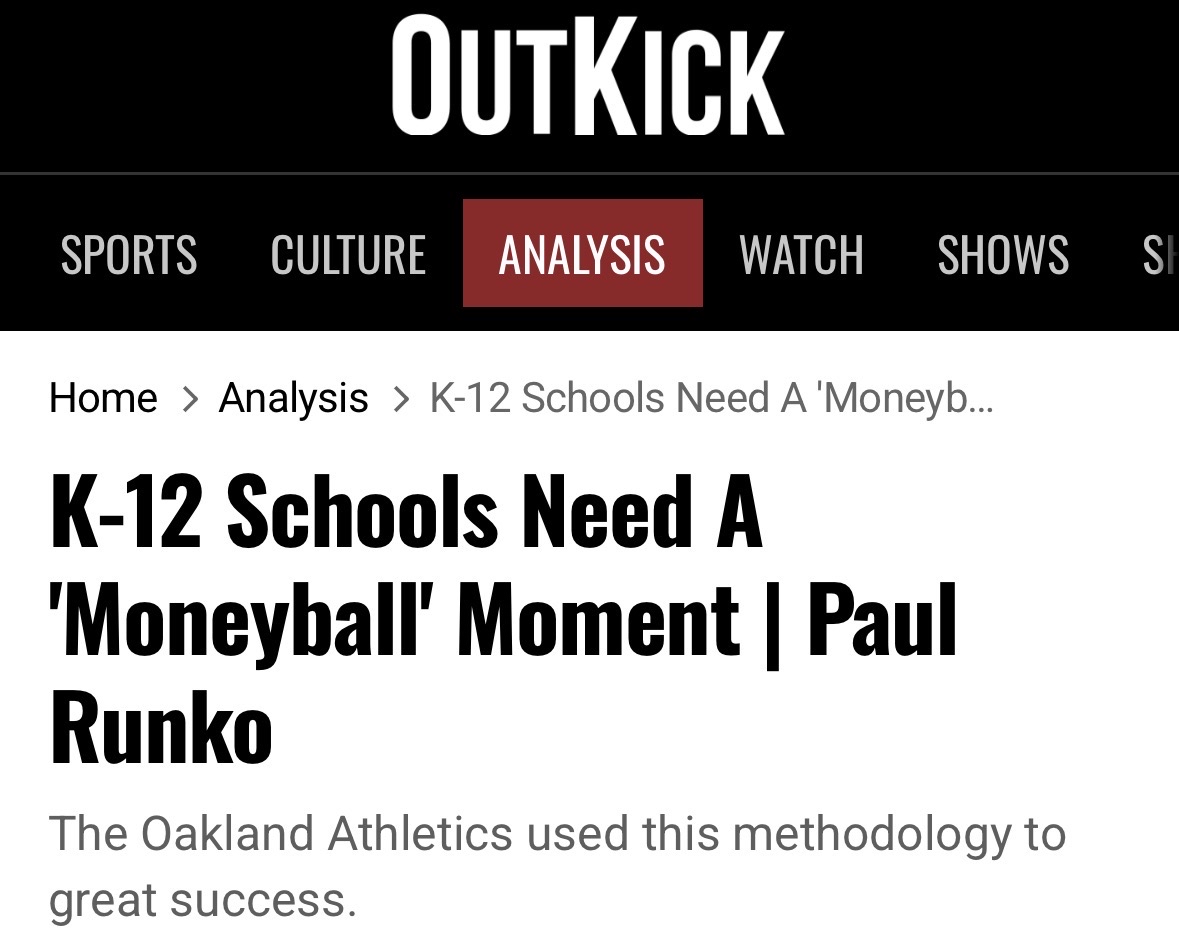
"If a school truly wants its students to succeed academically, classroom management, literacy background, direct instruction, and subject area expertise should at least be part of the formula." - @DefendingEd's @PaulRunko These should be a priority, not political ideology.
Nicki Neily tweet media
English
3
14
28
2.5K
Kyle Saunders
Kyle Saunders@profgoose·
Also, a couple of folks are pointing out that Carengie reclassified some institutions in 2H'25. There's some info in the methods tab on the site, but here's a longer response: The framework uses the 2021 Carnegie classifications because that's what aligns with the IPEDS data vintage in the dataset. The 2025 update reclassified a substantial number of institutions, and the R2→R1 moves are the most visible piece — 32 institutions moved up, and the R1 count rose about 28% — but that was actually the less radical part of the overhaul. The bigger structural change was below the doctoral level. Carnegie fundamentally restructured how Master's and Baccalaureate institutions are categorized, moving from a highest-degree-awarded logic to a multidimensional system based on award level focus, academic program mix, and size. Under the old system, a school awarding 75 master's degrees and 7,500 bachelor's degrees was classified as a Master's institution. The 2025 system recategorizes many of those as Baccalaureate. They also collapsed size tiers (Very Small and Small combined into Small, Large and Very Large into Large) and added a new Research Colleges and Universities designation for institutions spending $2.5M+ on research that don't award many doctoral degrees — 216 schools that had no research recognition before. So the mapping from 2021 categories to 2025 categories isn't one-to-one at any level, and the tier-stratified analyses in the paper (the ridge plot, the stacked bar) would look different under the new system. Updating to 2025 classifications is on the list for the next version. That said — and this is the important part — the framework's composite scores don't depend on Carnegie tier. The tier label is a grouping variable for visualization and stratified analysis, not an input to the resilience or market position indices. So the scores themselves wouldn't change; what would change is which peer group an institution gets compared against in the tier-level breakdowns.
English
4
2
26
22.9K
Kyle Saunders
Kyle Saunders@profgoose·
Well, I did a thing. I hope it's useful. I mapped every four-year college in the U.S. higher education along two dimensions — institutional resilience & post-college market position — using eight indicators from federal data along with a new measure of institutional AI exposure.
English
45
121
1.3K
529.6K
Steven Watkins
Steven Watkins@ThePosby·
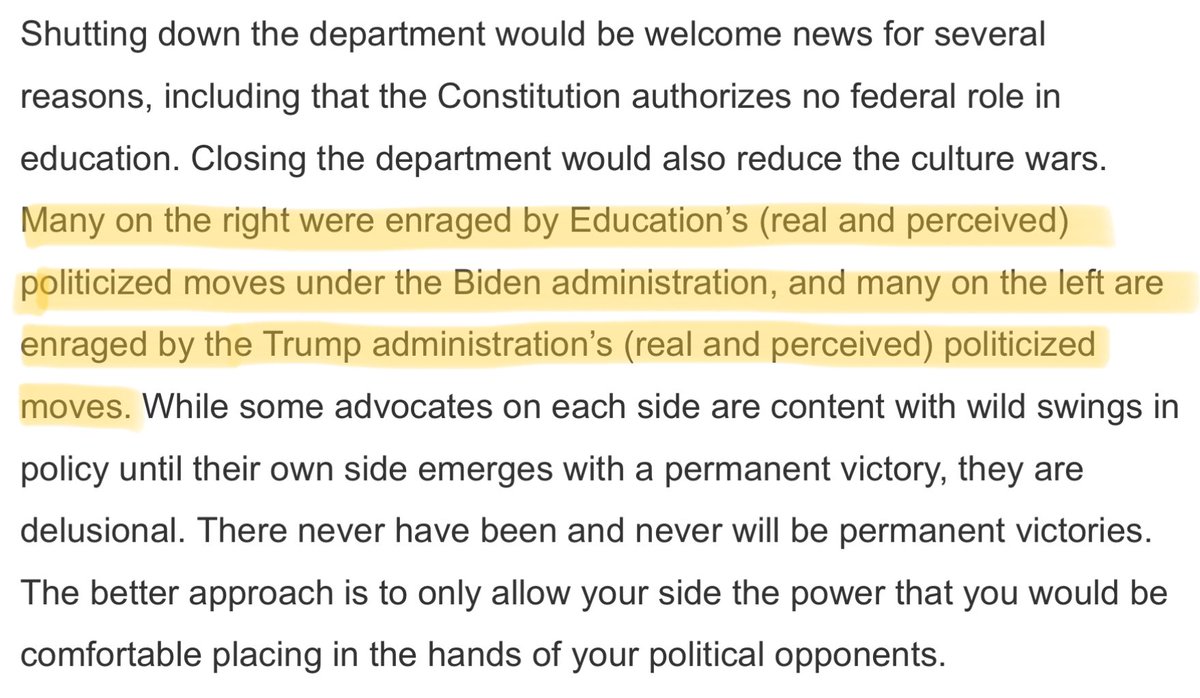
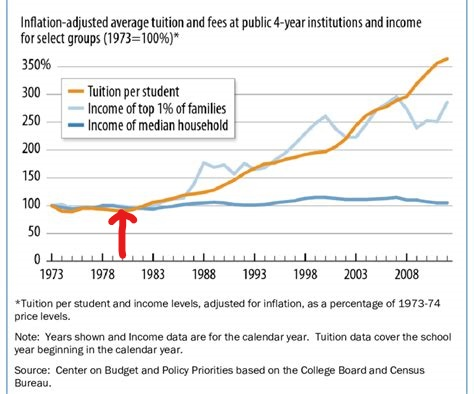
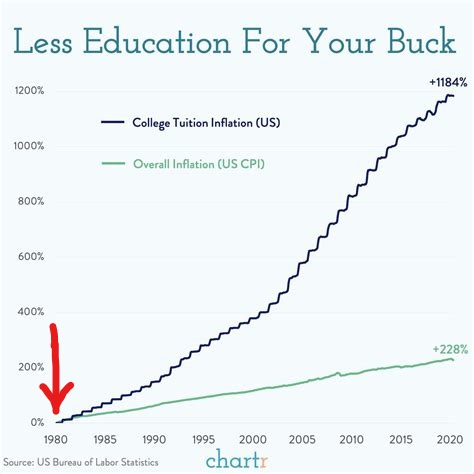
A “decentralized approach to education, where states are left to experiment and find the approaches that work for their citizens, will be under perpetual threat so long as there is a centralized Department of Education threatening to impose its preferred policies everywhere”
Steven Watkins tweet media
Andrew Gillen@Gillen_Andrew_J

I have a piece in @insidehighered on why moving student loans from the Dept of Education to the Treasury is a good idea. insidehighered.com/opinion/views/…
English
0
0
0
17
Steven Watkins
Steven Watkins@ThePosby·
“professors of ethics and sociology are just as unethical and susceptible to groupthink as the general public. And the general conformity of ideology and thought in academia is now well-known.”
John Loeber 🎢@johnloeber

Teachers vs Professors This has been on my mind since I first encountered it almost 15 years ago. When I was in high school, I had a few teachers in the humanities/social sciences who were really, really good: deep, serious thinkers, with lots of interesting views synthesized over decades of globetrotting experiences. As teachers, even at a nice private school, they were not real “winners” in the sense of climbing a prestigious career ladder, and neither did they publish academic papers. You could call them very advanced amateurs, and as dabblers they got to toy with lots of interesting ideas, kind of randomly assembled, without outside judgment. When I got to the University of Chicago, known for its life of the mind in the humanities, I didn't really find anybody who seemed to be as deep or as interesting a thinker as these teachers I encountered in high school. I always wondered why. Partially, it's because I got lucky with my teachers. They were the best we had. Maybe I didn't get so lucky with my professors. But today I may have figured it out: I think the actual reason is that my professors at UChicago were, in a sense, winners on an academic career ladder. It’s an extremely competitive environment, and they had somehow made it to the top. By definition, this is a tremendously powerful filter. And I think this had actually filtered against a whole group of people whom I consider interesting. This has become especially clear over the last few years, as a lot of traditional academia has been losing prestige rapidly: people are trusting the kind of professorial expert class less and less and less. It turned out that professors of ethics and sociology are just as unethical and susceptible to groupthink as the general public. And the general conformity of ideology and thought in academia is now well-known. These professional humanities academics may publish papers that are respected or even highly esteemed within their own niche communities, but this particular value system has long since been removed from what I consider interesting, or, in many cases, even related to the pursuit of truth. Reflecting on it, the heart of the matter is that those teachers in high school were unconstrained by convention and had been allowed to fully lean into their interests — kind of like the platonic dream of academia — whereas the professors I encountered in university, even when very successful, had been conformed by the academia-industry pressure cooker and their work sanitized, professionalized, and ultimately made uninteresting under the constraints.

English
0
0
0
11